
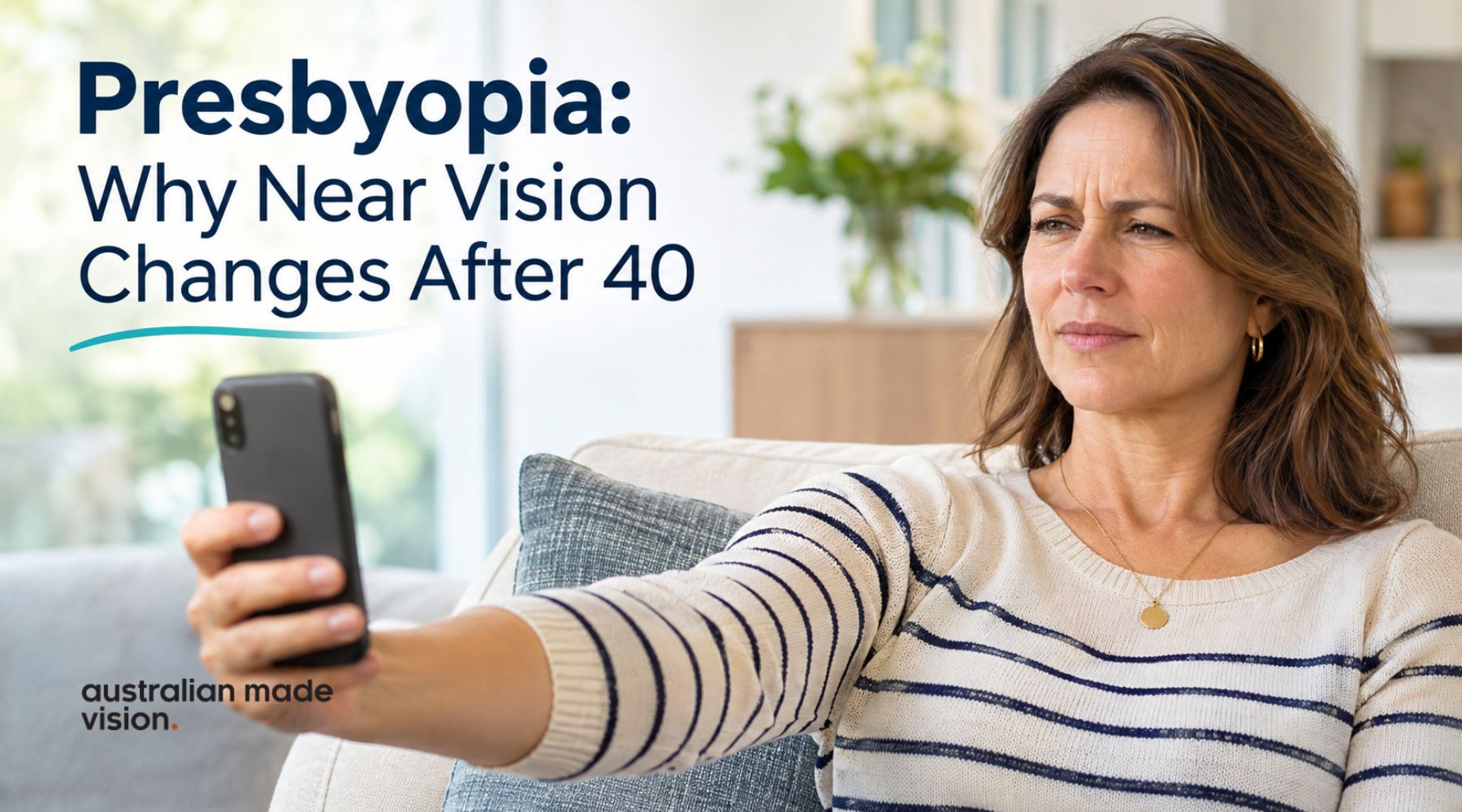
If you are over 40 and find yourself moving your phone further away to read a message, presbyopia may be one reason. Presbyopia is an age-related change that makes it harder to focus on nearby objects. It commonly becomes noticeable in your 40s as the natural lens inside the eye becomes less flexible.
Reading glasses or other corrective lenses can often make near tasks easier. But blurry vision can have several causes, so an eye examination is the right way to check what is happening rather than assuming every change is presbyopia.
In this article
When blurry vision needs urgent attention
Presbyopia generally develops gradually. Do not assume sudden blurred vision or a sudden loss of sight is an age-related reading problem. Seek urgent medical assessment for a sudden change in vision, particularly with severe eye pain, flashes of light, or a new shadow in your vision. If sudden vision changes occur with facial droop, one-sided weakness, or slurred speech, call triple zero (000).
What is presbyopia?
To see an object up close, the eye adjusts its focus. The natural lens changes shape to bring nearby details into focus. With age, this lens becomes harder and less flexible. As a result, reading distance can become more difficult even when vision across the room seems unchanged.
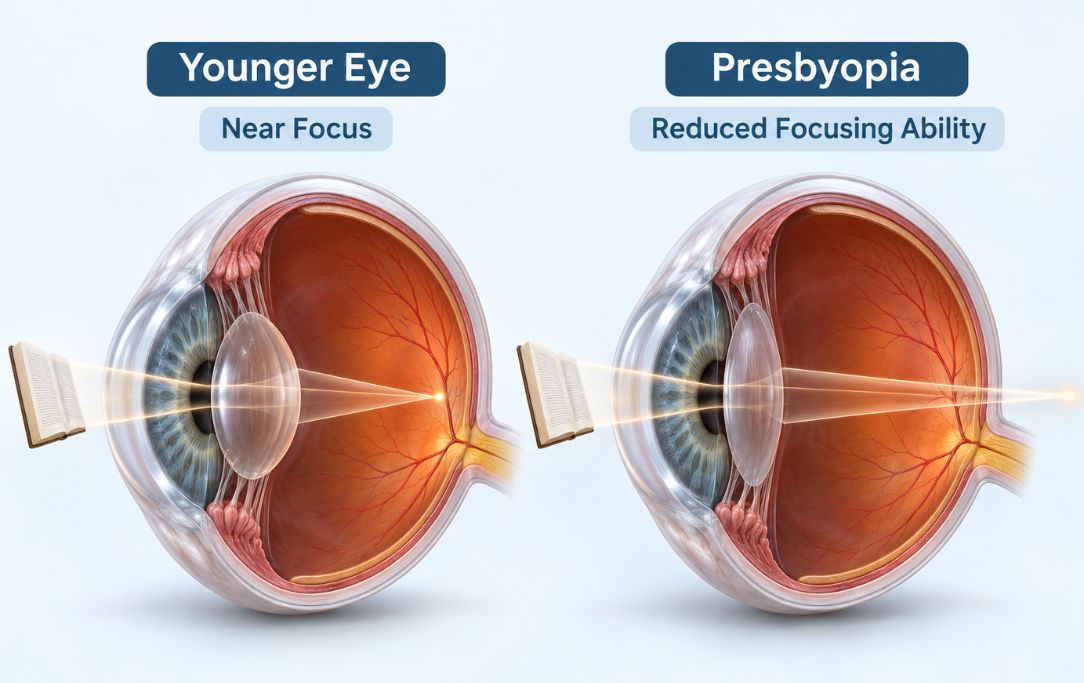
Presbyopia is different from long-sightedness (hyperopia). Both can affect near vision, but presbyopia relates to the age-related loss of focusing ability. A person can also have presbyopia alongside short-sightedness, long-sightedness, or astigmatism.
NEAR VISION CHANGING AFTER 40?
Finding Close Work Difficult?
An optometrist can check the cause of near blur and discuss reading glasses or other lens options. Sudden vision changes need urgent medical assessment.
Find an Optometrist →Common signs of presbyopia
Changes in near vision are often more noticeable during ordinary tasks than during a conversation or while looking into the distance. Signs may include:
Reading distance changes
Holding a book, menu, or phone further away to read the words.
Small print becomes blurry
Finding small print blurry at a comfortable reading distance.
More light is needed
Needing better lighting for close work.
Near work feels tiring
Experiencing tired eyes or headaches after reading or other near tasks.
Close detail is harder to focus on
Having difficulty focusing on close details even when distant objects remain clear.
Why does presbyopia begin around 40?
Ageing changes the flexibility of the natural lens over time. This makes the focusing movement needed for close work less effective. The change may have been developing for years before it becomes obvious. It is commonly noticed around ages 40 to 45, although the exact experience varies.
Presbyopia generally continues to change through midlife, so a near-vision prescription may also need review as the years pass. Reading glasses do not cause this progression and do not make the eyes weaker.
Do you need reading glasses?
Possibly. Simple reading glasses can be suitable when the main difficulty is close-up work. However, the right prescription depends on more than age. Your distance vision, the difference between your eyes, existing prescription, and the tasks you do all matter.
Ready-made reading glasses can be convenient, but they are not a substitute for an eye examination. A prescription check can help identify whether you need a different strength in each eye, correction for astigmatism, or another lens design.
Reading glasses and other lens options
An optometrist may discuss different options after examining your vision and learning how you use your eyes during the day:
Single-vision reading glasses
Designed for one close-up working distance; they are not a general substitute for distance spectacles. For a broader comparison of single-vision and other spectacle designs, see AMV’s guide to spectacle lens types .
Bifocal or multifocal glasses
Include more than one viewing power for people who need help at different distances. AMV’s spectacle lens guide explains how bifocal, multifocal, and progressive designs differ.
Progressive lenses
A multifocal design that changes power through the lens, usually to support distance, intermediate, and near tasks. If you are considering progressives, read how adjustment to progressive lenses can vary .
Occupational or workplace lenses
Can prioritise near and screen distances when those tasks are the main concern; they are usually not intended for driving. AMV explains these designs in more detail in Occupational Progressive Lenses for Desk and Screen Work .
Contact lenses
Options such as multifocal designs may be discussed if contact lenses are suitable for you.
Compare spectacle lens designs: For a broader look at single vision, bifocal, multifocal, progressive, and occupational options, see AMV’s guide to spectacle lens types .
Spend much of the day at a desk? AMV also explains workplace progressive lenses for desk and screen work .
Is Your Eye
Health on Track?
Complete our free 18-point checklist to check your eye health, spot any gaps, and take charge of your vision.
Start Free Checklist Test →Can exercises, screen breaks, or surgery reverse presbyopia?
No exercise or simple habit change is known to restore the lost flexibility of the natural lens. Better lighting, more comfortable text size, and breaks during prolonged near work may make some tasks easier, but they do not reverse presbyopia.
Some surgical procedures may be considered in selected circumstances, but they have limitations and risks and are not a routine first step for everyone. Anyone interested in surgery should discuss suitability, possible outcomes, and irreversible aspects with an appropriately qualified ophthalmologist.
If prolonged screen use also causes tired or uncomfortable eyes, read AMV’s digital eye strain guide for practical workplace considerations.
How does an optometrist assess presbyopia?
An optometrist can ask when the near blur began, whether it affects one or both eyes, which distances are difficult, and what glasses or contact lenses you currently use. A vision assessment may check clarity at near and distance, measure the prescription needed, and examine overall eye health.
The examination may also look for other explanations for blurred vision. The exact tests depend on your symptoms, health history, and findings. You can usually book an optometrist directly in Australia without first obtaining a GP referral.
Bring your current glasses or contact lenses and note the tasks that are becoming difficult. It may help to tell the optometrist approximately how far away you hold your phone, book, or computer screen.
When should you arrange an eye test?
Arrange an eye examination if you notice persistent or gradually worsening near blur, need to hold reading material further away, or have trouble with everyday close work. Do not wait for a routine check if the change is new, unexpected, or significantly affecting you.
Australian guidance recommends regular eye checks from midlife, with timing adjusted for eye symptoms and individual risk factors. Medicare eligibility and bulk billing are separate from clinical recommendations. Fees and what is covered vary, so confirm costs with the practice before booking.
Questions worth asking at your appointment
- Could my near blur be presbyopia, or are there other possible causes?
- Do I need reading glasses only, or correction at more than one distance?
- Which lens option suits my usual reading, screen, and distance tasks?
- Do I need a new prescription or any follow-up eye-health checks?
- What will the appointment, glasses, and any additional services cost?
A practical next step for blurry near vision
Presbyopia is common in midlife, but you do not need to guess which glasses will help. A proper eye examination can check the cause of your blur and whether you would benefit from a prescription or another option. If you are comparing eye-care practices, Australian Made Vision can help you find participating independent optometrists in your area.
Use the AMV directory to find an independent optometrist. Appointments, examinations, prescriptions, fees, and clinical care are provided by the individual practice, not Australian Made Vision.

Take the Next Step
Need Help With Near Vision?
Discuss near-vision changes, reading tasks, and suitable lens options with an independent optometry practice. Confirm its appointments, services, and fees directly.
Find an Optometrist →Frequently asked questions
Is blurry near vision after 40 always presbyopia?
No. Presbyopia is a common reason for gradually worsening close-up focus in midlife, but blurry vision can have other causes. An eye examination is needed to identify the cause and check eye health.
Does wearing reading glasses make presbyopia worse?
No. Wearing reading glasses does not make the eyes weaker or accelerate the normal age-related change in the lens. Your reading prescription may still change over time.
Can presbyopia affect someone who already wears glasses?
Yes. Presbyopia may develop alongside an existing prescription for short-sightedness, long-sightedness, or astigmatism. Your optometrist can check which viewing distances need correction.
Are reading glasses and progressive glasses the same?
No. Single-vision reading glasses mainly support close work at one prescribed distance. Progressive lenses are a type of multifocal lens with different viewing powers through the lens, designed to support several distances.
Can presbyopia be prevented?
Presbyopia is an age-related change and there is no established way to prevent it. Corrective lenses may help with near tasks, while an eye examination can determine whether presbyopia is the cause of your symptoms.
- Healthdirect Australia — Presbyopia (last reviewed September 2024; accessed 2 November 2026)
- Healthdirect Australia — Blurred vision (accessed 2 November 2026)
- Healthdirect Australia — Eye tests (accessed 2 November 2026)
- Better Health Channel, Victoria — Eyes: common problems (reviewed 8 November 2023; accessed 2 November 2026)
- Optometry Australia — Presbyopia consumer brochure (2018; accessed 2 November 2026)
- Services Australia — Screening, tests and scans covered by Medicare (accessed 2 November 2026)

Michael Nasser is a qualified Optical Dispenser with law and business degrees and a director of Opticare. He is an advocate for independent optometry in Australia and host of The Focused View, where he brings industry leaders together to discuss practice growth, technology, team development, and the future of independent eye care.
Australian Made Vision is an independent directory that helps patients find optometrists across Australia who may offer Australian-made spectacle lenses. We do not provide clinical services and recommend contacting practices directly to confirm the products and services they offer.