

Dry eye disease occurs when the tear film and the surface of the eye lose their normal balance. This may happen because the eyes do not produce enough tears, the tears evaporate too quickly, or both processes occur together. Common symptoms include grittiness, burning, redness, watering, fluctuating blurred vision, and discomfort with contact lenses. Similar symptoms can also occur with other eye problems, so ongoing or worsening symptoms should not be diagnosed from a symptom list alone.
Arrange prompt medical assessment if an eye is painful and red, or if you have a red eye while wearing contact lenses. Seek immediate medical care or go to an emergency department for new changes in vision, wavy lines or flashing lights, marked pain when looking at light, a red eye with a severe headache or feeling unwell, or an eye injury.
What is dry eye disease?
“Dry eye syndrome” is a familiar term, while “dry eye disease” is now more commonly used in clinical guidance. It is a multifactorial condition, which means several mechanisms and contributing factors may be involved rather than one simple cause. Current international consensus describes it as a symptomatic disease involving loss of normal balance in the tear film and/or the ocular surface.
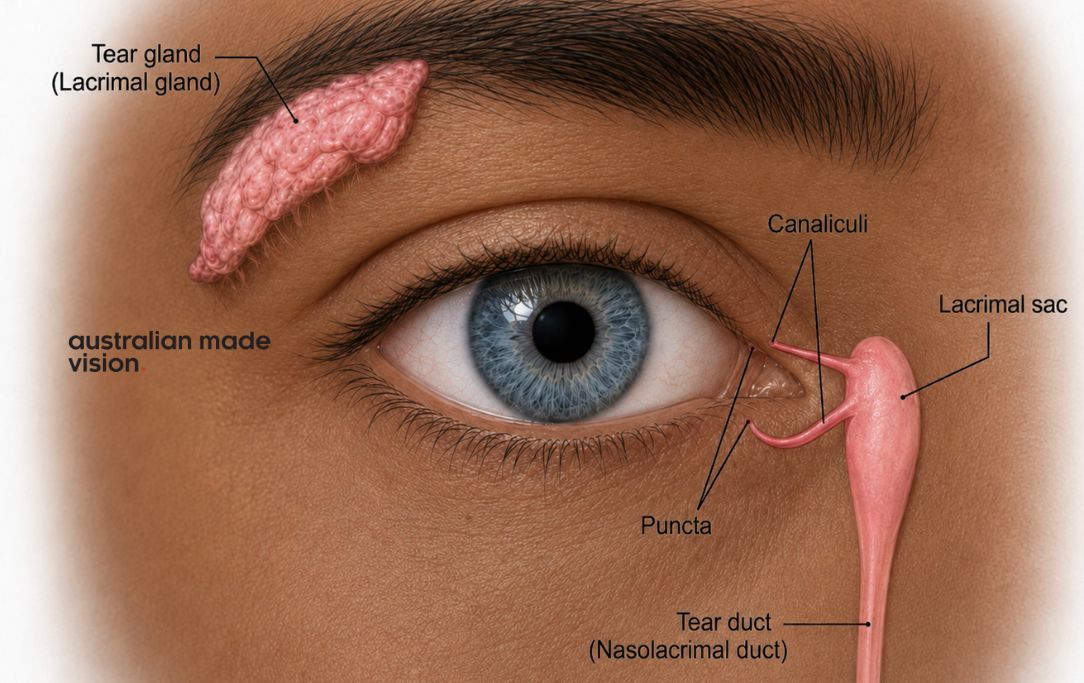
The tear film is the thin layer spread across the front of the eye each time you blink. It contains oily, watery, and mucus-like components that work together to keep the surface lubricated, protected and optically smooth. When the amount, quality, or stability of these components changes, the tear film may break up too quickly or fail to coat the eye properly.
How the tear film helps keep the eye comfortable
A stable tear film reduces friction when the eyelids move, supports the health of the cornea and creates a smooth surface for clear vision. This helps explain why dry eye can feel uncomfortable and also cause vision that clears after blinking but becomes blurry again soon afterwards.
The main types of dry eye
Dry eye is commonly described as evaporative, aqueous-deficient or mixed. Evaporative dry eye happens when tears leave the eye surface too quickly. It is often linked with problems affecting the meibomian glands, the small oil-producing glands along the eyelid margins. Their oils slow tear evaporation.
Aqueous-deficient dry eye occurs when the eyes do not produce enough of the watery part of the tears. Mixed dry eye involves features of both. Symptoms alone cannot reliably show which type is present, and the likely mechanism may change over time. An examination is needed to guide suitable care.
Find Eye Care That Suits Your Needs
Search for an independent optometrist near you and find a local practice that suits your specific eye care needs.
Find an OptometristWhat are the common symptoms of dry eye?
Dry eye symptoms vary from person to person and may change during the day. They can affect one eye or both eyes, and their severity does not always match what can be seen during an examination.
Common symptoms may include:
- a dry, gritty, scratchy, or “something in the eye” sensation
- burning, stinging, soreness, or irritation
- redness
- watery eyes
- blurred or fluctuating vision
- sensitivity to light
- tired or heavy-feeling eyes
- difficulty wearing contact lenses comfortably
These symptoms are not specific to dry eye. Allergy, infection, inflammation, an eye injury, and other conditions can cause similar changes. Pain, significant redness, light sensitivity or a change in vision needs more careful assessment.
Why dry eyes can make the eyes water
Watery eyes may seem like the opposite of dryness. However, irritation on the eye surface can sometimes trigger reflex tearing. These extra tears may run from the eye without forming a stable tear film, so the eyes can water and still feel dry or gritty.
Why vision may blur or fluctuate
The tear film is part of the eye’s focusing surface. When it becomes unstable, vision may vary between blinks. Some people notice that words, screens or distant details briefly sharpen after blinking, then blur again. Persistent, sudden or marked vision changes should not be assumed to be dry eye.
What causes or contributes to dry eye?
Dry eye may develop when tear production is reduced, evaporation increases, or the tear film becomes unstable for several reasons. A contributing factor is not always the sole cause, and the same person may have more than one.
Evaporative dry eye and meibomian gland dysfunction
The meibomian glands release oils into the tear film. If the glands become blocked or do not release oil normally, tears may evaporate faster. Eyelid inflammation, including blepharitis, may also affect the eyelid margin and tear film. An eye examination can assess the eyelids and glands rather than relying on symptoms alone.
Aqueous-deficient and mixed dry eye
Reduced watery tear production may be associated with ageing, some medicines or health conditions that affect tear-producing glands. Autoimmune conditions, including Sjögren’s syndrome, are one possible association, but dry-eye symptoms do not mean a person has an autoimmune disease. Mixed dry eye combines reduced tear production with excessive evaporation.
Other contributing factors
Factors that may contribute to symptoms include contact-lens wear, long periods of screen use, infrequent or incomplete blinking, air conditioning, wind, smoke, dust and dry air. Certain medicines and general health conditions may also play a part. Do not stop a prescribed medicine because of dry-eye symptoms. Ask the prescribing clinician or an eye-care professional whether a medicine review is appropriate.
How screens and the environment can affect symptoms
Concentrated screen use can change normal blinking. People may blink less often or fail to close the eyelids fully while reading or focusing on a device. This can leave the tear film exposed for longer and may worsen evaporation and discomfort. Screen use is one possible contributor, not the only explanation for dry eye.
Air conditioning, heaters, and direct airflow from fans can reduce humidity around the eyes. Outdoor wind, dust, and smoke can also irritate the ocular surface. In Australia, bushfire smoke may be one source of airborne irritation during affected periods. Practical changes can include taking regular breaks, making a few complete blinks, moving away from direct airflow and using suitable protective eyewear outdoors. These measures may reduce triggers but do not replace assessment when symptoms continue.
Can contact lenses cause or worsen dry-eye symptoms?
Contact-lens wear is a recognised risk factor for dry-eye symptoms and can make discomfort more noticeable for some people. A lens sits within the tear film, so comfort may be affected by the lens material, fit, replacement schedule, cleaning routine, wearing time and the condition of the eye surface.
An optometrist can review the lenses and the health of the front of the eye, then discuss whether changes are appropriate. A painful red eye or a red eye in a contact-lens wearer needs prompt assessment because causes other than dry eye may require urgent treatment.
Find Eye Care That Suits Your Needs
Search for an independent optometrist near you and find a local practice that suits your specific eye care needs.
Find an OptometristIs Your Eye
Health on Track?
Complete our free 18-point checklist to check your eye health, spot any gaps, and take charge of your vision.
Start Free Checklist Test →How is dry eye assessed?
Assessment usually starts with a history of the symptoms: when they began, how often they occur, what makes them better or worse and whether they affect reading, driving, screen use or contact lenses. The clinician may also ask about medicines, health conditions, previous eye procedures, the working environment and daily habits.
An eye examination may include vision checks and close inspection of the eyelids, eyelid margins, meibomian glands, tear film and ocular surface. A slit-lamp microscope allows the clinician to examine the front of the eye in detail. Dyes may be used to show how the tears spread and whether the surface has areas of irritation. Other tests may assess tear production, tear-film stability or evaporation.
The exact combination of tests varies between practices and depends on the symptoms and initial findings. When symptoms are severe, the findings are unclear or another medical condition may be involved, an optometrist or doctor may recommend review by an ophthalmologist or another health professional.
What management options may be discussed?
Dry eye management depends on the likely mechanism, symptom pattern, examination findings, general health and contact-lens use. A plan may combine several approaches and may need adjustment over time. The aim is to improve tear-film stability, reduce irritation and address contributing factors where possible.
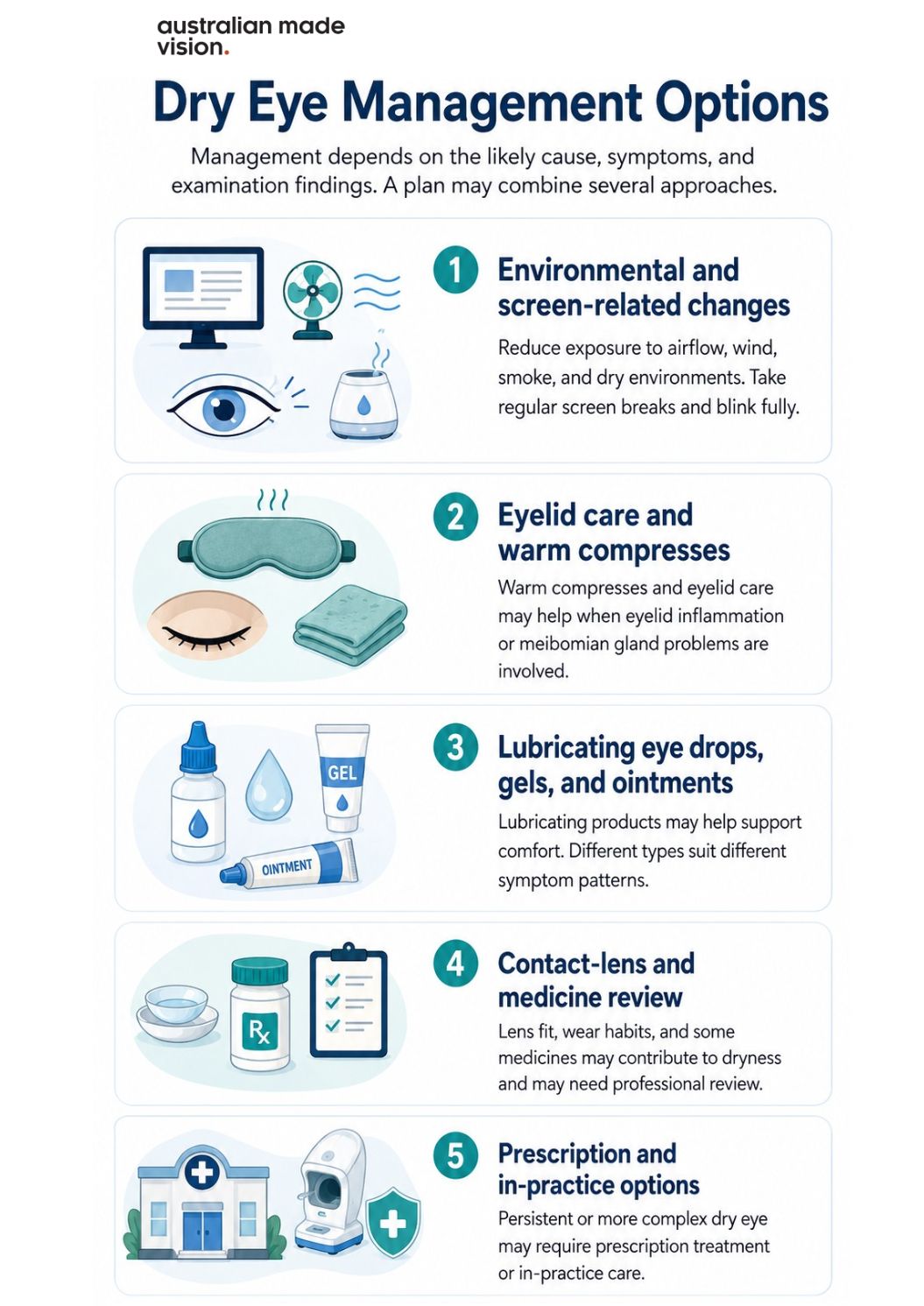
Environmental and screen-related changes
A clinician may suggest reducing exposure to direct air flow, wind, smoke, or very dry environments. Regular breaks from close work and deliberate, complete blinking may help some screen users. A humidifier may be useful in a dry indoor space. These adjustments can support comfort, but they are unlikely to address every cause of dry eye on their own.
Eyelid care and warm compresses
Eyelid hygiene or warm compresses may be recommended when eyelid inflammation or meibomian gland problems are contributing to symptoms. The method and frequency should suit the examination findings. Advice intended for one eyelid condition may not be right for another, so ask an optometrist, pharmacist or doctor before starting a new routine if you are unsure.
Lubricating eye drops, gels, and ointments
Lubricating products, sometimes called artificial tears or tear supplements, are available as drops, gels, and ointments. Different formulations suit different symptom patterns and may affect vision for a short time after use. A pharmacist or optometrist can help you compare options and check whether a product is suitable with contact lenses, other eye medicines or a particular health condition.
Repeatedly changing products without understanding the cause can delay a more useful assessment. Seek professional advice if symptoms persist, become painful, affect vision, or require increasingly frequent self-treatment.
Prescription and in-practice options
Persistent or more complex dry eye may require prescription treatment or an in-practice procedure. Depending on the cause, a clinician may discuss anti-inflammatory treatment, methods intended to conserve tears, or procedures designed to improve meibomian gland function. Benefits, limitations, risks, suitability, cost and availability vary.
Not every optometry practice offers the same tests or procedures. Confirm the service, clinician, fees and follow-up process directly with the individual practice. Referral to an ophthalmologist may be appropriate for severe disease, uncertain findings or treatment outside the optometrist’s scope.
Contact-lens and medicine review
When contact lenses are involved, management may include reviewing lens fit, material, replacement schedule, cleaning, and wearing habits. Some people may need a temporary or longer-term change, but that decision should follow an examination.
Certain medicines can contribute to dryness. A doctor may consider whether an alternative is appropriate, but prescribed medicines should not be stopped or changed without advice from the clinician responsible for them.
Find Eye Care That Suits Your Needs
Search for an independent optometrist near you and find a local practice that suits your specific eye care needs.
Find an OptometristWhen should you arrange an eye examination?
A routine appointment is reasonable when symptoms have continued for several weeks, keep returning, affect daily activities or vision, or make contact lenses difficult to wear. An examination can help identify the likely contributors and rule out other causes.
Arrange prompt assessment for a painful red eye or a red eye while wearing contact lenses. Seek immediate medical care or go to an emergency department for new vision changes, wavy lines or flashing lights, marked pain when looking at light, a red eye with severe headache or feeling unwell, or an eye injury.
Questions to ask an optometrist or practice
Before booking, it can help to ask:
- Does this location assess the tear film and meibomian glands?
- What may the examination include?
- Which dry-eye management options are available at this location, and who provides them?
- What fees and follow-up appointments may apply?
- Should I bring my current eye drops, medicines or contact-lens details?
- When might referral to a GP or ophthalmologist be needed?
Services, equipment, appointment length, fees and availability differ between practices. Confirm these details directly rather than assuming every listed practice offers the same dry-eye care.
Next steps if dry-eye symptoms continue
If dryness, grittiness, burning, watering or fluctuating vision keeps returning, an eye examination can help identify what may be contributing. Australian Made Vision provides general eye-health information and a directory of participating independent practices. Use the directory to find an independent optometrist, then confirm dry-eye services, fees, and availability directly with the practice.
Find Eye Care That Suits Your Needs
Search for an independent optometrist near you and find a local practice that suits your specific eye care needs.
Find an OptometristFrequently asked questions about dry eye syndrome
Can dry eye be cured permanently?
Dry eye is often a long-term condition and may not have one permanent cure. Management aims to improve comfort, support the tear film and address contributing factors. Symptoms may improve, return or change, so the plan may need to be reviewed over time.
Which eye drops may be suitable for dry eyes?
The most suitable product depends on the likely type of dry eye, symptom severity, contact-lens use, other eye medicines and how often treatment is needed. Drops, gels and ointments serve different purposes. Ask a pharmacist or optometrist for advice rather than choosing only by price or marketing claims.
Does screen time cause dry eye?
Long periods of screen use can contribute to dry-eye symptoms because blinking may become less frequent or incomplete. It is not the only cause, and persistent symptoms may involve contact lenses, eyelid-gland problems, medicines, health conditions or environmental factors.
Can I wear contact lenses if I have dry eye?
Some people can continue wearing contact lenses after their eye health, lens fit and wearing routine have been reviewed. Others may need changes or a break from lenses. A painful or red eye while wearing contact lenses needs prompt assessment.
Australian Made Vision is an independent directory that helps patients find optometrists across Australia who may offer Australian-made spectacle lenses. We do not provide clinical services and recommend contacting practices directly to confirm the products and services they offer.