Choosing between different types of spectacle lenses can be confusing, especially when terms such as single vision, multifocal, progressive, high-index and protective coatings are used together. The right option depends on your prescription, daily tasks, frame choice and the way you use your glasses.
This guide explains the main lens categories and common coatings, with practical examples for Australian wearers. It also highlights w
Key takeaways
- Understand the relationship between lens index, thickness and prescription strength.
- Compare single vision, bifocal, multifocal and progressive lens designs.
- Review lifestyle options such as polarised and photochromic lenses.
- Understand how lens materials and coatings can affect comfort, durability and reflections.
- Ask individual practices which Australian-made lens options they currently offer.
Understanding the basics: single vision and corrective lens foundations
Spectacle lenses are made to bend light so it focuses appropriately for a person’s prescription. The lens design, material, measurements and frame all affect how the finished glasses perform.
The optical centre and other fitting measurements need to be positioned appropriately for the prescription and lens design. The exact measurements required vary between single vision, multifocal and other lens types.
Some lenses are supplied as stock products while others are surfaced or digitally manufactured for a specific prescription. Participating practices may offer locally manufactured options, including products supplied by Australian companies such as Opticare. Availability and suitability should be confirmed with the individual practice.
Single vision lenses: the universal standard
Single vision lenses contain one main prescription power and may be used for distance, near or another defined task. They are commonly prescribed for conditions such as short-sightedness (myopia) and long-sightedness, depending on the person’s examination findings.
Lenses for astigmatism and complex prescriptions
Astigmatism is corrected by incorporating the required cylinder power and axis into the spectacle prescription. Accurate measurements and fitting are important, particularly when the prescription or frame design is more complex.
Digitally surfaced lenses may be one option for complex prescriptions, but the appropriate lens design depends on the prescription, frame and individual visual needs.
Mastering multiple distances: progressive and multifocal technologies
Bifocal and progressive designs provide more than one viewing distance in a single pair of glasses. For a detailed comparison, see multifocal vs progressive lenses.
Progressive lenses use a gradual change in power from distance through intermediate to near vision. The usable viewing areas and adaptation experience vary by lens design, prescription, frame and fitting measurements.
Progressive lenses: seamless vision for multiple distances
Progressive lenses provide distance, intermediate and near viewing areas without the visible segment line found in traditional bifocals. Different designs offer different corridor widths and fitting requirements, so professional measurement is important.
Occupational lenses: a work-focused option
Occupational or office lenses are designed to prioritise near and intermediate distances, making them useful for tasks such as computer work, reading and desk-based activities. They are not intended to replace general-purpose distance glasses for every situation.
If you need help comparing these options, use the Australian Made Vision directory to find participating independent optometry practices and confirm which lens designs they provide.
Protecting your vision: lifestyle lenses for Australian conditions
Sunglass and lifestyle lens choices can help manage bright light, glare and outdoor visual comfort. The best option depends on the activity, prescription and whether the glasses are being used for driving, sport, water activities or general outdoor wear.
Polarised lenses: glare reduction for reflective surfaces
Polarised lenses use a filter that reduces reflected glare from surfaces such as roads and water. They can be useful for driving, boating, fishing and other high-glare environments.
Photochromic lenses: adaptive comfort from indoors to outdoors
Photochromic lenses darken in response to light exposure and return towards clear indoors. Performance can vary with temperature, light conditions and lens technology, and some standard designs may not darken strongly behind a car windscreen.
For people who prefer a dedicated sun pair, prescription sunglasses are another option to discuss with an optometrist.
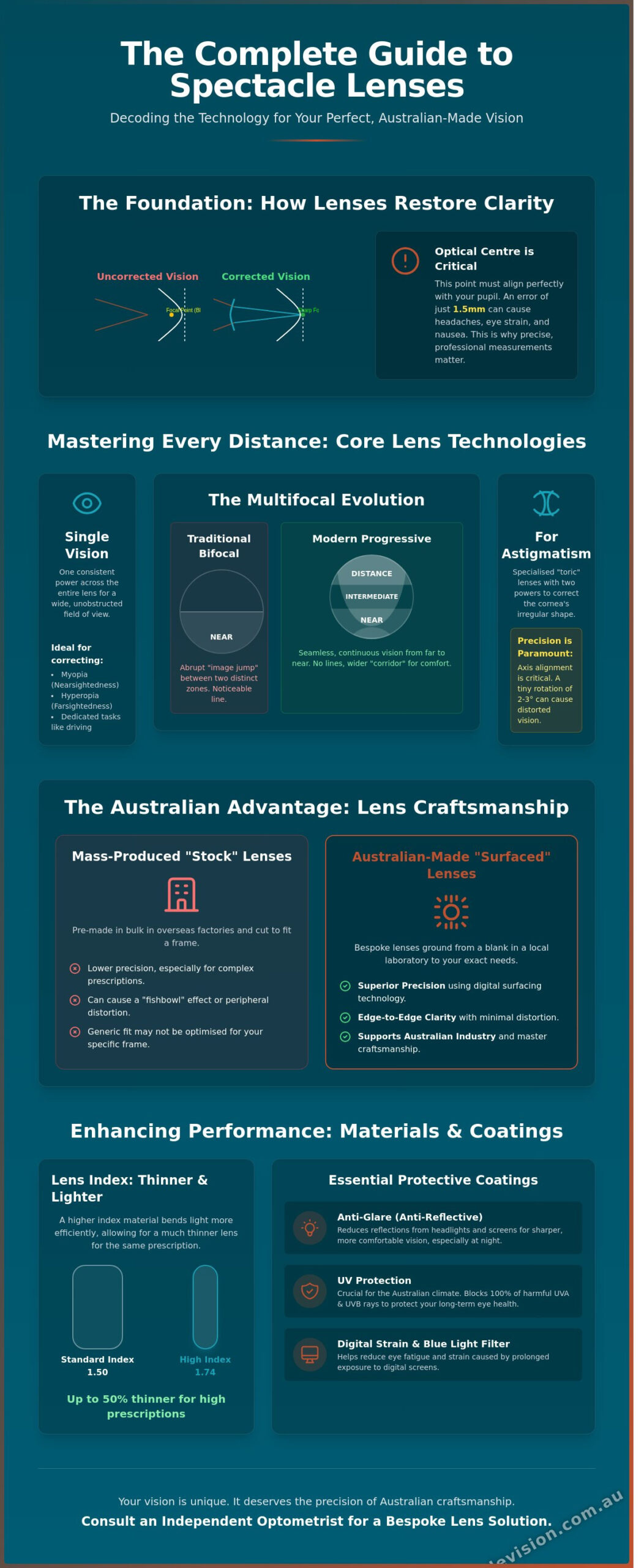
Spectacle lens overview infographic from the original article
Enhancing performance: lens materials and protective coatings
Modern spectacle lenses are available in several materials. The best choice depends on prescription strength, frame size, weight, impact requirements and budget.
High-index lenses use materials that bend light more efficiently and may reduce lens thickness for stronger prescriptions. The amount of thinning depends on the prescription, frame and index selected.
Polycarbonate and other impact-resistant materials may be considered where durability is important. An optometrist or optical dispenser can explain which materials are suitable for a particular prescription and frame.
Anti-reflective and blue light coatings
Anti-reflective coatings are designed to reduce reflections from spectacle lens surfaces and may improve appearance and visual comfort in some situations.
Some people also consider blue light glasses or blue-light-filtering coatings for screen use. Their usefulness depends on the reason they are being considered, so they should not be presented as necessary for everyone.
Hard coatings and scratch resistance
Hard coatings can improve scratch resistance, but no spectacle lens is completely scratch-proof. Use a clean microfibre cloth and a lens-safe cleaning product, and follow the care instructions supplied with the lenses.
Why lens origin and fitting matter
Lens origin, manufacturing method and fitting can all affect the final eyewear. Some independent practices offer Australian-made lenses alongside imported products, while others use different supplier combinations.
The precision of local manufacturing
Australian optical suppliers such as Opticare manufacture and supply lens options locally. Local production can support Australian manufacturing and may give practices access to prescription-specific lens processing. The exact product range, manufacturing location and turnaround time should be confirmed with the individual practice.
Why see an independent optometrist?
Independent practices can differ in the brands, lens suppliers, fitting services, equipment and aftercare they provide. Rather than assuming one care model is automatically better, compare the services and options available at the individual practice.
You can use the Australian Made Vision directory to compare participating independent practices and then confirm lens availability directly.
Investing in your vision for 2026 and beyond
The best spectacle lens is the one that suits your prescription, frame, daily tasks and budget. Modern lens technology offers many options, but not every feature is necessary for every wearer.
If Australian-made lenses are important to you, ask the practice which locally manufactured products they offer and whether those options suit your prescription.
To compare local practices, find an independent optometrist through Australian Made Vision.
The foundation of your vision starts with the raw material chosen in the laboratory. While older generations might remember heavy glass, modern types of spectacle lenses primarily use advanced polymers. Standard plastic, known as CR-39, remains a reliable choice for low prescriptions. However, as your script increases, standard plastic becomes bulky and heavy. This is where high-index materials become essential for comfort and style.
The “index” of a lens refers to its ability to bend light. A higher index means the material is more efficient, allowing the lens to be significantly thinner. For instance, a 1.74 high-index lens can be up to 50% thinner than a standard 1.50 index lens. This reduction in mass isn’t just about aesthetics; it prevents the “coke bottle” effect and makes the glasses comfortable for all-day wear. Polycarbonate is another vital material, offering 10 times the impact resistance of standard plastic. It’s the primary choice for Australian children and sports enthusiasts who need extra durability.
In local Australian labs, technicians bond protective layers to the lens surface using thermal curing or vacuum deposition. This isn’t a simple dip. It’s a precision process where microscopic layers are fused to the material. This ensures the treatments don’t peel or flake over time. When you choose locally crafted eyewear, you’re investing in a product that has undergone rigorous quality control in a controlled environment.
- CR-39 (1.50 index): Best for low prescriptions and budget-friendly options.
- Polycarbonate (1.59 index): Highly impact-resistant and lightweight.
- High-Index (1.61 to 1.74): Essential for strong prescriptions to keep lenses thin and light.
Anti-Reflective and Blue Light Coatings
Uncoated lenses reflect about 8% of light, which creates distracting “ghost images” during night driving. A premium anti-reflective (AR) coating increases light transmission to 99%, providing crisp clarity. Digital users often opt for blue light filters to manage eye fatigue. While clinical debates continue, many Australian patients report a 30% reduction in perceived strain during long office hours. Premium multi-coats also include oleophobic layers. These layers repel skin oils and make your glasses much easier to wipe clean.
Hard Coatings and Scratch Resistance
It’s a common misconception that lenses can be “scratch-proof.” In reality, they’re “scratch-resistant.” Australian-made lenses often feature a dual-sided hard coat that’s baked on for maximum durability. To keep these treatments intact, avoid using paper towels or tissues. These products contain abrasive wood fibres that cause micro-scratches. A simple microfibre cloth and a dedicated lens spray will extend the life of your eyewear by years. Supporting local manufacturing ensures these types of spectacle lenses meet the high standards required for our harsh UV environment.
The Independent Advantage: Why Lens Origin and Fitting Matter
Choosing your eyewear involves more than just picking a frame that looks good. The origin of your lenses and the expertise of the person fitting them define your visual clarity for years. While large corporate chains often rely on high-volume, offshore production, independent Australian optometrists prioritise a tailored approach. This ensures that the specific types of spectacle lenses you require are crafted with a level of care that mass production simply cannot replicate.
The Precision of Local Manufacturing
Local manufacturing at facilities like CR Surfacing Laboratories in Dandenong utilises state-of-the-art digital surfacing technology. By keeping production on Australian soil, these labs maintain rigorous quality control standards that exceed international minimums. CR Surfacing has operated for over 40 years, honing a process that treats every lens as a bespoke piece of medical equipment rather than a generic commodity. This dedication to craftsmanship results in optics with fewer distortions and higher clarity across the entire lens surface.
Choosing locally made products means your lenses don’t spend weeks in cargo holds or transit hubs. Instead, they’re often ready for fitting within 3 to 5 business days. This speed doesn’t come at the cost of precision; it’s the result of a streamlined, local supply chain. Beyond the technical benefits, supporting Australian-made optical products keeps jobs in our communities and reduces the carbon footprint associated with international shipping. It’s a choice that feels as good as it looks.
Why See an Independent Optometrist?
Independent practitioners take the time to understand your lifestyle and specific visual needs. A standard consultation at an independent clinic often lasts 30 to 45 minutes, providing a significant contrast to the 15-minute screenings common in some retail environments. This extra time allows for a deeper analysis of your eye health and a more precise prescription. Unlike corporate outlets that may be restricted to a limited house brand, independents can source various types of spectacle lenses from the world’s leading innovators and local labs.
Your relationship with an independent optometrist is a long-term partnership in health. They track changes in your vision over decades, offering continuity of care that’s hard to find in high-turnover corporate settings. They’re also more likely to invest in advanced diagnostic equipment, such as OCT scans, which can detect eye diseases years before symptoms appear. When you visit a local expert, you’re not just a customer; you’re a patient whose vision is a priority.
To experience the difference that personalised care and local craftsmanship make, you should seek out a professional who values quality over volume. You can find a local expert committed to these standards through the Australian Made Vision directory. Supporting these businesses ensures that the Australian optical industry remains vibrant and capable of delivering world-class eye care.
- Personalised Care: Consultations tailored to your specific work and hobby requirements.
- Bespoke Solutions: Access to a wider range of high-index and specialised lens materials.
- Community Impact: Every purchase supports local jobs and the Australian manufacturing sector.
- Reliable Quality: Lenses that meet strict Australian standards for durability and optical performance.
Investing in your vision is one of the most important health decisions you’ll make. By choosing an independent optometrist and Australian-made lenses, you’re opting for precision, ethics, and a superior visual experience. Don’t settle for a one-size-fits-all solution when bespoke, locally crafted excellence is available right in your neighbourhood.
Investing in Your Vision for 2026 and Beyond
Selecting the right types of spectacle lenses is a personal journey that blends clinical necessity with your unique daily habits. Your eyewear should work as hard as you do, whether you’re navigating a digital office or enjoying the bright coastal sun. Modern lens technology now offers bespoke solutions that cater to every distance and environment, ensuring your sight remains sharp and your eyes stay protected from fatigue.
Quality shouldn’t be a compromise. Since 1976, CR Surfacing Laboratories has led the way in optical innovation, crafting expertise-driven precision lenses right here in Dandenong, Victoria. This commitment to local manufacturing means your glasses aren’t just a product; they’re a piece of Australian heritage designed for local conditions. By partnering with an independent expert, you gain access to this high-level craftsmanship and personalised care that corporate chains often overlook.
Take the next step toward clearer, more comfortable sight today. Find an Independent Optometrist near you to discuss the best lens types for your vision. You deserve a view of the world that’s as clear and vibrant as the Australian landscape itself.
Frequently asked questions
What are the main types of spectacle lenses available today?
Common types include single vision, bifocal, progressive, occupational, polarised and photochromic lenses. The right design depends on your prescription and how you use your glasses.
Is there a difference between multifocal and progressive lenses?
Yes. Multifocal is a broad term for lenses with more than one viewing power. Progressive lenses are one type of multifocal lens that changes power gradually without a visible segment line.
How do I know if I need high-index lenses for my prescription?
High-index lenses may be useful for stronger prescriptions where reducing thickness or weight is a priority. Suitability depends on prescription strength, frame choice, lens size and budget.
Are blue light glasses necessary for office work?
Not necessarily. Some people choose blue-light-filtering lenses for comfort, but they are not required for every screen user. Your visual symptoms, prescription and work setup should guide the decision.
What are good lens options for driving in bright conditions?
Polarised prescription sunglasses can reduce reflected glare during daytime driving, while other lens options may suit different conditions. Sunglass tint, UV protection and driving suitability should be confirmed for the specific product.
Can I get Australian-made lenses at any optometrist?
Not every practice offers the same suppliers or lens ranges. Ask the practice directly which Australian-made lens products they currently offer and where those products are manufactured.
What happens if my new lenses don’t feel comfortable?
Contact the practice that supplied the glasses. A fitting, frame position or prescription review may be needed, depending on the symptoms and how long the glasses have been worn.