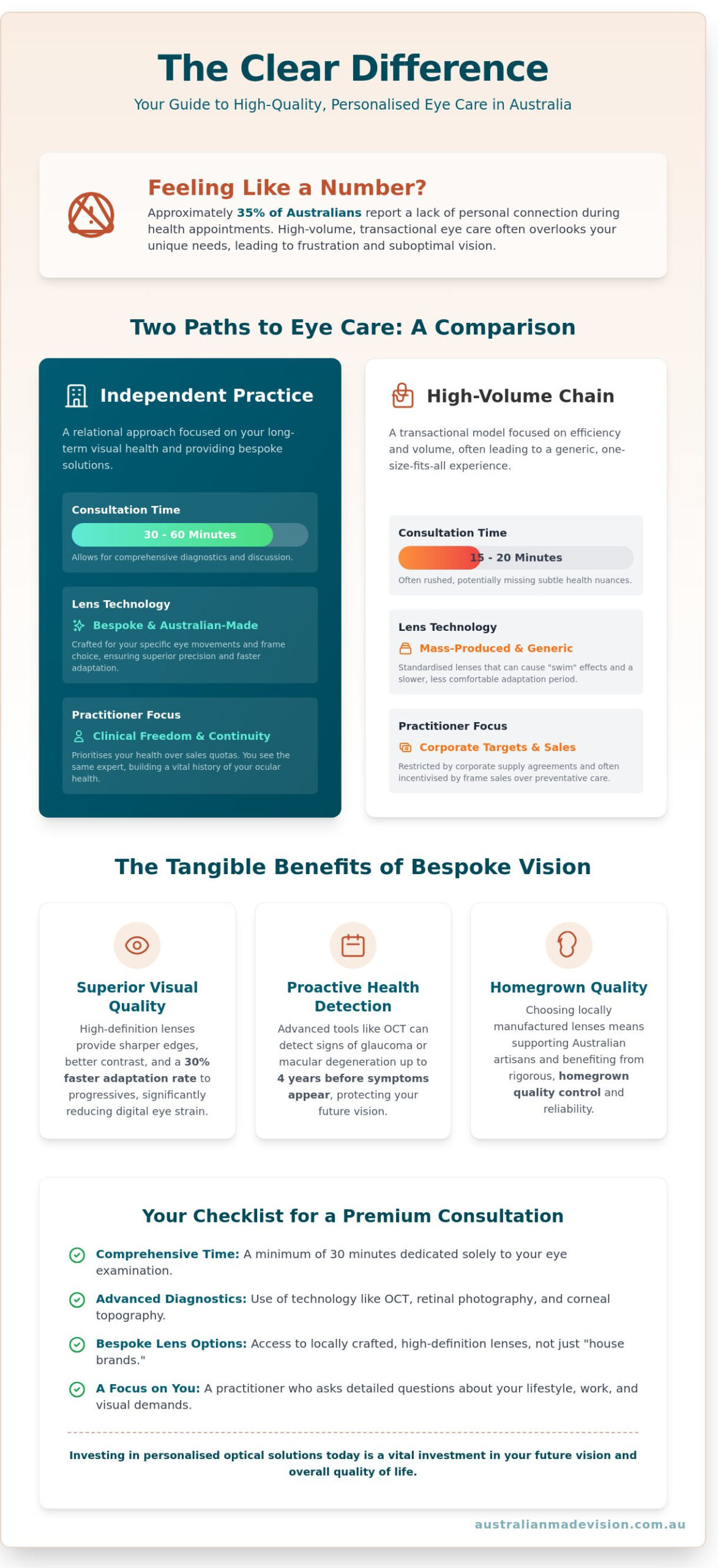
High-quality eye care is not defined by one business model, one piece of equipment or one type of lens. A useful way to compare practices is to look at how clearly they explain your eye health, how well the examination matches your needs, what follow-up is available, and whether recommendations are appropriate for your prescription and daily activities.
Independent optometry can offer advantages such as local ownership, continuity with the same team and flexibility in supplier choice, but individual practices differ. This guide explains practical factors to compare when choosing eye care in Australia without assuming that one type of provider is automatically better than another.
What Does High-Quality Eye Care Look Like?
Good eye care should be appropriate to the reason for your visit. A routine prescription check, a new symptom, a child’s vision concern and ongoing monitoring for an established condition may require different questions, tests or referral pathways.
Clear Communication and Appropriate Assessment
A useful consultation gives you a clear explanation of what is being checked, what the findings mean and what the next step may be. The exact examination can vary depending on your age, symptoms, medical history, prescription and the services available at the practice.
Continuity and Follow-Up
Some people value seeing the same optometrist or practice over time because previous records can help show how vision or eye-health findings have changed. Continuity is one factor to compare, but it should be considered alongside clinical suitability, accessibility, appointment availability and the services you need.
Technology That Has a Clear Purpose
Practices may use equipment such as retinal imaging or optical coherence tomography (OCT) when clinically appropriate. Technology should support the examination rather than be treated as proof that one practice provides better care. Ask why a test is being recommended, whether it is included in the consultation fee, and how the result will be used.
Personalised Vision Needs
Your visual needs can change depending on what you do each day. Someone who works across several screens may have different priorities from someone who drives frequently, works outdoors or needs detailed near vision for a hobby.
Questions About Your Daily Activities
A useful eyewear discussion can include the distances you use most, how long you spend on near tasks, whether glare is a problem, the type of frame you prefer and any difficulties with your current glasses. This information can help the optometrist or optical dispenser discuss suitable lens options.
Lens Design and Fitting
Some spectacle lenses use additional fitting measurements such as pantoscopic tilt, vertex distance or frame wrap, depending on the lens design. These measurements can be relevant to how a particular lens is positioned in front of the eyes, but not every prescription requires the same level of customisation.
Independent Optometry: What It Can Mean in Practice
Independent practices are generally owned and operated outside a large corporate optical chain. This may give the practice flexibility in areas such as supplier choice, product range, staffing and the way services are organised. However, independence does not by itself guarantee longer appointments, better outcomes, more advanced equipment or particular services.
For a clearer explanation of ownership and care-model differences, read what an independent optometry practice actually means in Australia.
Choosing the Right Practice for Your Needs
The practical comparison is between individual practices. Consider the optometrist’s role and experience, available services, access, fees, appointment process, follow-up arrangements and whether the practice can explain its recommendations clearly.
You can also use AMV’s guide to choosing the right optometrist for a broader selection checklist.
Specialised Services Vary Between Practices
Some optometry practices provide services for specific needs, while others may refer patients elsewhere. Do not assume that every independent or corporate practice offers the same services.
Children’s Vision and Myopia
If a child has short-sightedness or changing distance vision, assessment and management options depend on the child’s individual findings. Read about myopia and short-sightedness and confirm with the practice whether child myopia-management services are available.
Dry Eye Assessment and Care
Dry, gritty, burning or fluctuating vision can have several causes. Read the AMV dry eye guide and ask the individual practice what dry-eye assessment or management services it provides.
Australian-Made Lens Options
Some practices may offer spectacle lenses that are made in Australia. Manufacturing origin may matter to people who want to support Australian industry, but it should not be treated as automatic proof of better optical quality, faster delivery, greater durability or better clinical outcomes.
If Australian-made products are important to you, ask the practice which lenses are made in Australia, what part of the manufacturing process occurs locally and what evidence supports the claim. Then compare the lens in the same way you would any other option: suitability for your prescription, design, material, coatings, fitting, price, warranty and aftercare.
Checklist: How to Evaluate an Optometry Practice
- Does the practice clearly explain what the eye examination may include?
- Are the services you need available at this location?
- Can the practice explain fees, Medicare arrangements and possible extra charges before the appointment?
- Does the optometrist explain findings and next steps in language you understand?
- If eyewear is recommended, are the lens options and trade-offs explained clearly?
- What follow-up, adjustment or review support is available?
- If you value continuity, can you request the same optometrist for future visits?
- If Australian-made lenses matter to you, can the practice verify the product’s manufacturing origin?
Questions to Ask Your Optometrist or Practice
- What will this examination check based on my symptoms or reason for booking?
- Are any additional tests recommended, and why?
- What fees may apply beyond the standard consultation?
- Which lens designs suit my prescription and daily activities, and what are the main differences?
- What should I do if my symptoms or vision change after the appointment?
- Are the services or products being discussed available at this specific location?
When to Seek Prompt or Urgent Care
A routine practice-comparison guide cannot determine the cause of eye symptoms. Sudden vision loss, a new curtain or shadow in the vision, a sudden increase in flashes or floaters, significant eye injury, or severe eye pain may require urgent medical assessment rather than waiting for a routine appointment.
The Practical Next Step
Choose a practice based on the care and services you need rather than a label such as independent, corporate, premium or high-tech. If you want to compare participating independent practices, use the Australian Made Vision directory and confirm services, fees, equipment, products and availability directly with the individual practice.
Frequently Asked Questions
Is independent eye care automatically better than corporate eye care?
No. Ownership model alone does not determine clinical quality. Independent practices may offer benefits such as local ownership, continuity or supplier choice, while corporate practices may offer other conveniences. Compare the individual practice and whether it meets your needs.
Do high-quality eye tests always take 30 to 40 minutes?
No fixed appointment length defines a high-quality eye test. The time needed depends on the reason for the visit, the tests required, the person’s history and the practice’s appointment model.
Does having OCT mean a practice provides better eye care?
Not by itself. OCT can be useful for particular clinical questions, but whether it is needed depends on the person and the reason for the examination. Ask why the test is recommended and how the result will be used.
Should I choose Australian-made lenses over imported lenses?
Manufacturing origin is one consideration, not a guarantee of better vision or durability. Compare the lens design, prescription suitability, material, coatings, fitting, price and aftercare, and verify any Australian-made claim with the practice.
How often should I have an eye examination if I have no symptoms?
There is no single interval that is right for everyone. Timing depends on age, previous eye findings, medical history, risk factors and professional advice. Arrange an assessment sooner if you notice new or persistent changes in vision.
Can specialised lenses help with digital eye strain?
Some lens designs may be useful for particular working distances or visual tasks, but screen-related discomfort can have several causes. An eye examination can help determine whether prescription, dry eye, working distance, lighting or another factor may be contributing.
What should I look for in a children’s eye test?
Look for a practice that is comfortable assessing children and can explain what the examination may include. If there is a specific concern such as myopia, eye alignment or persistent symptoms, confirm that the practice provides the relevant assessment or referral pathway.