

Choosing glasses becomes easier when you look beyond the frames on display. Your facial proportions can give you ideas about styles to try, but face shape is only one part of choosing prescription glasses. A frame also needs to feel comfortable, sit securely and work with your lenses.
If you are wondering what glasses suit your face, start with shapes and colours you enjoy. Then check the bridge, frame width and how the glasses sit when you move. An optometrist or optical dispenser can help assess whether your preferred frame is suitable for your prescription.
At a glance: which frames could you try?
| Face shape | Frame styles worth comparing | A practical reminder |
|---|---|---|
| Oval | Rectangular, round, geometric, softly upswept | Keep the overall frame scale comfortable |
| Round | Rectangular, angular, soft-square, upswept | Round frames remain an option if you like them |
| Square | Oval, round, softly curved, light-rimmed | A square frame is fine if you prefer a defined look |
| Heart | Oval, soft-square, lighter-rimmed | Pay attention to bridge stability and frame width |
| Diamond | Oval, softly upswept, browline | Check cheek clearance and how the frame sits |
| Triangle or pear | Browline, upswept, softly angular | Choose a comfortable width rather than a strict shape rule |
| Long or oblong | Deeper rectangular, oval, rounded | Try different lens depths and proportions |
These are styling suggestions, not medical recommendations. Facial features do not always fit neatly into these categories, and there is no single scientifically established frame shape for each face type.
How to check your face shape at home
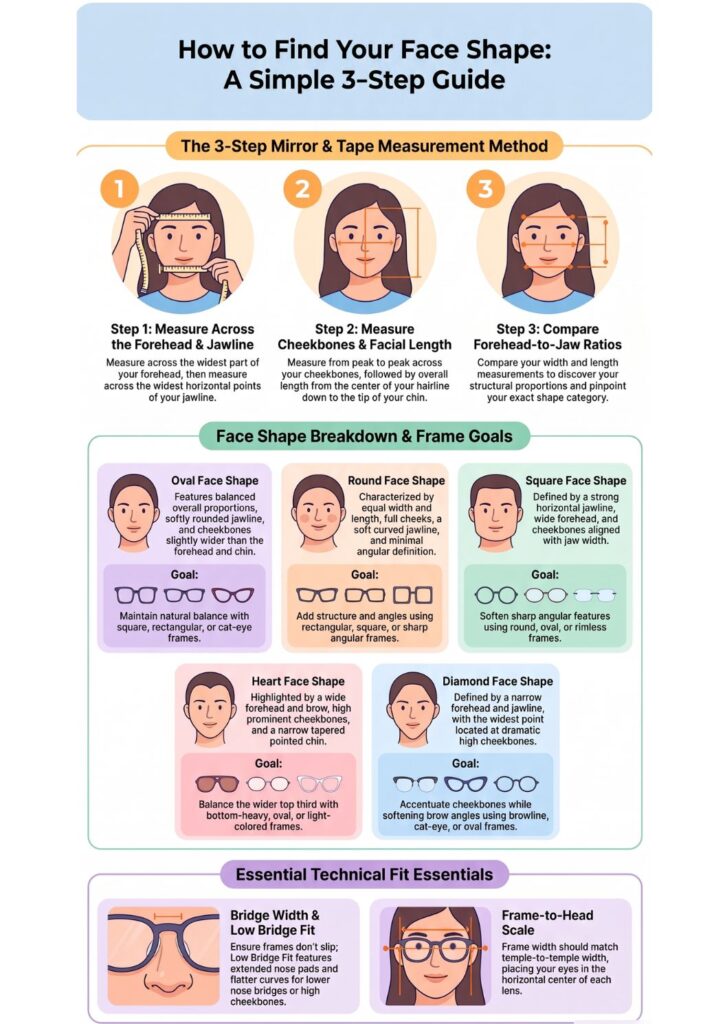
You do not need to calculate a precise facial ratio before trying on glasses. A mirror or a straight-on photograph can help you notice which parts of your face appear wider or longer. If you enjoy measuring, a flexible tape measure may make these differences easier to compare, but the measurements are approximate.
Step 1: Look at your forehead and jawline
Stand in even light, look straight ahead and move your hair away from your face. Notice where your forehead looks widest and compare it with the width of your jawline. Is your forehead noticeably broader than your jaw, are they similar in width, or is the lower part of your face wider? Look at the outline rather than trying to measure around every curve.
Step 2: Compare your cheekbones and face length
Next, look across the most prominent part of your cheekbones. Are your cheeks the widest part of your face? Then compare the apparent distance from the upper forehead or hairline to your chin with the overall width. If your hairline is hard to define, compare your overall facial proportions; you do not need an exact number.
Step 3: Notice the overall pattern, without forcing a label
A face that looks relatively long with softly balanced widths may resemble an oval or oblong shape. A fuller, shorter outline may look round, while a wider forehead and narrower chin may suggest a heart shape. A more angular jaw may suggest a square shape. You may recognise features from two or more descriptions, which is completely normal.
Important distinction: The measurements above are for visual comparison. Pupillary distance, lens fitting heights and other measurements used to make prescription spectacles are separate tasks carried out as part of optical dispensing.
Which glasses suit different face shapes?
Face-shape guides often suggest creating contrast: a curved frame against angular features, or a defined frame against softer features. That is a useful style experiment, not a rule about what you should wear. Use the following descriptions to build a shortlist, then assess how each frame looks and feels when you try it on.
Glasses for an oval face
An oval face is often described as slightly longer than it is wide, with a softly curved jaw and fairly balanced forehead and cheek proportions. Because these features are relatively even, several frame styles may create a balanced appearance.
Try a rectangular frame for a more defined outline, a rounded frame for a softer appearance, or a geometric frame if you prefer a distinctive detail. A gentle cat-eye or upswept shape can also be worth comparing. None of these choices is inherently better for your eyes or vision.
For an oval face, the main practical consideration may be frame scale. A frame that is very wide can feel loose at the temples, while a narrow one may press at the sides. The best comparison is how it looks and feels when properly positioned.
Glasses for a round face
A round face usually has gentle contours through the cheeks and jaw, with facial width and length appearing relatively similar. Rectangular, square and other angular frames can create a visual contrast with those softer curves. A slightly upswept design may change the emphasis around the upper face.
You do not have to avoid round spectacles. If you like circular or oval frames, compare a few sizes and rim thicknesses. A bold round frame can be a deliberate style choice; a lighter rim might give a subtler effect.
Check that the lower edge does not rest uncomfortably on the cheeks and that the frame remains stable when you smile. Those fitting details matter more than whether a shape chart marks the frame as a match.
Glasses for a square face
A square face is commonly described as having a more defined jaw, a relatively broad forehead and a facial outline with noticeable angles. Rounded or oval frames can soften the overall look. Thin metal rims, gently curved rectangles and some upswept shapes may create a similar effect.
If you enjoy structured styles, square or rectangular frames can work too. The choice is about the appearance you prefer, not a rule about your face shape. Try one rounded option and one angular option to see which feels more like you.
Pay attention to whether the frame front is too narrow at the sides of the head. A good fit should not require tight temple arms to hold an unsuitable width in place.
Glasses for a heart-shaped face
Heart-shaped faces are generally described as broader at the forehead or upper face and narrower towards the chin. The jaw may taper, and the cheekbones can be prominent. Oval, gently rounded and soft-square frames are useful starting points if you want a less top-heavy appearance.
Light-coloured rims, delicate metal styles and clear frames may also be interesting if you prefer a subtle look. You can also try a more pronounced cat-eye style; it simply creates a different emphasis around the brows and temples.
Because upper-face width varies from person to person, avoid choosing a frame only by its shape label. Check the bridge and temples, and look at whether the glasses sit evenly across your face.
Glasses for a diamond-shaped face
A diamond-shaped face is typically described as widest around the cheekbones, with a narrower forehead and jaw. Oval frames can echo the lower-face curves, while soft cat-eye or browline styles may shift visual emphasis towards the upper face.
You could compare a gentle upswept frame, a softly rounded rectangle and a lightweight metal design. Wider decorative rims are a personal style choice rather than something this face shape automatically needs or must avoid.
Check how the bottom of the frame sits relative to your cheeks, especially when smiling. A frame that repeatedly lifts or rubs may need a different bridge, shape or professional adjustment.
Glasses for a triangle or pear-shaped face
A triangle- or pear-shaped face is usually described as having a broader lower face and jaw than the forehead. This is different from a heart-shaped description, which is generally broader above and narrower towards the chin.
Browline frames, gently upswept shapes or frames with a little more detail across the upper rim can provide a contrasting look. Oval or softly angular styles can be worthwhile as well. If you prefer understated glasses, there is no need to choose a decorative top rim.
Make sure a frame that looks wide enough across the face also fits comfortably at the bridge and temples. Styling proportions do not tell you whether the physical frame is the right size.
Glasses for a long or oblong face
A long or oblong face appears longer than it is wide. Its jaw may be curved or angular; length is the main descriptive feature. Deeper rectangular, rounded or oval frames can add more visual depth around the eyes, while browline and larger-rimmed styles may change the perceived proportions.
Try frames with different lens heights instead of assuming you must buy oversized glasses. A very deep frame can affect weight, lens thickness or suitability for some prescriptions, and a smaller one may be more comfortable for everyday wear.
If you are choosing multifocals, ask whether there is enough usable lens area for the particular design rather than selecting a frame by its visual proportions alone.
What if your face does not fit one category?
Many faces combine characteristics: a softly rounded jaw with a broad forehead, for example, or high cheekbones with an overall long shape. Lighting, hairstyle, camera angle and expression can also change how the outline appears in a photograph.
You do not need to settle on one label. Choose two or three frames that create different visual effects and compare them side by side. A frame you enjoy wearing and that can be fitted appropriately is more useful than a mathematically perfect match to a diagram.
Face shape is only one part of the choice
Think about frame scale, not just shape
Petite, narrow, wide and oversized frames describe different proportions, but these labels are not standardised measurements or universal size categories. Two frames labelled with similar measurements can fit differently because the bridge, rim design, hinge placement and curvature vary.
An oversized frame can be a deliberate style choice. The practical questions are whether its weight feels comfortable, whether it is stable and whether its lens dimensions are suitable for your prescription. Conversely, a petite frame should not squeeze your temples simply because it looks proportionate from the front.
Choose a colour you want to wear
Frame colour can change how noticeable your glasses look. Clear or lightly coloured rims may feel understated, while dark acetate, tortoiseshell-style patterns or stronger colours can draw more attention to the frame. Metal finishes offer another way to change the overall effect without changing the frame shape.
Warm and cool colour palettes can offer styling ideas, but they are not medical guidelines. Compare colours in ordinary daylight if you can, and think about what works with your clothing, work and everyday habits.
Consider the way you use your glasses
A pair worn throughout the working day may need to feel different from occasional reading glasses or a dedicated pair for outdoors. Consider where you spend your time, how often you take the glasses on and off, and whether they need to stay stable during movement.
If you have a complex prescription or need lenses for more than one viewing distance, your lens requirements may limit which frames are practical. Read more in AMV’s guide to types of spectacle lenses.
Why a practice fitting adds more than an online preview
An online preview can help you compare styles, but a practice can check the actual frame against your prescription and lens design. An optical dispenser can adjust the frame into its wearing position, measure or verify pupillary distance (PD) and fitting heights, and assess bridge fit, frame depth and lens suitability. These checks connect the style you choose with how your finished glasses sit and work.
How should glasses fit on your face?
A good fit is about more than whether your glasses look straight in a mirror. An optical dispenser considers the bridge, temples, position of the frame and lens requirements together. There is no single width or numerical tolerance that fits everybody.
The bridge and nose pads should feel stable
The bridge is the part of the frame that rests across your nose. If the bridge fits poorly, the frame may slide, pinch or sit too high or too low on your face. A plastic bridge relies on its shape; some metal or combination frames have adjustable nose pads. Both approaches can work when the design and fitting are suitable.
Low-bridge-fit frames are designed to offer a different fit where a standard bridge does not sit securely, including for some people with a lower nasal bridge or prominent cheeks. Depending on the design, they may have differently shaped nose pads, bridge geometry or frame angles. Fit needs to be checked individually; neither ethnicity nor a face-shape label can determine which bridge design will work.
Check the temples and the sides of your head
The temple arms help keep spectacles in position. They should not press painfully at the sides of the head or around the ears. If the frame is too wide, it may move during normal activity; if it is too narrow, it can feel tight even when it looks attractive from the front.
Avoid trying to fix persistent slipping by bending the arms yourself. Frame materials and construction vary, so ask the dispensing practice about a suitable adjustment.
Look for cheek clearance and a level frame
Put the glasses on as you would normally wear them. Smile, look down and gently move your head. Does the lower rim dig into your cheeks or lift noticeably? Does the frame stay reasonably level, or does one side sit higher? Are your eyelashes touching the lenses?
Any of these observations can be a reason to ask about adjustment or another frame. They are fitting clues, not evidence of an eye condition. Persistent pain, pressure or unstable glasses should not be accepted as a necessary part of getting used to a new style.
What do the numbers inside your glasses mean?
You may see a marking like 52 □ 18 140 on the inside of a temple arm. In many frames, the first number represents the nominal horizontal lens width in millimetres, the second the designated bridge size, and the third the temple length. These figures help compare frame dimensions, but they do not describe the shape of your face.
For example, the bridge number is not a measurement of your nose width. Different frames with identical markings can rest differently because of their bridge design, nose pads, lens shape and overall construction.
If you already have a comfortable pair, its markings can be a useful starting point when trying other frames. Use them as a comparison, then check the actual fit rather than ordering solely from three numbers.
Can the frame work with your prescription?
A fashionable frame is not automatically suitable for every lens. The strength of your prescription, lens design, size of the frame and the way it sits in front of your eyes may influence what can be made and fitted appropriately.
Stronger prescriptions and lens thickness
With some stronger short-sighted prescriptions, lenses may be thicker towards the outer edges. A smaller frame or one that positions the eyes closer to its centre can sometimes help reduce unnecessary lens thickness, depending on the prescription and design. A larger or unusually shaped frame may change the thickness, finished weight and appearance.
Higher-index lens materials are sometimes considered to reduce thickness, but the highest index is not necessarily the most suitable option. The final result depends on material, prescription, lens design and frame. AMV explains these considerations further in its high-index lenses guide.
Multifocal and progressive lenses
Progressive lenses contain different viewing areas for distance, intermediate and near vision. The frame must provide suitable usable space and sit in the intended position for the selected lens design. There is no reliable universal minimum frame depth that applies to every progressive product and wearer.
Before settling on a shallow, very deep or strongly curved frame, ask the practice to check it against your lens design. You can also read AMV’s multifocal and progressive lens explanation.
Why pupillary distance is different from face-shape measurement
Pupillary distance (PD) describes the spacing between the pupils and is used in spectacle dispensing to help position the prescribed lenses appropriately. Depending on the prescription and lens design, the dispenser may also need monocular PDs, fitting heights and other position-of-wear measurements.
Your forehead, jaw and cheekbone measurements cannot substitute for these optical measurements. The image in this article is a styling aid, not a tool for ordering prescription lenses or checking their optical alignment. Optometry Australia has published professional guidance on the importance of measuring PDs and fitting heights correctly.
How to try on frames before making a decision
Begin with three different looks: one that feels familiar, one that contrasts with your facial proportions and one that is a little bolder. Try each with your usual hairstyle and everyday clothing. Look straight ahead and from the side, rather than relying on one selfie angle.
Once you have a shortlist, check the practical details:
- Is the frame stable when you look down and move your head normally?
- Does it sit without pinching your nose or pressing into the sides of your head?
- Does it stay clear of your cheeks and eyelashes during normal expressions?
- Do you like the overall scale and colour in ordinary lighting?
- Has the practice confirmed that the frame can accommodate your prescribed lenses?
Online virtual try-on tools can help you explore styles or colours. The preview may not accurately show the physical fit, lens thickness or optical positioning of prescription lenses. Use a real fitting to confirm those details before ordering.
When to ask an optometrist or optical dispenser for help
An optical dispenser can help compare frames, discuss fitting and check the practical lens requirements. An optometrist can assess your vision and eye health and provide a prescription when appropriate. The details of services offered vary by practice.
If your current glasses slip, rub or sit unevenly, contact the practice that supplied them and ask for a fitting review. If your vision is persistently blurred or has changed, or if your prescribed glasses no longer provide comfortable vision, arrange an eye examination instead of assuming your face shape or frame style is responsible. Healthdirect explains what an eye test may include.
When comparing practices, useful questions include: Will you check the frame with my prescription before ordering? What adjustments and aftercare are available? Does the quote include lenses, coatings and any fitting services? What happens if the finished glasses do not sit or work as expected?
Frequently asked questions
Can I wear round glasses if I have a round face?
Yes. A rectangular frame may create more visual contrast, but there is no rule preventing someone with a round face from wearing round glasses. Choose the appearance you prefer and make sure the frame fits appropriately.
What if I cannot tell my face shape?
That is common. Face-shape labels are approximate styling descriptions, not diagnoses. Compare a few different frame designs and focus on comfort, stability, prescription suitability and what you enjoy wearing.
Do oversized frames suit small faces?
They can, if that is the look you prefer and the physical fit and prescribed lenses are suitable. Larger frames can change lens thickness, weight and fit, so try the actual frame and discuss its suitability with the practice.
How do I know if my glasses are too wide?
Frames that slide frequently, sit loosely or need excessive temple tightening may require a fit check. The best assessment considers the bridge, temple position and overall frame construction, not just the marked width.
What if my glasses touch my cheeks when I smile?
Whether a frame touches your cheeks can depend on facial movement and frame design, but rubbing, repeated lifting or discomfort are good reasons to ask about an adjustment or different style. Bridge shape, nose pads and frame height may be relevant.
Do face measurements tell me my pupillary distance?
No. Comparing forehead, jawline and cheekbone proportions can help with styling choices, but it does not measure PD. Optical dispensing measurements should be made or verified for the intended prescription and lens design.
Are face-shape apps and virtual try-on tools accurate?
They can help visualise a frame, but their classifications and simulations are not a clinical assessment of facial anatomy or an optical fitting. Camera angle, lighting and software can affect the appearance, so verify fit in person where possible.
Find a frame that suits you and your vision
The most useful face-shape guide is one that helps you explore possibilities rather than limits your choices. Look at your proportions, try several frame styles and pay attention to how the glasses sit. For prescription eyewear, the final checks are comfort, stability and suitable lenses, not whether your face fits one illustration.
Australian Made Vision provides a directory of participating independent optometry practices. You can find an independent optometrist near you and contact a practice to ask about its frame selection, optical dispensing, eye examinations and fitting services. Availability, costs and services should be confirmed directly with the individual practice.
Sources
Face-shape categories are styling starting points, not rules. Prescription suitability and optical fit should be checked for the individual frame and wearer.
- Optometry Australia, Measuring PDs and heights (published 16 June 2016; professional dispensing context).
- Healthdirect Australia, Eye tests (last reviewed September 2024).
- Australian dispensing industry education, Frames and frame selection (technical explanation by an optical dispensing educator; professional context).
- Australian dispensing industry education, Fundamentals of ideal frame selection (professional frame-fitting discussion).
- Healthdirect Australia, Eye care (Australian eye-health pathway).