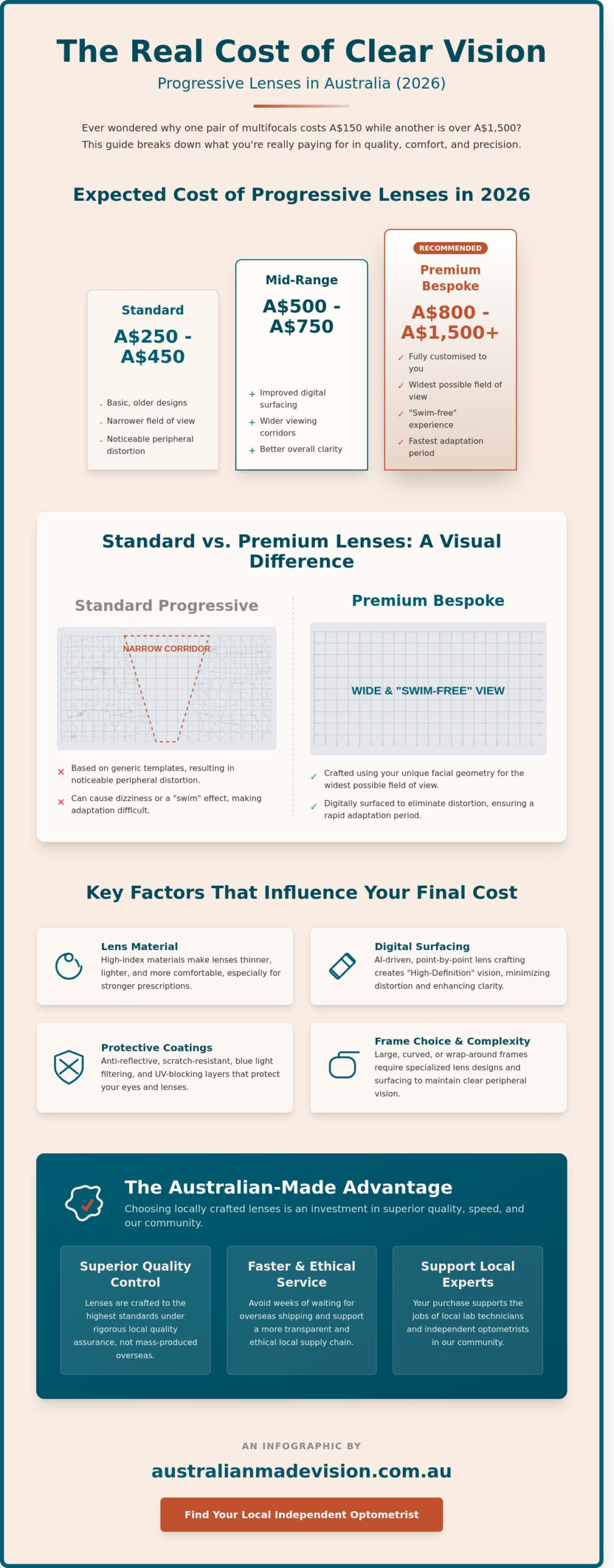
There is no single national price for progressive lenses in Australia. In 2026, the total you pay can change with the lens design, prescription, lens material, coatings, frame, fitting measurements and the practice’s pricing model. Current advertised examples from major Australian retailers show multifocal/progressive upgrades ranging from about $130 to $350 for selected design tiers, but those are retailer-specific upgrade prices rather than an Australia-wide average.
For a useful comparison, ask for an itemised quote that separates the frame, progressive lens design, material, coatings and any other options. The best-value lens is not automatically the cheapest or the most expensive; it is the option that matches your prescription, frame and daily visual tasks.
Quick Answer: What Do Progressive Lenses Cost in Australia?
Progressive lens pricing varies widely because providers package lenses differently. Some retailers price progressive lenses as an upgrade to a frame, while other practices quote the complete pair. As current examples, Specsavers lists standard, premium and elite multifocal upgrades at +$150, +$250 and +$350. Oscar Wylee lists a premium multifocal upgrade at +$130 for one pair and an elite upgrade at +$235 for one pair. These examples show the spread between design tiers, but they should not be treated as a national average.
What Are Progressive Lenses?
Progressive addition lenses are a type of multifocal spectacle lens. They provide a gradual change in optical power from distance through intermediate to near vision, without the visible segment line found in a traditional bifocal. The position and width of the usable viewing areas vary by lens design, prescription, frame and fitting.
Progressive lenses are commonly discussed when near focus becomes more difficult with presbyopia, but the appropriate correction depends on an individual eye examination and prescription.
What Affects the Cost of Progressive Lenses?
1. Progressive lens design
Lens design is one of the biggest price factors. Entry-level designs usually use a more standardised distribution of distance, intermediate and near zones. More advanced designs may provide broader usable areas or allow additional optimisation for the wearer and frame. More expensive does not automatically mean better for every person; the most suitable design depends on how the glasses will be used.
2. Prescription complexity
Higher prescriptions, astigmatism, prism and differences between the two eyes can affect lens availability, thickness, material choices and manufacturing requirements. A complex prescription does not necessarily require the highest-priced progressive design, but it can change which combinations are practical.
3. Lens material and high-index options
High-index materials can reduce lens thickness in stronger prescriptions because they bend light more efficiently. Their main benefit is thickness management; they do not automatically make vision sharper. Read AMV’s high-index lens guide for the trade-offs between index, thickness, optics and price.
4. Anti-reflective and other coatings
Anti-reflective coatings reduce reflections from the lens surfaces and can be useful for some wearers, especially when lens reflections are distracting. They do not remove every source of glare and should not be treated as mandatory for every progressive wearer. See AMV’s anti-reflective coating guide for benefits, limits, care and questions to ask.
5. Frame choice and fitting measurements
Progressive lenses must be positioned accurately in the chosen frame. Fitting height and pupillary measurements are commonly used, and some lens designs also use additional position-of-wear measurements. Frame size, shape and fit can affect which lens designs are suitable. Accurate fitting matters, but there is no evidence-based rule that one ownership model or one measurement system automatically produces better outcomes.
6. Practice services, warranty and remake policy
The quoted price may also reflect fitting, adjustments, follow-up and the practice’s remake or non-adaptation policy. These policies vary. Ask for the terms in writing before ordering rather than assuming a 30-, 60- or 90-day guarantee applies.
Are Progressive Lenses and Multifocals the Same Thing?
Progressive lenses are one type of multifocal lens. ‘Multifocal’ is the broader category and can also include bifocals, trifocals and some occupational lens designs. This page focuses specifically on the cost of progressive addition lenses, so it should remain distinct from broader multifocal pricing or lens-type pages.
How Private Health Insurance Affects the Price
Medicare covers eligible eye-test services but does not cover the cost of glasses or contact lenses. Private health insurance extras can help with optical costs, depending on the policy. Benefits, annual limits, waiting periods, preferred-provider arrangements and reset dates vary, so there is no reliable Australia-wide rebate amount.
Before ordering, check your insurer’s current optical benefit and ask the practice for the total price before and after any expected benefit. Government guidance states that extras cover can include glasses and contact lenses, but the amount covered depends on the policy.
Does Medicare Pay for Progressive Lenses?
No. Services Australia states that Medicare does not cover glasses or contact lenses. Medicare may cover eligible eye tests, and private health insurance may help with eyewear depending on the level of cover.
Can You Claim Progressive Glasses as a Tax Deduction?
Do not assume ordinary prescription progressive glasses are tax deductible. The Australian Taxation Office states that prescription glasses and contact lenses are generally private expenses, even when worn at work. Some protective eyewear used for work-related safety risks can be deductible in specific circumstances. Seek tax advice for your situation.
What About Australian-Made Progressive Lenses?
Australian-made progressive lenses are available from some manufacturers and practices. If supporting local manufacturing matters to you, ask which product is being supplied and what part of the manufacturing process occurs in Australia.
The Australian Made logo is supported by a third-party accreditation system, so a licensed claim can help verify origin. Manufacturing location, however, should not be presented as automatic proof of superior optical performance, faster adaptation, greater durability or a lower carbon footprint. Compare Australian-made and imported options on the same practical criteria: lens design, prescription suitability, measurements, material, coatings, total price, warranty and aftercare.
Progressive Lenses for Computer and Office Work
General-purpose progressives can provide intermediate vision, but the available computer zone may not suit every workstation or working distance. People who spend long periods at a desk may want to ask about occupational or office lenses, which are designed to prioritise intermediate and near viewing distances. These are usually a separate work pair rather than a replacement for general-purpose progressive lenses.
Progressive Lenses, Sunglasses and Light-Adaptive Options
Progressive prescriptions can often be combined with sun-lens options. If outdoor glare is a priority, ask about prescription sunglasses and polarisation. Compare polarised lenses for reflected-glare reduction and driving limitations.
If you prefer one pair that changes tint between indoor and outdoor conditions, read AMV’s photochromic lens guide and compare its driving and temperature limitations.
How Long Does It Take to Adjust to Progressive Lenses?
There is no single adaptation time that applies to everyone. Some wearers adjust quickly, while others need more time. Prescription changes, frame fit, lens design, fitting measurements and previous experience with progressives can all affect adaptation.
If the lenses remain difficult to use, return to the supplying practice rather than assuming you simply need to ‘push through’. The prescription, frame fit, measurements and lens design may need to be checked.
Can You Buy Progressive Lenses Online?
You can buy progressive glasses online, but fitting is more complex than for many single-vision prescriptions because additional measurements may be needed. An older CHOICE investigation found major problems in several multifocal pairs ordered online. That study should not be treated as a current market failure rate, but it illustrates why accurate measurements and a clear remake policy matter.
How to Compare Progressive Lens Quotes
- What is the total price for the finished pair?
- Which progressive lens design and tier are included?
- Why is this design being recommended for my prescription and daily tasks?
- Which lens material is included, and is a high-index upgrade actually useful for my prescription?
- Which coatings are included and which are optional?
- What fitting measurements will be taken?
- What warranty, adjustment and remake or non-adaptation policy applies?
- What is the price before and after any private health insurance benefit?
- If the lenses are described as Australian made, what exactly is made in Australia?
Find an Optometrist and Compare Your Options
A useful progressive-lens quote should explain the design, material, coatings, measurements, total price and aftercare in plain language. If you want to compare participating independent practices, use the Australian Made Vision optometrist directory and confirm current products, prices, health-fund arrangements and policies directly with the individual practice.
Frequently Asked Questions
How much do progressive lenses cost in Australia in 2026?
There is no single national average. Current advertised examples from major retailers show progressive/multifocal upgrades from about $130 to $350 for selected tiers, before considering the frame and other options. Independent-practice quotes and complete-pair prices can be higher or lower depending on the design, prescription, materials, coatings and services included.
Why do progressive lens prices vary so much?
The main reasons are lens design, prescription complexity, material, coatings, frame, fitting measurements and what service or remake support is included. Retailers also package these components differently, so headline prices are not always directly comparable.
Are premium progressive lenses always better?
No. Some premium designs can provide wider usable viewing zones or more personalisation, but the best choice depends on the wearer, prescription, frame and tasks. More expensive is not automatically better.
Does Medicare cover progressive lenses?
No. Medicare can cover eligible optometry services, but Services Australia states that it does not cover glasses or contact lenses. Private health insurance extras may contribute, depending on the policy.
How much will private health insurance pay?
There is no standard rebate. Optical extras benefits, annual limits, waiting periods and provider arrangements vary between policies. Check your current policy before ordering.
Are Australian-made progressive lenses better?
Australian-made products may be a good choice if local manufacturing matters to you, but origin alone does not prove better optics or durability. Compare the specific design, fitting, price, warranty and suitability for your prescription.
Do I need high-index progressive lenses?
Not automatically. High-index materials can reduce thickness in stronger prescriptions, but the benefit depends on the full prescription, frame size and shape, material trade-offs and cost.
How long should progressive lenses last?
There is no fixed lifespan. Replacement may be needed because the prescription changes, the lenses or coatings become damaged, the frame no longer fits well, or your visual needs change.
What if I cannot adapt to progressive lenses?
Return to the supplying practice. The prescription, frame fit, measurements and lens design can be reviewed. Remake and adaptation policies vary, so confirm the policy before buying.
Should I buy progressive lenses online?
Online ordering can work for some people, but progressives may require more fitting information than single-vision lenses. Check what measurements are required and what remake or refund support is available.