
Choosing Frames for Face Shape: The 2026 Australian Guide to Perfect Eyewear

Choosing Frames for Face Shape: The 2026 Australian Guide to Perfect Eyewear

Last Tuesday, a local client walked into an independent practice after their third attempt at buying glasses online resulted in frames that sat crooked and pinched their temples. It’s a common frustration to find a style that looks great in a digital preview, only to have it slide down your nose or clash with your features the moment you put it on. You might feel like you’re on a corporate conveyor belt, where the personal touch of a master craftsman has been replaced by a generic, one-size-fits-all approach.

We believe you deserve better than a compromise. By understanding the nuances of choosing frames for face shape, you can select a style that brings harmony to your appearance while supporting the precision of high-quality, Australian-made lenses. This guide will help you identify your unique facial structure and explain why a bespoke fitting from an independent expert is essential for your vision. You’ll gain the confidence to move past generic trends and invest in locally crafted eyewear that feels as good as it looks.

Key Takeaways

  • Learn the simple “mirror test” to identify your unique facial geometry, providing a solid foundation for a frame that feels as good as it looks.
  • Master the art of choosing frames for face shape by applying the “opposites attract” principle to balance your features with precision and style.
  • Explore why professional measurements like pupillary distance and eyebrow positioning are vital for ensuring your eyewear sits perfectly and performs optimally.
  • Discover the benefits of visiting an independent optometrist for a curated, bespoke experience that prioritises your clinical needs over corporate house brands.
  • Find out how to complete your look with premium Australian-made lenses, ensuring your vision is powered by local quality and world-class craftsmanship.

Identifying Your Unique Face Shape for the Perfect Frame

Finding the right eyewear isn’t just about following the latest trends. It’s about how the bridge sits on your nose and how the temples hug your head. Understanding facial geometry is the foundation of a comfortable, lasting fit. When you’re choosing frames for face shape, you’re essentially looking for visual balance. While the history of eyeglasses shows we’ve moved from basic utility to high-end style, the core principles of symmetry remain the same.

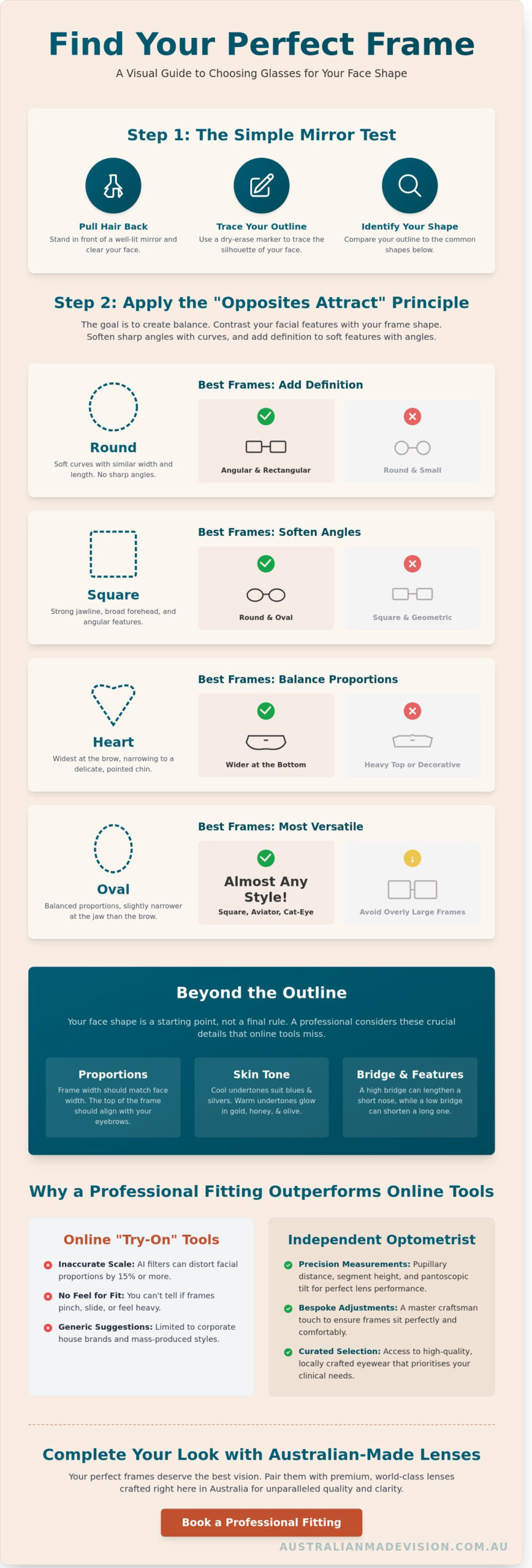
You can identify your shape with a simple mirror test. Stand in front of a well-lit mirror and pull your hair back. Use a bar of soap or an erasable marker to trace the outline of your face onto the glass. This method reveals your true silhouette without the distraction of individual features. To get it right, focus on the three pillars of facial structure: the width of your forehead, the prominence of your cheekbones, and the angle of your jawline.

Most Australians don’t fit perfectly into a single geometric category. We often see “hybrid” shapes, such as a square jawline paired with a softer, rounded forehead. This is why generic charts often fail. Seeking advice from an independent optometrist ensures you get a personalised recommendation that accounts for these subtle nuances. A local expert looks at the person, not just the category.

The Five Primary Face Shapes Explained

  • Oval: These balanced proportions are the most versatile. Most frame styles, from aviators to squares, look natural on an oval face.
  • Round: Characterised by soft curves with similar width and length. Angular, rectangular frames add necessary definition and length.
  • Square: Strong jawlines and broad foreheads define this shape. Round or oval frames help soften these bold features for a balanced look.
  • Heart: Widest at the brow and narrowing to a delicate, pointed chin. Frames that are wider at the bottom help add width to the lower face.
  • Diamond: A rare and dramatic shape with high cheekbones and narrow eyelines. Rimless styles or cat-eye frames highlight the eyes beautifully.

Common Misconceptions About Face Shapes

Your face shape isn’t permanent. It can change over time due to age, dental changes, or lifestyle shifts. A frame that suited you a decade ago might not provide the same balance today. Don’t rely on low-quality AI filters found on social media. These apps often distort facial proportions by 15% or more, leading to poor styling choices. Professional “rules” are actually guidelines. They’re meant to be personalised by an expert who understands the bespoke nature of Australian-made eyewear.

A Guide to Frame Styles for Every Australian Face Shape

Selecting the right eyewear relies on the classic principle that opposites attract. If your face has sharp, defined lines, you need curves to create balance. If your features are soft and circular, you need structure to provide definition. This visual harmony ensures your glasses complement your natural architecture rather than competing with it. When choosing frames for face shape, you’re essentially looking for a counterweight to your natural contours.

Frame thickness is a powerful tool for altering your appearance. Thick, bold acetate frames draw immediate attention to your eyes and can help hide a prominent brow line. Thinner metal frames tend to blend into the face, making them ideal for those who want their features to take centre stage. The bridge design is equally vital. A bridge width difference of just 2 millimetres can change how a frame sits. A high-positioned bridge makes a nose look longer; a lower, darker bridge can visually shorten it.

Your skin’s undertone is just as important as the frame’s physical shape. Australians with cool undertones typically look best in blues, greys, and silvers. If you have a warm undertone, honey, gold, or olive shades will provide a healthy glow. Matching these tones to locally crafted materials ensures your eyewear looks like a natural extension of your personality.

Best Frame Matches for Angular Faces

Square and rectangular faces possess strong jawlines and broad foreheads that benefit from softening. Round or oval eyewear provides a gentle contrast to these sharp angles, creating a more approachable look. Cat-eye frames are particularly effective for lifting the features and drawing the eye upward. If you want to minimise bulk, rimless or semi-rimless styles offer a lightweight alternative that doesn’t overwhelm a strong bone structure.

Contrasting Styles for Rounded Features

Round faces lack natural angles, so the goal is to add structure. Rectangular or geometric frames introduce sharp lines that define full cheeks and a soft chin. Wayfarer styles are a staple for this group because they create a horizontal line that breaks up the circularity of the face. You should avoid oversized round frames. These often mimic the face shape too closely and can make your features appear even more circular than they are.

The Versatility of the Oval and Heart Shape

Oval faces are the most versatile, allowing you to experiment with bold and unconventional shapes. Almost any style works, though you should ensure the frames are at least as wide as the broadest part of your face. Heart shapes, which are wider at the forehead and narrower at the chin, require a different approach. Choose “teacup” styles that are wider at the bottom to add volume to the lower half of your face. Light-coloured or thin-rimmed frames are excellent for avoiding a top-heavy look.

Personalised advice makes the process of choosing frames for face shape much simpler. You can search for independent optometrists who offer bespoke styling services to help you find the perfect Australian-made pair.

Choosing Frames for Face Shape: The 2026 Australian Guide to Perfect Eyewear

Beyond the Outline: Considering Features, Skin Tone, and Proportions

While choosing frames for face shape provides a solid foundation, the silhouette of your jawline is only half the story. True comfort and aesthetic harmony come from the finer details of your anatomy. Professional fitting involves looking at the landmarks of your face to ensure the glasses feel like a natural extension of your person rather than an added weight.

Your pupillary distance (PD) is often more critical for a successful fit than the overall face shape. This measurement, which is the distance between the centres of your pupils, determines where your eyes sit within the lenses. For an average Australian adult, the PD typically ranges between 54mm and 74mm. If a frame is too wide for your PD, your eyes may appear “pinched” toward the nose, which disrupts the visual balance of the glasses. Local experts at an independent optometrist can precisely measure this to ensure your pupils align with the optical centre of the lens.

We also consider the depth of your face. This is the distance from the bridge of your nose to where your ears sit. If this distance is short, standard temple arms may feel cumbersome. Most frames come with temple lengths between 135mm and 150mm. Finding the right length ensures the weight is distributed evenly, preventing the glasses from slipping forward when you lean over or stay active. Your eyebrow position also dictates how a frame “sits.” Ideally, the top rim should follow the curve of your brows without completely hiding them, as this preserves your natural facial expressions.

Understanding Skin Undertones and Frame Colour

Identifying your skin undertone is a masterstroke in styling. Warm undertones look vibrant in gold, honey, tortoise shell, and olive tones. Cool undertones shine in silver, charcoal, or deep blues. Choosing the right palette can make your eyes look brighter and your skin appear more radiant. Neutral tones like matte black or clear crystal are reliable, sophisticated choices for the professional Australian workplace, offering versatility across different outfits.

The Technical Fit: Bridge, Temples, and Weight

We prioritise the “three-point fit” rule for long-term comfort. The frame should only touch your head at the bridge of the nose and behind each ear. A bridge that’s too narrow restricts blood flow and can cause sinus pressure or persistent headaches. Conversely, a bridge that’s too wide will cause the glasses to slide down. Independent practices excel here, as they take the time to manually adjust temple arms to ensure they hug the head securely without creating painful pressure points.

Why Professional Fitting at an Independent Optometrist Outperforms Online Tools

Virtual try-on tools offer a convenient starting point, but they can’t replace the three-dimensional expertise of a local professional. These digital apps rely on flat facial mapping that often misses the subtle contours of your bone structure. An independent optometrist provides a clinical advantage that software simply cannot replicate. They understand how a frame’s weight distributes across your nose and how the temple arms interact with your ears. This ensures your glasses don’t just look good in a selfie; they remain comfortable after ten hours of wear.

Independent practices pride themselves on a curated selection of frames. Unlike large corporate chains that often push high-volume “house brands,” independent boutiques source unique, high-quality pieces that reflect genuine craftsmanship. This variety is essential when choosing frames for face shape because it allows for a more nuanced fit. You aren’t limited to a handful of mass-produced designs. Instead, you have access to locally crafted and internationally sourced frames that prioritise durability and aesthetic integrity.

The Personalised Care Factor

A one-on-one styling session is a collaborative process between you and an expert who understands your daily life. They don’t just look at your jawline; they ask about your hobbies, your work environment, and how often you’re outdoors. This holistic approach leads to much higher long-term satisfaction. Research from various Australian optical surveys suggests that nearly 20% of people who buy glasses online experience issues with fit or prescription accuracy. You can avoid these pitfalls and support your community when you find an independent optometrist who takes the time to get the details right.

Bespoke Adjustments for Longevity

Human faces are rarely perfectly symmetrical. One ear might sit slightly higher than the other, or the bridge of your nose might have a unique slope. Online retailers ship “one-size-fits-all” products that frequently lead to frustration. An expert practitioner uses manual frame manipulation to tailor the fit to your specific anatomy. This includes adjusting the “pantoscopic tilt,” which is the vertical angle at which the lenses sit in front of your eyes. Proper tilt is vital for clear vision, especially with complex multifocal prescriptions.

  • Vertex Distance: Professionals measure the exact gap between your eye and the lens to prevent distortion.
  • Frame Alignment: Manual tweaks ensure the frames don’t slide down your nose during activity.
  • Vision Optimisation: Precise measurements mean your pupils align perfectly with the “sweet spot” of the lens.

Before you commit to a new look, it’s vital to ensure your eye health is managed. Scheduling a comprehensive eye exam ensures your prescription is pinpoint accurate before you begin choosing frames for face shape. This professional foundation prevents the “buyer’s remorse” that often follows an unadjusted online purchase. By choosing an independent provider, you’re investing in your own vision and the strength of the Australian eyecare industry.

Ready to experience the difference of a professional, local fitting? Search our directory to find a trusted independent optometrist near you.

Completing the Look: Pairing Your Frames with Premium Australian-Made Lenses

While choosing frames for face shape helps you look your best, the lenses you place inside them determine how you see the world. Think of the frame as the body of a luxury vehicle and the lenses as the engine. You wouldn’t put a lawnmower motor in a high-performance car; similarly, a beautiful frame deserves high-precision optics. Locally manufactured lenses offer a level of quality control that mass-produced imports simply cannot match. When you choose Australian-made, you’re investing in bespoke surfacing that follows strict national standards for optical clarity.

Opting for local manufacturing also means faster turnaround times. Overseas labs often require 10 to 14 days for shipping and customs clearance. In contrast, independent Australian labs frequently deliver finished spectacles to your optometrist within 3 to 5 business days. This speed doesn’t compromise quality. It actually enhances it by allowing for direct communication between your local practitioner and the technicians crafting your vision.

Matching Frame Depth to Lens Type

Your choice of frame must align with your clinical needs. For example, progressive lenses usually require a minimum frame depth of 28mm to 30mm. This space ensures there is enough room for the distance, intermediate, and reading zones to sit comfortably within your line of sight. If a frame is too shallow, your reading area might be cut off, leading to significant neck strain and visual fatigue.

  • High-Index Lenses: These allow for thinner, lighter results in larger frames. They’re essential if you have a high prescription but want to avoid the “coke-bottle” look.
  • Anti-Reflective Coatings: These coatings reduce glare and make the lenses nearly invisible. They ensure people see your eyes rather than reflections on the glass.
  • Synergy of Design: Once you finish choosing frames for face shape, the final step is ensuring those frames are fitted with lenses that match your lifestyle.

The Ethics of Local Manufacturing

Choosing Australian-made lenses is a choice for sustainability. International shipping from major lens hubs can involve over 15,000 kilometres of air travel, creating a substantial carbon footprint. By sourcing your lenses from a local lab, you drastically reduce “lens miles” and support the domestic manufacturing sector. This keeps skilled jobs in our communities and ensures the longevity of the Australian optical industry.

Bespoke surfacing in local labs results in superior optical clarity because the lenses are tailored to your specific frame wrap and tilt. This level of customisation is often lost in bulk international orders. We encourage you to visit an independent practice that values this level of craftsmanship. You can find a dedicated professional near you by searching our directory of independent optometrists. Supporting these local experts ensures you receive personalised care and a product that is truly made for you.

Experience the Precision of Personalised Eyewear

Your eyewear is more than a medical necessity; it’s a reflection of your personal style and local heritage. While choosing frames for face shape provides a solid foundation, the final result depends on the nuanced adjustments only a professional can provide. Independent optometrists across Australia offer the bespoke attention your vision deserves, ensuring your new glasses feel as good as they look from day one.

By choosing local, you’re supporting the high-quality craftsmanship of Australian-made lenses and the expertise of dedicated clinicians. These professionals look beyond basic outlines to consider your skin tone and unique facial proportions. They ensure every pair is perfectly adjusted for long-term comfort, a standard that digital tools simply cannot replicate. This commitment to quality keeps our local industry thriving while providing you with superior optical clarity.

Ready to find your ideal pair? Find your nearest independent optometrist for a professional frame fitting and experience the difference of personalised care. Your eyes will thank you for the authentic quality and community-focused service that defines our national vision standards. Step out with confidence knowing your look is as unique as your own story.

Frequently Asked Questions

How do I know what my face shape is for glasses?

You can determine your face shape by tracing the outline of your face on a mirror with a bar of soap or by examining a straight-on photo of yourself. Focus on the proportions of your forehead, cheekbones, and jawline to see which area is widest. Approximately 60 percent of people find their face fits into one of five categories: oval, round, square, heart, or diamond.

Independent optometrists provide a personalised consultation to help identify these nuances. They use their clinical expertise to ensure your bespoke frames enhance your natural features while supporting the local Australian eyewear industry.

Can I wear round glasses if I have a round face?

You can wear round glasses on a round face, but styling experts typically recommend rectangular or square frames to provide a more balanced look. Adding sharp angles helps define your features by providing a direct contrast to softer facial curves. In a 2023 review of Australian eyewear trends, angular frames remained the preferred choice for those seeking to add structure to their profile.

Choosing a frame that contrasts with your face shape creates a more harmonious appearance. If you prefer a softer look, consider a “pro-round” shape that has slightly flattened edges to offer the best of both worlds.

Do big frames look good on small faces?

Large frames often overwhelm small faces, so it’s vital to choose a size that doesn’t hide your eyebrows or rest heavily on your cheeks. A frame should ideally be 2 to 3 millimetres wider than your face at the temples for a balanced appearance. If the frame is too wide, it can make your eyes look closer together, which disrupts your facial symmetry.

Local Australian artisans specialise in crafting smaller, high-quality frames that offer a bold look without sacrificing a proper anatomical fit. Visiting an independent practice allows you to access these unique, smaller-scale designs that corporate chains often overlook.

What glasses make you look younger?

Frames with an upswept shape, such as a subtle cat-eye, often make you look younger by drawing the viewer’s eye upwards. Choosing warm colours like tortoiseshell, burgundy, or honey can also add a healthy glow to your complexion compared to harsh black frames. Research into facial aesthetics suggests that lifting the visual focus can reduce the appearance of sagging in the lower third of the face.

Avoid heavy frames that sit low on the nose, as these can emphasise fine lines. A bespoke, lightweight frame from a local maker provides a sophisticated, modern aesthetic that feels fresh and energetic.

Why do my glasses always slip down my nose?

Glasses usually slip down the nose because the bridge is too wide or the temple arms haven’t been adjusted to grip correctly behind your ears. This is a common issue for the 15 percent of Australians with a low nose bridge who may require specific bridge designs or adjustable nose pads. Precision in manufacturing is essential to prevent this constant annoyance.

Your local independent optometrist can perform a professional adjustment to ensure your frames stay perfectly in place. They take the time to measure your unique anatomy, ensuring your Australian-made eyewear remains comfortable throughout the day.

Does face shape matter for sunglasses too?

Face shape is just as important for sunglasses because the larger lens size can easily amplify or clash with your facial proportions. Since Australians face some of the highest UV levels globally, choosing frames for face shape helps ensure your sunnies provide maximum coverage without leaving gaps for light to enter. A well-fitted pair of sunglasses combines vital clinical protection with a style that complements your heritage.

The same rules of contrast apply here; square faces look excellent in rounder aviators, while round faces benefit from wayfarer styles. Quality Australian-made sunglasses are designed to withstand our harsh conditions while keeping you looking your best.

What is the best frame for an oval face?

The best frames for an oval face are those that are as wide as, or slightly wider than, the broadest part of the face. Since oval faces are naturally balanced, you have the freedom to experiment with almost any shape, including bold geometric squares or classic walnut shapes. This versatility allows you to support local industry by choosing from a wider variety of unique, locally crafted designs.

While most styles work, avoid frames that are too narrow or excessively deep, as these can break the natural symmetry of an oval profile. Your independent optometrist can help you select a pair that maintains this ideal balance.

How do I choose the right frame size?

To choose the right frame size, check the three measurements usually printed inside the temple arm, which represent lens width, bridge width, and temple length in millimetres. For example, a “52-18-140” indicates a 52mm lens width. Ensuring these numbers match your facial dimensions is a key step in choosing frames for face shape that feel comfortable for all-day wear.

A proper fit ensures the pupils are centred in the lenses, which is critical for your visual clarity and eye health. Independent practices offer a broader range of sizes and bespoke options, ensuring you don’t have to settle for a “one size fits all” corporate alternative.

Disclaimer

The information in this article is provided for general educational purposes only and should not be considered medical advice. For personalised advice regarding your vision or eye health, please consult a qualified optometrist.

Australian Made Vision is an independent directory that helps patients find optometrists across Australia who may offer Australian-made spectacle lenses. We do not provide clinical services and recommend contacting practices directly to confirm the products and services they offer.