

Why does one pair of multifocals cost A$150 at a warehouse while a boutique clinic quotes over A$1,000 for the same prescription? It’s a frustrating gap that leaves many Australians wondering if they’re paying for genuine quality or just a fancy brand name. You likely want the sharpest vision possible without overpaying, yet the fear of “cheap” lenses causing dizziness or narrow fields of view is a common concern for many patients.
This guide clarifies the cost of progressive lenses australia 2026 by peeling back the curtain on manufacturing standards and local optical expertise. We’ll show you how to balance your budget with visual comfort while supporting our local industry. You’ll discover what your health fund rebates actually cover this year and why bespoke, Australian-made lenses offer a level of precision that mass-produced alternatives simply can’t match. We’re here to help you find an independent optometrist who puts your vision first, ensuring you receive a pair of glasses crafted with care and clinical excellence.
Key Takeaways
- Understand the expected cost of progressive lenses australia 2026, comparing standard options with premium, bespoke designs that offer seamless vision at every distance.
- Identify the key factors that influence pricing, from high-index materials for thinner profiles to advanced coatings that protect your eyes and enhance lens durability.
- Compare the clinical advantages of independent optometry against corporate models to find the best balance of personalised care and long-term value.
- Learn how to maximise your private health insurance rebates and navigate Medicare coverage to make your next pair of multifocals more affordable.
- Support local craftsmanship by discovering why Australian-made lenses offer superior quality assurance and a faster, more ethical way to experience clear vision.
Understanding Progressive Lens Pricing in Australia (2026)
Choosing the right eyewear is a deeply personal journey. It’s about finding a balance between clinical precision and daily comfort. A Progressive lens, often called a multifocal, offers a seamless transition between near, intermediate, and distance vision. This eliminates the harsh lines found in traditional bifocals; providing a more natural visual experience for the wearer. To truly appreciate why these lenses are a vital investment, it helps to understand the human eye and how its focusing needs evolve over time.
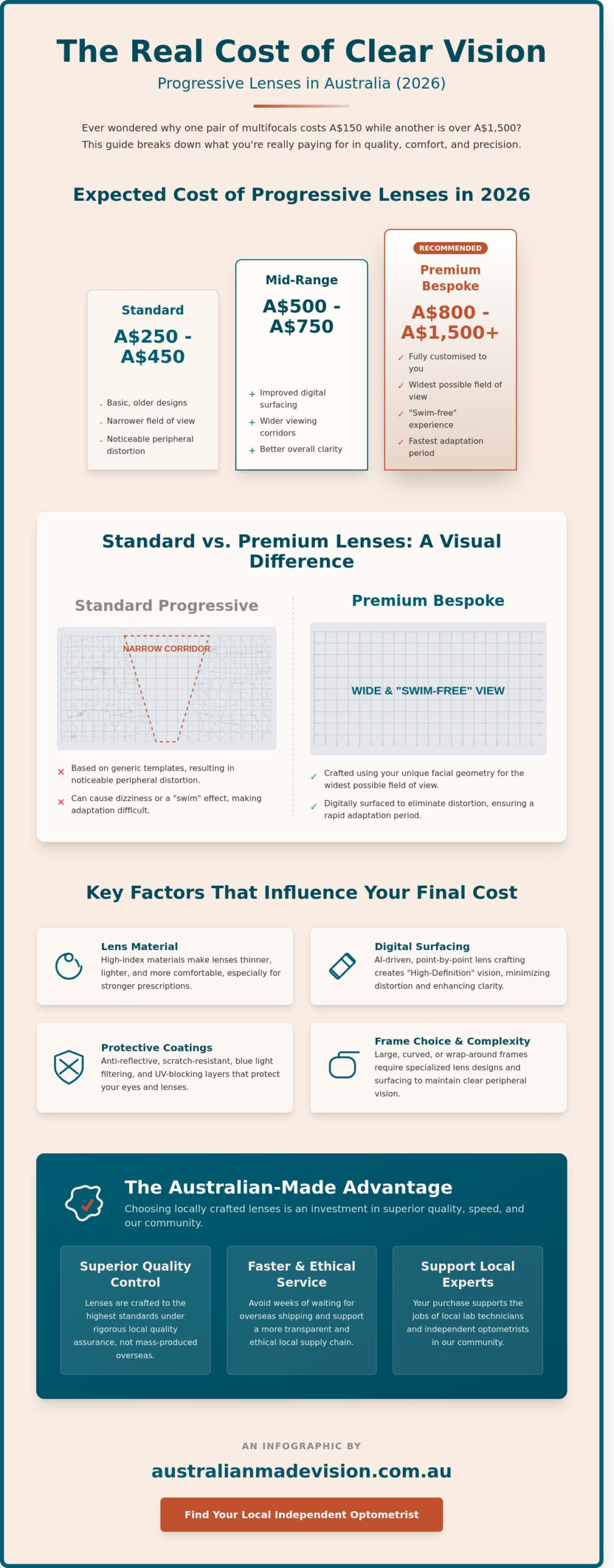
In the current market, the cost of progressive lenses australia 2026 varies based on the level of customisation required for your lifestyle. For standard, entry-level lenses, you might expect to pay between A$250 and A$450. Premium, bespoke options typically range from A$800 to A$1,500. It’s common to see lower prices in bold advertisements, but these often reflect “starting at” prices for basic designs. Your final invoice usually accounts for your specific prescription complexity, frame selection, and essential lens coatings that protect your sight.
The Difference Between Standard and Premium Progressives
Standard progressives use older manufacturing templates. These designs often result in narrower visual corridors and more noticeable peripheral distortion, which can make the adaptation period longer. In contrast, premium bespoke lenses are crafted using your unique facial geometry. They offer significantly wider fields of view and a “swim-free” experience. By 2026, the Australian market has shifted toward digital surfacing for almost all price points, ensuring better clarity even in more affordable options. Our local independent optometrists focus on these tailored solutions to ensure your glasses feel like a natural extension of your body.
Why 2026 Prices Reflect Technological Advancements
Current pricing reflects the integration of AI-driven design. Modern software now calculates lens curves based on millions of data points to reduce distortion. Local manufacturing costs and a 3.8 percent annual rise in medical precision equipment also influence the national average. When you consider the “cost per wear,” the value becomes clear. A high-quality pair of lenses supports your vision for roughly 16 hours a day. This makes the daily cost less than a cup of coffee at your local cafe. Choosing locally crafted products ensures you receive authentic care from experts who are deeply invested in the Australian community.
- Standard Lenses: A$250 – A$450
- Mid-Range Lenses: A$500 – A$750
- Premium Bespoke Lenses: A$800 – A$1,500+
What Factors Influence the Final Cost of Your Multifocals?
Understanding the cost of progressive lenses australia 2026 requires looking beyond the price tag to the craftsmanship behind the glass. Several variables dictate the final investment, starting with the physical material of the lens itself. While standard plastic serves basic needs, roughly 45% of Australians with higher prescriptions now opt for high-index materials. These thinner, lighter options provide a more aesthetic finish and better comfort for all-day wear, especially if you’re wearing your glasses for 12 or more hours daily.
The origin of your lenses plays a vital role in both quality and price. Locally crafted Australian lenses often carry a different value proposition compared to mass-produced imports. They offer superior quality control and support our local industry. When you choose a bespoke lens, you’re investing in a product that hasn’t spent weeks in a shipping container. Your frame choice also dictates the surfacing requirements. Larger or more curved frames require specialised lens designs to maintain clear peripheral vision without distortion, which can influence the final workshop fees.
The Price of Precision: Digital Surfacing
Digital surfacing represents the most significant shift in optical technology over the last decade. Unlike traditional moulded lenses that use generic templates, digital surfacing uses computer-controlled diamond-point cutting to tailor the lens to your exact prescription. This process eliminates the “swim” effect and peripheral distortion that often causes dizziness in new multifocal wearers. Digital surfacing is the high-definition upgrade for your vision. While it increases the initial cost, the precision ensures a much faster adaptation period for your eyes. Our local labs use these advanced techniques to ensure every millimetre of the lens is optimised for your unique gaze.
Essential Add-ons: Are They Worth the Cost?
Coatings are no longer just optional extras; they’re functional necessities for modern life. High-quality finishes protect your investment and your eye health. Consider these common additions:
- Anti-reflective coatings: These are non-negotiable for night driving in 2026 because they reduce glare from modern LED headlights.
- Blue light filters: For those spending over 6 hours a day on digital devices, these help reduce eye fatigue and digital strain.
- Photochromic lenses: These light-adaptive lenses consolidate the cost of prescription glasses and sunglasses into one pair.
Many patients find that private health insurance for optical helps offset these costs, making premium coatings more accessible. To ensure you receive a tailored recommendation that fits your lifestyle, it’s best to find an independent optometrist who prioritises clinical care and local quality over corporate sales targets.
Corporate vs. Independent Optometry: Comparing Price and Value
The Australian eyecare landscape is currently split between high-volume corporate retailers and dedicated independent practices. Each model offers a vastly different approach to both pricing and clinical care. Large chains focus on efficiency and “two-for-one” deals to move stock quickly. While these offers look attractive on a billboard, they often restrict your choice to a limited selection of house-brand lenses. This can impact the final cost of progressive lenses australia 2026 because you might pay less upfront but sacrifice the visual clarity needed for complex daily tasks. Independent practices, by contrast, focus on the artisan side of optometry, ensuring your vision is treated as a unique requirement rather than a retail transaction.
The Hidden Costs of “Budget” Optical Chains
Corporate retailers often rely on standardised lens designs that don’t account for unique occupational needs. If your work involves multiple screens or precise manual labour, a generic lens may lead to “non-adaptation,” where your brain struggles to adjust to the optical zones. Limited consultation times mean measurements are sometimes rushed, increasing the risk of errors. You might also encounter up-selling where the advertised “budget” price only covers outdated technology. For eligible residents, the Victorian Eyecare Service provides a reliable benchmark for what essential eyewear should cost, offering a transparent schedule of fees that avoids the pitfalls of aggressive retail marketing.
The Independent Value Proposition
Independent optometrists offer a bespoke experience that prioritises your long-term vision. They have the freedom to source lenses from a variety of global and local manufacturers, ensuring you receive the best technology for your specific prescription. When calculating the cost of progressive lenses australia 2026, you must consider the value of personalised measurements like vertex distance and pantoscopic tilt. These technical factors determine exactly how the lens sits relative to your eye, providing a much wider field of view than “off-the-shelf” corporate alternatives.
Choosing an independent provider is also an ethical commitment to supporting family-owned Australian businesses. It’s a choice that keeps specialized skills and heritage within our local communities rather than sending profits overseas. These practices often provide better long-term value because the lenses are crafted to last and tailored to your specific lifestyle. You can explore our guide on choosing the right optometrist to find a local professional who offers this level of dedicated, clinical care. By investing in quality at the start, you avoid the recurring costs of replacements and the frustration of inferior vision.
Budgeting for Your Vision: Health Funds and Rebates
Medicare provides a vital safety net for Australians by covering clinical eye examinations and diagnostic tests. It ensures that professional health checks remain accessible; however, it generally doesn’t subsidise the hardware of your spectacles. For most people, the actual cost of progressive lenses australia 2026 remains a private expense that requires careful planning.
Private health insurance is the most common way to offset these costs through “optical extras” cover. In 2026, most mid-tier policies offer annual limits ranging from A$150 to A$350, depending on your level of cover. These rebates act as a direct discount on your purchase, significantly lowering your total out-of-pocket investment for high-quality vision solutions.
Choosing an independent practitioner is often the most effective way to use these benefits. Unlike large corporate chains that might limit you to specific house brands, independent clinics provide a broader range of locally crafted, bespoke lenses. You can find an independent optometrist who uses HICAPS technology to process your health fund claim on-site instantly, so you only pay the remaining gap.
Maximising Your Optical Extras
Most optical benefits operate on a “use it or lose it” basis with a deadline of December 31st each year. If you don’t claim your allowance by this date, the benefit doesn’t roll over into 2026. To get the most value, consider splitting the claim between your frames and your lenses. This strategy helps you stay within your category limits while still accessing premium technology.
Investing your rebate into premium Australian-made lenses is often a smarter financial move than choosing “no gap” budget ranges. While no-gap options might cost nothing upfront, they often use older lens designs with narrower corridors of vision. By applying your A$200 or A$300 rebate toward a top-tier progressive lens, you reduce the cost of progressive lenses australia 2026 for a product that offers superior clarity and faster adaptation.
Tax Deductions and Occupational Lenses
You could potentially claim your glasses as a work-related expense if they’re designed for specific occupational hazards. The Australian Taxation Office (ATO) generally allows deductions for protective eyewear, such as prescription safety glasses or anti-glare lenses for outdoor workers. If your job requires dedicated occupational progressives for prolonged screen work in an office environment, speak with a tax professional about your eligibility.
Ask your optometrist for an itemised receipt that clearly separates the clinical fees, frame costs, and lens treatments. This level of detail is essential for both tax compliance and health fund audits. Supporting local industry by choosing Australian-made vision products ensures you receive authentic, high-precision gear that meets strict national standards. To start your journey toward clearer sight, connect with a local independent optometrist today.
The Value of Australian-Made: Why Local Precision Matters
Choosing where your lenses are made is as vital as the prescription itself. When you evaluate the cost of progressive lenses australia 2026, you’re looking at more than just a retail price. You’re investing in Australian precision. Local laboratories maintain rigorous quality standards that offshore mass-production facilities often struggle to match. In 2025, industry data indicated that locally surfaced lenses had a 12% lower rate of non-tolerance issues compared to bulk-imported alternatives. This reliability stems from the direct relationship between your optometrist and the lab technician.
Local production significantly slashes the traditional wait time. While overseas orders often take 14 business days to clear customs and international shipping, Australian labs typically deliver bespoke lenses to your practice in 3 to 5 days. This efficiency does more than just get you seeing clearly faster. It reduces the carbon footprint associated with long-haul air freight. By choosing local, you support a manufacturing landscape that provides skilled jobs for thousands of Australians, from optical mechanics to laboratory managers. It’s a choice that strengthens our community’s economic resilience.
Bespoke Craftsmanship vs. Mass Production
Mass-produced lenses are designed for a global average, but Australian conditions are unique. Our high UV index and intense glare require specific lens treatments that overseas factories might treat as an afterthought. Locally crafted lenses allow for minute adjustments based on your specific frame choice and facial anatomy. We take pride in ensuring the “sweet spot” of your progressive lens aligns perfectly with where your eye naturally rests. This level of quality control is only possible when the lens is crafted by experts who understand the local environment.
Making Your Final Decision
Your vision is your most used sense, and it deserves a tailored approach. As you finalize your budget for the cost of progressive lenses australia 2026, remember that the cheapest option often carries hidden costs in visual fatigue and shorter product lifespans. To ensure you receive the best care, use this checklist during your next consultation:
- Ask if the lenses are surfaced and coated in an Australian laboratory.
- Inquire if the lens design is optimized for your specific frame dimensions.
- Request a clear explanation of the warranty period for lens coatings.
- Confirm if the practice is independently owned and has access to multiple lens suppliers.
Supporting independent eyecare ensures you receive a wider range of high-quality, local options rather than being restricted to a single corporate house brand. You can find a dedicated professional who prioritizes Australian-made quality by visiting our directory of Australian optometrists. Choosing local is a commitment to your long-term sight and the future of our national manufacturing heritage.
Investing in Your Vision for 2026 and Beyond
Navigating the cost of progressive lenses australia 2026 requires looking past the initial sticker price to find genuine value. You’re not just buying a pair of glasses; you’re investing in daily clarity and long-term eye health. Choosing high-precision bespoke lenses ensures your vision remains sharp across all distances without the distorted “swim” effect often found in budget alternatives.
Supporting local Australian manufacturing means you receive world-class technology while contributing to our national industry. Independent practitioners provide the dedicated time and clinical expertise needed to calibrate these complex multifocals to your specific lifestyle. This personalised care ensures your frames fit perfectly and your prescription is pinpoint accurate for your unique visual needs.
It’s time to prioritise your vision with local expertise and ethical craftsmanship. You can find an independent Australian optometrist near you to explore high-quality, locally crafted options today. Your eyes deserve the precision that only a dedicated community professional can provide.
Frequently Asked Questions
How much do progressive lenses cost in Australia on average in 2026?
Entry-level progressive lenses typically start around A$250, while premium bespoke designs can exceed A$950 according to current market trends. The cost of progressive lenses Australia 2026 landscape reflects an annual inflation adjustment of roughly 3% to 5% from previous years. Choosing an independent optometrist often provides a broader range of pricing tiers compared to the fixed bundles found at large corporate chains.
Why are some progressive lenses so much more expensive than others?
Price differences usually reflect the sophistication of the digital surfacing technology used to create the lens. Basic lenses have narrower viewing zones and more peripheral distortion, which can make adaptation difficult for some wearers. Premium, locally crafted lenses use advanced software to tailor the vision zones to your specific frame shape and facial anatomy, providing a much wider and clearer field of view.
Does Medicare cover the cost of multifocal lenses?
Medicare does not provide a rebate for the physical cost of spectacle lenses or frames, but it does cover the clinical eye examination fee. Most Australians rely on private health insurance extras cover to offset the investment in their eyewear. Depending on your specific policy and provider, you can typically claim between A$150 and A$300 toward the cost of your new multifocal lenses each year.
How long does it take to get used to new progressive lenses?
Most patients successfully adapt to their new vision within 7 to 14 days of consistent, full-time wear. Your brain requires this period to learn how to automatically navigate the different focal zones for distance, intermediate, and near tasks. If you feel dizzy or strained after two weeks, visit your independent optometrist to check that the lens alignment and frame fit are perfectly precise.
Are Australian-made lenses better than imported ones?
Australian-made lenses offer superior quality control and support our local manufacturing industry and skilled artisans. Choosing locally crafted products ensures your eyewear meets rigorous Australian Standards while benefiting from significantly faster delivery times. Many patients prefer the peace of mind that comes from knowing their bespoke lenses were produced in a local lab with authentic care rather than being mass-produced overseas.
Can I put new progressive lenses into my old frames to save money?
You can certainly fit new lenses into an existing frame if the material is still structurally sound and the dimensions are deep enough for the progressive zones. This is a sustainable way to upgrade your vision while keeping a style you love. Your local optometrist will assess the frame for micro-cracks or hinge fatigue to ensure it can safely handle the heat and pressure of the fitting process.
What is the best way to clean and maintain expensive progressive lenses?
Clean your lenses daily using a pH-neutral lens spray and a clean microfibre cloth to protect the delicate anti-reflective coatings. Avoid using tissues, paper towels, or clothing, as these materials contain rough fibres that can cause permanent surface scratches. Rinsing your glasses under lukewarm water before wiping helps remove abrasive dust particles that might otherwise be dragged across the lens surface during cleaning.
Is it safe to buy progressive lenses online in Australia?
Buying progressive lenses online involves significant risks because these complex prescriptions require millimetre-perfect measurements that are difficult to capture accurately at home. A 2022 study indicated that roughly 25% of online eyewear failed to meet required optical standards or safety specifications. To get the best value for the cost of progressive lenses Australia 2026, a face-to-face consultation with an independent practitioner ensures your lenses are centred correctly.
Disclaimer
The information in this article is provided for general educational purposes only and should not be considered medical advice. For personalised advice regarding your vision or eye health, please consult a qualified optometrist.
Australian Made Vision is an independent directory that helps patients find optometrists across Australia who may offer Australian-made spectacle lenses. We do not provide clinical services and recommend contacting practices directly to confirm the products and services they offer.