
What if the persistent headache you feel every afternoon at 3:00 PM isn’t a result of your workload, but a direct response to the invisible high-energy light radiating from your workstation? You likely feel that the dull ache and dry, itchy eyes that follow a long day of screen time have become an accepted tax on our digital lives. Investing in high-quality blue light glasses is no longer just a lifestyle trend; it’s a vital step toward protecting your long-term ocular health and restoring your natural sleep-wake cycle in 2026.
We believe you deserve better than the mass-produced, one-size-fits-all solutions often found in corporate chains. In this guide, you’ll discover the clinical science behind light filtration and about lenses offer the ultimate protection for your unique digital lifestyle. We’ll explore how to identify authentic quality, the benefits of choosing an independent optometrist, and how to reclaim your visual comfort while supporting our local manufacturing heritage.
Key Takeaways
-
Understand how High-Energy Visible (HEV) light impacts your digital well-being and why modern screen habits require specific visual protection.
-
Learn the technical difference between surface coatings and in-material monomers to ensure your blue light glasses provide genuine visual comfort.
-
Discover why locally crafted, Australian-made lenses offer superior optical clarity and quality control compared to mass-produced online alternatives.
-
Recognise why a comprehensive eye exam with an independent optometrist is the essential foundation for a bespoke prescription that supports your eye health.
-
Empower your digital lifestyle by choosing ethical, precision-engineered eyewear that reduces visual noise and enhances contrast for long-term screen use.
Table of Contents
What Are Blue Light Glasses and Why Do We Need Them?
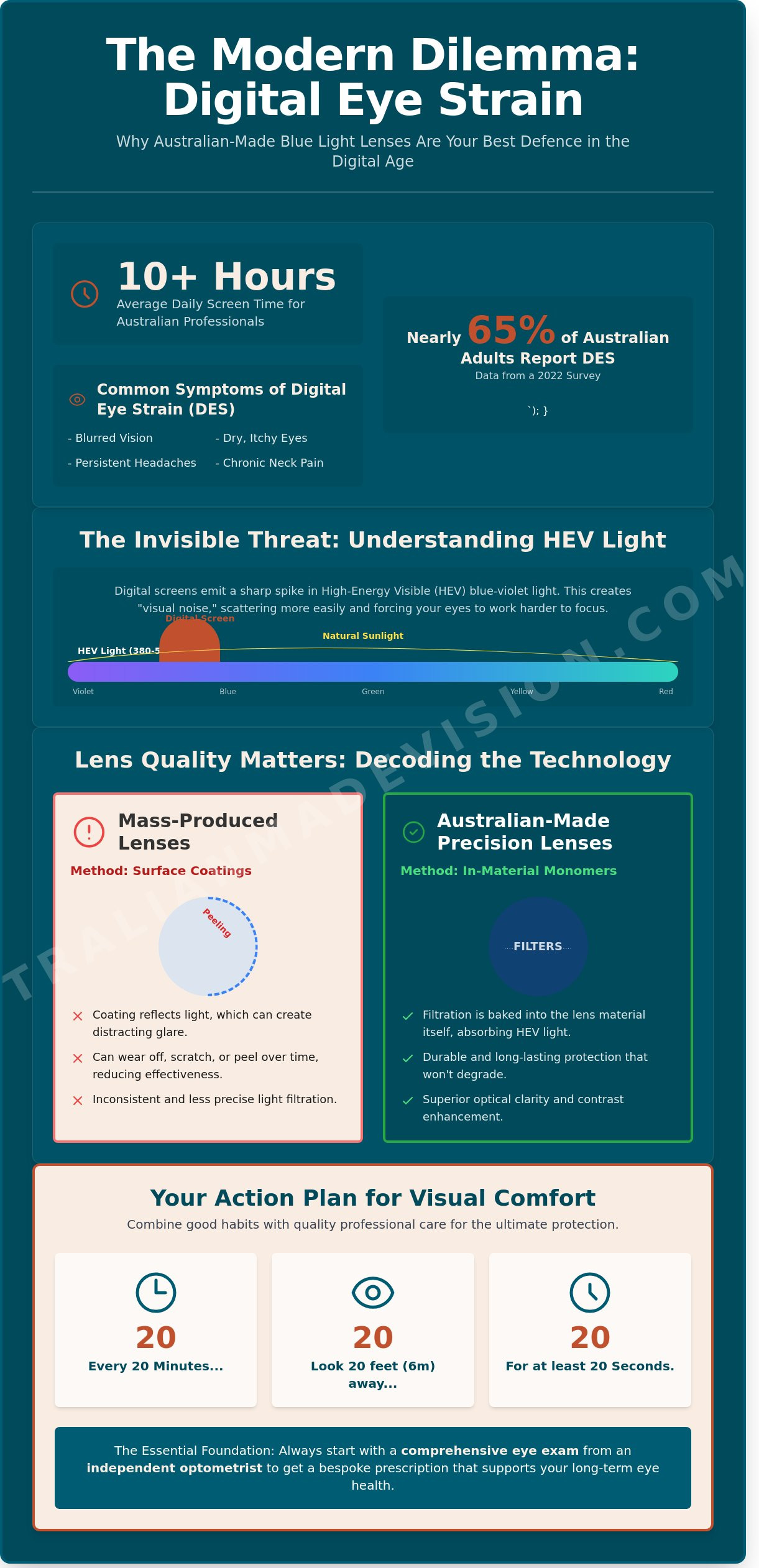
Australians are spending record amounts of time in front of digital devices. Recent workplace data from 2023 indicates that the average professional now clocks over 10 hours of screen time daily. This shift has fundamentally changed how we view eye health and the tools required to protect it. To meet this modern challenge, blue light glasses have emerged as a vital accessory for the office and the home. These are specialised spectacles designed to filter out High-Energy Visible (HEV) light before it reaches your eyes, helping to maintain comfort during long sessions at a workstation.
It’s a common misconception that all blue light is the same. Our sun provides a natural source of this light, which helps regulate our sleep cycles and boosts our mood during the day. However, our eyes weren’t built for the concentrated, artificial blue light emitted by LED screens and modern office lighting. While sunlight offers a full, balanced spectrum, digital devices emit a sharp spike in specific wavelengths. As a brand that values authentic, locally crafted solutions, we believe it’s essential to understand how these artificial sources impact your daily well-being.
The Rise of Digital Eye Strain in Australia
A 2022 survey found that nearly 65% of Australian adults report symptoms of Digital Eye Strain (DES). These issues often manifest as blurred vision, persistent dry eyes, and even chronic neck pain from leaning toward monitors. Our eyes find it much harder to focus on digital pixels compared to printed text on a page. Pixels lack the sharp contrast and defined edges of physical ink, forcing our ciliary muscles to work overtime to maintain a clear image. This constant micro-adjustment leads to the fatigue many of us feel by 3:00 PM.
To manage this effectively, we recommend the 20-20-20 rule as a standard part of your routine. Every 20 minutes, you should look at something 6 metres away for at least 20 seconds. Combining this habit with quality optical protection provides a comprehensive approach to eye wellness. Independent optometrists often suggest this dual approach because it addresses both the physical habits and the environmental stressors of the modern workplace. Choosing bespoke lenses ensures you’re getting a product tailored to your specific visual needs rather than a mass-produced, one-size-fits-all solution.
Understanding the Blue Light Spectrum
The light spectrum is complex, containing both beneficial and harmful segments that affect us in different ways. Blue-turquoise light is generally considered helpful for our circadian rhythms and cognitive function. On the other end, blue-violet light is the more energetic, potentially irritating portion that screens tend to over-index on. HEV light is the high-frequency band between 380 and 500 nanometres. For those seeking deeper technical details, The Science of Visual Comfort: How Blue Light Lenses Work explains how modern coatings interact with these specific wavelengths to reduce glare.
By choosing locally crafted lenses, you ensure your blue light glasses are manufactured to high standards that filter the right frequencies while maintaining colour clarity. We take great pride in the precision required to create these coatings right here in Australia. Supporting local manufacturing means your lenses are created with an ethical commitment to quality. This ensures your vision remains sharp and your eyes feel rested, whether you’re finishing a report or catching up on news. Trusting a local master of the craft means you’re getting expert care that corporate chains simply can’t replicate.
The Science of Visual Comfort: How Blue Light Lenses Work
Understanding the technology behind blue light glasses requires a look at how light interacts with the eye. Most people don’t realise that there are two primary ways to create these lenses. First, we have surface coatings. These are thin layers applied to the lens that reflect specific wavelengths away from the eye. Second, and often more robust, are in-material monomers. These are special molecules baked directly into the lens material during the manufacturing process. This local, precision-focused approach ensures the filtration doesn’t wear off over time.
By filtering these wavelengths, we reduce what optometrists call visual noise. Blue light has a shorter wavelength and scatters more easily than other colours. This scattering creates a hazy effect on digital screens, forcing your eyes to work harder to maintain focus. High-quality lenses improve contrast, making text appear sharper and reducing the effort required for long hours of screen work. Research from 2022 suggests that reducing this scatter can help alleviate the symptoms of digital eye strain for up to 65% of regular computer users.
Filtering vs. Blocking: Finding the Right Balance
A common mistake is thinking that more blocking is always better. In reality, blocking 100% of blue light is detrimental to your daily life. We need certain blue-turquoise light frequencies to regulate our mood and cognitive function during daylight hours. Total blockage often results in a heavy, distracting yellow tint that distorts colour perception and makes the world look unnatural. This is why our locally crafted lenses focus on selective filtration instead.
Professional-grade lenses maintain a natural colour balance while targeting the specific high-energy violet-blue light that causes discomfort. We also combine this with premium anti-reflective coatings. These coatings eliminate the harsh glare from office lights and monitors, which is a major contributor to digital eye strain. By combining these technologies, we achieve a lens that is clear to the eye but effective against screen-related fatigue.
The Melatonin Connection and Sleep Hygiene
Our bodies rely on light cues to manage our internal clocks. When the sun goes down, our brains produce melatonin to prepare us for rest. However, the artificial light from our devices can trick the brain into thinking it’s still midday. This disruption can delay sleep onset by as much as 30 to 60 minutes. Research into What Are Blue Light Glasses and Why Do We Need Them? shows that evening exposure significantly suppresses melatonin release, leading to poorer sleep quality.
Wearing blue light glasses in the 2 to 3 hours before bed can help mitigate this disruption. It’s a simple way to protect your sleep cycle without having to give up your devices entirely. Of course, glasses are just one part of a healthy routine. They work best alongside other habits like dimming house lights and setting consistent wake-up times to support your natural rhythm.
Choosing the right pair involves more than just picking a frame off a shelf. It’s about finding a solution tailored to your specific lifestyle and visual needs. You can find a local independent optometrist who understands the value of bespoke, high-quality Australian eye care to help you make the right choice for your vision and your health.
Professional Lenses vs. Cheap Online Alternatives
Choosing between a pair of A$20 spectacles from a social media advertisement and professional blue light glasses from an independent clinic is like comparing a toy car to a precision-engineered vehicle. Most budget alternatives are manufactured using injection-moulded plastic. This high-speed process often leaves internal stresses within the material, creating subtle distortions that your brain must constantly work to filter out. In contrast, professional-grade lenses are crafted from high-index monomers that offer superior light transmission and edge-to-edge clarity.
The "gimmick" reputation surrounding blue light technology often stems from these low-grade materials. If a lens features a heavy yellow tint but lacks optical precision, it won’t effectively solve digital eye strain. It might actually exacerbate the issue by forcing your eyes to struggle with blurred images. Independent Australian optometrists provide bespoke lenses that filter specific harmful wavelengths while maintaining a natural colour balance. This ethical approach ensures you’re investing in a genuine medical device rather than a disposable accessory.
Optical misalignment, known as induced prism, is a common culprit behind the failure of cheap eyewear. This occurs when the optical centre of the lens doesn’t align perfectly with your pupil. It forces your eye muscles to pull in unnatural directions to keep your vision single and clear. Within 30 minutes of use, this unnecessary strain often triggers tension headaches and significant fatigue. Premium Australian lenses eliminate this risk through individualised measurements taken by a qualified professional to ensure the "sweet spot" of the lens is exactly where you need it.
Durability is another area where local quality shines. Cheap online coatings often begin to craze, crack, or peel within 90 days of regular use. These budget layers are often "dipped" rather than bonded. In contrast, premium Australian-made coatings are applied in vacuum-sealed environments using ion-assisted deposition to ensure a permanent molecular bond. These layers provide superior scratch resistance and anti-static properties, meaning you spend less time cleaning your lenses and more time focused on your work.
Our local labs focus on longevity rather than disposability. By using sophisticated multi-layered technology, these lenses repel dust, water, and grease. You won’t find yourself constantly rubbing the lenses with your shirt, which is the fastest way to ruin cheap plastic spectacles. Supporting local manufacturing also means you have a clear point of contact if your glasses ever require adjustment or maintenance, fostering a sense of community trust that a faceless online retailer can’t provide.
The Hidden Dangers of Low-Quality Optics
Mass-produced "gaming glasses" often lack rigorous quality control, leading to lens warpage that causes dizziness and nausea during long work sessions. Because these frames aren’t fitted to your unique face shape, the pupillary distance (PD) is rarely accurate. A 2011 study published in the Journal of the American Optometric Association found that 44.8% of spectacles ordered online failed at least one optical test. Without a precise fit, your eyes struggle to maintain focus, rendering any protective benefits useless.
Why Precision Surfacing Matters
Local Australian laboratories use advanced digital surfacing to create bespoke lenses tailored to your specific visual needs. This process accounts for how the frame sits on your nose and the specific angle of the lens relative to your eyes. Professional lenses are surfaced to a tolerance of 0.01 dioptres for maximum clarity. This level of accuracy ensures your blue light glasses provide a sharp, comfortable visual field that generic alternatives simply can’t match.
The Independent Advantage: Why Your Optometrist Matters
Selecting a pair of blue light glasses is a clinical decision as much as a lifestyle one. While large corporate retailers often operate on a "turnstile" model designed for high volume, independent optometrists offer a different level of care. These local practitioners typically dedicate 30 to 45 minutes to a comprehensive exam. This contrasts with the 15-minute appointments common in big-box stores. This extra time isn’t just for chat; it’s essential for identifying the subtle causes of digital eye strain that a quick automated test might miss.
Independent practices serve as the backbone of the Australian optical industry. They provide access to a broader range of high-quality lens designs that aren’t restricted by corporate supply contracts. When you choose an independent provider, you’re supporting a local small business that prioritises health outcomes over retail targets. This relationship ensures your eye care is consistent, as you’ll likely see the same professional who knows your clinical history year after year.
The benefits of choosing a local expert include:
-
Access to advanced diagnostic technology often unavailable in discount chains.
-
A curated selection of frames that suit Australian facial shapes and styles.
-
Personalised lens coatings tailored to your specific screen usage.
-
Long-term continuity of care from a trusted community member.
More Than Just a Prescription
A standard vision test often only scratches the surface of what your eyes need. During a thorough consultation, an independent optometrist checks for underlying issues like dry eye disease or binocular vision dysfunction. These conditions contribute significantly to digital fatigue. According to the 2022 Vision Index report, 88% of Australians suffer from sore or tired eyes. A professional can determine if your discomfort stems from blue light or a physical misalignment that requires a specific prism in your lens.
Correct frame fitting is another area where expertise shines. If your lenses sit too high or too low, the blue light filter won’t align with your line of sight. This misalignment can cause visual distortions or headaches. We recommend that you find an independent optometrist who will take precise measurements of your pupillary distance and vertex distance. This level of detail ensures your glasses work exactly as intended from the moment you put them on.
Bespoke Solutions for Your Lifestyle
Your workspace is as individual as your fingerprint. A generic pair of blue light glasses from a chemist won’t account for the distance between your chair and your dual-monitor setup. Independent experts specialise in occupational lenses. These advanced designs offer a wider field of view for intermediate distances, combined with premium blue light coatings. They can customise the lens power based on whether you work on a laptop at a cafe or a large desktop in a home office.
Choosing to support the independent optometry sector also means you’re often accessing Australian-made lens technology. These products are crafted with a level of precision that mass-produced imports can’t match. You get a bespoke solution that reflects the heritage of local manufacturing and the clinical dedication of a community-focused health professional. It’s an investment in both your vision and the local economy.
Ready to experience the difference of personalised eye care? Find a local independent optometrist near you to start your journey toward better vision.
Choosing Australian-Made: Quality You Can Trust
Supporting local manufacturing is a powerful ethical choice that benefits our entire community. When you select lenses produced in Australia, you’re directly contributing to the 1.2 million jobs currently sustained by the national manufacturing sector. This isn’t just about economics; it’s about preserving a heritage of skill and precision that has existed in our country for generations. Choosing locally made products ensures that your investment stays within the Australian economy, fostering growth and innovation in our own backyard.
The quality control standards in Australian optical laboratories are among the most stringent in the world. Every lens produced locally must adhere to the AS/NZS ISO 10322 standards, which govern the power and surface quality of ophthalmic products. This rigorous oversight means your blue light glasses are crafted with a level of accuracy that mass-produced international imports often struggle to match. Our local technicians take personal responsibility for every pair of glasses that leaves their laboratory, ensuring you receive a product that is clinically superior.
Environmental responsibility is another significant factor in the Australian-made advantage. A recent 2024 consumer report indicated that 60% of Australians now prioritise sustainability when making purchase decisions. Lenses ordered from overseas often travel over 15,000 kilometres by air, creating a substantial carbon footprint. In contrast, locally produced lenses typically travel less than 500 kilometres from the laboratory to your optometrist. This reduction in transport distance makes Australian Made Vision lenses the most responsible choice for the eco-conscious professional.
The Artisan-Expert Approach to Eyewear
Our local optical technicians view lens production as a refined craft. This artisan mindset is particularly beneficial when you require bespoke prescriptions or complex lens designs. Because the laboratory is nearby, independent optometrists can offer significantly faster turnaround times. You can often receive your finished blue light glasses in just 3 to 5 business days, whereas international orders frequently take 14 days or longer. This speed reflects a streamlined, local process that prioritises your visual comfort without the delays of global logistics chains.
Your Next Steps to Better Vision
Investing in your eye health is one of the best decisions you can make for your long-term wellbeing. To ensure you get the highest standard of care, follow this simple checklist for your next pair of spectacles:
-
Book a comprehensive eye examination with an independent optometrist to assess your digital habits.
-
Ask specifically for Australian-made lenses to guarantee superior quality and local accountability.
-
Inquire about the origin of the lens coatings to ensure they meet Australian clinical standards.
-
Choose an independent provider to access a wider range of customisable lens options.
You can find a dedicated professional who shares these values by visiting our directory of independent optometrists. These local experts provide the tailored recommendations and personal care that corporate providers often overlook. Clear, comfortable vision is essential in our fast-paced digital world. By choosing Australian Made Vision, you’re supporting local industry while securing the pinnacle of digital eye care for yourself.
Prioritising Your Digital Well-being
Choosing the right blue light glasses is no longer just about style; it’s a vital step for long-term ocular health in our screen-heavy 2026 landscape. We’ve explored how precision-engineered lenses, manufactured to strict Australian laboratory standards, offer superior protection compared to mass-produced online alternatives. By opting for bespoke lenses crafted with 0.01mm accuracy, you ensure your eyes receive the exact support they need for 8 or more hours of daily digital use.
Supporting local industry means you’re not just getting a product; you’re investing in the 100% independent local practices that form the heart of our communities. These experts provide personalised care that corporate chains often miss, ensuring your prescription is tailored to your unique lifestyle. When you choose Australian-made quality, you’re choosing a heritage of craftsmanship and a commitment to the highest optical standards in the world.
Ready to experience the difference that professional, locally crafted eyewear makes? Find an independent Australian optometrist near you to discuss blue light lenses and discover a clearer, more comfortable way to work and play. Your eyes deserve the care of a master of their craft who truly understands your vision.
Frequently Asked Questions
Do blue light glasses actually work for headaches?
Blue light glasses can alleviate headaches caused by digital eye strain by filtering the high-energy wavelengths that fatigue your ciliary muscles. A 2017 study in Ophthalmic and Physiological Optics found that reducing short-wavelength light improved sleep quality, which indirectly reduces the frequency of tension headaches.
When you wear these lenses, your eyes don’t have to work as hard to focus on flickering digital screens. This reduction in visual stress helps prevent the onset of mid-afternoon brow aches and temple pressure common for office workers.
Can I wear blue light glasses all day even if I don’t have a prescription?
You can safely wear non-prescription blue light glasses throughout the entire day without any risk to your vision. These "plano" lenses act as a protective shield for your eyes, whether you’re under harsh office fluorecents or scrolling through your phone at home.
Our locally crafted frames are designed for comfort, making them a stylish accessory that serves a functional health purpose. Since they don’t alter your actual vision, they’re perfect for anyone who spends more than 4 hours a day in front of a digital device.
Are blue light glasses the same as polarised sunglasses?
No, blue light lenses and polarised sunglasses serve two distinct purposes and work in different ways. Polarised lenses feature a chemical filter that blocks 99% of horizontal glare from surfaces like the ocean or a wet road, which is essential for Australian driving conditions.
In contrast, blue light glasses target the 380 to 500 nanometer range of light emitted by screens and LED globes. While sunglasses are built for the intense Australian sun, blue light lenses are bespoke tools specifically for indoor digital environments.
How can I tell if my blue light glasses are high quality?
High quality blue light glasses are identified by their ability to filter specific wavelengths between 415nm and 455nm while maintaining clear colour perception. Cheap A$20 pairs from mass-market websites often only block 10% of harmful light or have a heavy yellow tint that distorts your vision.
Check for a subtle blue reflection on the lens surface or a very faint amber hue when held against a white background. Authentic lenses from an independent practice will always meet Australian Standards, ensuring the coating won’t peel or crack after a few months of use.
Do blue light glasses help with sleep if I use my phone at night?
Wearing blue light glasses while using your phone at night helps preserve your natural circadian rhythm by protecting your melatonin levels. Research from the University of Houston in 2017 showed a 58% increase in nighttime melatonin levels when subjects wore blue light filtering lenses.
By blocking the "blue" signal that tells your brain it’s daytime, these lenses help you fall asleep faster after screen use. It’s a simple, ethical way to manage your digital habits without giving up your evening devices entirely.
What is the difference between a coating and a blue light filter in the lens material?
The primary difference lies in durability and the specific wavelengths of light being blocked. A surface coating is a thin layer applied to the lens that reflects blue light away, but these can wear down over 12 to 18 months of regular cleaning.
In-material filters are a more sophisticated option where the filtering molecules are baked into the lens monomer itself. This provides a permanent solution that doesn’t scratch off and often results in a more authentic, clear appearance for the wearer.
Why should I buy blue light lenses from an optometrist instead of online?
Purchasing from an independent Australian optometrist ensures your lenses are locally crafted to meet precise optical standards that generic online retailers often ignore. We take bespoke measurements to align the optical centre of the lens with your pupils, preventing the 5% to 10% increase in eye strain caused by poorly fitted frames.
When you support a local practice, you’re also getting a professional fitting to ensure the weight is distributed evenly across your nose and ears. This personal care is something a faceless online algorithm simply can’t provide for your long term eye health.
Are there any side effects to wearing blue light filtering lenses?
There are no documented negative side effects to wearing blue light filtering technology for your eyes. You might notice a very slight shift in how you perceive colours, as the lenses make white backgrounds appear a fraction warmer.
Most people find their brain adapts to this change within 2 to 3 minutes of putting the glasses on. It’s a small adjustment that leads to much greater comfort during your work day and a more relaxed visual experience overall.
Disclaimer
The information in this article is provided for general educational purposes only and should not be considered medical advice. For personalised advice regarding your vision or eye health, please consult a qualified optometrist.
Australian Made Vision is an independent directory that helps patients find optometrists across Australia who may offer Australian-made spectacle lenses. We do not provide clinical services and recommend contacting practices directly to confirm the products and services they offer.