What if your sunglasses are merely dimming the world rather than actually managing reflected glare from the Australian sun? Many people know the frustration of squinting through a windscreen or across the water when bright reflections make details harder to see.
Polarised lenses are designed to reduce reflected glare from surfaces such as roads and water. This guide explains how the technology works, how it differs from a standard tint and what to consider when choosing lenses for driving, outdoor activities and everyday wear.
If you need vision correction outdoors, polarisation can also be incorporated into many prescription sunglasses, depending on your prescription and the lens options available through the individual practice.
Key takeaways
- Understand how polarised filters reduce reflected glare from roads, water and other flat surfaces.
- Compare polarised lenses with standard tinted lenses and understand why UV protection and polarisation are separate features.
- Consider lens colour, material, digital displays and the activities you use your eyewear for.
- Learn how Australian-made lens options may support local manufacturing when the specific product origin is verified.
- Ask an independent optometrist or practice which polarised lens options are available for your prescription and lifestyle.
What are polarised lenses and why do they matter in Australia?
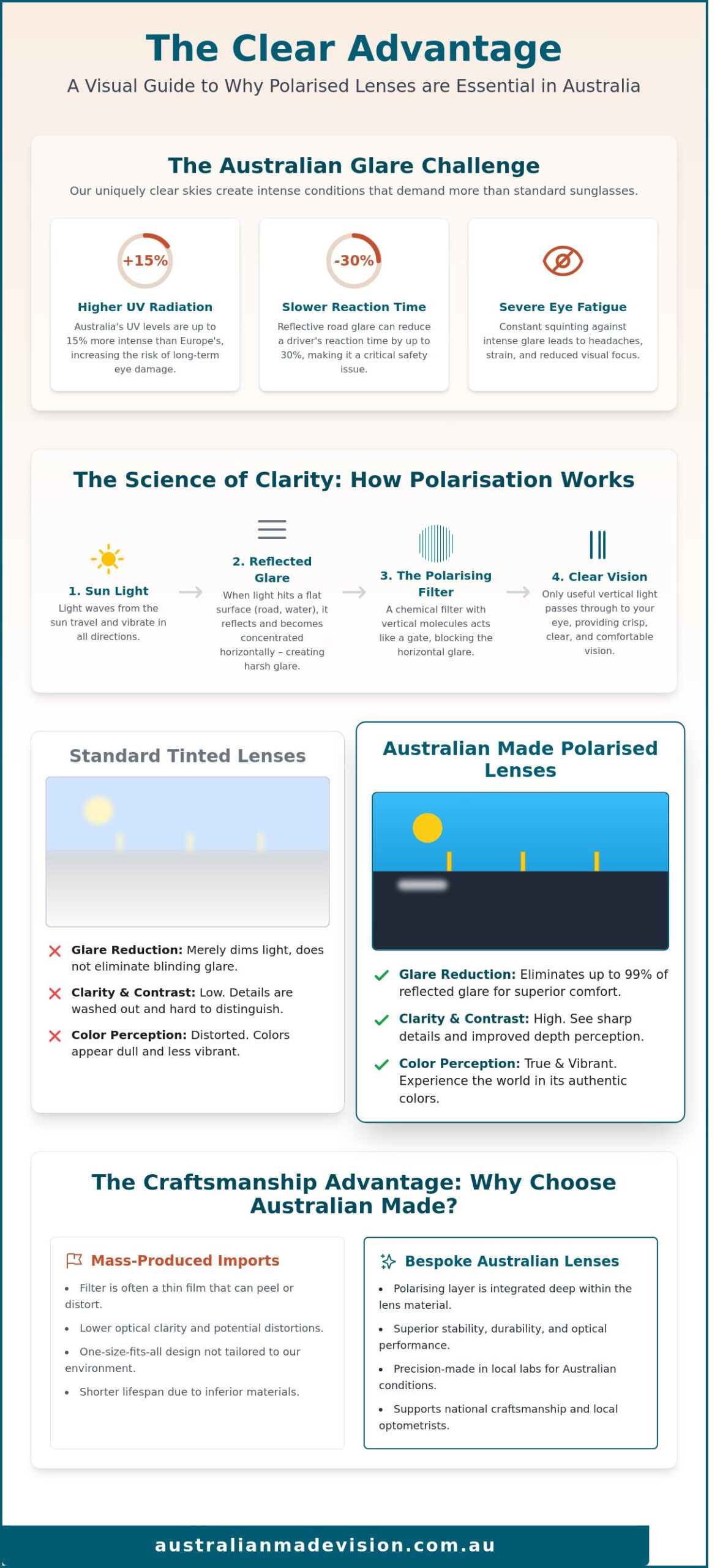
Polarised lenses are designed to manage reflected glare. Unlike standard sunglasses that simply use a dark tint to reduce overall brightness, polarised lenses contain a filter that blocks much of the horizontally reflected light that commonly comes from roads, water and other flat surfaces.
While standard tinted lenses can make a bright day more comfortable, they do not filter reflected glare in the same way. That difference is why polarised lenses are often considered for driving, fishing, boating and other high-glare outdoor activities.
Australian Made Vision provides general eyewear information and a directory of participating independent practices. The individual practice can confirm which polarised lens designs, materials, colours and Australian-made options are available.
The Australian sun factor
Bright Australian conditions can create strong reflections from roads, water and other surfaces. Polarised lenses may make these reflections less distracting, but the lens still needs appropriate UV protection because polarisation and UV protection perform different functions.
For driving and outdoor use, the suitability of a polarised lens depends on the activity, tint category, UV protection, prescription and how the lens interacts with displays or equipment you need to see.
Common misconceptions about polarisation
A darker lens does not automatically mean better glare control. Darkness describes how much visible light reaches the eye, while polarisation describes how the lens filters reflected light.
UV protection and polarisation should also be considered separately. A polarised lens should not be assumed to provide the required UV protection simply because it is polarised; check the product information and ask the practice about the lens specification.
Lens quality, coatings, material and construction can vary between products. If durability or optical performance is important for your use, compare the specific lens options available rather than relying only on a polarised label.
The science of glare: How polarised lenses actually work
Light travels in different orientations. When sunlight reflects from a flat surface such as a road or water, much of that reflected light becomes horizontally oriented. This concentrated reflection is what creates glare.
A polarising filter is aligned so that it reduces much of this horizontally reflected light while allowing other light to pass through. The result can be less reflected glare and clearer detail in situations where surface reflections are strong.
Standard sunglasses mainly reduce overall brightness, while polarised lenses selectively reduce reflected glare. The practical benefit depends on the conditions and the activity.
Understanding Brewster’s Angle
The amount of polarised reflection changes with the angle of the light and the reflective surface. This helps explain why glare can feel stronger at some sun angles than others. For most wearers, the useful takeaway is simply that glare varies throughout the day and with the surface being viewed.
Visual contrast and colour perception
Reducing reflected glare can make it easier to see detail in high-glare situations. For fishing and boating, for example, polarisation may make it easier to see through some surface reflections on water.
If you are unsure which lens type suits your activities, use the Australian Made Vision directory to compare participating independent practices and confirm available lens options directly with the practice.
Polarised vs. standard tinted lenses: A side-by-side analysis
Standard tinted lenses reduce the overall amount of visible light reaching the eyes. Polarised lenses add a filter that reduces reflected glare from flat surfaces such as roads and water. The better option depends on where and how you use the eyewear.
- Tinted lenses: may suit general brightness reduction where directional glare is not the main concern.
- Polarised lenses: may suit driving, fishing, boating and other situations where reflected glare is common.
- Decision factors: prescription, UV protection, lens colour, digital displays, budget and the activities you need the eyewear for.
The LCD screen trade-off
Because polarised lenses filter light in a particular orientation, some liquid crystal displays (LCDs) can look darker, show colour changes or become difficult to read at certain angles. If you rely on vehicle displays, instruments, camera screens or other specialised equipment, test them with polarised lenses before ordering.
When standard tints might be preferred
Polarisation is not necessary for every activity. Some occupations or sports require clear visibility of particular screens, reflections or surface cues, so a standard tint may be more suitable. A practice can help you compare the options for your specific use.
A practical guide to choosing your polarised lenses
Choosing polarised lenses involves more than picking a frame or tint. Check the lens material, UV protection, tint category, prescription compatibility and whether the product origin matters to you. If an Australian-made claim is important, confirm the specific lens product and manufacturer rather than assuming all lenses supplied by a practice are made locally.
Lens material can also affect thickness, weight and durability. For stronger prescriptions, high-index lenses may help reduce lens thickness depending on the prescription and frame. An anti-reflective coating on the back surface may also reduce reflections from light entering behind the wearer.
Matching lens colour to your lifestyle
Lens colour can affect contrast and colour perception. Grey is commonly chosen for neutral colour perception, while brown or copper tints may increase contrast in some conditions. The most suitable choice depends on the activity, environment and personal preference.
The DIY polarisation test
One simple check is to place two polarised lenses in front of each other and rotate one pair by 90 degrees. The overlapping area should become much darker as the filters cross. Some digital screens also become darker or change appearance when viewed through polarised lenses at certain angles.
If you are unsure whether your current sunglasses are polarised, a participating practice in the Australian Made Vision directory can help you check the lenses and discuss replacement options if needed.
Australian-made polarised lenses and local manufacturing
Choosing Australian-made polarised lenses can support local optical manufacturing when the specific product is genuinely made in Australia. Local production may also give practices access to suppliers and laboratories within Australia, although lens availability and manufacturing arrangements vary.
Australian optical suppliers such as Opticare work with practices on prescription lens options, including locally manufactured products. Where a practice offers Opticare or another Australian-made lens option, it should confirm the exact product, manufacturing origin and features that apply to the prescription being ordered.
The benefit of local manufacturing should be described in practical, verifiable terms rather than as an automatic claim of superiority over imported products. Useful questions include where the lens is manufactured, which lens designs are available, expected turnaround, warranty or aftercare, and whether the option suits your prescription and frame.
Independent practices and lens choice
Independent practices may work with different lens suppliers and product ranges. This can give patients additional options to compare, but services and supplier relationships vary between practices. Confirm the lens brands, manufacturing origin and fitting services directly with the individual practice.
Supporting local industry
Choosing verified Australian-made products can support Australian manufacturing and optical jobs. If buying locally made lenses is important to you, ask the practice to identify the specific Australian-made product rather than relying on general local or Australian branding.
To compare participating independent practices, use the Australian Made Vision directory and confirm available polarised and Australian-made lens options directly with the practice.
Clearer vision for your Australian lifestyle
Polarised lenses can be useful when reflected glare from roads, water or other surfaces is a regular problem. The best choice depends on your prescription, UV protection, lens material, tint, daily activities and any displays or equipment you need to see clearly.
If Australian-made lenses are important to you, confirm the origin of the specific product and compare the lens features that matter for your prescription rather than assuming local manufacture automatically makes one option better for everyone.
Frequently asked questions
Can I get polarised lenses with my prescription?
Yes. Polarised lenses are available with many prescriptions, including single-vision and some multifocal or progressive lens designs. If you are short-sighted (myopic), the practice can also discuss frame and lens-material choices that may affect thickness and weight.
Are polarised lenses better for driving than normal sunglasses?
Polarised lenses can reduce reflected glare from roads, car surfaces and other vehicles, which many drivers find more comfortable. They are not automatically the best choice for every driver, particularly if certain vehicle displays become difficult to read through polarised lenses.
Do polarised lenses protect my eyes from UV rays?
Polarisation and UV protection are different features. A polarised lens can also provide UV protection, but you should check the product information or ask the practice to confirm the UV protection of the specific sunglasses or lenses you are considering.
Why do polarised lenses make my phone screen look weird?
Many digital displays contain their own polarising filters. When the filter in the screen and the filter in your sunglasses interact at certain angles, the display can look darker, distorted or show colour changes.
How can I tell if my sunglasses are actually polarised?
A simple check is to look at a compatible digital display through the lenses and rotate the glasses. A polarised lens may make the screen significantly darker at certain angles. A practice can also verify the lenses if you are unsure.
Are polarised lenses worth the extra cost for children?
That depends on the child’s prescription, activities, UV protection needs and how often they are exposed to strong reflected glare. An optometrist can help a parent or carer compare polarised and non-polarised options without assuming one lens type is necessary for every child.
Can I wear polarised lenses for night driving?
Dark sunglasses should not be worn for night driving. For night-time reflections, clear prescription lenses with an appropriate anti-reflective coating may be discussed with an optometrist or optical dispenser.
What is the best lens colour for polarised sunglasses in Australia?
There is no single best colour for everyone. Grey is often chosen when neutral colour perception is preferred, while brown or copper may increase contrast in some conditions. The right choice depends on your activities, environment and visual preferences.