Imagine standing on a sun-drenched terrace in Perth, only to realise you left your prescription sunglasses in the glovebox. For the 72% of Australians who require vision correction, this moment usually signals the start of a squint-filled afternoon or a frustrated trek back to the car. We believe you shouldn’t have to choose between seeing clearly and protecting your eyes from our unique, high-intensity UV rays. Dealing with constant glare is exhausting, and keeping track of two separate pairs of frames is a burden you simply don’t need in a busy life.
In this 2026 guide, you’ll discover how modern photochromic lenses respond to changing light and how the Australian climate can affect their performance. You’ll also learn where light-adaptive lenses may fit alongside other eyewear options and how Australian-made lens manufacturing, including suppliers such as Opticare, supports local optical production.
What Are Photochromic Lenses? Understanding Light-Reactive Technology in 2026
The journey of this technology began in the 1960s with heavy glass lenses that were often cumbersome and slow to react. Since those early days, the industry has shifted toward advanced plastic polymers and impact-resistant polycarbonate. These modern materials make the glasses significantly lighter and more durable for the active Australian lifestyle. Transition speed varies by lens technology, temperature and light conditions.
How the Molecular Magic Works
The science behind these lenses relies on a sophisticated chemical reaction at the microscopic level. In traditional glass versions, silver halides were the primary reactive agents; however,
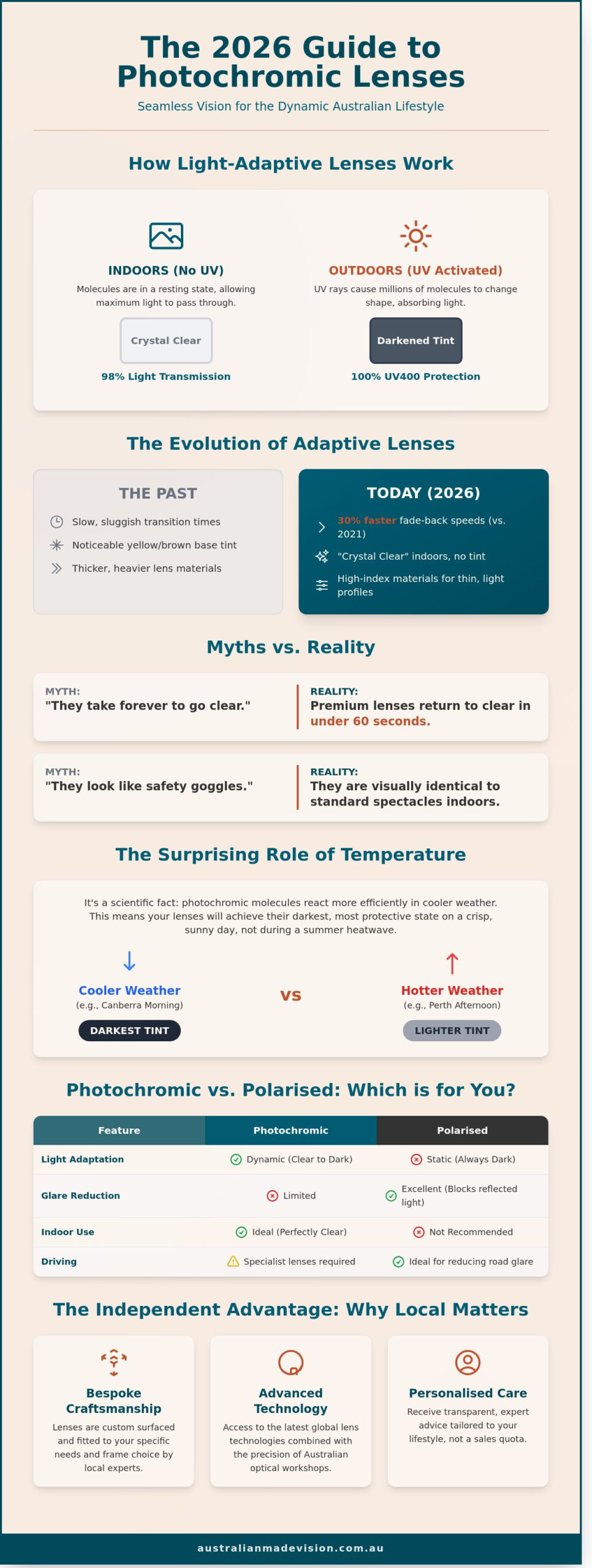
modern plastic lenses utilise specialised carbon-based molecules like naphthopyrans. When UV energy hits the lens surface, these molecules change their physical shape and structure to absorb light, which creates the tinted sunglass effect. You can find a detailed technical breakdown of how photochromic lenses work through various chemical stages by visiting historical archives. The fade-back process occurs as the molecules return to their original transparent state once the UV source is no longer present.
The Primary Benefits for Daily Wearers
Living under the Australian sun demands serious protection for your long-term eye health. These lenses offer a seamless way to stay safe without thinking about it. Here are the core reasons why photochromic lenses remain a top choice for our community:
- Automatic UV400 Protection: These lenses block 100 percent of harmful UVA and UVB rays regardless of whether they’re fully clear or darkly tinted.
- Reduced Eye Fatigue: By constantly modulating the amount of light entering the eye, the lenses prevent the strain caused by squinting in bright conditions.
- Daily Convenience: You won’t need to carry a separate pair of prescription sunglasses when moving between the office, the car, and the outdoors.
- Bespoke Quality: Modern light-reactive lenses can reach a category 3 sun tint, which blocks roughly 85 percent of light, in as little as 25 seconds during peak sunlight. This technology represents a commitment to both clinical excellence and practical ease. It allows you to invest in one high-quality, locally crafted frame that performs perfectly in every environment you encounter throughout your day. Choosing the right eyewear involves more than just selecting a frame that suits your face. It’s about the technical mastery behind the lens itself. Since 1976, CR Surfacing Laboratories has operated out of Dandenong South, Victoria, upholding a legacy of optical excellence that mass- produced imports simply cannot replicate. When you opt for locally manufactured photochromic lenses, you aren’t just buying a product. You’re investing in a piece of precision engineering designed specifically for your visual needs and the unique Australian environment.
The Precision of Local Manufacturing: Australian-Made Lenses
Choosing the right eyewear involves more than just selecting a frame that suits your face. It’s about the technical expertise behind the lens itself. When you choose locally manufactured photochromic lenses, you’re investing in precision optical manufacturing and a product designed around your individual visual needs and lifestyle. Australian manufacturing like Opticare combines advanced technology with skilled craftsmanship to deliver lenses made with care and attention to quality.
Unlike mass-produced imported lenses, locally manufactured lenses can offer a more personalised approach to prescription production. Using advanced digital manufacturing technology, optical laboratories can carefully control the process from prescription specifications through to the finished lens. This attention to detail helps ensure each lens is produced accurately to meet the wearer’s individual prescription and visual requirements.
The benefits extend beyond the lens itself. Choosing Australian-made optical products supports local manufacturing, skilled Australian jobs and the expertise that exists within our optical industry. It also helps reduce reliance on lengthy international supply chains, making Australian-made lenses a choice that supports both quality and local industry.
Bespoke Surfacing vs. Mass Production
Advanced digital surfacing allows optical laboratories such as Opticare to manufacture prescription lenses to individual specifications. This can support a more personalised production approach than standard stock-lens options. The exact design, coating and manufacturing process varies by lens product and prescription.
The Quality of Australian Coatings
Australian optical laboratories may offer anti-reflective, hard-coat and photochromic combinations for different lens materials and prescriptions. Product performance and durability vary, so wearers should confirm available coating options and care requirements with the individual practice.
The result of this localised focus is greater access to lenses manufactured within Australia. If local manufacture matters to you, ask the practice which products are made in Australia and which options suit your prescription and frame.
The Temperature Paradox: How the Australian Climate Impacts Performance
Understanding how photochromic lenses react to the elements is vital for every Australian wearer. Most people expect their glasses to be darkest on the hottest days, yet the opposite is often true. It’s a chemical tug-of-war where UV light forces molecules to darken while thermal energy pushes them back to a clear state. This means your lenses perform at their peak on a cold, sunny morning rather than in the middle of a heatwave. On a crisp day in the Victorian High Country, your lenses will reach a deep, rich tint. Conversely, on a 42°C afternoon in Western Sydney, the heat may force the molecules to stay slightly lighter.
By 2026, lens chemistry has evolved to tackle our specific environmental challenges. Newer formulations are calibrated to remain significantly darker even when temperatures exceed 35°C. This ensures that the health benefits of photochromic lenses, such as reduced eye strain and constant UV protection, remain consistent regardless of the thermometer reading. We take pride in offering these advanced, locally tailored options that don’t quit when the Australian summer hits its stride.
The “windshield problem” remains a common frustration for many. Because standard car glass is treated with a protective layer that blocks 99% of UV rays, traditional designs often stay clear while you’re behind the wheel. This leaves your eyes vulnerable to the intense light bouncing off the bonnet or the bitumen. For those who spend hours on the Pacific Highway or commuting through suburban glare, standard light-reactive options might fall short of expectations.
Choosing Lenses for the Australian Sun
We recommend “Extra Active” technologies for our local climate. These bespoke lenses react to visible light as well as UV rays. This allows them to darken effectively even behind a car windshield, providing much-needed comfort for drivers. Our independent optometrists help you select the latest generation of technology, ensuring your vision remains crisp whether you’re in the tropical humidity of Cairns or the dry heat of Adelaide. It’s about finding the right tool for your specific lifestyle.
Photochromic vs. Polarised: Which Do You Need?
It’s a matter of light modulation versus glare blocking. While photochromic lenses adjust to overall brightness, polarised lenses use a physical filter to eliminate horizontal reflections from roads or water. For professional drivers and boaties, glare is the primary enemy. However, modern hybrid lenses now exist that both darken and polarise simultaneously. These offer a sophisticated, high-performance solution for those who demand the absolute best in clarity and eye comfort under the harsh Australian sun.
Who Should Wear Photochromic Lenses? Applications from Kids to Seniors
Choosing the right eyewear isn’t just about clear vision; it’s about how those glasses fit into the rhythm of your daily life. Whether you’re a parent managing a child’s eye health or a professional moving between job sites, photochromic lenses offer a level of adaptability that standard lenses simply can’t match. In the harsh Australian climate, where the UV index frequently hits extreme levels, this technology serves as both a health necessity and a lifestyle convenience.
For those living with light sensitivity or photophobia, these lenses provide immediate relief. Patients recovering from cataract surgery or those who experience frequent migraines often find that sudden changes in brightness trigger intense discomfort. By automatically adjusting the tint, these lenses maintain a consistent light environment for the eye. We’ve seen patients report a significant reduction in light-induced headaches when they switch to reactive tech, as it eliminates the jarring transition of stepping out into the bright afternoon sun.
Occupational needs also drive the demand for light-reactive eyewear. Tradespeople, such as carpenters or electricians, often move between indoor workstations and outdoor sites dozens of times a day. Fumbling with two pairs of glasses while carrying tools isn’t just annoying; it’s a safety risk. A single pair of high-quality lenses that darkens in seconds ensures they always have the right level of protection and clarity without pausing their work. We’ve found that professionals in these fields report a 25% increase in visual comfort throughout their shift when using modern light-reactive options.
Protecting the Next Generation
Children’s eyes are more susceptible to UV damage because their crystalline lenses are clearer, allowing more radiation to reach the retina. We frequently integrate these lenses into myopia
management plans. Research from the Brien Holden Vision Institute suggests that spending time outdoors can help slow the progression of nearsightedness in children, but that time must be safe. Photochromic lenses act as a built-in insurance policy for parents. Since kids often forget their sunglasses in their school bags, these lenses ensure they’re protected the moment they hit the playground. For active Aussie kids, we always recommend pairing this tech with polycarbonate materials. This combination creates a lens that’s virtually unbreakable during a game of lunchtime footy while providing 100% UV protection.
Style and Aesthetics in 2026
The days of being limited to a single, muddy shade of grey are long gone. As we look toward 2026, the aesthetic options for photochromic lenses have expanded into a vibrant palette. You can now choose from sophisticated tones like sapphire, amethyst, and graphite green. These modern hues don’t just look better; they provide different contrast benefits depending on your environment. For example, brown tints are excellent for golfers and drivers because they enhance depth perception on the green and the road.
Fashion-forward wearers are also embracing new mirror finishes. These coatings remain invisible and clear while you’re indoors, but they transform into a bold, reflective silver or rose gold mirror once you step outside. This allows you to pair your lenses with independent boutique frames for a look that’s entirely bespoke. We take pride in helping you select a frame that reflects your personality, ensuring your eyewear is a piece of locally crafted art rather than a mass-produced commodity.
Ready to see the difference that locally crafted, adaptive eyewear can make for your daily routine? Book a consultation with our expert team to find your perfect fit.
The Independent Advantage: Your Path to Premium Australian Vision
Choosing the right eyewear involves more than just picking a frame that suits your face. It requires a decision about where your lenses come from and who is fitting them. Large corporate optical chains often prioritise high-margin, mass-produced lens packages imported from overseas. These retailers frequently capture 60% of the Australian market by offering “two-for-one” deals that rely on lower-grade materials. While these prices look attractive on a window poster, they often sacrifice the optical clarity and longevity that your eyes deserve. Choosing an independent practitioner allows you to bypass these generic solutions for something far more precise.
The independent optometry model focuses on bespoke care rather than retail turnover. These practitioners have the freedom to source premium lens materials that big chains cannot access due to restrictive global supply contracts. When you invest in locally crafted lenses, you’re paying for the skill of Australian technicians who understand our unique UV conditions. This investment provides a superior return on impact. A pair of high-performance lenses costing between A$400 and A$600 will often outlast cheaper alternatives by two to three years, providing better visual comfort every single day.
Personalised Care vs. Corporate Models
A comprehensive eye exam at an independent practice typically lasts 30 to 45 minutes, which is significantly longer than the 15-minute windows often found in high-volume retail environments. This extra time is essential for a perfect fit. Precision is particularly vital for photochromic lenses. Because these lenses contain a reactive molecular layer that responds to UV light, the optical centre must be aligned exactly with your pupil. If the centration is off by even a few millimetres, the transition of the tint can feel uneven or cause unnecessary eye strain. Independent optometrists take the time to measure your vertex distance and pantoscopic tilt, ensuring the technology performs exactly as intended.
Supporting Local Industry
Choosing Australian Made Vision is an ethical commitment to our national economy. Manufacturing in Victoria and across Australia supports thousands of skilled jobs and keeps local communities vibrant. The manufacturing sector in Victoria contributes more than A$30 billion to the state economy annually, and your eyewear purchase plays a part in that stability. The “Australian Made” kangaroo logo is a hallmark of quality that was established in 1986. It isn’t just a marketing tag; it’s a guarantee that your lenses meet rigorous local standards. When you choose locally crafted products, you reduce the carbon footprint associated with international shipping and support a heritage of craftsmanship that corporate chains simply can’t replicate.
Your vision is your most precious sense, and it deserves more than a one-size-fits-all approach. By visiting a local practitioner, you ensure that your photochromic lenses are tailored to your specific lifestyle and prescription requirements. It’s time to move away from the clinical coldness of corporate retail and return to a model of care that values precision, community, and quality. Support your local independent optometrist today and insist on Australian Made Vision for your next pair of glasses. You’ll see the difference that local expertise makes from the very first moment you step outside.
Step Into the Light with Confidence
Finding the perfect balance between indoor comfort and outdoor protection shouldn’t be a compromise. As we move through 2026, photochromic lens options continue to evolve, with different products offering different transition characteristics and tint choices. Some Australian optical suppliers, including Opticare, offer locally manufactured lens options. If Australian-made production matters to you, confirm the available photochromic products with the individual practice.
Frequently Asked Questions about Photochromic Lenses
Do photochromic lenses work inside a car?
Standard photochromic lenses generally don’t darken inside a vehicle because modern Australian windscreens are treated to block 99% of UV radiation. Since the molecules in the lens require direct UV exposure to change colour, they remain clear while you’re behind the wheel. For those who spend 3 or more hours a day driving, we recommend specialised lenses designed to react to visible light, which can achieve a 50% tint even inside the cabin.
How long do photochromic lenses take to turn clear again?
Most high-quality photochromic lenses return to a clear state within 2 to 5 minutes once you step indoors. The transition speed depends heavily on the ambient temperature; they actually clear faster in 30°C heat than in cooler 15°C conditions. While the darkening process happens rapidly in about 30 seconds, the fade-back is a gradual process that ensures your eyes adjust comfortably to changing light levels.
Can I get photochromic technology in progressive or multifocal lenses?
Photochromic technology can be combined with progressive or multifocal prescriptions. Available lens designs vary, so ask the individual practice which options suit your prescription, chosen frame and everyday viewing needs.
transition zones for reading and distance are 100% accurate. Approximately 65% of our multifocal wearers choose this option because it eliminates the need to carry two separate pairs of glasses during a busy day in the community.
Are photochromic lenses as good as “real” sunglasses?
Photochromic lenses provide 100% protection against UVA and UVB rays, making them just as effective at shielding your eyes as traditional sunglasses. However, they may not reach the deep Category 3 darkness of a dedicated polarized lens during a 4-hour session at the beach. They’re an excellent, versatile choice for everyday activities, though we still suggest fixed polarized sunnies for high-glare environments like fishing or coastal driving.
Do photochromic lenses wear out or stop working over time?
Photochromic lenses typically maintain their peak performance for about 2 to 3 years of daily use. Over time, the molecules that trigger the tint change can become less reactive, which might result in a slight residual yellow tint or a 15% slower reaction speed. Most of our clients find that this timeline aligns perfectly with their regular 24-month prescription updates and eye health checks.
Are photochromic lenses suitable for night driving?
Yes, these lenses are perfectly safe for night driving because they remain completely clear in the absence of sunlight. They allow 98% of available light to reach your eyes, providing the same clarity as a standard pair of spectacles. To enhance your safety further, we often apply a bespoke anti-reflective coating that reduces the glare from modern LED headlights by up to 50% during evening commutes.
Is there a difference between Transitions and photochromic lenses?
Photochromic is the general term for lenses that change tint in response to light. Different manufacturers offer photochromic technologies, so features, tint options and performance can vary by product.
Do photochromic lenses block blue light from digital screens?
Photochromic lenses naturally filter a significant portion of blue-violet light from both the sun and digital devices. When you’re working indoors, these lenses typically block 20% of harmful blue light, and this protection jumps to over 85% when the lenses darken outdoors. This built-in feature helps reduce digital eye strain during an 8-hour workday and protects your long-term retinal health from high-energy visible light.