
Astigmatism is a refractive error that changes how light is focused inside the eye. It may make vision look blurred or distorted at close, intermediate or far distances. An eye examination can measure the amount and direction of the refractive error and help determine whether correction would be useful.
Common correction options include spectacles and contact lenses. Refractive surgery may be discussed for selected people after an individual assessment. Symptoms alone cannot confirm astigmatism because blurred vision, eyestrain, and difficulty seeing at night can have several causes.
Do not assume sudden blurred or lost vision is astigmatism. Seek urgent medical assessment. If a sudden vision change occurs with facial droop, weakness or numbness on one side, dizziness, loss of balance or slurred speech, call triple zero (000) and ask for an ambulance.
What is astigmatism?
The cornea is the clear front surface of the eye, while the crystalline lens sits behind the coloured iris. Together, they help bend and focus light onto the retina at the back of the eye. When the cornea or lens has an uneven curve, light does not focus evenly. This can leave the image blurred, stretched or distorted.
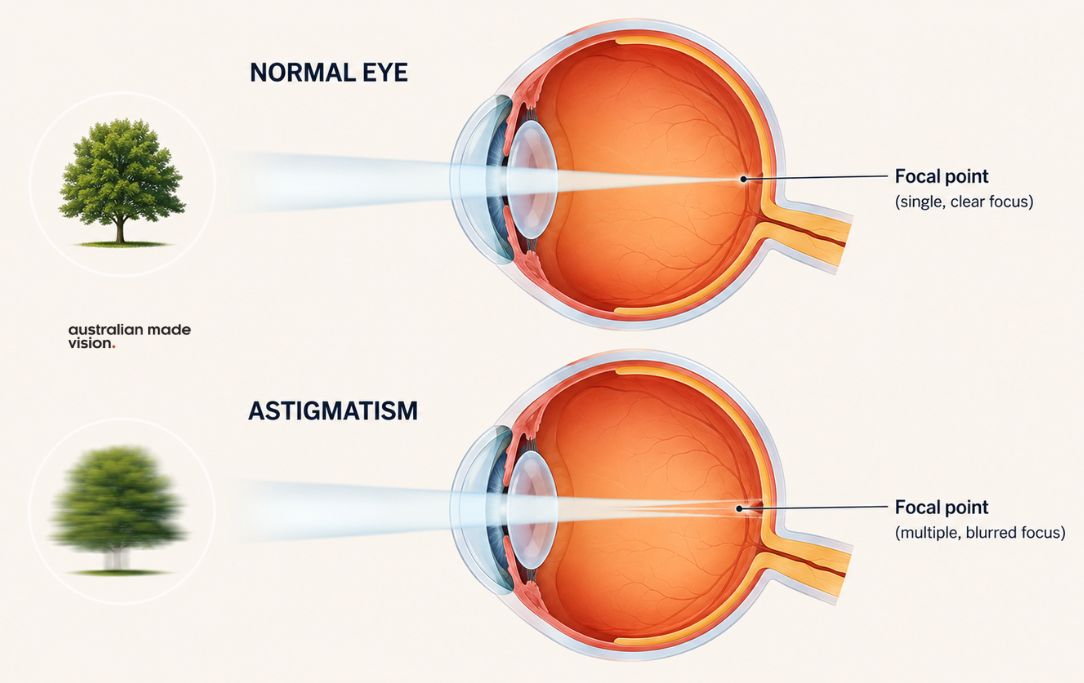
Astigmatism is a type of refractive error. It is not an eye infection, and it does not mean that the eye is weak. The amount of astigmatism can be different in each eye, and it can occur alongside short-sightedness (myopia) or long-sightedness (hyperopia).
Regular and irregular astigmatism
With regular astigmatism, the cornea is curved more in one main direction than another. With irregular astigmatism, the curvature varies across the surface of the cornea. Irregular or changing astigmatism may lead an optometrist or ophthalmologist to consider additional corneal assessment. This page does not cover the detailed diagnosis or management of corneal conditions such as keratoconus.
Find Eye Care That Suits Your Needs
Search for an independent optometrist near you and find a local practice that suits your specific eye care needs.
Find an OptometristWhat symptoms can astigmatism cause?
The effect of astigmatism varies. Some people have mild changes and few noticeable symptoms, while others find that detail is unclear across several distances. Possible symptoms include:
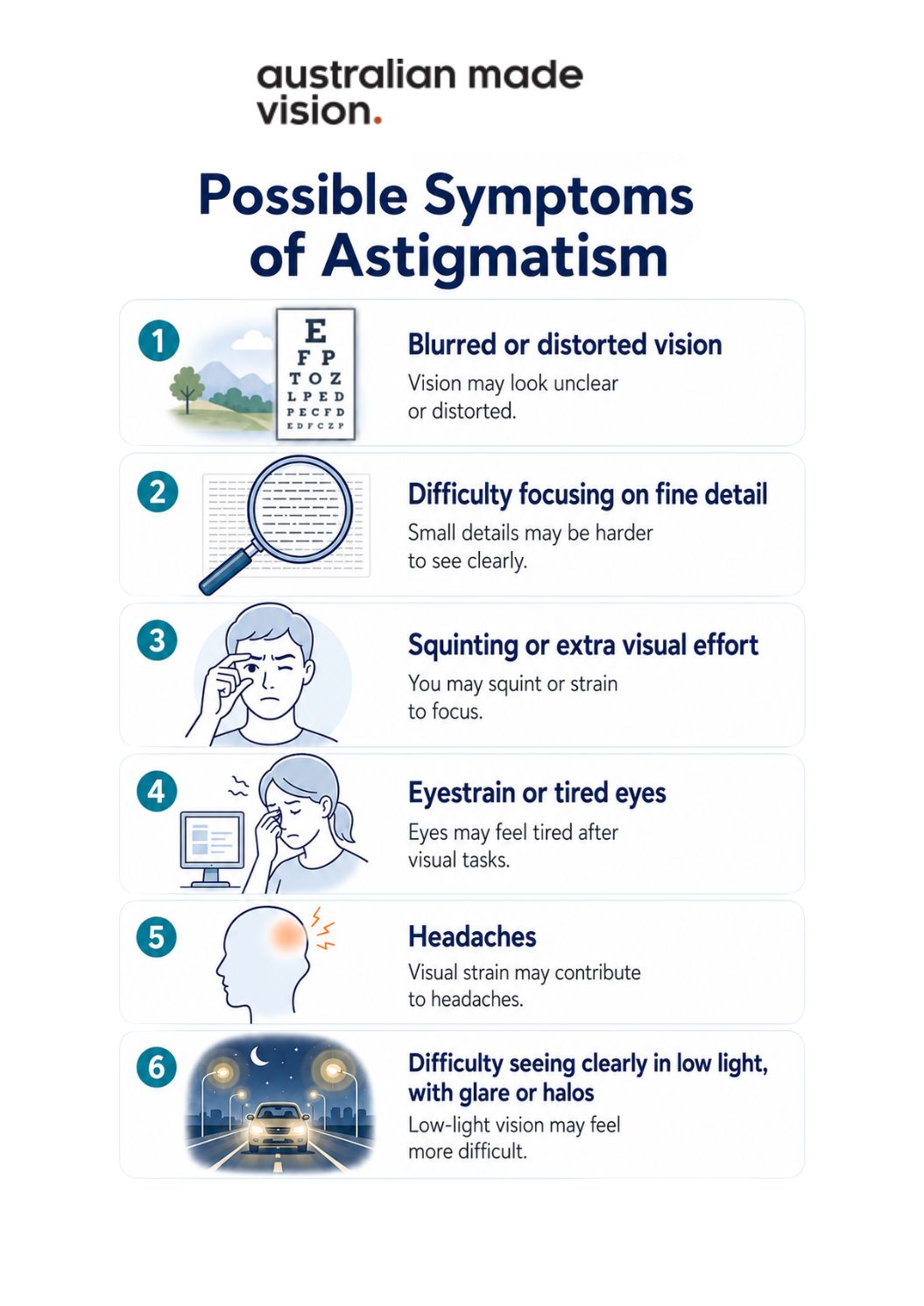
- blurred or distorted vision when looking near or far away
- difficulty focusing on fine detail
- squinting or needing extra visual effort to see clearly
- eyestrain or tired eyes
- headaches in some people
- difficulty seeing clearly in low light, sometimes with glare or halos around lights
These symptoms are not specific to astigmatism. Blurred vision can also be linked to other refractive errors, dry eye, cataracts, eye injury, medical conditions or medicines. An eye examination is needed to work out what may be contributing to the change.
What causes astigmatism?
Astigmatism may be inherited or present from birth, and it can change over time. It often occurs with another refractive error, including myopia or hyperopia. Having astigmatism does not automatically mean there is an eye disease.
Other possible associations include an eye injury, a change after eye surgery, ageing and corneal conditions such as keratoconus. These factors do not affect everyone in the same way. A noticeable change in the prescription may simply require updated correction, but an optometrist may recommend further assessment when the pattern, amount or progression raises a concern.
The cause cannot be determined from symptoms or the prescription numbers alone. Examination findings, vision history, and any changes over time need to be considered together.
How is astigmatism assessed during an eye test?
An optometrist will usually begin by asking about the vision change, when it started, whether it affects one or both eyes, and which activities are difficult. General health, medicines and family eye-health history may also be relevant.
The assessment may include:
- a visual acuity test to check how clearly you see detail at different distances
- refraction testing to measure the lens power that provides the clearest vision
- measurement of how the eyes focus light
- measurement of corneal curvature
- additional examination of the cornea when irregular or changing astigmatism is suspected
Not every person needs the same tests, and practices may use different equipment. The optometrist decides what is appropriate based on the symptoms, health history and initial findings. If a result suggests a condition that needs specialist care, referral to an ophthalmologist may be discussed.
What do CYL and AXIS mean on a prescription?
A spectacle prescription may include CYL and AXIS values when astigmatism correction is required. CYL, short for cylinder, describes the amount of lens power used for the astigmatism component of the prescription. AXIS describes the orientation of that cylindrical correction and is recorded as a number between 1 and 180 degrees.
Important prescription note
These values are only part of the full prescription. They should be interpreted with the other measurements for each eye, rather than used on their own to judge how well someone sees or which lens option is suitable.
Find Eye Care That Suits Your Needs
Search for an independent optometrist near you and find a local practice that suits your specific eye care needs.
Find an OptometristDoes mild astigmatism always need correction?
Not always. The decision depends on the amount of astigmatism, whether it causes symptoms, the person’s other prescription measurements and the visual demands of daily life. Someone may notice blur when driving at night, reading fine print or working at a screen, while another person with a similar measurement may have fewer concerns.
An optometrist can explain whether correction is likely to improve clarity or comfort, and whether it is needed all the time or only for particular tasks. Fixed cut-offs and one-size-fits-all wear advice are not appropriate because the full examination matters.
How can astigmatism be corrected?
No correction option is best for everyone. The choice depends on the prescription, eye health, comfort, lifestyle, handling ability, and examination findings. Common options are outlined below.
| Option | What it may do | Points to discuss |
|---|---|---|
| Spectacles | Use a prescribed cylindrical lens power to improve focus. | When to wear them, lens design, adjustment, and the tasks they are intended for. |
| Soft toric contact lenses | Are designed to provide astigmatism correction while sitting on the eye. | Fitting, stability, comfort, replacement schedule, hygiene, and whether the prescription is available. |
| Rigid contact lenses | May be discussed for selected prescriptions or corneal shapes. | Professional fitting, adaptation, cleaning, follow-up, and individual suitability. |
| Refractive surgery | May reshape the cornea for selected people. | Eligibility, expected benefits, limitations, risks, recovery, and whether referral is appropriate. |
Spectacles
Spectacles are a common, non-invasive way to correct astigmatism. The lenses are made to include the cylindrical power and axis required by the prescription. Whether glasses are recommended for full-time wear or selected activities depends on the person’s vision and the optometrist’s advice.
Soft toric contact lenses
Soft toric contact lenses are designed to correct astigmatism while maintaining a stable orientation on the eye. They are not suitable for everyone and need professional fitting. Comfort, eye health, handling, hygiene, and the available prescription range all affect whether they are a practical option.
Rigid contact lenses
Rigid gas-permeable lenses may be considered for selected prescriptions or corneal shapes. They require individual fitting and follow-up. They should not be described as automatically clearer or more comfortable than another option because the result varies from person to person.
Refractive surgery
Laser or other refractive surgery may be discussed for selected adults after a detailed assessment. Suitability depends on factors such as the stability of the prescription, corneal measurements, eye health, and general health. Surgery is not appropriate for everyone, and no procedure can be presented as a guaranteed or risk-free correction.
Is Your Eye
Health on Track?
Complete our free 18-point checklist to check your eye health, spot any gaps, and take charge of your vision.
Start Free Checklist Test →Astigmatism in children
Children may not always recognise that their vision is blurred or know how to describe the problem. A parent or carer may notice persistent squinting, trouble focusing, complaints of headaches, or difficulty seeing clearly at particular distances. These signs can have several causes and do not confirm astigmatism.
Arrange an eye assessment if there is an ongoing concern about a child’s sight. An optometrist can check how clearly the child sees, assess the prescription and discuss whether correction or follow-up is needed. The page should not suggest that astigmatism is the cause of learning or school-performance difficulties without a separate, evidence-based assessment.
When should you have your vision checked?
Arrange a routine eye test when blur, distortion, squinting, visual effort, eyestrain, or low-light difficulty is persistent or gradually affecting daily activities. It is also sensible to seek a prompt review when there is a noticeable continuing change in vision or a concern about a child’s sight.
Call triple zero (000) if a sudden vision change occurs with possible stroke signs, including facial droop, one-sided weakness, or numbness, dizziness, loss of balance or slurred speech.
Do not wait for a routine appointment when symptoms begin suddenly or are accompanied by other serious neurological signs.
Find Eye Care That Suits Your Needs
Search for an independent optometrist near you and find a local practice that suits your specific eye care needs.
Find an OptometristQuestions to ask an optometrist
The following questions can help you understand the assessment and the options being discussed:
- What do the CYL and AXIS values mean in my prescription?
- Do I need correction all the time or only for particular tasks?
- What are the benefits and limits of spectacles and contact lenses for my prescription?
- What fitting, care, and follow-up would contact lenses require?
- Has my prescription changed, and does anything need further assessment?
- What findings would lead to a referral to an ophthalmologist?
A practical next step
Persistent or changing blur is worth discussing with an optometrist because several conditions can affect focus. An eye examination can measure the refractive error, check the health of the eyes, and clarify which correction options may be suitable.
Australian Made Vision provides general eye-health information and a directory of participating independent practices. You can find an independent optometrist and contact the individual practice directly about appointments, services and fees.
Find Eye Care That Suits Your Needs
Search for an independent optometrist near you and find a local practice that suits your specific eye care needs.
Find an OptometristFrequently asked questions about astigmatism
Is astigmatism an eye disease?
Astigmatism is a refractive error, which means the eye does not focus light evenly. It is not an infection. Astigmatism can sometimes be associated with a corneal condition, injury, or surgery, so examination is important when the prescription changes or the pattern is irregular.
Can astigmatism change or get worse over time?
Yes, astigmatism can change over time. A change may relate to normal ageing, an eye injury, surgery, or a corneal condition, but the cause cannot be determined from the prescription alone. A noticeable or continuing change should be checked.
Can you have astigmatism and myopia at the same time?
Yes. Astigmatism can occur with myopia, which makes distant objects look blurred, or with hyperopia, which affects the way the eye focuses. A prescription can include measurements for more than one refractive error.
Do you need to wear glasses all the time for astigmatism?
It depends on the prescription, symptoms and daily tasks. Some people are advised to wear correction throughout the day, while others may use it for driving, study, screen work or other activities. An optometrist can explain the recommended wear schedule for the individual prescription.
Can astigmatism affect night driving or low-light vision?
Astigmatism may make low-light vision more difficult and can be associated with glare or halos around lights. These symptoms can also have other causes. The page should not imply that astigmatism alone makes someone unsafe to drive; changing or troublesome night vision should be assessed.
Are toric contact lenses suitable for everyone with astigmatism?
No. Suitability depends on the prescription, corneal shape, tear film, eye health, comfort and ability to handle and care for the lenses. Contact lenses require professional fitting and careful hygiene to reduce the risk of irritation, infection or eye damage.
Australian Made Vision is an independent directory that helps patients find optometrists across Australia who may offer Australian-made spectacle lenses. We do not provide clinical services and recommend contacting practices directly to confirm the products and services they offer.