
Before Year End
If you have private health insurance with Extras cover, it is worth checking your optical benefits before the year ends.
Some health funds reset annual Extras limits on 1 January, while others use different dates.
If you were already planning new glasses, contact lenses or prescription sunglasses, checking your remaining optical benefit now can help you understand what your fund may contribute and what you may need to pay yourself.
Start with your member account or product guide, then ask the practice for an itemised quote before ordering.
IMPORTANT
There is no universal 31 December expiry date for Australian optical Extras. Some major funds use calendar-year limits, while others use different benefit periods. Always check the rules for your own policy before making a claim or ordering eyewear.
PLAN YOUR EYEWEAR WITH CONFIDENCE
Already planning new eyewear?
Check your optical Extras with your health fund, then ask a local practice about suitable eyewear, an itemised quote and its claiming arrangements before you order.
Find an Optometrist →What Are Optical Extras?
Optical Extras are benefits available under some private health insurance Extras policies. Depending on your cover, your fund may contribute towards:
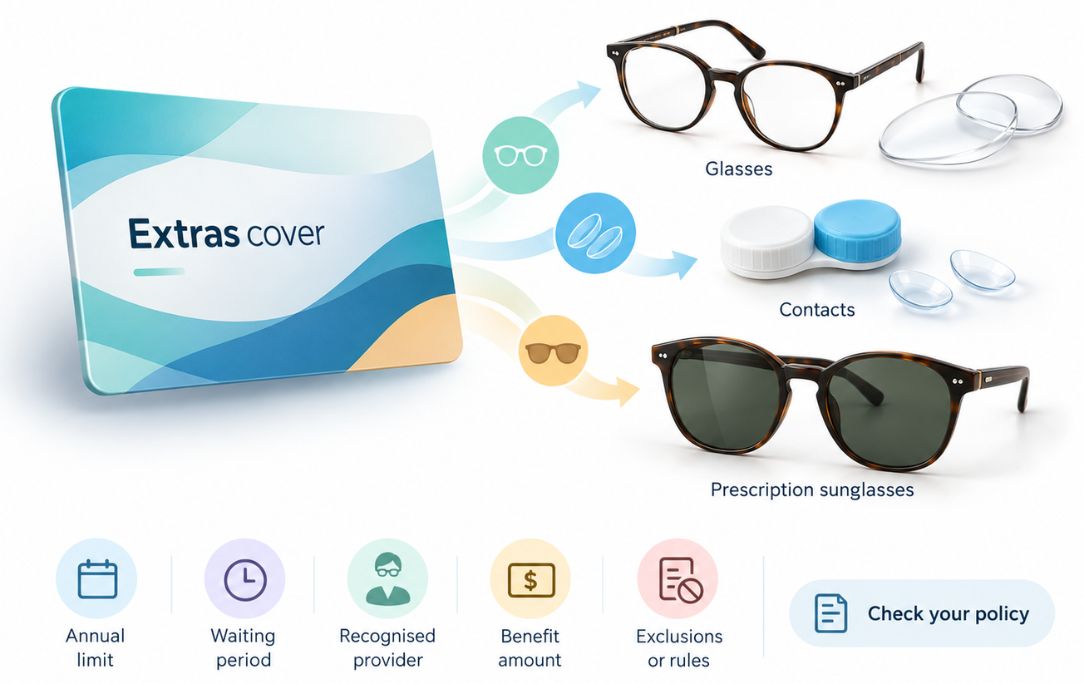
- frames and prescription lenses
- contact lenses
- prescription sunglasses
What is included varies by fund and policy. Annual limits, waiting periods, recognised-provider rules, benefit amounts and exclusions can all apply. Some policies also exclude particular lens coatings, upgrades or non-prescription eyewear.
Are optical Extras the same as Medicare?
No. Medicare and private health insurance Extras are separate.
Services Australia says Medicare can cover eligible eye tests when an optometrist bulk bills. It does not cover the cost of glasses or contact lenses. Private health insurance may help with those costs, depending on your level of cover.
When planning the cost, ask the practice about consultation fees or bulk billing and ask your health fund what benefit may apply to the eyewear you are considering.
Do Optical Benefits Reset on 1 January?
Some major funds use 1 January, but not all. HBF HBF Health Insurance and nib nib Health Insurance state that annual limits reset on 1 January. Bupa Bupa Australia says annual limits for its FLEXtras product reset on 1 January, while ahm ahm Health Insurance says most Extras limits reset on 1 July.
| Example fund | Current reset information | What readers should do |
|---|---|---|
| HBF HBF Health Insurance | Annual limits reset on 1 January each year. | Check the member account and product rules for optical. |
| nib nib Health Insurance | Annual limits reset on 1 January; nib specifically mentions optical. | Check remaining limits in the member account. |
| Bupa Bupa Australia | FLEXtras annual limits reset on 1 January. | Check your own Bupa product because rules can vary by cover. |
| ahm ahm Health Insurance | Most Extras limits reset on 1 July. | Check the product guide because some services use different periods. |
These are examples only. Your own product guide or member account is the best place to confirm your optical reset date, remaining limit and any special rules.
Does that mean unused optical benefits disappear?
They can. If your optical annual limit resets and your health fund does not allow unused optical benefits to roll over, any remaining amount may no longer be available in the new benefit period.
Sometimes. If your optical annual limit resets and unused benefits do not roll over, any remaining amount may no longer be available in the new benefit period.
Rollover rules vary between health funds and policies.
Rollover rules vary. For example, ahm’s 2026 rollover information says optical is excluded where it has a separate annual limit.
Treat “use it or lose it” as a reminder to check your cover, not as a rule that applies to everyone.
Why Check Your Optical Extras Before the End of the Year?
If your optical limit resets on 1 January and new eyewear is already on your list, checking a few months before year end gives you time to understand the benefit and compare suitable options without rushing.
A quick check can help you confirm:
- how much optical benefit remains
- when the optical benefit period resets
- which eyewear items are eligible
- whether provider requirements apply
- whether a waiting period or other restriction applies
- the expected benefit and out-of-pocket amount
Before You Claim, Check These Six Things
Log in to your health fund account or app and look specifically for optical. Do not assume your total Extras balance applies to eyewear.
Check the current product guide or member account for the date that applies to your optical benefit.
Ask whether your policy contributes towards the product you are considering, such as frames and prescription lenses, contact lenses or prescription sunglasses. A useful question is: “What benefit would my policy pay towards this exact item?”
Ask whether the practice is recognised for the benefit you want to claim. The practice can explain its claiming process, but the health fund determines what your policy pays.
Before ordering, check the total price, expected health-fund contribution and your likely out-of-pocket cost.
If your vision has changed, your current eyewear is no longer suitable or an eye-care professional has recommended a review, arrange appropriate care. Do not book healthcare simply to use up an insurance allowance.
Is Your Eye
Health on Track?
Complete our free 18-point checklist to check your eye health, spot any gaps, and take charge of your vision.
Start Free Checklist Test →Do you need an eye test before buying new glasses?
Not just because an Extras benefit is available. Whether you need an eye examination depends on your vision, symptoms, prescription, and individual circumstances.
If you have noticed a change in vision, are having difficulty with your current prescription or have been advised to return for review, an optometrist can assess your vision and discuss whether your prescription or eyewear needs have changed.
Services Australia says you can book an eye test directly with an optometrist without a GP referral. Medicare arrangements for the examination are separate from private health insurance benefits for glasses or contact lenses, so ask the practice about fees or bulk billing.
What if you already know you need new glasses or contact lenses?
If new prescription eyewear is already something you need, checking your optical benefit before ordering can help you plan your budget and compare suitable options.
Before ordering, consider asking the practice:
- What options suit my prescription and everyday needs?
- What is included in the quoted price?
- Are there additional lens options I should understand?
- Can you provide an itemised quote?
- Does this practice participate with my health fund?
- What should I confirm with my insurer before ordering?
The point is to understand what your cover can contribute to something you already need, not to spend simply because a limit may reset.
Can optical Extras be used for prescription sunglasses?
They may be. Some Australian Extras policies include prescription sunglasses, but eligibility and benefit amounts depend on the specific policy.
Check with your fund before ordering. Then discuss your prescription, UV protection, frame fit and intended use with the individual practice.
You can also read AMV’s guide to Prescription Sunglasses in Australia.
Planning new eyewear?
If you already need an eye examination, replacement glasses, contact lenses or prescription sunglasses, checking your remaining optical Extras can be a useful part of planning the cost.
Australian Made Vision can help you find independent optometry practices across Australia. Each practice provides its own examinations, prescriptions, products, fees and clinical care.
Find an independent optometrist near you: Australian Made Vision directory
Before booking or ordering, confirm the practice’s services, fees and health-fund claiming arrangements directly with the practice. Confirm your benefits and eligibility with your health fund.
Find Eye Care That Suits Your Needs
Search for an independent optometrist near you and find a local practice that suits your specific eye care needs.
Find an OptometristFrequently asked questions
Do all optical Extras expire on 31 December?
No. Some health funds reset annual limits on 1 January, while others use different dates. Some benefits may also have rollover rules. Check the current rules for your own optical cover.
Do optical Extras renew in October?
No. There is no universal October reset for Australian optical Extras. HBF and nib use 1 January for annual limits, Bupa’s FLEXtras also resets on 1 January, and ahm says most Extras limits reset on 1 July.
Does Medicare pay for glasses?
No. Services Australia says Medicare does not cover the cost of glasses or contact lenses. Private health insurance may contribute to eligible optical products depending on your level of Extras cover.
Can I claim prescription sunglasses through Extras cover?
Some policies include prescription sunglasses. Eligibility, annual limits and benefit amounts vary, so check the exact item with your fund before ordering.
Do unused optical benefits roll over?
Not always. Rollover rules vary and some programs exclude optical. Check your current product guide or member account to see what applies to your cover.
Should I get an eye test just because my benefits are about to reset?
No. Your health needs should come first. Arrange an eye examination when it is appropriate for your vision, symptoms, prescription review or professional advice, not simply because an insurance limit is approaching its reset date.
Australian Made Vision is an independent directory that helps patients find optometrists across Australia who may offer Australian-made spectacle lenses. We do not provide clinical services and recommend contacting practices directly to confirm the products and services they offer.
Sources
- HBF Health Insurance – Understand your Extras cover. https://www.hbf.com.au/support/help-centre/health-insurance-explained/understand-your-extras-cover Public page states annual limits reset on 1 January each year.
- nib – When do private health insurance annual limits reset? https://www.nib.com.au/the-checkup/understanding-and-using-cover/health-insurance/when-do-private-health-insurance-annual-limits-reset Public page states annual limits reset on 1 January and specifically mentions optical.
- Bupa – FLEXtras designed by you. https://www.bupa.com.au/health-insurance/flextras Public page states FLEXtras annual limits reset on 1 January. Check the member’s own Bupa product information because rules can vary by cover.
- ahm – When do annual limits on my Extras reset? https://help.ahm.com.au/hc/en-us/articles/115005463988-When-do-annual-limits-on-my-extras-reset Public page states most Extras limits reset on 1 July.
- ahm – Your Extras annual limits are sticking around for longer. https://help.ahm.com.au/hc/en-us/articles/15826854580879-Your-extras-annual-limits-are-sticking-around-for-longer 2026 rollover information states optical is excluded where it has a separate annual limit.
- Services Australia – Screening, tests and scans covered by Medicare. https://www.servicesaustralia.gov.au/screening-tests-and-scans-covered-medicare?context=60092 States that Medicare can cover eligible eye tests but does not cover glasses or contact lenses.
- Ahpra – Guidelines for advertising a regulated health service. https://www.ahpra.gov.au/Resources/Advertising-hub/Advertising-guidelines-and-other-guidance/Advertising-guidelines.aspx Advertising must not encourage the indiscriminate or unnecessary use of regulated health services.
- Medibank – Optical Health Insurance. https://www.medibank.com.au/health-insurance/optical/ Current public information says prescription glasses, contact lenses and prescription sunglasses are included in eligible Extras cover, subject to waiting periods, annual limits and exclusions.