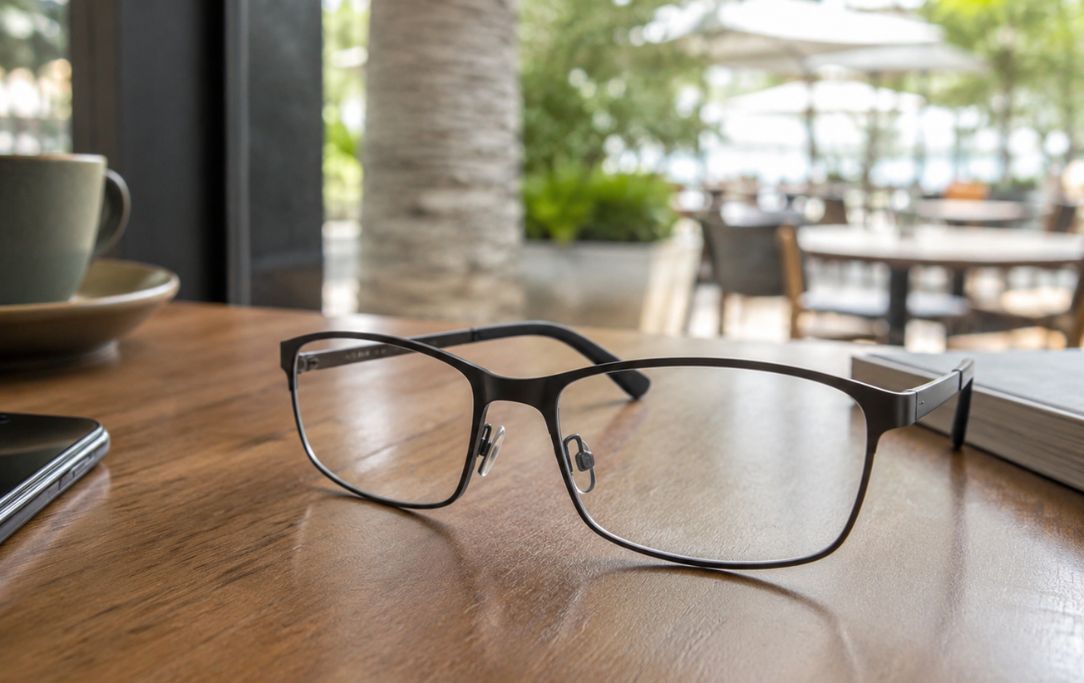
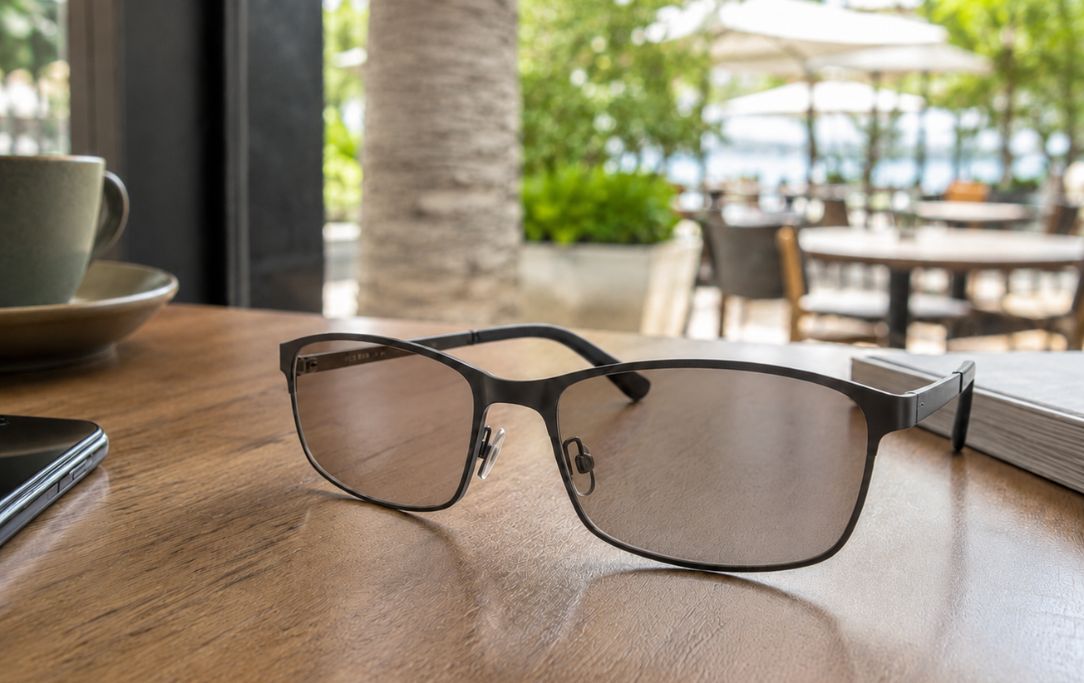
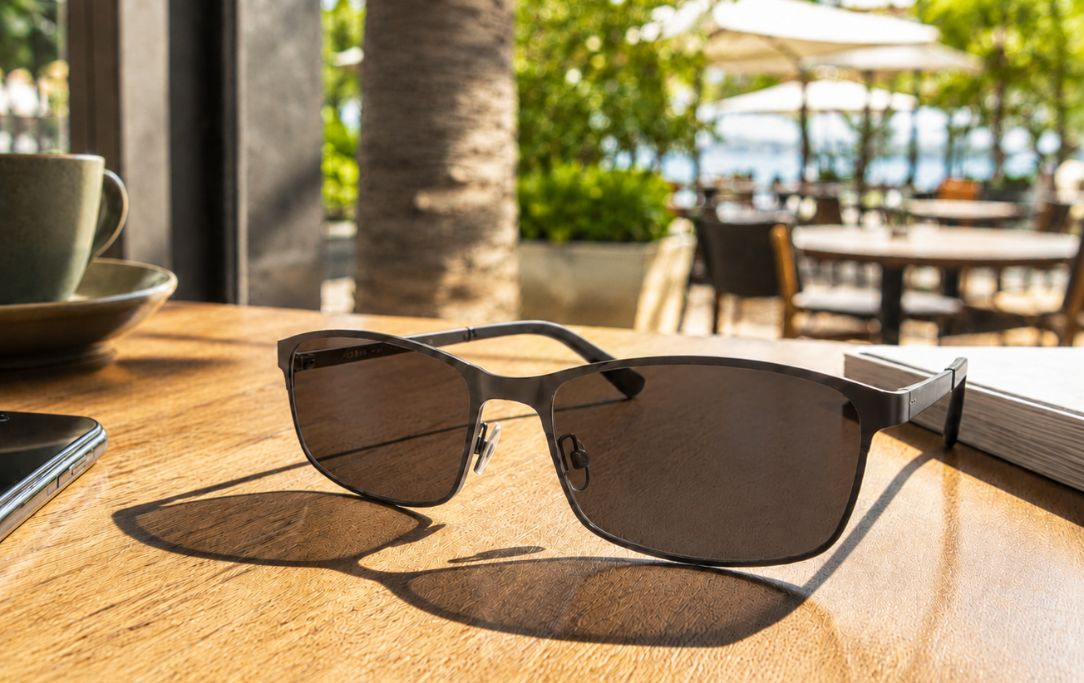
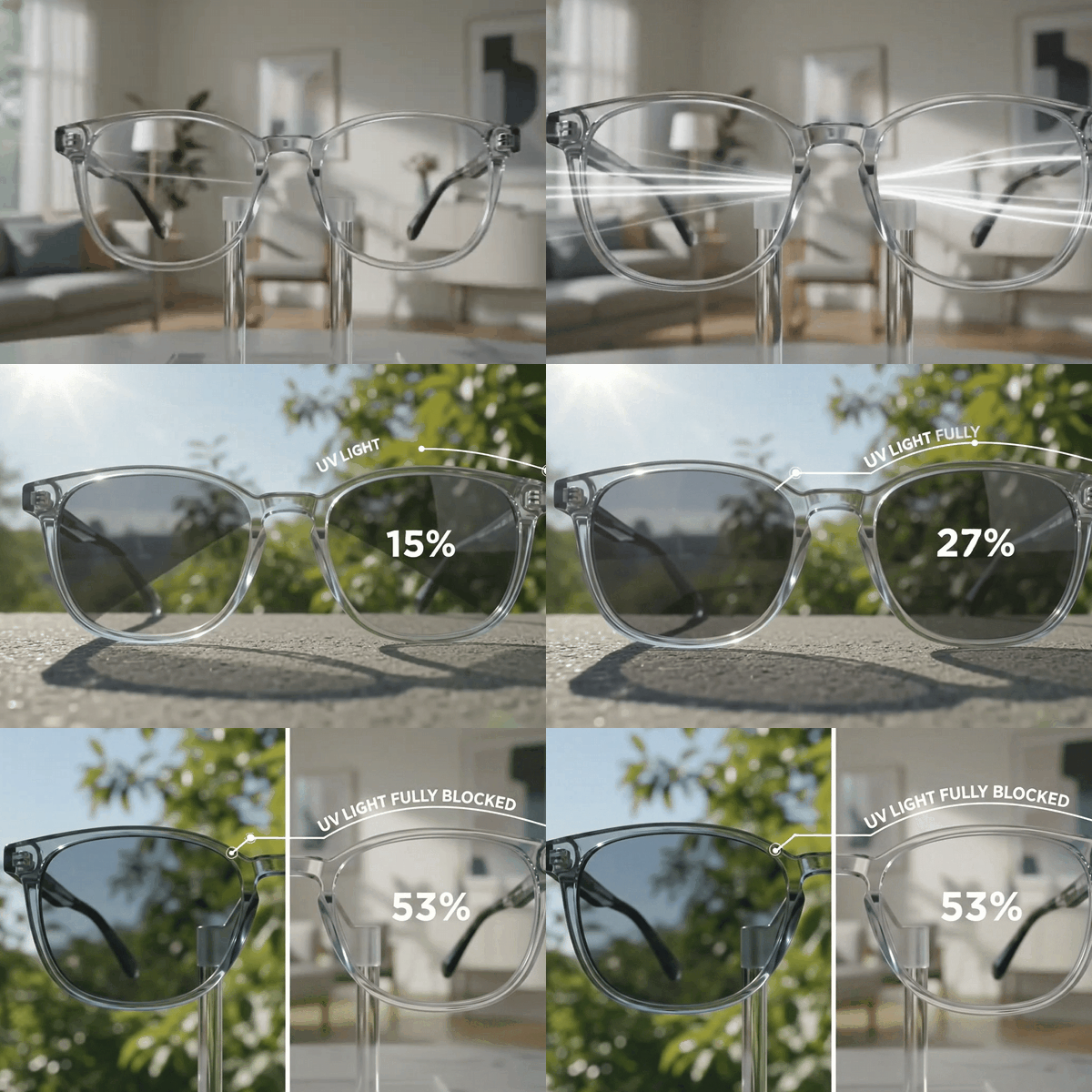
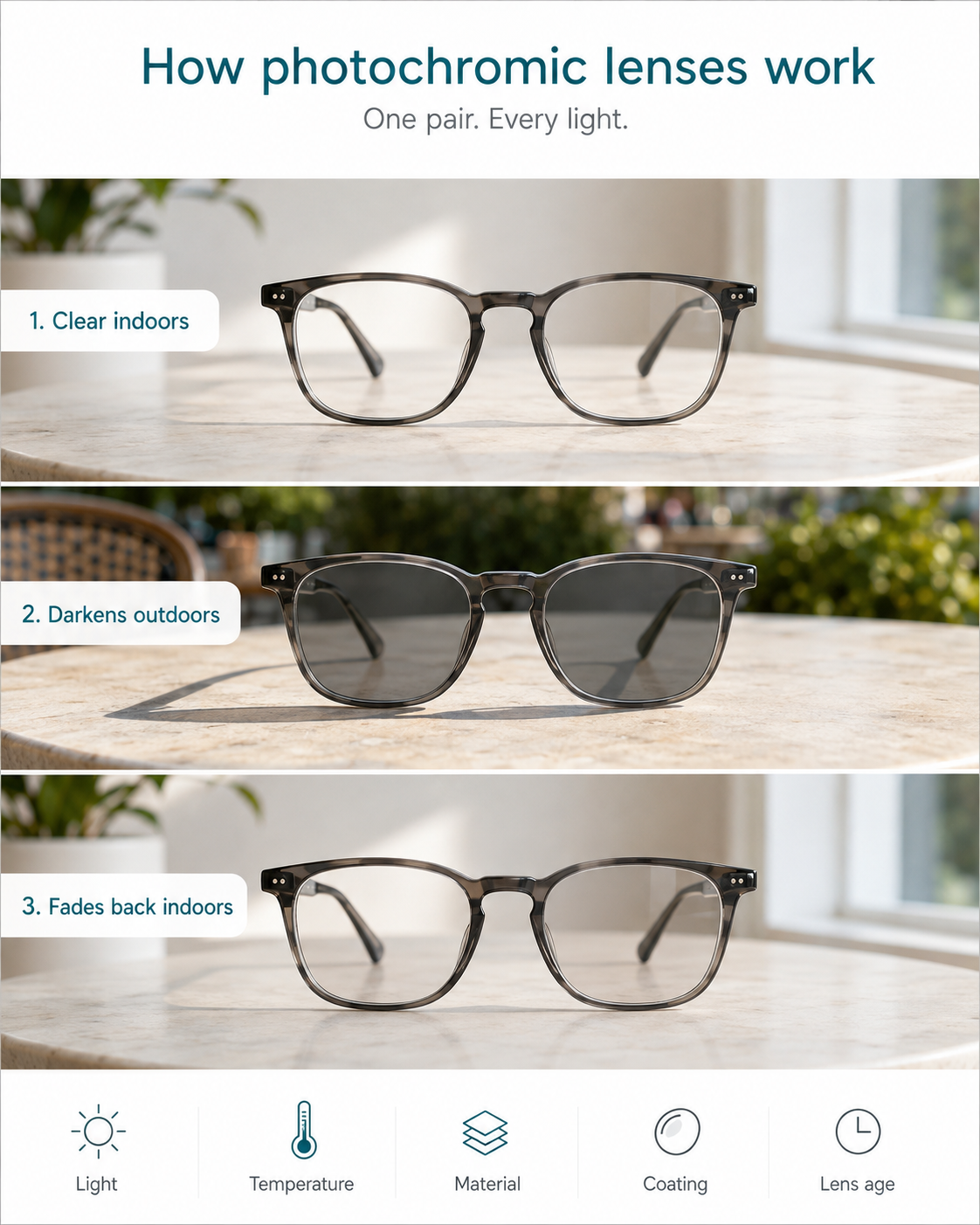
How do photochromic lenses work?
Photochromic compounds undergo a reversible change when exposed to activating wavelengths of light. This changes how much visible light the lens absorbs, producing the darker appearance. When the activating light is no longer present, the compounds move back towards their clearer state.
Many products respond mainly to ultraviolet light. Some variants also respond to visible light, which can affect how they perform where much of the UV has been filtered, including inside a vehicle. These claims need to be checked for the exact product because material, colour and coatings can affect the result.
Darkening and fade-back are gradual rather than instant. Timing and tint depth change between products and environments, so a product comparison is more useful than one general timing claim.
What affects darkening and fade-back?
The main factors include:
- the amount and type of activating light
- ambient temperature
- lens material, colour and coatings
- product design and photochromic formulation
- lens age and condition, where supported by the product information
What are the limitations of photochromic lenses?
Standard UV-responsive lenses may not become as dark inside a vehicle as they do outdoors because laminated windscreens filter most UVA radiation. Some visible-light-responsive products are designed to darken more in a car, but performance still varies.
Photochromic lenses also need time to darken and return towards clear. Some wearers notice a temporary tint after moving indoors, while others prefer the predictable appearance of a fixed-tint sunglass lens.
Temperature is another factor. Some lenses become darker in cooler conditions and lighter in warmer conditions. Fade-back can also change with temperature.
A photochromic tint is not automatically polarised. It may reduce general brightness without controlling reflected glare from roads or water in the same way as a polarising filter. For long periods of driving, boating or other high-glare activities, prescription sunglasses with polarisation may be a better separate option.
Are photochromic lenses suitable for driving?
They can be worn for daytime driving when the finished lens is appropriate for road use, but standard photochromic lenses may not darken fully behind a laminated windscreen. Cancer Council Australia reports that laminated windscreens block about 98% of UVA, which helps explain why a mainly UV-responsive lens may remain relatively light inside the car.
Some products respond to visible light and may darken more behind a windscreen. Check the indoor base tint, daytime darkness, fade-back, road-use information and prescription suitability.
For prolonged daytime driving or strong reflected glare, a dedicated polarised prescription sunglass pair may provide more consistent tint and glare control. Night driving is a separate issue; do not use a tinted lens at night if it reduces the light you need to see.
Photochromic vs polarised vs prescription sunglasses
These options solve different problems. Photochromic lenses adjust their tint with activating light. Polarised lenses reduce certain reflected glare. Fixed-tint prescription sunglasses provide a consistent outdoor tint.
Photochromic lenses are often considered for frequent indoor-outdoor movement. Polarised sunglasses may suit driving, water and high-glare activities. Fixed-tint prescription sunglasses may suit people who want predictable outdoor darkness and do not mind changing pairs.
None of these labels proves the complete performance of a finished lens. UV protection, prescription accuracy, tint, road-use suitability, fit and product evidence should still be checked.
Who may find photochromic lenses useful?
Photochromic lenses may suit people who:
- frequently move between indoor and outdoor settings
- want one everyday pair for short or moderate periods outside
- prefer not to carry and change between two pairs throughout the day
- use single-vision, multifocal, progressive or higher-index lenses where a compatible option is available
- are comfortable with a tint that changes gradually rather than remaining fixed
They may be less suitable when the main need is prolonged driving, strong reflected glare, a consistently dark sunglass tint or a completely clear indoor appearance.
Children and adults can be considered for photochromic lenses, but suitability depends on prescription, activities, fit and product information. Do not use them as a substitute for assessment of persistent light sensitivity, pain, redness or vision changes.
What should you compare before choosing a product?
Compare the features that affect your day rather than choosing by a general “best lens” claim:
- indoor clarity and residual tint
- outdoor darkness in your usual conditions
- performance behind a windscreen and in heat
- tint colour and appearance
- compatibility with your prescription, material, frame and multifocal design
- whether the product is photochromic only, visible-light responsive or photochromic-polarised
- UV information for the finished prescription lenses
- total price, coatings, warranty, remake policy, adjustments and aftercare
Australia’s mandatory safety standard for sunglasses and fashion spectacles does not apply to prescription and readymade spectacles. For prescription photochromic lenses, ask what evidence supports the stated UV protection and visible-light performance.
When should you arrange an eye examination?
A current prescription and accurate dispensing measurements are useful when ordering prescription photochromic lenses. Arrange an eye examination if your prescription may be outdated, details are becoming harder to see or your vision needs have changed.
New or persistent light sensitivity, eye pain, redness or vision changes should be assessed rather than managed by changing lenses alone. The cause cannot be determined from an eyewear guide.
Choosing the next step
The most suitable option depends on your prescription, indoor-outdoor routine, driving, glare exposure, preferred tint, budget and aftercare needs. Compare a specific photochromic product with polarised and fixed-tint prescription sunglasses rather than assuming one pair will cover every situation.
Use the Australian Made Vision directory to find an independent optometrist. The practice can assess your prescription and explain the products, measurements, prices and fitting options it provides.
Frequently asked questions
The information in this article is provided for general educational purposes only and should not be considered medical advice. For personalised advice regarding your vision or eye health, please consult a qualified optometrist.
Australian Made Vision is an independent directory that helps patients find optometrists across Australia who may offer Australian-made spectacle lenses. We do not provide clinical services and recommend contacting practices directly to confirm the products and services they offer.
- Cancer Council Australia — Fact sheet: Eye protection — Prescription-lens UV context, tint and polarisation distinctions, and advice to confirm UV protection. https://www.cancer.org.au/about-us/policy-and-advocacy/prevention/uv-radiation/related-resources/fact-sheet-eye-protection — Accessed 31 July 2026.
- Cancer Council Australia — Fact sheet: Tinted windows — Australian vehicle-glass context, including UVA filtering by laminated windscreens. https://www.cancer.org.au/about-us/policy-and-advocacy/prevention/uv-radiation/related-resources/tinted-windows — Accessed 31 July 2026.
- Australian Radiation Protection and Nuclear Safety Agency (ARPANSA) — Sun protection using sunglasses — Australian UV, glare, reflective-surface and driving guidance. https://www.arpansa.gov.au/understanding-radiation/radiation-sources/more-radiation-sources/sun-protection-sunglasses — Accessed 31 July 2026.
- ACCC Product Safety — Sunglasses and fashion spectacles mandatory standard — Scope of the Australian mandatory standard and exclusion of prescription and readymade spectacles. https://www.productsafety.gov.au/business/search-mandatory-standards/sunglasses-and-fashion-spectacles-mandatory-standard — Accessed 31 July 2026.
- Moon B-Y, Kim S-Y and Yu D-S — Differences in the optical properties of photochromic lenses between cold and warm temperatures — Peer-reviewed study of temperature-related tint and fade-back differences between products. PLOS ONE, 2020. https://doi.org/10.1371/journal.pone.0234066
- Cancer Council Australia — UV Index — Australian guidance noting that UV can remain strong on cool or cloudy days. https://www.cancer.org.au/cancer-information/causes-and-prevention/sun-safety/uv-index — Accessed 31 July 2026.
- Transitions Australia — Transitions lenses and current product information — Manufacturer source used only to confirm that current named products and product variants differ. Product claims must be rechecked before publication. https://www.transitions.com/en-au/ — Accessed 31 July 2026.
- Therapeutic Goods Administration — Prescription lenses: exempt medical devices — Current Australian regulatory context for prescription lenses supplied only for refractive correction. https://www.tga.gov.au/news/news-articles/prescription-lenses-exempt-medical-devices — Accessed 31 July 2026.
- Australian Health Practitioner Regulation Agency — Guidelines for advertising a regulated health service — Accuracy, evidence, comparison and unreasonable-expectation checks for regulated-health-service advertising. https://www.ahpra.gov.au/Resources/Advertising-hub/Advertising-guidelines-and-other-guidance/Advertising-guidelines.aspx — Accessed 31 July 2026.