
Most people do not need blue-light glasses to protect their eyes from ordinary screen use. A 2023 Cochrane review found that blue-light filtering lenses may not meaningfully reduce short-term eye strain compared with clear lenses, while evidence about sleep remains uncertain. The review also found no clinical trial evidence that these lenses protect macular health.
For people comparing blue light glasses in Australia, that does not mean the product is useless or that no one can prefer it. It means the decision should be based on realistic expectations. Screen discomfort often relates to prolonged close work, reduced blinking, glare, lighting, the viewing setup or an unsuitable prescription rather than blue light alone.
This guide explains what blue-light lenses are, what the evidence supports, how they compare with other lens options and what to ask before paying extra for a filter.
Quick answer
Most people do not need blue-light glasses to protect their eyes from ordinary screen use. They may still be chosen as an optional lens feature, but current evidence does not establish retinal protection, and benefits for eye strain or sleep remain limited or uncertain.
What are blue light glasses?
Blue light is part of the visible-light spectrum. It has a shorter wavelength than colours such as red or orange. Sunlight is the main natural source, while indoor lighting, televisions, computers, tablets and phones also emit some blue light.
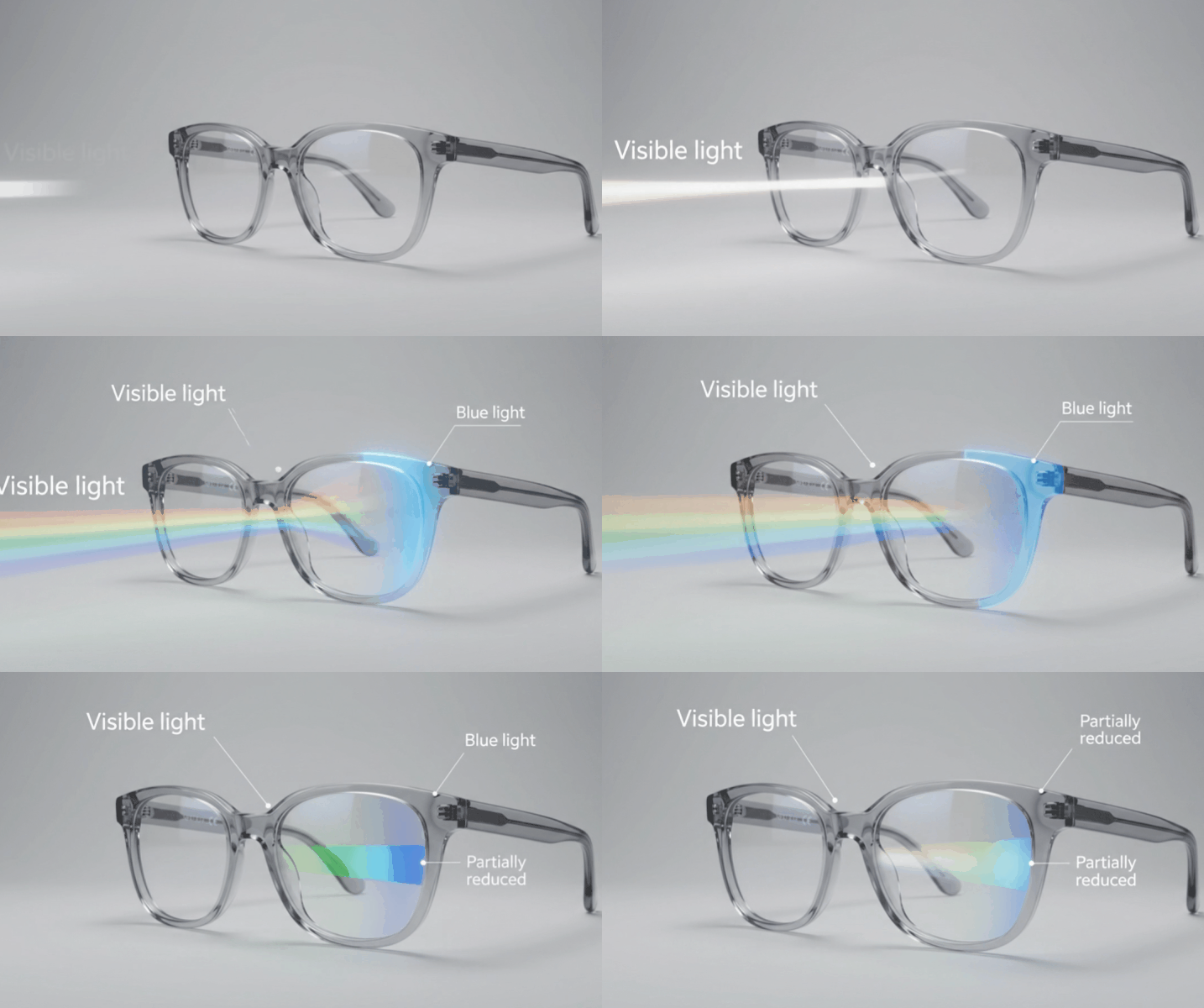
Blue light glasses use a lens material, tint or surface treatment designed to reduce varying amounts of short-wavelength visible light. The amount filtered, the wavelength range, and the visible colour of the lens depend on the specific product. Some lenses appear almost clear, while stronger filters may look yellow or amber.
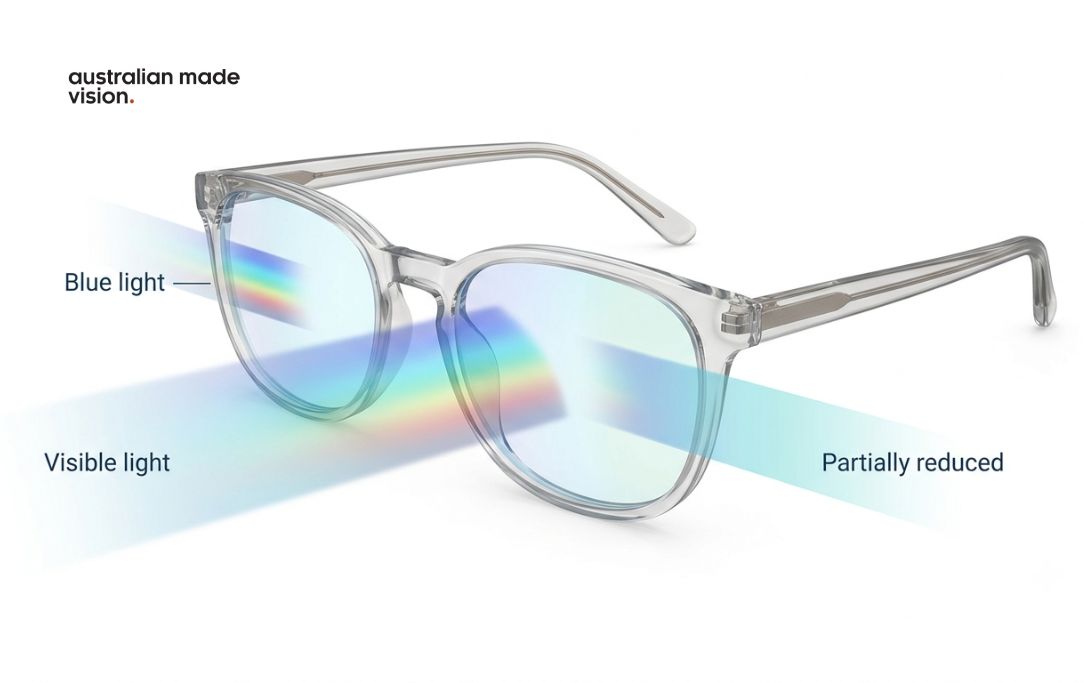
A blue-light filter is not the same as ultraviolet protection. It is also different from an anti-reflective coating, which is intended to reduce reflections from lens surfaces, and from an office lens, which changes the prescription design for near and intermediate tasks. A single pair of glasses may include more than one feature, but each should be assessed separately.
Find Eye Care That Suits Your Needs
Search for an independent optometrist near you and find a local practice that suits your specific eye care needs.
Find an OptometristDo blue light glasses work for digital eye strain?
The strongest summary currently available is the Cochrane review of 17 randomised trials involving 619 adults. It concluded that blue-light filtering lenses may not reduce short-term eye strain associated with computer work compared with non-filtering lenses. The certainty of some findings was limited, and the studies varied in design, participants and follow-up.
This does not prove that every wearer will have the same experience. Someone may prefer the appearance of a lens, notice less reflection from a separate coating or simply feel more comfortable wearing a particular pair. Those individual preferences should not be turned into a general medical claim that blue-light filtering treats digital eye strain.
Look beyond the filter
For Australian screen users, a more useful first question is: “What is contributing to the discomfort?”
Screen habits
Work setup
Tear-film quality
Focusing demands or prescription
Why screens can still feel uncomfortable
Healthdirect Australia explains that eye strain can occur during prolonged concentration, including reading, driving and device use. Long periods of close work can leave the eyes feeling tired, sore, dry or difficult to focus.
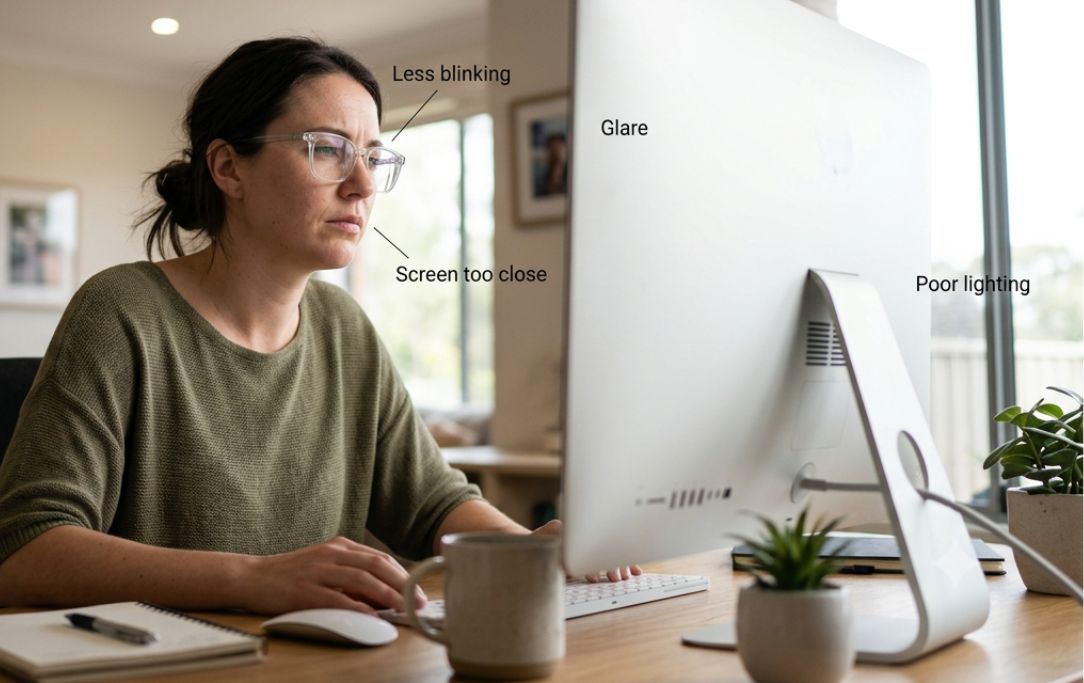
Several factors may contribute:
- Reduced blinking, which can allow the eye surface to become dry or irritated.
- Long periods of near focus without a change in viewing distance.
- Glare, reflections, unsuitable brightness or poor room lighting.
- A screen that is too close, too high or difficult to read.
- A glasses prescription that no longer meets the person’s needs or is not suited to the task.
- Another eye or vision issue that needs assessment.
Related guide
Practical steps are covered in more detail in Australian Made Vision’s guide to reducing digital eye strain .
Can screen blue light damage your eyes?
The Royal Australian and New Zealand College of Ophthalmologists (RANZCO) stated in its 2019 position paper that there was no evidence that normal environmental exposure to blue light, including light from digital screens, causes damage to eyesight. It also said filtering screen blue light is not generally necessary for ordinary use.
ARPANSA’s summary of LED safety evidence similarly reports that comfortable computer and mobile displays are not expected to present a health risk under reasonable viewing conditions. Viewing distance, brightness, glare, duration, and the type of light source still matter, particularly when a display is uncomfortably bright.
Blue light should also not be confused with ultraviolet radiation. UV exposure from sunlight is a separate eye-health issue. A claim that a lens filters blue light does not automatically confirm the level of UV protection, and a UV-protection claim should be checked against the product information.
Evidence check
Marketing claims that ordinary screen use causes retinal damage, macular degeneration or permanent vision loss go beyond the evidence available for typical viewing conditions. Blue-light glasses should not be presented as insurance against those outcomes.
Is Your Eye
Health on Track?
Complete our free 18-point checklist to check your eye health, spot any gaps, and take charge of your vision.
Start Free Checklist Test →Can blue light glasses improve sleep?
Light is one of the signals that helps regulate the body clock, and evening screen use can delay bedtime for several reasons. The activity itself may be stimulating, notifications may keep a person engaged, and light exposure may play a role. That does not automatically mean a clear blue-light filtering spectacle lens will improve sleep.
The Cochrane review found mixed results across six small trials and rated the evidence about sleep quality as very uncertain. ARPANSA’s 2024 discussion of blue light and sleep also notes that evidence about blue light from mobile devices causing sleep disturbance remains unclear.
A practical approach is to reduce late-night screen use, dim the environment and keep devices away from the bed when they interfere with sleep. These habits may help by reducing both light exposure and on-screen distractions. Persistent sleep problems are better discussed with a GP or another suitably qualified clinician rather than treated with glasses alone.
Comparing blue light, anti-reflective, and office lenses in Australia
These options address different parts of the viewing experience. The most suitable choice depends on the prescription, the task, the working distance, reflections, colour requirements and personal preference.
| Option | What it changes | Where it may be useful | Key limitation / question |
|---|---|---|---|
| Blue-light filter | Reduces part of the short-wavelength visible-light spectrum. | Optional preference when the wearer understands the evidence limits and likes the lens characteristics. | Filtering strength, tint and claims vary. Ask for product-specific information. |
| Anti-reflective coating | Reduces reflections from the lens surfaces. | May be considered when reflections from lighting or the lens itself are bothersome. | It is separate from blue-light filtering. Ask which features are included. |
| Occupational or office lens | Uses prescription zones designed for near and intermediate working distances. | May suit people who need a wider computer or desk-working area than general-purpose lenses provide. | Task-specific designs can limit distance vision. Ask when and where the lenses should be worn. |
| Standard clear prescription lens | Corrects the prescribed refractive error without a dedicated blue-light feature. | May be sufficient when the prescription and fitting suit the task. | Comfort still depends on the setup, lens design, fit and individual visual needs. |
Find Eye Care That Suits Your Needs
Search for an independent optometrist near you and find a local practice that suits your specific eye care needs.
Find an OptometristWho might still choose blue light lenses?
A person may still choose a blue-light filter as an optional lens feature after reviewing the evidence and comparing it with other options. Preference can be influenced by the lens appearance, a mild tint, the way a sample looks under particular lighting or a desire to reduce a defined part of the visible spectrum.
The decision deserves more care when accurate colour judgement matters. Designers, photographers, video editors, and others who work with colour should ask whether the specific filter changes colour perception. A sample lens or written transmission information may be more useful than a broad label such as “blue blocker”.
Prescription accuracy and fit still matter. A filter cannot correct an outdated prescription, an unsuitable working distance or a frame that does not sit correctly. Product availability, warranties, and aftercare also vary between practices, so those details need to be confirmed before purchase.
What to try before buying blue light glasses
Before paying for an additional filter, review the parts of screen use that are more commonly linked with discomfort:
- Take regular visual breaks. The 20-20-20 approach means looking at something about 20 feet, or 6 metres, away for 20 seconds every 20 minutes.
- Blink deliberately during concentrated tasks, especially when the eyes begin to feel dry.
- Set the screen brightness and contrast to a comfortable level rather than making the display much brighter than the room.
- Reduce reflections from windows or overhead lights and keep the screen clean.
- Position the top of the screen around or slightly below eye level and use a comfortable viewing distance.
- Increase text size instead of leaning towards the screen.
- Have the prescription reviewed if vision is blurred, focusing is difficult, or current glasses no longer help.
Important
Dryness, headaches, or focusing symptoms can have different causes. Eye drops, exercises, or task-specific lenses should not be chosen from a general article alone. An optometrist or doctor can discuss options based on your symptoms and examination findings.
Find an Optometrist Near YouWhen screen discomfort should be checked
Healthdirect recommends seeing a doctor or optometrist when eye-strain symptoms do not improve after resting the eyes, when they become worse, or when existing glasses no longer help as much as they used to.
An eye examination may include checking vision, the current prescription and other factors related to the symptoms. The exact tests vary with the person and the practice.
Sudden or severe changes in vision should not be attributed to blue light or managed by buying glasses. They need prompt, situation-specific medical assessment.
Questions to ask an optometrist in Australia
A clear product discussion should explain what the lens does, what it does not do and how it fits with the prescription and daily tasks. Useful questions include:
- What evidence supports the specific benefit being claimed for this lens?
- Which wavelengths does it reduce, and by how much?
- Does the lens have a visible tint or affect colour perception?
- Is an anti-reflective coating included, or is it a separate option?
- Would a standard prescription or an office-lens design better address my working distance?
- Do my prescription and measurements need to be updated before ordering?
- What warranty, remake policy and aftercare are included?
- If the product is described as Australian made or locally processed, what exactly was made in Australia and how is that claim substantiated?
A practice should be able to separate evidence-based information from marketing language. It is reasonable to ask for the product name and written specifications before deciding.
Are blue light glasses worth it?
Blue light glasses may be worth considering as an optional add-on when the wearer understands the evidence limits, likes the lens characteristics and is comfortable with the extra cost. They should not be treated as a default requirement for anyone who uses a computer or phone.
Before deciding, consider the reason for buying them. If the main concern is eye strain, review breaks, blinking, glare, screen position, and the prescription first. If reflections are the problem, ask whether an anti-reflective coating is the more relevant feature. If the working distance is difficult through current glasses, a task-specific prescription design may deserve discussion.
The balanced takeaway is simple: blue-light filters are a preference, not proven protection against normal screen use. Persistent symptoms deserve assessment rather than a product-only solution.
A measured next step
Blue-light glasses are not necessary for most people to protect their eyes from normal screen use. They remain an optional feature that may suit personal preferences, provided the benefits are not overstated.
When screen discomfort persists, worsens or affects daily work, an eye test can help identify whether the prescription, focusing demands, dryness or another issue may be contributing. Services and lens options vary between practices, so confirm what is available directly with the practice.
Use the Australian Made Vision directory to find an independent optometrist near you.
Find Eye Care That Suits Your Needs
Search for an independent optometrist near you and find a local practice that suits your specific eye care needs.
Find an OptometristBlue Light Glasses FAQs
Do I need blue light glasses if I use a computer all day?
Not routinely. Evidence does not show that everyone who uses a computer needs blue-light filtering for eye protection or short-term eye-strain relief. Regular breaks, a comfortable setup, and an appropriate prescription are more useful starting points.
Do blue light glasses prevent retinal damage or macular degeneration?
Clinical trials have not established that blue-light filtering spectacle lenses protect macular health. Ordinary screen exposure has also not been shown to require blue-light glasses for retinal protection under normal viewing conditions.
Can blue light glasses help headaches?
Headaches during screen use can have several contributors, including visual effort, dryness, glare, posture or an unsuitable prescription. A blue-light filter should not be assumed to treat the cause. Recurrent or worsening headaches should be discussed with an appropriate health professional.
Do blue light glasses help sleep?
The evidence is uncertain. Some small trials reported improvements, while others did not. Reducing late-night screen use and keeping devices out of the bedtime routine may be more practical than relying on glasses alone.
What is the difference between blue-light filters, anti-reflective coatings and office lenses?
A blue-light filter reduces part of the visible-light spectrum. An anti-reflective coating reduces reflections from lens surfaces. An office lens changes the prescription design to support near and intermediate tasks. These features can be combined, but they solve different problems.
Can a blue-light filter be added to prescription glasses?
Many lens ranges offer a blue-light filtering option, but availability and specifications vary. Ask the practice whether the filter is built into the lens material, applied as a coating, combined with other treatments or available for the prescribed lens design.
Australian Made Vision is an independent directory that helps patients find optometrists across Australia who may offer Australian-made spectacle lenses. We do not provide clinical services and recommend contacting practices directly to confirm the products and services they offer.
- Cochrane — Blue-light filtering spectacle lenses for visual performance, macular protection and improving sleep quality (2023).
- RANZCO — Blue Light and Digital Screens position statement (approved July 2019; published October 2019).
- Healthdirect Australia — Eye strain (last reviewed April 2024).
- ARPANSA — ICNIRP statement on the potential health effects of light-emitting diodes (LEDs).
- ARPANSA — In the dark on blue light (4 April 2024).