
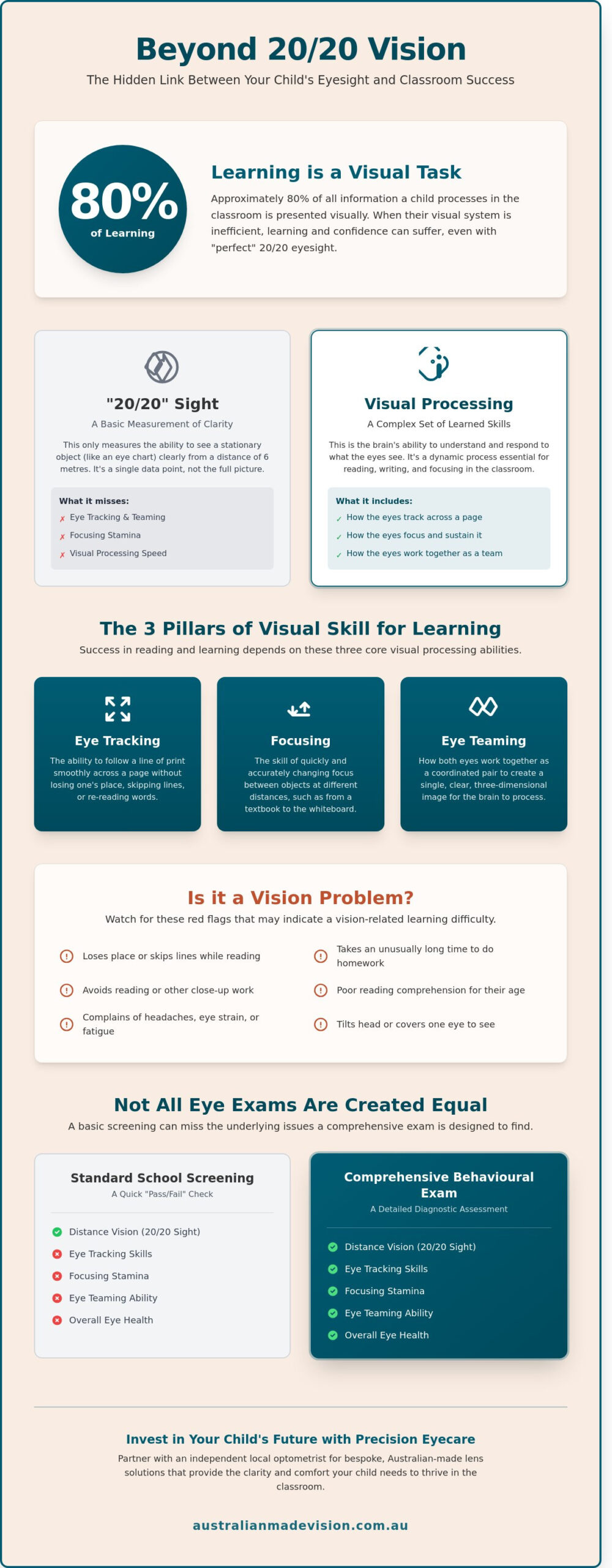
What if your child’s struggle with reading has nothing to do with their intelligence or effort, even if they passed their school vision screening with a perfect 20/20 score? It’s a confusing reality for many Australian families who see their children work twice as hard for half the results. The connection between vision and learning is far more complex than simply being able to see a whiteboard clearly, as approximately 80 percent of a child’s classroom learning is processed through their eyes.
You probably already feel that deep sense of frustration when homework time turns into a battle or when a bright child starts to lose their confidence. It’s natural to worry about potential misdiagnoses when the traditional checks say everything is fine, yet the reading progress remains stalled. This guide promises to clarify how sophisticated visual processing skills, like eye tracking and focusing, are the true foundations of success in the 2026 classroom.
We’ll explore the specific red flags that indicate a vision-related learning problem and explain why tailored care from a local independent optometrist makes all the difference. You’ll learn how to identify a trusted artisan of eye health who focuses on bespoke solutions and clinical precision for your child’s unique needs.
Key Takeaways
- Understand why clear 20/20 sight is only the beginning and how complex visual processing determines your child’s classroom performance.
- Learn to identify the subtle physical signs that distinguish vision and learning difficulties from common conditions like ADHD or dyslexia.
- Discover why a comprehensive behavioural eye exam provides a more detailed assessment of your child’s development than a standard retail check.
- Explore how choosing bespoke, Australian-made lenses ensures the precision and quality required to support your child’s focus and reduce eye strain.
- Gain the confidence to support your child’s education by partnering with independent local optometrists who provide personalised, community-focused care.
Beyond 20/20: Defining the Link Between Vision and Learning
In the modern Australian classroom, we ask more of a child’s eyes than ever before. While many parents believe that a “20/20” result on a basic school screening means their child is ready for the academic year, this only tells part of the story. Physical sight is simply the ability to see a letter on a chart from six metres away. In contrast, vision and learning are deeply intertwined because vision is the brain’s ability to interpret and act on what the eyes see. Research from the American Optometric Association indicates that 80% of all information a child receives in school is processed through the visual system.
The concept of Visual learning describes how students use images, symbols, and spatial awareness to acquire knowledge. When a child’s visual system isn’t functioning efficiently, this process breaks down. They might see the words clearly but struggle to track them across a page or sustain focus for longer than 10 minutes. This is why a simple screening often fails; it doesn’t test how the eyes perform during the sustained, heavy workloads required in 2026 classrooms.
The Difference Between Sight and Visual Processing
Sight is a measurement of clarity; vision is a specialised skill set. A child can have perfect 20/20 sight yet still fail to process text effectively. Visual efficiency involves how the eyes work together as a team. If the eyes don’t align correctly, the brain receives conflicting signals. This leads to fatigue and blurred text, even if the individual letters appear sharp. We believe in providing bespoke visual solutions that address these functional gaps, ensuring every child has the tools to succeed.
Why Early Detection in Australia is Critical
The Australian primary school curriculum now introduces complex near-vision tasks as early as Prep. Undiagnosed issues often lead to a sharp decline in a child’s confidence by Year 3, a pivotal year for literacy development. When a student falls behind because their eyes feel “tired,” they frequently label themselves as “not smart.” Addressing these gaps early through a comprehensive exam with a qualified local optometrist ensures that visual delays don’t become permanent learning barriers. It’s about giving every Australian child the best start with high-quality, personalised care that reflects our community values.
By choosing an independent practitioner, you access a level of precision and care that corporate chains often miss. These experts take the time to understand your child’s specific classroom environment. This thoroughness is the hallmark of Australian eyecare, combining clinical excellence with a genuine commitment to the next generation’s vision and learning outcomes.
The Essential Visual Skills Required for Classroom Success
Vision is a sophisticated process where the eyes and brain work in unison to make sense of the world. It isn’t just about having 20/20 sight. In the early years of primary school, approximately 80% of a child’s learning happens through their eyes. When we discuss vision-related learning problems, we aren’t just looking at how clearly a student sees the board. We’re examining how the brain interprets visual signals and how much effort that process requires.
An inefficient visual system carries a heavy energy cost. A child might start the school day with clear vision, but by 2:00 PM, their brain is exhausted from the constant strain of keeping images single and clear. This fatigue often looks like a lack of concentration or behavioral issues. Choosing high-quality, bespoke care from a local professional can help identify these subtle hurdles early. You can find a trusted partner for your child’s health through our directory of independent optometrists.
Tracking, Focusing, and Binocularity
Eye tracking is the mechanical ability to follow a line of print smoothly across a page. If this skill isn’t developed, a child will frequently lose their place or skip entire lines of text. Binocularity, or eye teaming, ensures both eyes work together as a coordinated pair. When the eyes don’t align perfectly, words may appear to float or double, making reading a painful chore. Focusing, also known as accommodation, allows a student to shift their gaze from the whiteboard to their desk and back again instantly. These skills develop rapidly between ages 3 and 6, providing the foundation for academic endurance.
Visual Perception and Memory
Visual perception is the brain’s ability to give meaning to what the eyes see. Visual discrimination is a key component; it helps a child distinguish between similar letters like “b” and “d” or “p” and “q”. Without this, literacy becomes a confusing puzzle. Visual memory allows a student to recall what a word looks like, which is vital for building reading fluency and spelling skills. When these cognitive functions are weak, vision and learning become disconnected. This often manifests as poor handwriting, as the child struggles with visual-motor integration, the link between seeing a shape and directing the hand to draw it accurately.
Precision matters in eyecare. Every child deserves a visual system that supports their potential rather than holding them back. By focusing on these essential skills, we ensure our kids have the tools they need to thrive in a modern Australian classroom. Our commitment to local, high-quality optometry ensures that every diagnosis is as authentic and reliable as the communities we serve.
Identifying the Signs: Learning Difficulties vs. Vision Problems
Children don’t often complain about their sight. They have no baseline for “normal” vision, so they assume everyone sees the world exactly as they do. If words appear to dance across a page or blur after ten minutes of study, a child simply thinks this is the standard reading experience. This silence is why 1 in 4 Australian children continue to live with undiagnosed vision issues that directly impact their academic performance. Because 80% of classroom learning is visual, even a minor tracking error can lead to significant frustration.
The overlap between vision and learning difficulties is extensive. Symptoms of binocular vision dysfunction often mimic those of ADHD or dyslexia. For instance, a child who loses their place while reading or struggles to stay focused on a page might be misdiagnosed with an attention disorder when the true culprit is an inability to coordinate their eyes. A 2021 study highlighted that children with vision impairment are twice as likely to receive an ADHD diagnosis. Distinguishing between a neurological learning difference and a functional vision problem requires a precise, professional assessment.
Physical Red Flags During Near-Work
Parents should observe their children closely during homework sessions. Physical cues are often the first indicators that a child’s visual system is under strain. Watch for these specific behaviours:
- Frequent eye rubbing or squinting: This suggests the eyes are struggling to maintain focus or are becoming fatigued.
- Head tilting or closing one eye: Children do this to eliminate double vision or to use their “stronger” eye, which can lead to neck pain and poor posture.
- Physical complaints: If a child mentions “sore eyes” or develops headaches specifically after school hours, it’s a sign of visual stress.
These signs indicate that the child’s eyes aren’t working as a team. While a basic school screening might check distance vision, it often misses these complex near-work issues. Independent optometrists provide the specialised testing needed to uncover these hidden barriers.
Behavioural and Academic Indicators
The link between vision and learning becomes most apparent in a child’s attitude toward schoolwork. Look for a pattern of “visual avoidance.” A child might be happy to play with complex Lego sets or engage in outdoor sports but will suddenly become restless when a book is opened. This isn’t necessarily a lack of discipline. It’s often a coping mechanism for visual discomfort.
- Short attention span for reading: They can focus on non-visual tasks but “tune out” during literacy sessions.
- Poor comprehension: The child might sound out words perfectly but fails to understand the story because their brain is entirely focused on keeping the text clear.
- Skipping words or lines: This points to poor tracking skills where the eyes don’t move smoothly across the page.
A professional differential diagnosis is essential to ensure your child receives the right support. Choosing an independent optometrist allows for a more tailored approach. These local practitioners often spend more time on comprehensive testing, ensuring that your child’s vision is a bridge to their education rather than a barrier. They provide bespoke care that prioritises the long-term health and academic success of the local community.
The Role of Comprehensive Eye Tests and Behavioural Optometry
A basic retail “quick check” usually focuses on one thing: can the child read the letters on the distant wall? While this is a start, it’s far from a complete picture of vision and learning. A comprehensive exam is a deeper investigation into the visual system’s efficiency. Behavioural optometrists don’t just check for clarity; they assess how the brain and eyes work as a team. They look for subtle issues in tracking, teaming, and focusing that often mimic the symptoms of learning difficulties. It’s about how the child processes the world, not just how clearly they see it.
Effective treatment starts with understanding these functional gaps. Solutions aren’t always just a pair of glasses. They can include vision therapy programs designed to “train” the eyes or specialised, locally crafted lenses that reduce the strain of near-work. By treating the whole visual system, we give children the tools they need to process information without physical exhaustion. This bespoke approach ensures every child has the best possible foundation for their education.
What Happens During a Comprehensive Children’s Exam
A thorough assessment involves more than just reading a chart. During children’s eye tests, the practitioner evaluates eye health, refractive error, and complex visual processing skills. With children in 2026 often spending over 5 hours a day on digital screens, myopia management has become a central pillar of these exams. Practitioners provide tailored advice based on a child’s specific academic struggles, such as losing their place while reading or suffering from headaches after school.
Why an Independent Optometrist is the Best Choice
Choosing an independent optometrist ensures your child receives the gift of time and expertise. Unlike the 15-minute high-turnover slots in corporate retail, independent practices typically offer 30-to-40-minute appointments. This allows for a gentle, thorough approach that builds a child’s confidence. You also gain access to a wider range of bespoke lens solutions, often finished by local artisans who understand the value of precision. It’s about a long-term relationship with a practitioner who knows your child’s history and cares about their future. It’s about trust.
Ready to support your child’s academic journey with expert care? Find a local expert dedicated to Australian vision standards today.
Supporting Your Child with Quality Australian-Made Solutions
Choosing the right lenses for your child is about more than just a prescription; it’s about the precision of the craft. When lenses are manufactured locally in Australian laboratories, they undergo rigorous quality checks that mass-produced imports often bypass. A lens that is off by even a few millimetres in its optical centre can force a child’s eyes to work harder. This extra effort leads to the visual fatigue that directly hinders vision and learning. By supporting local industry, you ensure your child receives high-quality optics that meet strict Australian standards for clarity and durability.
Precision in manufacturing reduces the “swim” effect often found in lower-quality lenses, which can cause motion sickness or headaches in sensitive students. In 2026, the demand for high-performance eyewear is greater than ever as classrooms become increasingly digital. Selecting Australian-made solutions means you are choosing reliability. It means your child’s spectacles are crafted by technicians who understand the importance of every single millimetre in a young person’s visual field.
The Advantage of Bespoke Optical Lenses
Bespoke lenses are tailored to the specific geometry of a child’s face and their chosen frame. Unlike the “one size fits all” approach found in some large corporate chains, independent optometrists focus on the nuance of the frame fit. Advanced anti-reflective coatings can reduce classroom glare by up to 99 percent. These coatings are essential for kids sitting under harsh fluorescent lights or working on tablets. Blue light filters also help manage digital strain during long study sessions. These small technical details make a massive difference in how long a student can focus on their studies without discomfort. Customised lenses ensure the prescription aligns perfectly with the child’s pupils, providing the widest possible field of clear vision.
Taking the Next Step for Your Child’s Future
The foundation of academic success starts with a comprehensive eye examination. Experts recommend booking an eye test at least six weeks before the new school term begins. This timeline allows for a thorough assessment and any necessary lens production. You can use our directory to find a local independent optometrist who prioritises personalised care over sales targets. These practitioners take the time to understand your child’s specific classroom needs. Vision is the primary sense used for learning; it accounts for roughly 80 percent of all information processed in school. Investing in your child’s vision and learning is an investment in their future confidence and classroom performance. By choosing independent, Australian-made care, you’re supporting both your child and your local community.
Empowering Your Child’s Academic Journey in 2026
Your child’s success in the classroom depends heavily on their ability to process visual information. Research indicates that 80% of all classroom learning is visual, meaning even minor tracking or focusing issues can create significant academic hurdles. You’ve learned that standard 20/20 screenings often miss these complex functional problems. Choosing a comprehensive eye exam with a behavioural focus ensures that every visual skill is fully supported for the school year ahead.
Prioritising your child’s vision and learning needs means looking beyond the corporate chains. Independent Australian optometrists offer the personalised care required for early intervention, particularly for the 20% of children who struggle with undiagnosed vision problems. By choosing locally crafted lenses, you’re supporting Australian-made manufacturing while ensuring your child receives a bespoke solution tailored to their unique eye health. You can access expert resources on paediatric eye health and myopia management to give your child a clear advantage.
Find an independent Australian optometrist specialised in children’s vision to begin this journey. Taking these proactive steps today builds a strong foundation for your child’s lifelong confidence and academic achievement.
Frequently Asked Questions
Can a child have 20/20 vision and still have a vision problem?
Yes, a child can possess 20/20 distance vision while still struggling with a functional vision problem. This standard measurement only accounts for what a child sees at 6 metres away; it doesn’t evaluate how their eyes work together for close-up tasks. Research from the College of Optometrists in Vision Development shows that 1 in 4 school-aged children suffer from undiagnosed visual deficits that impact their ability to learn effectively.
How do I know if my child’s struggle with reading is vision-related?
You might notice your child rubbing their eyes, tilting their head, or losing their place while reading. These physical behaviours often signal that the eyes aren’t tracking smoothly across the page. If a student avoids near-work or complains of headaches after 15 minutes of homework, it’s a strong indicator that vision and learning are being disrupted by a functional issue that requires a clinical assessment.
At what age should a child have their first comprehensive eye test?
Optometry Australia recommends a child’s first eye examination occur between 6 and 12 months of age. Following this initial check, kids should have a comprehensive review at age 3 and again before they start their first year of primary school. Early intervention is vital because 80% of a child’s learning is processed through their visual system, making clear sight essential for their early development.
Will my child need to wear glasses all the time if they have a learning-related vision issue?
Whether your child needs full-time wear depends entirely on their specific diagnosis and lifestyle. Many children only require bespoke spectacles for “near work” activities like reading or using a tablet in the classroom. Our local independent optometrists focus on tailored solutions, ensuring your child receives the exact support they need for their unique school environment without unnecessary restrictions on their daily activities.
What is the difference between a school vision screening and an optometrist exam?
A school screening is a basic check that misses approximately 60% of vision issues found in a professional clinical setting. While screenings identify major sight problems, a comprehensive exam by an optometrist assesses eye muscle coordination, focusing skills, and internal eye health. Choosing an independent practitioner ensures your child receives a thorough 30 to 40 minute assessment rather than a 5 minute check that only measures distance.
Can vision therapy help with learning difficulties like dyslexia?
Vision therapy doesn’t treat dyslexia directly, but it resolves visual processing issues that often mimic or worsen reading difficulties. If a child has poor eye teaming or tracking, they’ll struggle to decode words regardless of their phonetic ability. Specialised programmes designed by Australian independent optometrists can significantly improve the link between vision and learning by reducing the physical effort required to read and comprehend text.
How does blue light from school tablets affect a child’s vision and learning?
Excessive blue light from tablets can lead to digital eye strain and disrupt the circadian rhythms essential for a good night’s sleep. A 2022 study found that Australian children spend an average of 3.3 hours on screens daily, which can lead to “computer vision syndrome.” Using high-quality, Australian-made lenses with protective coatings helps manage this exposure during the school day, keeping their eyes comfortable and their minds focused.
Why should I choose an independent optometrist for my child’s eye care?
Choosing an independent optometrist means you’re supporting a local expert who prioritises long-term clinical care over high-volume corporate sales. These practitioners offer a wider range of high-quality, Australian-made frames and bespoke lenses, ensuring your child’s eyewear is as unique as their needs. You can find a trusted local professional through our directory to ensure your family receives authentic, community-focused care from a master of their craft.
Disclaimer
The information in this article is provided for general educational purposes only and should not be considered medical advice. For personalised advice regarding your vision or eye health, please consult a qualified optometrist.
Australian Made Vision is an independent directory that helps patients find optometrists across Australia who may offer Australian-made spectacle lenses. We do not provide clinical services and recommend contacting practices directly to confirm the products and services they offer.