
Have you ever wondered why two pairs of glasses that look identical can leave one person with a headache while the other enjoys crystal-clear vision? It’s a common frustration for the 13 million Australians who currently wear corrective eyewear, especially when you’re met with a wall of technical jargon. You’ve likely felt the pressure of choosing between various types of spectacle lenses without really knowing which one suits your desk job or your weekend drives. It’s easy to feel overwhelmed by the choice between multifocals and progressives while worrying about overpaying for features you might not need.
We believe you deserve clinical expertise wrapped in a straightforward, honest conversation. This guide will help you discover the ideal lens technology for your unique lifestyle, from Australian-made progressives to advanced protective coatings that shield your eyes from digital strain. You’ll gain a clear understanding of how bespoke, locally crafted lenses offer superior precision compared to mass-produced alternatives. We’re going to break down every category and coating in this complete 2026 guide so you can find an independent local expert who treats your vision with the master craftsmanship it deserves.
Key Takeaways
- Learn the relationship between lens index and thickness to ensure your bespoke eyewear is as lightweight and aesthetically pleasing as possible.
- Discover how modern progressive technology eliminates the “jump” of traditional bifocals, providing a seamless corridor for clear vision at every distance.
- Explore the diverse types of spectacle lenses to find a high-quality solution tailored to your specific refractive needs and Australian lifestyle.
- Understand why specialised coatings are essential for protecting your eyes from the intense glare and high UV indices unique to our local environment.
- See how choosing locally crafted lenses supports Australian manufacturing while providing the precision and care only an independent optometrist can offer.
Understanding the Basics: Single Vision and Corrective Lens Foundations
Spectacle lenses are sophisticated medical devices tailored to your specific biology. They aren’t merely plastic inserts for a frame; they are precision instruments. Their primary job is to refract, or bend, light to compensate for your eye’s unique shape. This process ensures images land directly on the retina rather than in front of or behind it. High-quality corrective lenses are the result of rigorous engineering and optical physics designed to restore clarity to your daily life.
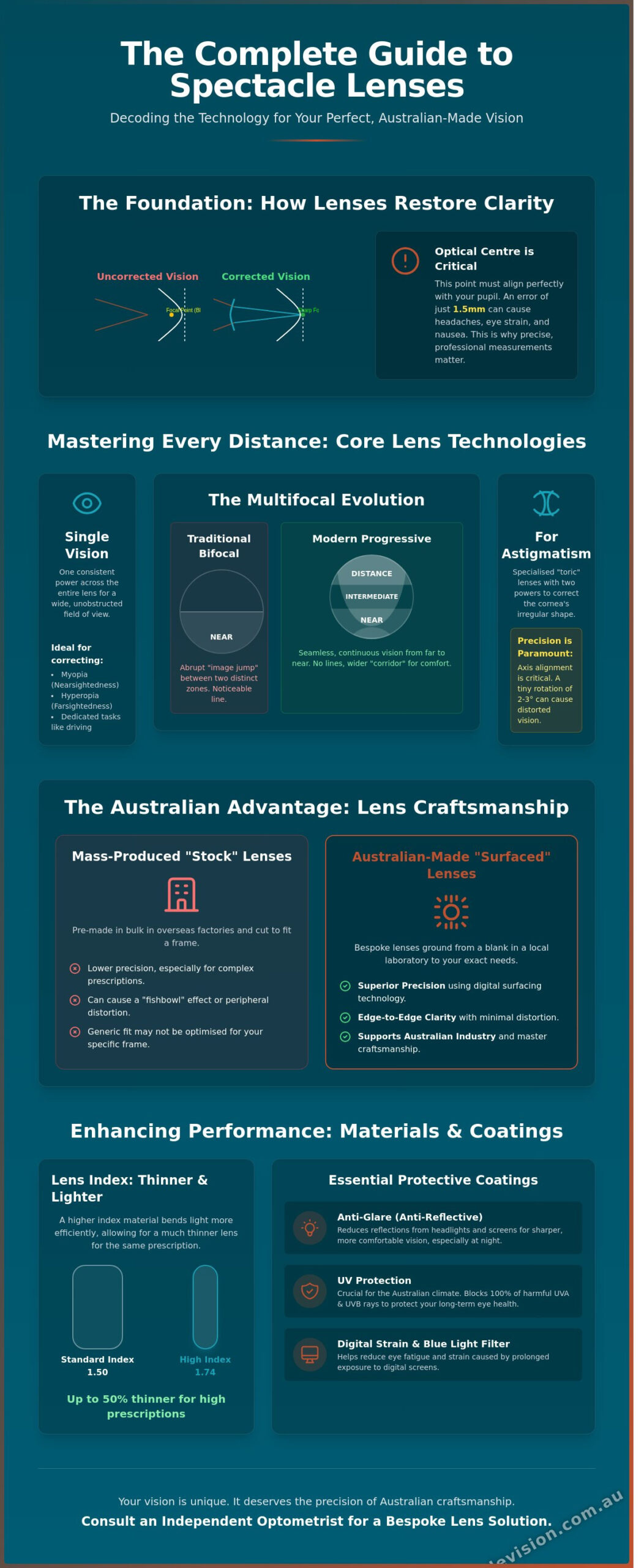
Every lens has a specific point known as the optical centre. This is the exact location on the lens where light passes through without any unwanted prism effect. For your vision to feel natural and comfortable, this centre must align perfectly with the middle of your pupil. If this measurement is off by even 1.5 millimetres, it can lead to headaches, nausea, or significant eye strain. This is why our independent optometrists prioritise physical measurements over automated estimations.
You might notice a difference between “stock” lenses and “surfaced” Australian-made options. Many large corporate providers rely on stock lenses mass-produced in overseas factories to reduce costs. These are pre-made in bulk and cut to fit a frame. In contrast, surfaced lenses are bespoke products ground from a semi-finished blank in a local laboratory. Choosing locally surfaced types of spectacle lenses allows for greater precision, especially for those with high prescriptions or unique frame choices. It supports our local industry while ensuring your eyewear meets the highest Australian standards of craftsmanship.
Single Vision Lenses: The Universal Standard
Single vision lenses are the most common solution for vision correction across Australia. These lenses feature one consistent focal power across their entire surface, making them incredibly reliable. They effectively treat myopia, which affects approximately 6.3 million Australians, and hyperopia. Because the power is uniform, they provide a wide, unobstructed field of view. This makes them the preferred choice for dedicated tasks like night driving or long sessions of reading. They offer a simplicity that many patients find reassuring and easy to adapt to quickly.
Lenses for Astigmatism and Complex Prescriptions
Astigmatism occurs when the cornea is shaped more like a football than a round ball, causing light to focus on multiple points. To correct this, we use toric lenses. These are a specialised category within the different types of spectacle lenses that feature two different powers at 90-degree angles to one another. The alignment of these powers, known as the axis, is critical. Even a tiny rotation of 2 or 3 degrees can make your vision feel tilted or distorted.
Our commitment to Australian-made surfacing ensures that these complex scripts are handled with extreme care. Local technicians use digital surfacing technology to smooth out the edges of the prescription. This process significantly reduces peripheral distortion, which is the “fishbowl” effect often felt in cheaper, mass-produced lenses. By choosing a lens crafted in a local lab, you receive a product that feels stable and clear right to the very edge of the frame. This precision is what defines the difference between simply seeing and seeing with absolute confidence.
Mastering Multiple Distances: Progressive and Multifocal Technologies
Multifocal technology has travelled a long way since the invention of the bifocal in 1784. While those traditional lined lenses served a purpose for decades, modern patients usually prefer the seamless transition of a progressive lens. These advanced types of spectacle lenses eliminate the abrupt “image jump” experienced with bifocals. They provide a continuous range of vision from the horizon down to the smartphone in your hand. This evolution reflects a shift from simple magnification to complex optical geometry designed for a multi-screen world.
The success of these lenses depends heavily on the “corridor width.” This refers to the usable vertical channel of the lens that transitions between different focal points. A narrow corridor can feel restrictive; it often forces you to move your head more than your eyes. Modern advances in lens materials and digital surfacing mean local Australian labs can now customise this corridor to your specific frame and posture. This precision reduces peripheral distortion by up to 20% compared to older, mass-produced manufacturing methods that use generic templates.
New wearers should expect a short adjustment period. Most people adapt to the new visual map within 7 to 14 days. During this time, your brain learns to automatically look through the correct part of the lens without conscious effort. Choosing a lens crafted in a local lab ensures the digital mapping matches your unique pupillary distance with 0.01 dioptre precision. This local expertise makes the “swaying” sensation often associated with cheap, imported multifocals almost non-existent for the wearer.
Progressive Lenses: Seamless Vision for Every Distance
A progressive lens is a masterpiece of optical engineering. It features three distinct zones: the top for distance, the middle for intermediate tasks, and the bottom for reading. Because there’s no visible line, these lenses offer a younger, more modern aesthetic that doesn’t advertise the wearer’s age. Premium Australian-made progressives use Freeform technology to widen the field of view. This gives you a broader “sweet spot” for driving or walking down stairs, ensuring your peripheral vision remains clear and stable.
Occupational Lenses: The Modern Office Essential
Standard progressives are great for general use, but they often fall short at a desk. If you spend 6 or more hours a day looking at a screen, you might experience “monitor neck.” This happens because the intermediate zone in a standard lens is often too small, forcing you to tilt your head back to see clearly. When comparing different types of spectacle lenses for work, occupational or “near-variable” lenses are the superior choice. They prioritise the intermediate and near zones, providing a wide, comfortable view of your monitor and keyboard while still allowing you to see colleagues across the room.
These bespoke office solutions significantly reduce eye fatigue and postural strain. By supporting local manufacturing, you gain access to technicians who can fine-tune these zones based on your specific desk height and monitor distance. Finding the right fit requires a conversation with a professional who understands these technical nuances. You can find an expert near you by searching the Australian Made Vision directory to support independent local practices that prioritise your long-term eye health.
Protecting Your Vision: Lifestyle Lenses for the Australian Climate
Living under the Australian sun requires more than just a dark pair of glasses. Our UV index frequently hits 11 or higher during summer months, reaching levels that the World Health Organization classifies as extreme. This intense exposure means your choice in types of spectacle lenses is a critical health decision rather than a simple fashion accessory. Many people mistake a dark tint for safety. However, a dark lens without a proper UV filter is dangerous. It causes your pupils to dilate, which allows more harmful radiation to reach the sensitive internal structures of your eye. Genuine protection comes from locally crafted lenses that meet the rigorous AS/NZS 1067.1:2016 standards.
Independent optometrists stay updated on the latest advancements in eyeglasses to ensure you get the best protection for our harsh environment. They provide bespoke solutions that mass-produced imports often miss. By choosing lenses through the Australian Made Vision network, you support local master craftspeople who understand the specific glare and light conditions of our landscape. These experts help you match lens technology to your daily habits, whether you spend your weekends on the green or the water.
- Fishing and Water Sports: Requires high-contrast polarisation to see through the surface of the water.
- Golf: Benefits from specific tints that enhance depth perception and green contours.
- Driving: Needs glare reduction to manage reflections from the bonnet and the road surface.
Polarised Lenses: The Gold Standard for Glare
Polarised lenses act like a chemical venetian blind for your eyes. They contain a special filter that blocks horizontal light waves. These are the waves that bounce off flat surfaces like the ocean or a wet road, creating that blinding “white out” effect. For the 85% of Australians living within 50 kilometres of the coast, this technology is essential for visual comfort. It allows you to see with incredible clarity even in the middle of a bright Queensland afternoon.
The safety benefits for drivers are measurable and significant. Research indicates that polarisation can improve driver reaction times by up to 20% when facing intense road glare. Independent optometrists frequently recommend these types of spectacle lenses for patients who struggle with eye fatigue during long commutes. By removing the need to squint, these lenses reduce the strain on your facial muscles and help prevent glare-induced headaches. It is a precision tool for anyone who values high-performance vision in the great outdoors.
Photochromic Lenses: Adaptive Comfort from Indoors to Out
Photochromic lenses contain trillions of light-sensitive molecules, such as silver halide, that change shape when they hit UV rays. This reaction causes the lenses to darken automatically when you step outside and clear up once you return indoors. They offer a seamless “one-pair” solution for active Australians who don’t want to constantly swap between clear glasses and sunnies. This convenience makes them a favourite for busy professionals and retirees alike.
You should consider how temperature and environment affect these lenses. Photochromic molecules move more slowly in heat, which means they might not get as dark on a 40 degree day in Perth as they would on a cool morning in Hobart. Standard versions also stay clear inside a car because modern windscreens block the UV light needed to trigger the change. If you spend a lot of time behind the wheel, your local independent optometrist might suggest “extra active” versions. These are specifically engineered to react to visible light, ensuring your eyes stay protected even while you drive.
Enhancing Performance: Lens Materials and Advanced Protective Coatings
The foundation of your vision starts with the raw material chosen in the laboratory. While older generations might remember heavy glass, modern types of spectacle lenses primarily use advanced polymers. Standard plastic, known as CR-39, remains a reliable choice for low prescriptions. However, as your script increases, standard plastic becomes bulky and heavy. This is where high-index materials become essential for comfort and style.
The “index” of a lens refers to its ability to bend light. A higher index means the material is more efficient, allowing the lens to be significantly thinner. For instance, a 1.74 high-index lens can be up to 50% thinner than a standard 1.50 index lens. This reduction in mass isn’t just about aesthetics; it prevents the “coke bottle” effect and makes the glasses comfortable for all-day wear. Polycarbonate is another vital material, offering 10 times the impact resistance of standard plastic. It’s the primary choice for Australian children and sports enthusiasts who need extra durability.
In local Australian labs, technicians bond protective layers to the lens surface using thermal curing or vacuum deposition. This isn’t a simple dip. It’s a precision process where microscopic layers are fused to the material. This ensures the treatments don’t peel or flake over time. When you choose locally crafted eyewear, you’re investing in a product that has undergone rigorous quality control in a controlled environment.
- CR-39 (1.50 index): Best for low prescriptions and budget-friendly options.
- Polycarbonate (1.59 index): Highly impact-resistant and lightweight.
- High-Index (1.61 to 1.74): Essential for strong prescriptions to keep lenses thin and light.
Anti-Reflective and Blue Light Coatings
Uncoated lenses reflect about 8% of light, which creates distracting “ghost images” during night driving. A premium anti-reflective (AR) coating increases light transmission to 99%, providing crisp clarity. Digital users often opt for blue light filters to manage eye fatigue. While clinical debates continue, many Australian patients report a 30% reduction in perceived strain during long office hours. Premium multi-coats also include oleophobic layers. These layers repel skin oils and make your glasses much easier to wipe clean.
Hard Coatings and Scratch Resistance
It’s a common misconception that lenses can be “scratch-proof.” In reality, they’re “scratch-resistant.” Australian-made lenses often feature a dual-sided hard coat that’s baked on for maximum durability. To keep these treatments intact, avoid using paper towels or tissues. These products contain abrasive wood fibres that cause micro-scratches. A simple microfibre cloth and a dedicated lens spray will extend the life of your eyewear by years. Supporting local manufacturing ensures these types of spectacle lenses meet the high standards required for our harsh UV environment.
Find a local expert to help you choose the right materials by searching our directory of independent Australian optometrists.
The Independent Advantage: Why Lens Origin and Fitting Matter
Choosing your eyewear involves more than just picking a frame that looks good. The origin of your lenses and the expertise of the person fitting them define your visual clarity for years. While large corporate chains often rely on high-volume, offshore production, independent Australian optometrists prioritise a tailored approach. This ensures that the specific types of spectacle lenses you require are crafted with a level of care that mass production simply cannot replicate.
The Precision of Local Manufacturing
Local manufacturing at facilities like CR Surfacing Laboratories in Dandenong utilises state-of-the-art digital surfacing technology. By keeping production on Australian soil, these labs maintain rigorous quality control standards that exceed international minimums. CR Surfacing has operated for over 40 years, honing a process that treats every lens as a bespoke piece of medical equipment rather than a generic commodity. This dedication to craftsmanship results in optics with fewer distortions and higher clarity across the entire lens surface.
Choosing locally made products means your lenses don’t spend weeks in cargo holds or transit hubs. Instead, they’re often ready for fitting within 3 to 5 business days. This speed doesn’t come at the cost of precision; it’s the result of a streamlined, local supply chain. Beyond the technical benefits, supporting Australian-made optical products keeps jobs in our communities and reduces the carbon footprint associated with international shipping. It’s a choice that feels as good as it looks.
Why See an Independent Optometrist?
Independent practitioners take the time to understand your lifestyle and specific visual needs. A standard consultation at an independent clinic often lasts 30 to 45 minutes, providing a significant contrast to the 15-minute screenings common in some retail environments. This extra time allows for a deeper analysis of your eye health and a more precise prescription. Unlike corporate outlets that may be restricted to a limited house brand, independents can source various types of spectacle lenses from the world’s leading innovators and local labs.
Your relationship with an independent optometrist is a long-term partnership in health. They track changes in your vision over decades, offering continuity of care that’s hard to find in high-turnover corporate settings. They’re also more likely to invest in advanced diagnostic equipment, such as OCT scans, which can detect eye diseases years before symptoms appear. When you visit a local expert, you’re not just a customer; you’re a patient whose vision is a priority.
To experience the difference that personalised care and local craftsmanship make, you should seek out a professional who values quality over volume. You can find a local expert committed to these standards through the Australian Made Vision directory. Supporting these businesses ensures that the Australian optical industry remains vibrant and capable of delivering world-class eye care.
- Personalised Care: Consultations tailored to your specific work and hobby requirements.
- Bespoke Solutions: Access to a wider range of high-index and specialised lens materials.
- Community Impact: Every purchase supports local jobs and the Australian manufacturing sector.
- Reliable Quality: Lenses that meet strict Australian standards for durability and optical performance.
Investing in your vision is one of the most important health decisions you’ll make. By choosing an independent optometrist and Australian-made lenses, you’re opting for precision, ethics, and a superior visual experience. Don’t settle for a one-size-fits-all solution when bespoke, locally crafted excellence is available right in your neighbourhood.
Investing in Your Vision for 2026 and Beyond
Selecting the right types of spectacle lenses is a personal journey that blends clinical necessity with your unique daily habits. Your eyewear should work as hard as you do, whether you’re navigating a digital office or enjoying the bright coastal sun. Modern lens technology now offers bespoke solutions that cater to every distance and environment, ensuring your sight remains sharp and your eyes stay protected from fatigue.
Quality shouldn’t be a compromise. Since 1976, CR Surfacing Laboratories has led the way in optical innovation, crafting expertise-driven precision lenses right here in Dandenong, Victoria. This commitment to local manufacturing means your glasses aren’t just a product; they’re a piece of Australian heritage designed for local conditions. By partnering with an independent expert, you gain access to this high-level craftsmanship and personalised care that corporate chains often overlook.
Take the next step toward clearer, more comfortable sight today. Find an Independent Optometrist near you to discuss the best lens types for your vision. You deserve a view of the world that’s as clear and vibrant as the Australian landscape itself.
Frequently Asked Questions
What are the main types of spectacle lenses available today?
The primary types of spectacle lenses include single vision, bifocals, and progressive lenses. Single vision lenses provide one consistent power across the entire surface, while progressives offer a seamless transition for near, intermediate, and distance vision. About 60% of Australian adults require some form of vision correction, and choosing the right design depends on your daily activities and prescription complexity.
Is there a difference between multifocal and progressive lenses?
Progressive lenses are a modern version of multifocal lenses that provide clear vision at all distances without the visible lines found on traditional bifocals. While older multifocal designs have a distinct segment for reading, progressives use a graduated curve to blend different focal points. This eliminates the “image jump” that affects roughly 25% of bifocal wearers, offering a more natural visual experience and a sleeker look.
How do I know if I need high-index lenses for my prescription?
You typically need high-index lenses if your prescription is stronger than +/- 2.00 dioptres. These lenses use advanced materials to bend light more efficiently, which results in a lens that is up to 30% thinner and lighter than standard plastic. This prevents the “coke bottle” effect and ensures your glasses don’t slide down your nose. Your independent optometrist can recommend the specific index required for your unique frame choice.
Are blue light glasses actually necessary for office work?
Blue light filters are highly beneficial if you spend more than 5 hours a day looking at digital screens. While they aren’t a clinical requirement for everyone, 70% of office workers report symptoms of digital eye strain by the end of the working week. These coatings help reduce glare and may improve sleep quality by filtering high-energy visible light. It’s a bespoke addition that supports long-term comfort in our tech-heavy environments.
What are the best lenses for driving in bright Australian conditions?
Polarised lenses are the superior choice for driving in Australia because they eliminate 99.9% of horizontal glare from road surfaces and other cars. With our local UV levels frequently reaching 11 or higher on the index, high-quality protection is a health necessity rather than a luxury. These lenses improve contrast and reaction times, ensuring you stay safe on the road. They are a staple for anyone who values precision and safety during their daily commute.
How long does it take to get used to new progressive lenses?
Most patients adapt to new progressive lenses within 7 to 14 days of consistent daily wear. During this time, your brain learns to automatically look through the correct part of the lens for different tasks. If you still feel unsteady after 2 weeks, visit your local independent optometrist for a fitting check. About 5% of wearers require a minor adjustment to the frame alignment to align the optical centre perfectly with their pupils.
Can I get Australian-made lenses at any optometrist?
You won’t find Australian-made lenses at every clinic, as many large corporate chains source their products from overseas mass-manufacturing hubs. Independent optometrists are far more likely to partner with local laboratories that craft lenses right here in Australia. Supporting local industry ensures you receive a high-quality, authentic product with a smaller carbon footprint. It also means your glasses are often ready for collection 2 or 3 days faster than those sent abroad.
What happens if my new lenses don’t feel comfortable?
If your new lenses don’t feel comfortable, you should return to your optometrist for a professional adjustment within the first 30 days of purchase. Most independent practices provide a comprehensive satisfaction guarantee to ensure your vision is crystal clear. Sometimes a small 2-millimetre tweak to the frame’s bridge or temple arms is all it takes to fix the issue. Your local master of the craft will take the time to ensure the fit is perfect for your face.
Disclaimer
The information in this article is provided for general educational purposes only and should not be considered medical advice. For personalised advice regarding your vision or eye health, please consult a qualified optometrist.
Australian Made Vision is an independent directory that helps patients find optometrists across Australia who may offer Australian-made spectacle lenses. We do not provide clinical services and recommend contacting practices directly to confirm the products and services they offer.