

What if your sunglasses are merely dimming the world rather than actually protecting your sight from the harsh Australian sun? Most of us know the frustration of squinting through a windscreen on the M1 or across the water at Sydney Harbour, feeling that familiar ache of eye fatigue set in before lunch. It’s a common struggle. 2025 data suggests that reflective glare can reduce a driver’s reaction time by up to 30%, making high-quality polarised lenses a vital safety tool rather than a luxury.
We believe you deserve better than mass-produced, generic eyewear that fails when the sun is at its peak. These lenses are different. This guide explains exactly how they eliminate 99% of reflected glare to provide clinical-grade clarity while supporting our local craftspeople. You’ll discover why this technology is essential for our unique climate and how it differs from standard UV protection.
We’ll break down the science of light, clarify the technical differences between lens types, and show you how to find bespoke, Australian-made options through our independent network. By the end, you’ll have the knowledge to choose eyewear that protects your health and supports our national manufacturing heritage.
Key Takeaways
- Understand how molecular-level filters eliminate blinding glare from Australian roads and waterways, providing a level of clarity that standard tinted lenses cannot achieve.
- Learn how to choose the ideal lens colour and material to enhance your visual contrast and protection specifically for the harsh Australian climate.
- Discover the science behind polarised lenses and how to navigate common technical considerations, such as viewing digital dashboards and mobile displays.
- Explore the benefits of supporting local craftsmanship by choosing bespoke lenses precision-made in Victorian laboratories rather than mass-produced corporate imports.
- Identify why partnering with an independent optometrist ensures a personalised fitting process that prioritises your long-term eye health and unique lifestyle needs.
What are polarised lenses and why do they matter in Australia?
Polarised lenses represent a pinnacle of optical engineering, specifically crafted to manage the way light enters your eyes. Unlike standard sunglasses that merely use a dark tint to dim the world, these specialised lenses contain a molecular-level filter. This filter acts like a set of microscopic Venetian blinds, blocking horizontal light waves while allowing vertical waves to pass through. It’s this precise mechanism that eliminates the blinding “bounce” of light off flat surfaces.
While standard tinted lenses might make a bright day more comfortable, they don’t address the specific problem of glare. Glare occurs when sunlight hits a surface like a wet road or a glass building and reflects directly into your eyes at a concentrated angle. Understanding how polarised lenses work helps you see why they’re the superior choice for visual clarity. By filtering out that horizontal noise, you gain better depth perception and truer colour representation.
Choosing high-quality polarised lenses isn’t just about comfort; it’s about safety and precision. At Australian Made Vision, we believe that the lenses you wear should be as unique as the landscape you’re exploring. Supporting locally crafted eyewear means you’re investing in technology tailored for our specific environmental challenges. It’s a commitment to quality that mass-produced, corporate alternatives often struggle to match.
The Australian sun factor
Australia’s atmosphere is uniquely clear but also dangerously thin in terms of ozone protection. According to ARPANSA, UV radiation levels in Australia are up to 15% higher than those in Europe at similar latitudes. This clear air doesn’t scatter light as much as the hazier skies of the Northern Hemisphere, which means glare is significantly more intense. Whether you’re navigating the 1,670 kilometres of the Bruce Highway or enjoying a weekend on the water, the reflective load on your eyes is immense.
Driving on long, reflective Australian highways presents a real safety risk. The “mirage” effect on hot bitumen can hide road hazards or other vehicles. Standard sunglasses often fail during peak summer months because they don’t have the filtering power to cut through this intense surface reflection. Polarised lenses provide the visual sharpness needed to react quickly to changes in road conditions, making them an essential tool for every Australian driver.
Common misconceptions about polarisation
A frequent mistake people make is assuming that a darker lens automatically offers better protection. Darkness only indicates how much light the lens absorbs; it doesn’t tell you anything about its ability to cut glare. In fact, a very dark lens without a polarisation filter can be counterproductive, as it causes your pupils to widen and let in more reflected light. It’s the quality of the filter, not the depth of the shade, that matters most for clear vision.
You should also distinguish between UV protection and polarisation. While they’re both vital, they serve different purposes. UV protection is a chemical treatment that blocks harmful rays from damaging your ocular health over time. Polarisation is a physical filter that manages immediate visual comfort. High-quality polarised lenses from an independent optometrist will always combine both technologies to ensure your eyes are shielded from both long-term disease and immediate strain.
Finally, not all polarised lenses are created equal. While a cheap pair of service station sunnies might claim to be polarised, the filter is often just a thin film that can peel or distort over time. Bespoke, locally manufactured lenses integrate the polarising layer deep within the lens material. This provides a more stable, durable, and optically superior experience that respects the heritage of Australian craftsmanship.
The science of glare: How polarised lenses actually work
Light waves are a bit chaotic. They vibrate in every direction as they travel from the sun to your eyes. When this light hits a flat, reflective surface like a wet Australian highway or the shimmering coast, its behaviour changes. Instead of scattering, the waves align themselves horizontally. This concentrated, horizontal light is what we call glare. It’s intense, distracting, and often dangerous because it masks the details of the world around you.
The magic of polarised lenses lies in their internal structure. During the manufacturing process, a special chemical filter is applied to the lens material. Think of this filter as a microscopic Venetian blind. The molecules in the filter are aligned vertically. They allow ‘useful’ vertical light waves to pass through while physically blocking the ‘noisy’ horizontal waves that cause glare. This ensures your eyes only receive the information they need to see clearly.
While standard sunglasses simply darken your entire field of view, polarised vs. standard tinted lenses differ because the former selectively filters out the blinding light without sacrificing clarity. This technology is a hallmark of high-quality, locally crafted eyewear designed for our harsh conditions. It represents a commitment to precision that generic, mass-produced frames often lack. By choosing polarised lenses, you’re opting for a sophisticated tool that protects your vision and enhances your safety on the road.
Understanding Brewster’s Angle
The effectiveness of your eyewear often depends on the sun’s position. This brings us to a concept called Brewster’s Angle. For most water surfaces, this occurs when the sun is roughly 53 degrees from the vertical. When light hits a surface at this specific point, the reflection becomes perfectly polarised. Brewster’s Angle is the specific angle where light reflection is most perfectly polarised. In Australia, this means your lenses might feel more effective at 10:00 am than they do at high noon. The angle of the sun dictates how much of that blinding ‘white’ light bounces off the road and into your eyes.
Visual contrast and colour perception
Removing the veil of glare does more than just stop you from squinting. It dramatically increases visual contrast. Without that layer of reflected light, the sky looks a deeper blue and the bush appears a more vibrant green. For those who enjoy fishing in our local waterways, these lenses are a game changer. They allow you to see through the surface reflection into the water below, revealing rocks, fish, and submerged hazards. This depth perception is essential for safety and performance during outdoor activities.
High-quality lenses ensure you see the world as it’s meant to be seen, with authentic colour and sharp detail. Unlike cheaper alternatives that might distort your view or shift colours unnaturally, bespoke lenses maintain true colour accuracy. This precision is why many Australians prefer the expertise of a local professional who understands the specific light conditions of our landscape. If you’re ready to see the difference for yourself, you can find a local independent optometrist who can provide a personalised recommendation for your lifestyle.
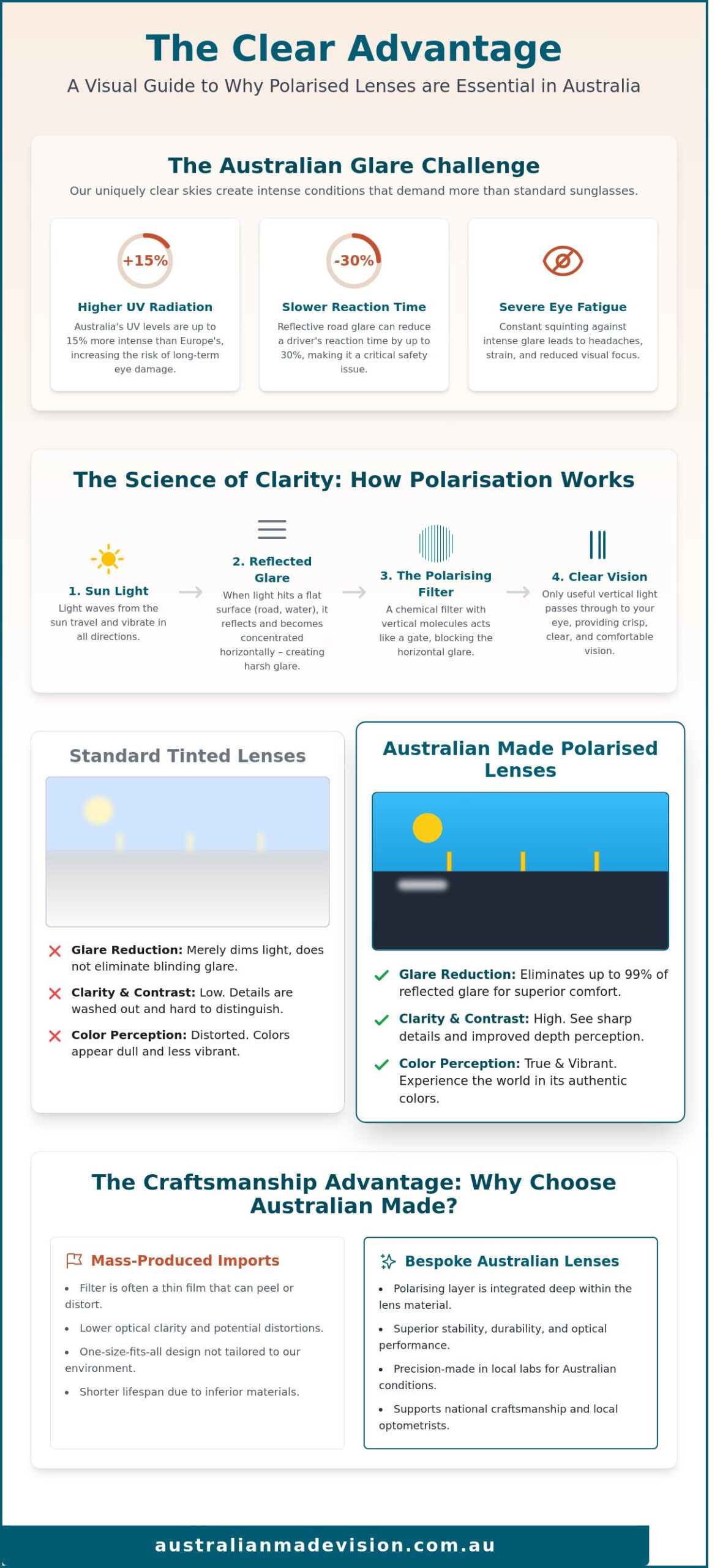
Polarised vs. standard tinted lenses: A side-by-side analysis
Understanding the difference between a standard tint and polarised lenses is essential for anyone spending time in the harsh Australian sun. Standard tinted lenses function like a dimmer switch. They reduce the overall volume of light reaching your eyes, making a bright day feel more comfortable. However, they don’t distinguish between helpful light and blinding glare. Polarised lenses contain a unique chemical filter that specifically blocks horizontal light waves. These are the waves that bounce off flat surfaces like the Pacific Highway or the Swan River, creating that sharp, white light that causes squinting.
In most Australian independent clinics, opting for polarisation adds roughly A$80 to A$120 to the cost of your prescription. This investment pays for itself through safety and comfort. For a driver commuting 45 minutes each way, the reduction in visual noise is immediate. For fishers or sailors, it provides the ability to see beneath the water’s surface by stripping away the surface reflection. Beyond the immediate view, the long-term benefit is a significant reduction in eye strain. Clinical observations show that consistent exposure to glare leads to squint fatigue. This repetitive muscle tension is a leading cause of afternoon headaches for outdoor workers. By removing the need to squint, you’re protecting your long-term eye health and reducing the daily strain on your nervous system.
- Tinted Lenses: Best for basic light sensitivity and maintaining true colour perception in low-glare environments.
- Polarised Lenses: Best for driving, water sports, and high-glare environments where visual clarity is a safety requirement.
- Value Ratio: While more expensive upfront, the durability and comfort often lead to a longer lifespan for the spectacles.
The LCD screen trade-off
The most common reason people hesitate to choose polarised lenses is the interaction with digital displays. Because these lenses filter light waves in a specific direction, they can make some screens look dark or show rainbow patterns. This was a major issue with older liquid crystal displays (LCDs) found in car dashboards from the early 2010s. Modern smartphones and high-end vehicle displays now use In-Plane Switching (IPS) or OLED technology, which remains visible at most angles. Professionals like commercial pilots or landscape photographers often choose standard tints because they must read specific instruments or view camera sensors without any visual interference. If you work in these fields, we recommend testing your specific devices with a sample lens at your local independent optometrist before committing.
When standard tints might be preferred
There are rare moments where glare is actually a useful visual cue. Downhill skiers often prefer standard tints because glare helps them identify patches of black ice on the slopes. Without that reflection, the terrain can look deceptively uniform. For 95% of the Australian population, these scenarios are the exception rather than the rule. If you find polarisation too intense, a mirror coating is a great secondary option. These coatings reflect a high percentage of light away from the eye without the directional filtering. This provides a cooler internal temperature for the eye and a sleek, bespoke look that suits our local lifestyle. Choosing the right option depends on your specific hobbies and daily environment, which is why a personalised consultation with a local expert is so valuable.
A practical guide to choosing your polarised lenses
Choosing the right pair of polarised lenses involves more than just picking a frame that looks good. You need to consider how the lens material and colour will perform in the harsh Australian sun. Look for the Australian Made logo on your lens packaging or certificate of authenticity. This iconic gold kangaroo ensures the product meets the AS/NZS 1067.1:2016 standard, guaranteeing 100% UV protection and high-quality local manufacturing.
Lens material dictates your daily comfort and visual clarity. Crown glass offers the best optical precision and resists scratches, making it perfect for a day at the beach where sand is a constant threat. If you lead an active lifestyle, polycarbonate lenses are 10 times more impact-resistant than standard plastic. For those with stronger prescriptions, high-index resins reduce lens thickness by up to 30 per cent, preventing that heavy feeling on the bridge of your nose. Always ask for an anti-reflective coating on the back surface. This layer stops light from bouncing off the inside of the lens into your eyes, which is a common issue when the sun is positioned behind you.
Matching lens colour to your lifestyle
Colour serves as a functional tool rather than just an aesthetic choice. Drivers often prefer copper or brown tints because they enhance contrast and make red brake lights or green traffic signals pop against the grey bitumen. If you spend your weekends on the water, grey or green lenses are the gold standard. Grey maintains true colour perception, while green provides high contrast in the variable light of the ocean. Independent optometrists excel here because they provide bespoke tints. Unlike big-box retailers, they can tailor the density and hue of your polarised lenses to match your specific prescription and visual needs.
The DIY polarisation test
You can verify the quality of your eyewear with a simple 30-second check. Take two pairs of sunglasses and hold them up to the light, one behind the other. Rotate one pair 90 degrees. If the lenses are polarised, the overlapping area will turn almost completely black as the two filters cross and block all light. This happens because the vertical and horizontal filters are working together to cancel out the visible spectrum.
You can also hold your glasses up to a digital computer screen or a petrol pump display. Slowly tilt your head. The screen should darken or change colour as you reach a 45 to 90-degree angle. If you’re unsure about the performance of your current eyewear, you can find an independent optometrist for a professional demonstration. They use specialised testing tools to ensure your vision is fully protected from reflected glare. Supporting these local experts means you’re investing in the future of Australian manufacturing and the health of your community.
Why Australian-made polarised lenses outperform corporate alternatives
The production of high-performance eyewear often happens behind the closed doors of massive offshore factories. Choosing Australian-made lenses shifts this narrative back to local soil, specifically to specialised laboratories in Dandenong, Victoria. Here, optical technicians combine decades of heritage with modern surfacing technology to create polarised lenses that meet rigorous national standards. This local oversight ensures that every lens undergoes strict quality control before it ever reaches your frames, providing a level of scrutiny that mass-market corporate alternatives often struggle to replicate.
The independent optometry advantage
Large optical chains frequently rely on a restricted list of lens suppliers to maximise profit margins. This often leads to a “one-size-fits-all” approach where your unique visual needs are secondary to corporate inventory. Independent optometrists operate differently. They have the freedom to source from a broader range of high-performance, Australian-made products. For the 1 in 5 Australians with complex prescriptions, this flexibility is vital. Local surfacing provides superior visual accuracy because the lab is just a phone call away from the practitioner. If a script requires a specific base curve or bespoke edge thinning, a Dandenong-based technician can execute those details with millimetre precision. This collaboration ensures your lenses are tailored to your specific frame choice and facial anatomy rather than being pulled from a pre-moulded stock pile.
Supporting the local community
Every pair of locally crafted lenses supports a chain of Australian jobs, from the laboratory technicians in Victoria to the clinical staff in your local suburb. Opting for Australian Made Vision means you aren’t just buying a product; you’re investing in the thousands of people who make up our national optical manufacturing sector. This conscious choice preserves the heritage of Australian lens making and ensures our industry remains at the forefront of global innovation. The pride of “Dandenong-made” quality isn’t just a label; it’s a guarantee that your eyewear hasn’t spent weeks in transit from an offshore facility or sat in a shipping container for months.
- Local labs offer significantly faster turnaround times, often delivering bespoke orders in under 5 business days.
- Australian manufacturing standards are among the strictest in the world for UV protection and impact resistance.
- Supporting local business keeps more of your hard-earned money within the Australian economy, fostering community growth and stability.
- Independent practices provide a continuity of care that corporate environments often lack, building long-term relationships with patients.
Choosing locally made polarised lenses is the bridge between clinical health and ethical craftsmanship. It provides the peace of mind that your eyewear was built by experts who understand the unique intensity of the Australian sun. You get to enjoy world-class clarity while knowing your purchase benefits your neighbours and the national industry. It’s a commitment to quality that you can see through every day, backed by the reliability of Australian manufacturing.
To find a practitioner who prioritises this level of personalised care and local quality, locate your nearest independent optometrist and experience the difference of Australian-made vision today.
Clearer Vision for Your Australian Lifestyle
Protecting your sight in our harsh environment requires more than a simple dark tint. High-quality polarised lenses provide a 99% reduction in blinding glare, which is vital for safe driving and outdoor comfort across the continent. Choosing bespoke optics ensures your eyewear is precisely calibrated for Australia’s unique UV levels rather than a generic global standard. Our Dandenong laboratory has led this specialised field since 1976, crafting high-performance solutions that truly withstand the local climate.
When you opt for Australian-made quality, you’re investing in a legacy of precision and genuine community care. Independent optometrists offer a level of tailored service that corporate chains don’t provide. They focus on your individual health needs, ensuring your frames and lenses work together perfectly for your daily life. Supporting local industry keeps our skilled artisans thriving while providing you with the most reliable vision possible. It’s a choice that benefits your eyes and your community simultaneously.
Find an independent Australian optometrist near you and experience the difference of locally crafted excellence today.
Frequently Asked Questions
Can I get polarised lenses with my prescription?
Yes, you can certainly get polarised lenses tailored to your specific prescription. Our independent Australian labs craft these bespoke lenses for about 95% of all vision corrections, including single vision and multifocal designs. Whether you’re short-sighted or need help with reading, local optometrists ensure your vision remains sharp while eliminating harsh surface glare. It’s a personalised approach that guarantees both clarity and comfort for your daily outdoor activities.
Are polarised lenses better for driving than normal sunglasses?
Yes, polarised lenses offer a safer driving experience than standard tinted sunglasses. They specifically block horizontal light bouncing off hot bitumen or other car windscreens, which can improve driver reaction times by 0.3 seconds when travelling at 80km/h. This small margin provides an extra 7 metres of stopping distance, making them a vital tool for navigating Australian roads safely. You’ll find that eye fatigue reduces significantly during long trips across the state.
Do polarised lenses protect my eyes from UV rays?
Yes, high-quality polarised lenses provide comprehensive protection against harmful ultraviolet radiation. In Australia, sunglasses must meet the AS/NZS 1067.1:2016 standard, meaning Category 3 lenses block 100% of UVA and UVB rays. While the polarisation filter handles the glare, the lens material itself acts as a shield to prevent long-term sun damage and cataracts. Choosing a locally crafted pair ensures you’re meeting these rigorous national safety standards for your eye health.
Why do polarised lenses make my phone screen look weird?
This happens because most digital devices use liquid crystal displays (LCDs) that also contain a polarising filter. When the vertical filter in your sunglasses meets the filter in your phone screen at a certain angle, the light can’t pass through, making the display look dark or distorted. You’ll often notice this effect most when rotating your phone 90 degrees to take a photo. It’s a natural physical interaction rather than a defect in your eyewear.
How can I tell if my sunglasses are actually polarised?
You can easily verify your lenses by looking at a digital monitor or a fuel pump screen while wearing them. Simply tilt your head 90 degrees to the side; if the lenses are genuinely polarised, the screen will appear to turn black or very dark. This occurs because the two polarising filters are crossing each other, effectively blocking all light from reaching your eyes. It’s a simple, effective test you can perform in seconds to confirm the quality of your purchase.
Are polarised lenses worth the extra cost for children?
Investing in polarised lenses for children is a wise decision for their long-term eye health. Since roughly 80% of a person’s lifetime UV exposure happens before they turn 18, providing the best possible glare protection is essential. Independent optometrists often recommend these for active Aussie kids who spend hours playing sports or at the beach where glare is most intense. The added cost, often around A$40 to A$60, is a small price for superior protection and visual comfort.
Can I wear polarised lenses for night driving?
No, you shouldn’t wear polarised sunglasses for night driving as they are dangerously dark for low-light conditions. Most of these lenses only allow about 15% of available light to pass through, which severely limits your visibility after sunset. While they’re excellent for daytime sun, night-time glare is better managed through clear lenses with a specialised anti-reflective coating. Your local optical expert can recommend the right coating to reduce reflections from oncoming headlights without compromising safety.
What is the best lens colour for polarised sunglasses in Australia?
Grey and brown are the most effective choices for our harsh Australian light conditions. Grey lenses are perfect for everyday use because they maintain true colour perception, while brown or copper tints can increase visual contrast by 20%. Many locals choose brown for driving or fishing as it helps highlight depth and detail against the bright blue sky and water. Your independent optometrist can help you choose the shade that best suits your lifestyle and local environment.
Disclaimer
The information in this article is provided for general educational purposes only and should not be considered medical advice. For personalised advice regarding your vision or eye health, please consult a qualified optometrist.
Australian Made Vision is an independent directory that helps patients find optometrists across Australia who may offer Australian-made spectacle lenses. We do not provide clinical services and recommend contacting practices directly to confirm the products and services they offer.