Discover how the synergy of independent clinical expertise and Australian-made lens technology defines the gold standard for high-quality eye care. In a world of fast-paced, transactional health services, many Australians are seeking a deeper, more personalised standard of care for their vision. They are asking a crucial question: What truly separates a premium optometry experience from a standard, volume-focused eye test?
The answer lies in a combination of clinical independence, advanced diagnostic tools, and the precision of locally crafted optical lenses. This is the foundation of high-quality eye care—an approach that treats you as an individual, not just a prescription number. It’s an investment in your long-term vision and overall quality of life.
What Defines High-Quality Eye Care in 2026?
High-quality eye care is a holistic approach that pairs diagnostic excellence with optical solutions tailored to your unique life. It moves beyond a simple transactional model to build a lasting professional relationship focused on your health.
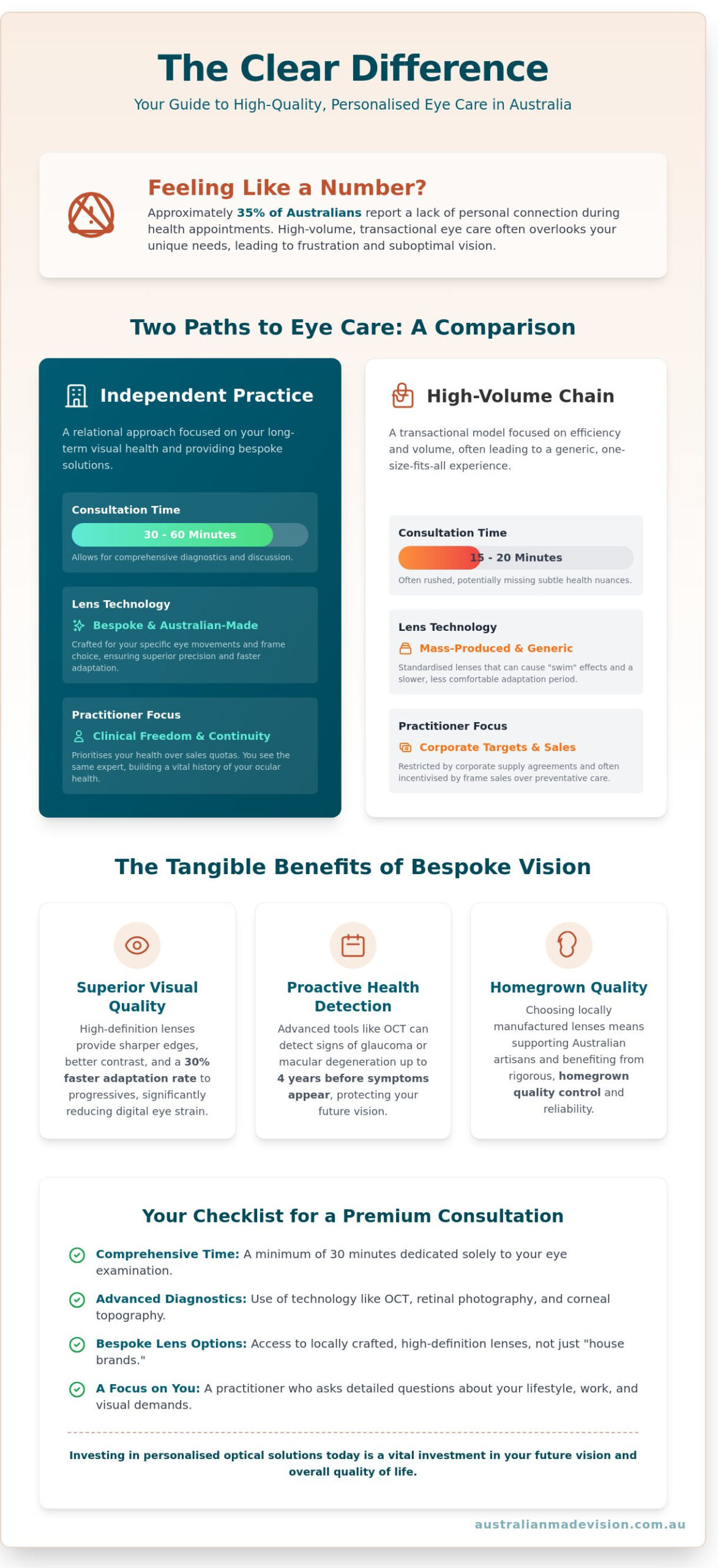
- Time and Thoroughness: A quality consultation is never rushed. A 30–40 minute examination is the baseline required to comprehensively assess your vision and eye health.
- Relational vs. Transactional: Independent care focuses on building a long-term understanding of your eyes, whereas corporate retail models often prioritise volume and sales targets.
- Advanced Diagnostics: Modern practices use advanced technology like OCT scans to detect conditions like glaucoma and macular degeneration years before symptoms appear.
The Shift Toward Personalised Vision Standards
The days of ‘one-size-fits-all’ lenses are fading, especially for Australians with dynamic lifestyles. High-quality care recognises that your vision needs at the office computer are different from your needs when driving at night or playing sport on a weekend.
This is where the concept of ‘bespoke’ or custom-made lenses becomes critical. These are not generic, mass-produced lenses; they are individually crafted based on your precise prescription and how your chosen frames sit on your face. A comprehensive understanding of the human eye is the first step in this personalised process.
Why Precision Matters for Your Daily Life
Investing in high-quality eye care delivers tangible benefits that you’ll notice every day. It’s about achieving more than just standard 20/20 vision; it’s about experiencing true visual comfort and clarity.
Precision care helps to significantly reduce digital eye strain and fatigue, a common issue for many office workers. It also ensures a smoother, more natural adaptation period for those new to progressive lenses, eliminating the disorienting "swim" effect often associated with generic options. The result is vision that feels effortless and sharp, from the centre of the lens right to the edge.
The Independent Practice: A Case Study in Better Visual Outcomes
The independent optometrist is the cornerstone of high-quality eye care. Free from corporate sales targets and restricted product lists, they can make decisions based solely on what is best for your eyes.
Imagine a standard, high-volume eye test: a quick check of your prescription, followed by a swift handover to a salesperson. Now, compare that to a comprehensive consultation with an independent practitioner who takes the time to discuss your work, hobbies, and visual challenges before recommending a solution. This patient-first approach is what leads to better health outcomes.
Clinical Freedom vs. Corporate Targets
Independent optometrists have the clinical freedom to prioritise your long-term health over retail quotas. This allows them to source the best lens technology from a range of suppliers, ensuring your solution is genuinely tailored to you.
Perhaps the greatest benefit is the continuity of care. Seeing the same practitioner year after year allows them to build a detailed history of your eye health, making it easier to detect subtle changes over time. For more guidance, explore our guide on choosing the right optometrist.
Access to Specialised Myopia and Dry Eye Care
High-quality eye care also means having access to specialised services. Independent clinics are often at the forefront of managing complex conditions.
- Myopia Management: They offer advanced strategies to help slow the progression of short-sightedness in children.
- Dry Eye Treatment: Many have invested in specialised equipment to diagnose and treat the underlying causes of dry eye syndrome, providing lasting relief.
You can use our directory to find an independent optometrist near you who offers these specialised services.
Advanced Lens Technology: Why Local Manufacturing Elevates Quality
Exceptional eye care is a partnership between a skilled optometrist and superior optical hardware. Even the most accurate prescription is compromised if the lenses aren’t crafted to the highest standard. This is where Australian manufacturing makes a critical difference.
While the technology for creating bespoke lenses is available globally, sourcing them from a local Australian laboratory provides distinct advantages in quality control, speed, and customisation. This local connection ensures a level of service and precision that is fundamental to high-quality eye care.
The Australian-Made Advantage
Choosing Australian-made lenses is a decision that benefits you and the wider community. Local laboratories operate under stringent quality standards, allowing for meticulous oversight at every stage of the manufacturing process.
This proximity means faster delivery times and a significantly reduced carbon footprint compared to lenses shipped from overseas. Above all, it supports local jobs and a proud tradition of Australian craftsmanship, ensuring that your investment in your health also contributes to our national economy.
Bespoke Lenses vs. Stock Lenses
‘Stock lenses’ are mass-produced and stored in warehouses. While functional for simple prescriptions, they fail to account for the unique way your specific frames fit your face.
Bespoke lenses, however, are calculated using individual measurements like:
- Pantoscopic Tilt: The vertical angle of the frame on your face.
- Vertex Distance: The distance from your eye to the back of the lens.
- Face Form Wrap: The curve of the frame as it follows your facial contours.
By incorporating these variables, bespoke lenses provide a wider field of clear, comfortable vision. When this customisation is paired with the reliability and quality assurance of local Australian manufacturing, the result is a truly superior visual experience.
Checklist: How to Evaluate a Practice for High-Quality Care
Ready to find a provider who meets the gold standard? Use this checklist to evaluate your options and make an informed decision.
- Ownership: Is the practice independently owned and operated?
- Consultation Time: Does a standard eye examination last at least 30 minutes?
- Lens Origin: Can they tell you where their lenses are manufactured? Look for a commitment to Australian-made.
- Technology: Do they have advanced diagnostic tools like an OCT scanner?
- Specialised Services: Do they offer services like children’s eye tests or myopia management?
Questions to Ask Your Optometrist
- What lens designs do you recommend for my lifestyle and why?
- What technology do you use to monitor for conditions like macular degeneration?
- How do you customise my lenses for my specific digital device usage?
Red Flags of Low-Quality Care
- Feeling rushed through any part of the examination.
- Intense pressure to buy specific house-brand products.
- The inability to clearly explain the benefits of different lens options.
The Future of Vision: Investing in Your Eyesight Today
Prioritising high-quality eye care is one of the most important investments you can make in your overall well-being. It goes beyond a simple retail purchase and becomes a proactive partnership for your long-term health.
By choosing an independent optometrist who partners with Australian lens manufacturers, you are ensuring your vision is in the best possible hands. We encourage you to look for the ‘Australian Made’ logo when selecting your next pair of lenses and to find a professional who will be a true partner in your eye health journey.
The Long-Term Value of Premium Lenses
Superior lenses offer more than just clearer vision today; they provide lasting value. Advanced coatings protect against scratches and reflections, extending the lifespan of your glasses. Furthermore, precise, personalised care can play a role in managing the progression of certain vision conditions, safeguarding your sight for the future.
Supporting the Independent Optometry Network
Choosing an independent optometrist strengthens a network of local, community-focused health professionals across Australia. These practices are often owned by the people who work in them, ensuring a deep commitment to patient care and the local community. It’s a model of care that puts your health first, always.
Frequently Asked Questions
What is the difference between a corporate eye test and high-quality independent care?
The primary difference is the focus. High-quality independent care prioritises building a long-term, health-focused relationship with you, offering personalised solutions and continuity of care. Corporate models are often structured around patient volume and meeting retail targets.
Why should I choose Australian-made lenses over imported ones?
Choosing Australian-made lenses ensures superior quality control, faster delivery, and direct support for the local economy. It pairs the world’s best lens technology with the accountability and craftsmanship of a local team.
Does high-quality eye care cost more than standard optical services?
While the initial investment may be higher than a bulk-billed or heavily discounted service, high-quality care provides greater long-term value. This includes more durable lenses, better visual comfort, and the early detection of eye conditions, which can save significant costs and protect your vision down the line.
How often should I have a comprehensive eye exam if I have no symptoms?
For adults, a comprehensive eye exam is recommended every one to two years, even if you have no noticeable vision problems. Regular exams are crucial for detecting silent eye conditions like glaucoma before they cause irreversible damage.
Can high-quality lenses help with digital eye strain?
Absolutely. Bespoke lenses, particularly those with blue light filtering and anti-reflective coatings, are specifically designed to reduce the visual stress caused by screens. They are customised to your exact prescription and how you use your devices, providing significant relief.
What should I look for in a children’s eye test?
A high-quality children’s eye test should be comprehensive, assessing not just vision clarity but also eye alignment, tracking, and overall eye health. Look for an optometrist who has experience with children and offers services like myopia management.
Are independent optometrists more expensive for frames?
Not necessarily. Independent optometrists often carry a diverse range of frames from unique, high-quality brands that aren’t available in chain stores. While they have premium options, they typically offer frames at various price points to suit different budgets.
How do I know if my lenses are actually made in Australia?
Ask your optometrist. A practice that partners with local labs will be proud to tell you. You can also look for the official ‘Australian Made’ logo, a trusted symbol of authentic, locally manufactured products.
Disclaimer
The information in this article is provided for general educational purposes only and should not be considered medical advice. For personalised advice regarding your vision or eye health, please consult a qualified optometrist.
Australian Made Vision is an independent directory that helps patients find optometrists across Australia who may offer Australian-made spectacle lenses. We do not provide clinical services and recommend contacting practices directly to confirm the products and services they offer.