
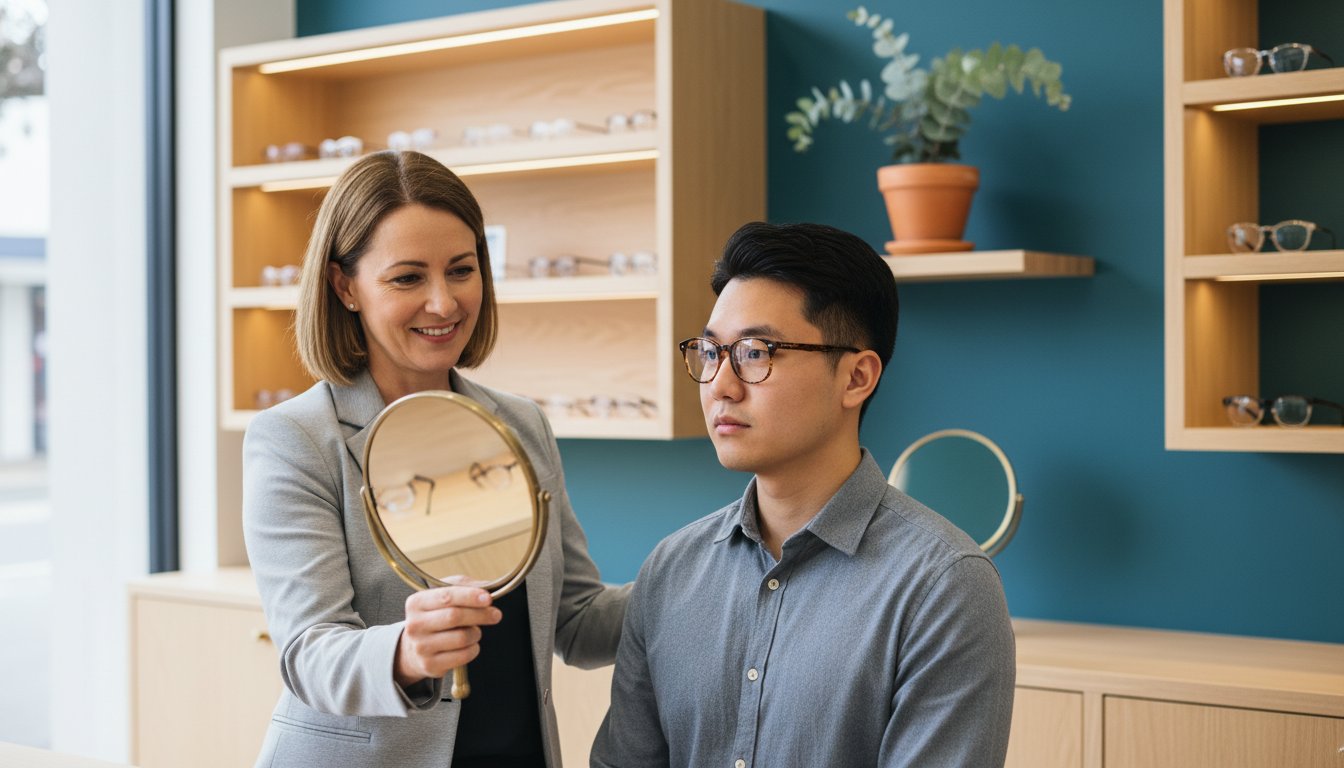
What if the most expensive part of your new glasses isn’t the designer frames, but the hidden cost of a generic prescription? With over 6,500 registered optometrists currently practising across Australia, many patients still leave high-volume retail stores feeling like a mere number in a corporate database. It’s easy to feel overwhelmed by the choice between various providers, especially when the roles of optometrists and opticians seem to overlap in the busy aisles of a shopping centre.
You deserve to know exactly who is handling your eye health and where your lenses are actually crafted. We understand that you want more than just a quick fix; you want durable, locally made vision solutions that stand the test of time. This guide clarifies the essential differences between eye care roles so you can choose a provider with absolute confidence in 2026.
We’ll explore how independent Australian practices prioritise your clinical outcomes over corporate benchmarks. You’ll discover how to find a master of the craft who provides the personalised care and bespoke quality your unique vision requires.
Key Takeaways
- Understand the distinct roles of optometrists and opticians to ensure you receive the clinical care and lens precision your vision requires.
- Discover how independent practices offer a more tailored experience and a wider range of bespoke frames compared to mass-market corporate retailers.
- Learn why locally crafted, precision-surfaced lenses are superior to mass-produced stock options for long-term eye health and visual clarity.
- Use our 2026 eye care checklist to ask the right questions about clinical technology and lens origin at your next appointment.
- Explore how choosing an independent Australian optometrist supports local industry while providing you with high-quality, authentic care.
Opticians vs Optometrists: Understanding the Roles in Australian Eye Care
Walking into an eyewear boutique can feel overwhelming when you aren’t sure who does what. Many Australians use the terms interchangeably, but an optometrist and a dispensing optician play distinct roles in your vision journey. They work in tandem to provide a holistic experience that combines medical science with technical precision. It’s a partnership that ensures your eyes stay healthy while your glasses perform exactly as they should.
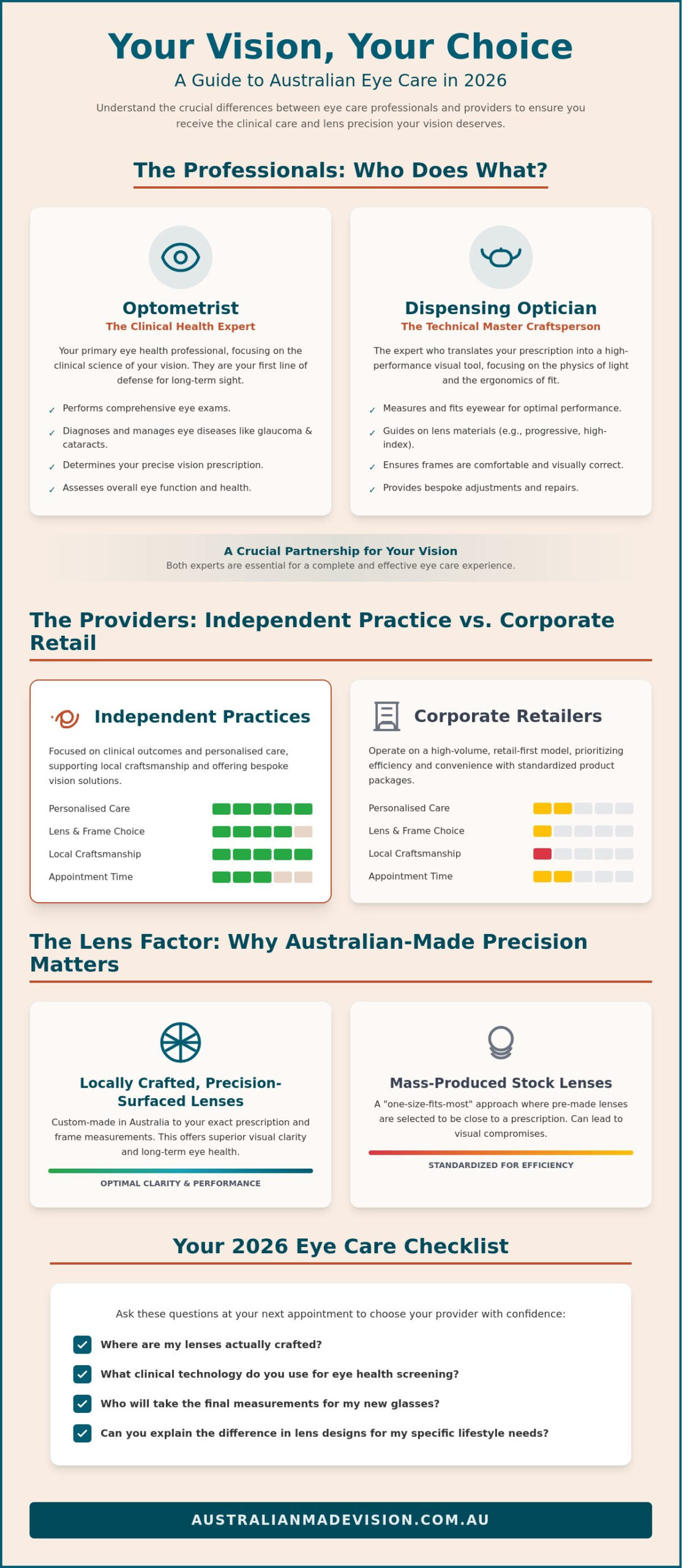
An optometrist acts as your primary eye health professional. They focus on the clinical side of care, from diagnosing diseases to determining your exact prescription. Once that prescription is written, dispensing opticians step in to translate those numbers into a physical product. They are the master craftspeople who understand the physics of light and the ergonomics of a perfect fit. Without both experts, your eyecare experience remains incomplete.
What Does an Optometrist Do?
Your optometrist is the first line of defence for your vision health. In Australia, these professionals complete extensive university training to identify and manage complex conditions. They don’t just check if you need reading glasses. They use advanced technology to screen for silent threats like glaucoma, macular degeneration, and cataracts. These conditions often show no symptoms in their early stages, making regular check-ups vital for long-term sight.
During a comprehensive eye exam, the optometrist assesses how your eyes work together and how they respond to light. They provide the clinical foundation that every pair of glasses is built upon. By choosing an independent practitioner, you often receive a more personalised level of care. These experts take the time to understand your lifestyle and history rather than rushing you through a corporate checklist.
The Vital Role of the Dispensing Optician
Dispensing opticians are the technical masters of the optical world. Their expertise lies in the precise measurement and fitting of your eyewear. It’s one thing to have a prescription, but it’s another thing entirely to have that prescription sit perfectly in front of your pupils. They calculate the vertex distance, pantoscopic tilt, and wrap of the frames to ensure your vision is undistorted and comfortable all day long.
These professionals guide you through complex choices like progressive lenses or high-index materials. They understand how different lens designs interact with your specific frame choice. A skilled dispenser ensures your glasses don’t just look good but function as a high-performance tool. Their focus on visual ergonomics means your frames won’t slip, pinch, or cause unnecessary strain during your daily tasks.
When you support an independent practice, you’re often engaging with a team that values local craftsmanship. They take pride in sourcing quality materials and providing bespoke adjustments that corporate chains frequently overlook. This dedication to the craft reflects a deep commitment to the Australian community and the heritage of quality manufacturing.
Comparing Care Models: Independent Practices vs Corporate Retailers
Most Australians access eye health services through two distinct avenues: large corporate chains or independent local practices. This decision shapes your entire experience. It influences everything from the duration of your appointment to the specific origin of your eyewear. While both models provide essential services, their underlying philosophies differ significantly.
Corporate retailers typically operate on a volume-driven model designed for efficiency and high turnover. These environments often utilize standardized lens packages that simplify the manufacturing process for the company. While this approach offers convenience in busy shopping centres, it can limit the technical options available to you. Corporate opticians are frequently restricted to a specific catalogue of lenses and frames owned by their parent corporation; these may not always represent the pinnacle of bespoke lens technology or local craftsmanship.
The Corporate Retail Experience
The corporate model thrives on a retail-first philosophy where speed is often the primary metric of success. This focus on high-volume sales can lead to a “one-size-fits-all” approach to eye care. You might find that your consultation feels structured around a transaction rather than a clinical discussion. High staff turnover is common in these settings, meaning the person who assists you this year might not be there for your next check-up. This lack of consistency makes it difficult to build a lasting relationship with a practitioner who understands your unique visual history.
The Independent Advantage
Independent practices offer a bespoke alternative rooted in clinical excellence and community heritage. These practitioners have the professional freedom to source high-quality, locally-made lenses from independent Australian laboratories. They aren’t tied to a single global supplier. This allows them to select the absolute best technology for your specific ocular needs. Choosing an independent practice is a direct way to support local family-owned businesses that contribute to the Australian economy and maintain high standards of ethical manufacturing.
These practices excel at providing continuity of care. Seeing the same practitioner over several years allows for a more accurate assessment of long-term eye health. They remember your lifestyle requirements and the subtle changes in your vision that a high-volume clinic might overlook. If you value a tailored approach, you can find an independent optometrist who prioritises your long-term wellness over a quick retail sale. This relationship ensures your vision is managed with the precision, patience, and authentic care that only a local expert can provide.
The Lens Factor: Why Australian Made Precision Matters
While your choice of frames reflects your personal style, it’s the lenses that do the heavy lifting for your eye health. Many people spend hours picking the perfect designer brand, yet the clear material inside is what determines how well you see the world. Expert opticians understand that a lens isn’t just a piece of plastic. It’s a bespoke medical device crafted to correct your unique refractive errors. Choosing Australian-made lenses ensures you aren’t just getting a generic “stock” product pulled from a warehouse shelf. Instead, you’re investing in technology designed specifically for your eyes.
Stock lenses are manufactured in bulk overseas to standard powers. They often lack the nuance required for complex prescriptions or specific lifestyle needs. Locally crafted lenses use advanced digital surfacing techniques to match the exact contours of your chosen frame. This results in sharper vision and significantly less eye strain throughout the day. Australian labs maintain rigorous quality control standards, often exceeding international requirements. Because the manufacturing happens right here, turnaround times are faster. Many patients receive their custom glasses in 3 to 7 business days rather than waiting weeks for an international shipment.
Craftsmanship in Every Prescription
Australian-made lenses are tailored to the specific way a frame sits on your face. This involves measuring the distance between your pupils and how the frame tilts on your nose to ensure the optical centre aligns perfectly. High-performance coatings, such as advanced anti-reflective layers or blue light filters, are applied with artisan care to improve clarity. Precision surfacing is a state-of-the-art manufacturing process that uses digital mapping to reduce peripheral distortion in complex prescriptions. This level of detail provides a wider field of view and smoother transitions for those wearing multifocals.
The Environmental and Ethical Choice
Sourcing your vision needs locally is a conscious decision that benefits the planet. Every lens produced in Australia reduces the carbon footprint associated with long-distance air freight and international logistics. You’re also helping to sustain the thousands of jobs within the local optical manufacturing and retail sector. Supporting independent opticians and practices that prioritise local labs ensures these vital skills remain within our borders. It’s about keeping the expertise of our community alive while receiving a product that’s built to last.
You can use our optometrist directory to find local practices that value Australian-made quality and personalised care. Choosing local means choosing a future where Australian craftsmanship continues to thrive. It’s a commitment to quality that you can see through every day. When you support local industry, you’re investing in a heritage of precision that benefits every Australian patient.
Choosing Your Eye Care Professional: A 2026 Checklist
Your vision is your most precious sense. It deserves more than a “discount” approach focused solely on the lowest price tag. While a bargain might feel good at the checkout, your long-term ocular health relies on precision and clinical expertise. High-quality eyecare is an investment in your quality of life. This is especially true for families. Since experts estimate that 80% of a child’s learning is visual, childrens eye tests require a specific level of patience and specialised equipment that high-volume retail chains often lack.
Questions to Ask Your Optician
When you visit a practice, don’t be afraid to interview the staff. Knowledgeable opticians should be transparent about their supply chain and the technology they use. Start by asking, “Where are my lenses being manufactured?” Lenses crafted locally in Australian labs often meet higher quality standards and support our national industry. You should also ask if they offer a wide range of lens technologies beyond their own house brands. Independent practices usually provide access to bespoke options tailored to your specific lifestyle. Finally, confirm if you’ll see the same optometrist for follow-up appointments. Continuity of care is vital for tracking subtle changes in your eye health over time.
Red Flags in Eye Care
Be wary of appointments that feel rushed. A comprehensive eye exam typically takes 30 minutes or more to ensure every aspect of your vision is assessed. If a provider dismisses symptoms like eye twitching or persistent headaches without a thorough investigation, it’s a sign they may be prioritising volume over value. Aggressive upselling of coatings or frames you don’t need is another warning sign. While “free” eye tests are common, they can sometimes lead to restricted choices. These models often rely on high-pressure sales of house-brand products to recoup costs, which might not be the best fit for your unique prescription. Choosing skilled opticians who value local manufacturing ensures you receive a product built to last. Trust your instincts; if the environment feels more like a fast-food outlet than a clinical practice, your vision may be better served elsewhere.
How to Support Local: Finding an Independent Optometrist
Choosing an independent practice creates a direct link between your eye health and the preservation of Australian made quality. While corporate chains often focus on high turnover retail, independent providers invest in local craftsmanship and long term patient outcomes. This choice supports the A$4 billion Australian optical industry, ensuring that skilled jobs remain within our communities. By opting for a local professional, you’re choosing a bespoke service where the focus stays on your specific visual needs.
The distinction between optometrists and opticians, often referred to as optical dispensers in Australia, becomes clear when you see the level of collaboration in an independent setting. These professionals work closely together to ensure your lenses are crafted with precision. When you support local, you aren’t just a number in a database. You’re a valued member of a community that prioritises ethical manufacturing and clinical excellence.
Using the Australian Made Vision Directory
Finding a local professional who prioritises personalised care is simple with our curated platform. The Australian Made Vision directory connects you with practices that have been vetted for their commitment to quality and the local industry. These providers offer access to high end, locally produced lenses that corporate retailers might overlook. It’s time to take control of your eye health. We encourage you to book your next appointment with an independent provider who understands the value of Australian heritage.
The Future of Australian Vision
The heritage of optical craftsmanship in Australia is built on decades of precision and innovation. As we look toward the future, the strength of our local industry depends on the conscious choices of everyday Australians. By joining a community that values vision health over retail volume, you help protect the future of local manufacturing. This commitment ensures that the next generation of opticians and optometrists has a thriving industry to lead. You deserve eyecare that reflects the high standards of Australian production.
Prioritising Your Vision for a Clearer Australian Future
Choosing the right eye care in 2026 involves more than just a quick prescription check. You’ve seen how independent optometrists offer a depth of personalised care that focuses on your long-term health. These professionals often work closely with skilled opticians to ensure your eyewear is as functional as it is stylish. By opting for a local practice, you gain access to advanced clinical expertise in areas like myopia management while supporting a national network of dedicated experts.
Quality vision relies on the precision of your lenses. Since 1976, we’ve focused on supporting Australian-made optical technology that meets the highest standards of craftsmanship. It’s about more than just seeing clearly; it’s about the trust that comes from knowing your lenses were crafted right here at home. When you choose an independent provider, you’re making a conscious decision to value bespoke quality over mass-produced alternatives. It’s a simple step that makes a significant difference for your eye health and our local industry.
Support local industry and find your nearest independent optometrist here
Taking care of your eyes is one of the best investments you can make for your future well-being.
Frequently Asked Questions
Is an optician the same as an eye doctor?
No, an optician is not a doctor and does not perform eye examinations or diagnose medical conditions. In the Australian eyecare landscape, an optometrist is your primary clinical contact for eye health and prescriptions. Opticians, often referred to as optical dispensers, are the technical experts who specialise in the fit and craftsmanship of your eyewear. They interpret your prescription to ensure your locally crafted lenses provide the best possible vision.
Can an optician give me a prescription for glasses?
Opticians cannot legally perform eye tests or write prescriptions for corrective lenses. You must visit an optometrist for a comprehensive clinical exam to determine your visual needs. Once you have your prescription, our skilled opticians use their expertise to help you select the right bespoke frames. They ensure your Australian-made lenses are aligned perfectly with your pupils, which is a vital step for your visual comfort and clarity.
Why are independent optometrists often considered better than corporate chains?
Independent optometrists offer a level of personalised care and continuity that large corporate chains often lack. Statistics from industry reports indicate that patients in independent practices are 30% more likely to see the same practitioner at every visit. This fosters a deep community connection and allows for tailored recommendations. These local experts have the freedom to source high-quality, authentic products rather than being limited to a specific corporate range.
How often should I see an optometrist for a full eye test?
You should generally book a comprehensive eye test every 2 years to maintain optimal health. Leading eye care professionals recommend this frequency should increase to once every 12 months for those aged over 65. Regular checks are essential because they allow for the early detection of conditions like glaucoma, which currently affects approximately 300,000 Australians. Staying proactive ensures your vision remains sharp and your eye health is protected for the long term.
Are Australian-made lenses more expensive than imported ones?
Australian-made lenses represent a commitment to quality and precision that often provides better long-term value than mass-produced imports. While price points vary, choosing locally manufactured lenses supports the 100,000 Australians employed in the manufacturing sector. These lenses are engineered specifically for our harsh UV environment and high standards of craftsmanship. You aren’t just paying for a product; you’re investing in local heritage and a level of durability that imported alternatives rarely match.
What should I bring to my first appointment with a new optician?
You should bring your current glasses, your most recent prescription, and your Medicare card to your first visit. If you use our directory to find one of the leading independent opticians in your area, it’s also helpful to bring a list of your current medications. This information helps the team understand your history and ensures your bespoke frames are tailored to your lifestyle. Having your previous eyewear allows the expert to see what has worked for you in the past.
Can an optician help with dry eye or eye infections?
Clinical issues like dry eye or infections must be managed by an optometrist rather than an optician. Your optometrist has the therapeutic qualifications to prescribe the necessary treatments or medicated drops. The optician’s role begins once your eyes are healthy and you’re ready for new spectacles. They focus on the technical precision of your lenses and the fit of your frames, ensuring your vision is supported by the finest local craftsmanship.
Do independent opticians accept all major health funds?
Yes, almost all independent practices across Australia accept the full range of major private health funds. Most locations use HICAPS technology, allowing you to claim your optical rebates instantly on the spot. This means you can enjoy the superior care of a local, ethical provider while still using your insurance benefits. It’s a great way to support Australian industry and community businesses while ensuring your out-of-pocket costs remain manageable before your benefits reset on 31 December.
Disclaimer
The information in this article is provided for general educational purposes only and should not be considered medical advice. For personalised advice regarding your vision or eye health, please consult a qualified optometrist.
Australian Made Vision is an independent directory that helps patients find optometrists across Australia who may offer Australian-made spectacle lenses. We do not provide clinical services and recommend contacting practices directly to confirm the products and services they offer.