
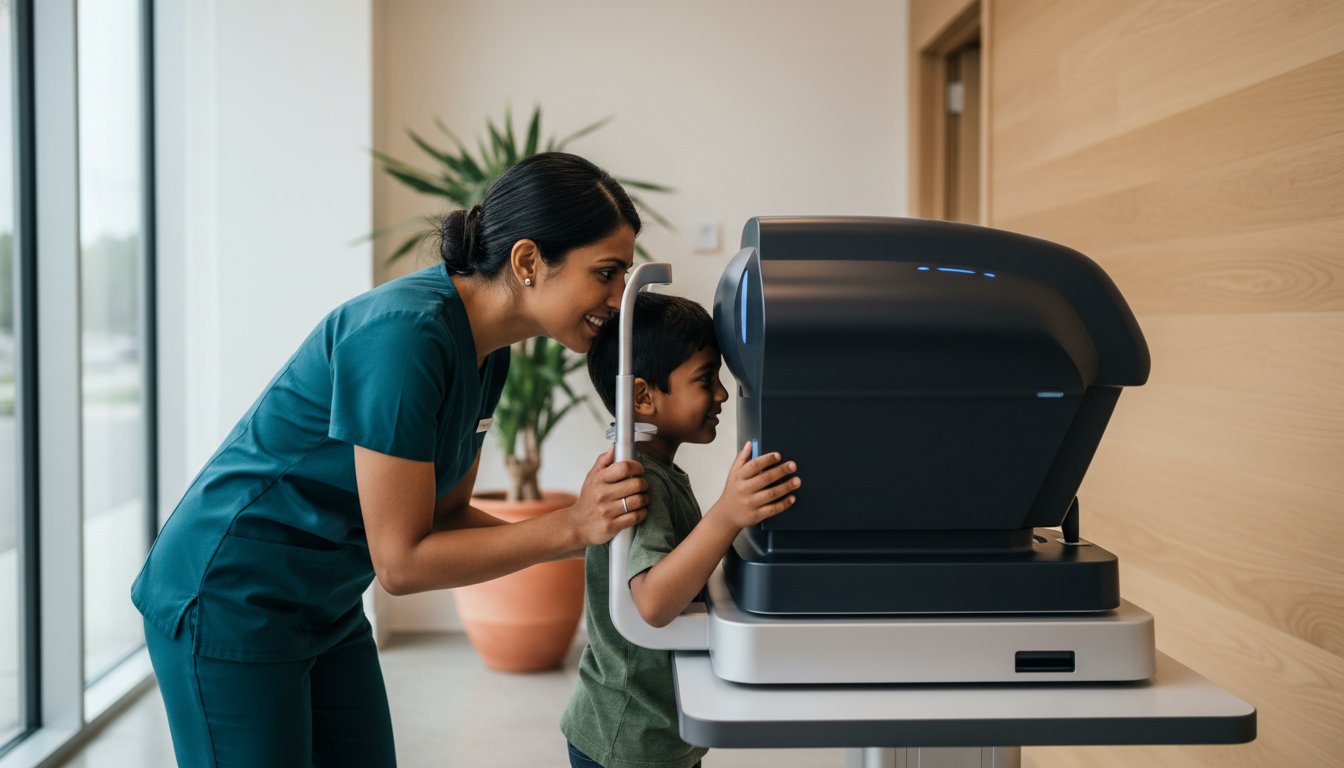
By 2050, research from the Brien Holden Vision Institute suggests that 50% of the global population will be short-sighted, a shift that’s already impacting families across Australia. You’ve likely felt that prickle of concern when your child squints at a distant sign or spends another hour on their tablet. We understand the confusion parents feel when weighing up myopia management options or dealing with the guilt of digital eye strain.
The good news is that we’ve entered a new era of clinical precision where we can do more than just correct blurry vision. You’ll discover how proactive care and locally crafted lens technology can significantly slow the rate of prescription changes in children. This guide explores the latest treatment paths and helps you find independent local experts who treat your child’s vision with the same care as a bespoke piece of craftsmanship. We’ll show you how to protect their sight today to prevent serious eye health issues in the future.
Key Takeaways
- Learn the vital difference between simply correcting blurred vision and adopting a proactive clinical strategy to slow the physical elongation of your child’s eye.
- Understand the innovative science behind peripheral defocus and how specialised lens designs effectively signal the eye to slow its progression.
- Explore the three main pillars of myopia management, comparing the lifestyle benefits of bespoke spectacle lenses, atropine drops, and contact lenses.
- Discover why independent Australian optometrists offer the continuity of care and broader range of custom-surfaced designs necessary for a successful treatment journey.
- Gain insight into the Australian-made advantage, where locally crafted lenses provide superior precision, quality control, and faster turnaround times for your family.
What is Myopia Management and Why is it Critical Now?
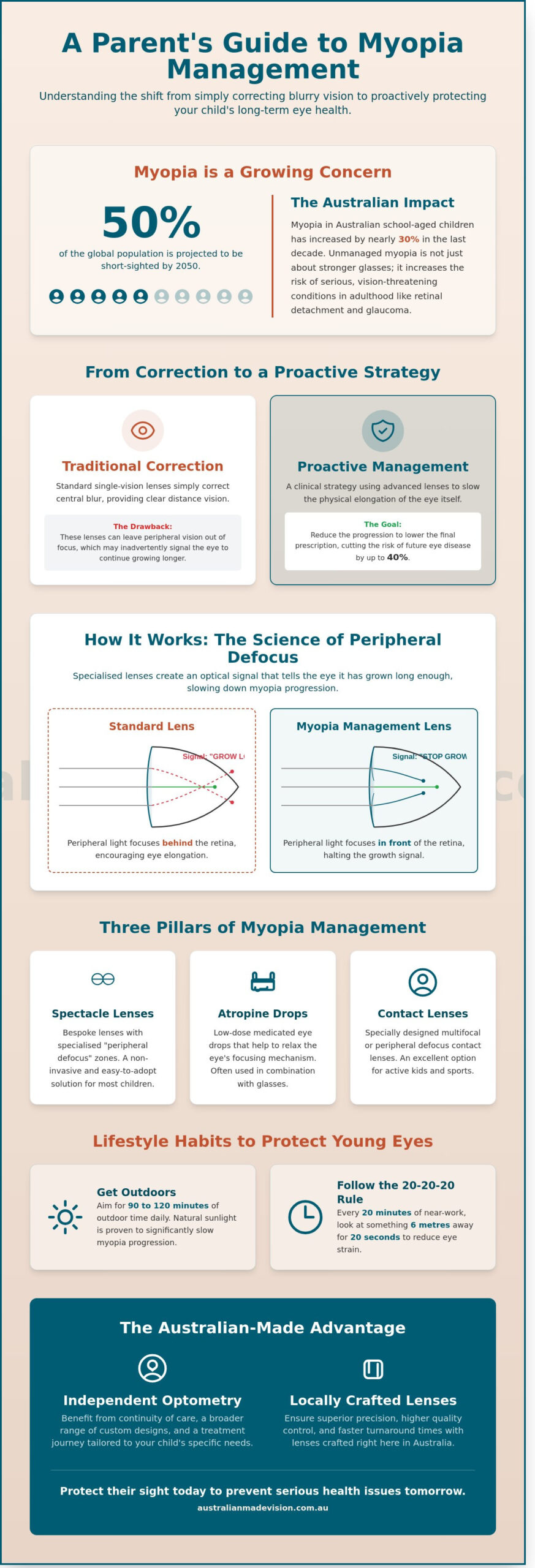
Myopia management is a proactive clinical strategy designed to slow the physical growth of a child’s eye. It differs fundamentally from traditional vision correction. While standard glasses simply clear up distance blur, this specialised approach focuses on slowing the progression of the condition itself. We’ve seen a sharp rise in short-sightedness across Australia. Recent data suggests that myopia prevalence in school-aged children has increased by nearly 30% over the last decade due to changing lifestyle habits like reduced time outdoors.
Unmanaged myopia isn’t just a matter of needing thicker glasses. It carries serious long-term health risks that can impact quality of life in later years. For a comprehensive overview of myopia and its physiological impacts, parents can explore how the shape of the eye dictates vision quality. When the eye grows too long, the internal structures stretch and weaken. This increases the likelihood of retinal detachment and glaucoma in adulthood. Our goal is to provide high-quality, local care that protects your child’s vision for the long haul.
The Shift from Correction to Prevention
Standard single-vision lenses aren’t enough for children with progressing prescriptions. These lenses correct the central vision but can leave the peripheral vision slightly out of focus, which sometimes signals the eye to grow even longer. Myopia management is a clinical intervention to reduce axial elongation. We aim to keep a child’s final prescription under -5.00D. Maintaining a lower prescription reduces the risk of permanent vision loss by up to 40% compared to those who reach high levels of myopia. This preventative mindset is at the heart of bespoke optometry.
Signs Your Child Needs a Myopia Assessment
Recognising the early warning signs can change the trajectory of your child’s eye health. You might notice them squinting to see the whiteboard, sitting too close to the television, or complaining of headaches after school. Early intervention between the ages of 6 and 12 offers the most significant benefits. This is when the eyes are most responsive to treatment protocols. You can find a trusted local expert for children’s eye tests through our directory of independent Australian practices. Choosing an independent optometrist ensures your child receives authentic care tailored to their specific lifestyle and developmental needs.
The Science: How Modern Treatments Slow Eye Growth
Understanding myopia management begins with a look at the eye’s physical shape. In a myopic eye, the eyeball stretches and becomes too long from front to back. This elongation isn’t just a minor focus issue; it puts physical stress on the delicate tissues at the back of the eye. Modern treatments are non-invasive and fit seamlessly into a child’s school day, using advanced optics to signal the eye to slow its growth. These bespoke solutions allow children to play, learn, and grow without the limitations of traditional, older lens technologies.
Understanding Peripheral Defocus
Traditional glasses correct central vision but allow light at the edges of the lens to focus behind the retina. This creates a signal that encourages the eye to grow longer to reach that focal point. Specialized lenses use a concept called peripheral defocus to change this. By creating a treatment zone where light focuses in front of the peripheral retina, these lenses tell the eye it has grown enough. Finding the best option for myopia control depends on a child’s specific needs and activity levels. Our commitment to precision surfacing ensures these complex, locally crafted designs provide the exact optical profile required for each unique case.
The Role of Lifestyle and Environment
Environmental factors in the Australian lifestyle also influence how eyes develop. While digital devices are essential in modern classrooms, prolonged near-work can accelerate eye growth. We encourage families to adopt the 20-20-20 rule. Every 20 minutes, look at something 6 metres away for 20 seconds. This simple habit reduces strain and gives the eyes a necessary break. Outdoor time is equally vital. Research indicates that 90 to 120 minutes of daily exposure to natural sunlight can significantly slow myopia progression.
Your local expert will monitor these factors using axial length measurement. This is a precise way to track the eye’s physical size over time, rather than just checking a prescription. It’s a proactive approach that focuses on long-term health rather than just a quick fix. To ensure your child receives this level of personalized care, you can find an independent optometrist who understands the unique needs of your local community. Using myopia management strategies early on is the most effective way to protect a child’s vision for their adult life.
Comparing Myopia Management Treatment Options
Every child’s vision journey is unique, requiring a bespoke approach rather than a one size fits all solution. Modern myopia management relies on three main pillars: specialised spectacle lenses, low-dose atropine drops, and contact lens options. We find that the best outcomes happen when parents work closely with local experts to choose a path that fits the child’s lifestyle and age.
Spectacle lenses are often the first choice for younger children. They are non-invasive and easy for five or six year olds to manage without parental supervision throughout the school day. For children whose vision is deteriorating quickly, we might recommend combination therapy. This involves using both medicated drops and specialised glasses to achieve a synergistic effect. Clinical data suggests this dual approach can be more effective for rapid progressors than using a single method alone.
Specialised Spectacle Lenses vs. Contact Lenses
Specialised glasses utilise DIMS (Defocus Incorporated Multiple Segments) or HALT (Highly Aspherical Lenslet Target) technology. These lenses look like standard glasses but contain microscopic treatment zones that signal the eye to slow its growth. They represent the lowest-risk entry point for Australian families because they don’t involve touching the eye or rigorous cleaning routines. This makes them a highly convenient option for busy primary school students.
- Safety: Spectacles carry zero risk of corneal infection, unlike contact lenses.
- Adaptation: Most children adapt to DIMS or HALT lenses within 48 hours.
- Lifestyle: Ortho-K contact lenses are great for swimmers or athletes because they are worn only at night, leaving the day lens-free.
Contact lenses, including Ortho-K and soft multifocals, are excellent for older, responsible children. While they offer great freedom for sports, they require a higher level of hygiene and manual dexterity. Finding a trusted independent optometrist through our directory can help you determine if your child is ready for the responsibility of contact lenses.
The Role of Atropine Eye Drops
Low-dose atropine drops, usually in concentrations between 0.01% and 0.05%, work by chemically signalling the eye to slow down its axial elongation. This treatment is backed by extensive research. You can explore the latest findings in this evidence-based myopia management review which highlights the safety and efficacy of modern interventions. It’s a simple addition to a nightly routine, requiring just one drop before bed.
Some children experience side effects like mild light sensitivity or slightly blurred vision when reading. We often manage these issues by pairing the drops with photochromic lenses that darken in the sun. Because atropine doesn’t correct the child’s blur, it must be used alongside glasses or contact lenses. This flexibility allows us to create a layered treatment plan that targets the myopia management goals from multiple angles.
Why Independent Optometry Leads the Way in Myopia Care
Choosing the right partner for your child’s vision is a significant decision for any Australian family. Myopia management isn’t a one-off transaction; it’s a clinical strategy that evolves as your child grows. Independent practices prioritise the long-term health of the community over high-volume retail targets. This focus allows for a bespoke experience where the practitioner selects from a vast range of global and locally crafted lens designs tailored to your child’s specific lifestyle.
The Advantage of Personalised Clinical Care
Successful myopia management requires detailed, unhurried consultations that don’t fit into a standard fifteen-minute retail slot. When you visit a local independent, you’re often seeing the same practitioner year after year. They understand your child’s visual history, their hobbies, and how their eyes have changed since their last visit. This continuity is the cornerstone of the personalised eye care advantage that independent practices offer.
These practitioners take the time to explain the “why” behind every recommendation. They aren’t restricted by a limited corporate product list. Instead, they can access the latest optical innovations to ensure your child receives the most effective treatment available. It’s about building a relationship based on trust and shared goals for your child’s future sight.
Access to Advanced Diagnostic Technology
Independent optometrists frequently invest in specialised equipment that goes beyond the basics. Many practices now use optical biometers to measure the axial length of the eye to within 0.01mm. This precise measurement is the gold standard for tracking how well a treatment plan is working. Without this data, practitioners are simply guessing based on prescription changes alone. By choosing an independent, you’re often accessing technology that provides a much clearer picture of your child’s eye growth.
- Tailored Solutions: Bespoke lens designs can be customised to fit your child’s unique facial features and frame choice.
- Expert Guidance: You can ask your optometrist about specific lens technologies and how they compare to other options on the market.
- Long-term Commitment: Independent owners are deeply invested in the Australian optical landscape and the health of their local patients.
Empower your family with expert care by choosing a practitioner who puts clinical outcomes first. You can find a local independent optometrist through our directory to begin your child’s journey toward clearer, healthier vision.
The Australian-Made Advantage in Myopia Lenses
Selecting the right tools for myopia management involves more than just a standard prescription. Lenses crafted in local Australian laboratories offer a level of precision that mass-produced imports often fail to match. By keeping production on-shore, our optical technicians maintain tight control over the entire surfacing process from start to finish. This proximity means complex, custom-surfaced prescriptions for children are often ready in 3 to 5 business days. This is a significant improvement over the 14-day wait times common with overseas manufacturing. It’s a faster, more reliable way to ensure your child doesn’t spend extra time struggling with outdated vision correction.
Quality You Can Trust for Your Child
Australian optical laboratories operate under some of the most stringent manufacturing protocols in the world. These facilities use advanced digital surfacing technology to tailor lenses specifically to your child’s unique eye measurements and frame choice. Local production also allows for superior application of high-performance coatings. These include specialised anti-reflective layers that are essential for reducing glare during classroom learning. Australian-made lenses meet some of the world’s strictest quality benchmarks, ensuring every pair of glasses is durable enough for active kids.
Supporting the Local Community
Choosing locally crafted eyewear does more than help your child see clearly; it directly strengthens the Australian economy. Every pair of lenses manufactured here supports local jobs and sustains the network of independent optometrists who provide personalised, clinical care. These independent practitioners maintain direct relationships with their labs, allowing for bespoke adjustments and faster troubleshooting if your child’s frames need a service. This partnership ensures that myopia management remains a collaborative effort between your family and local experts.
When you invest in Australian-made solutions, you ensure that the expertise needed to manage your child’s vision remains accessible in your local area. You can find an expert local provider through our directory of independent optometrists to begin a tailored care plan. Prioritise your child’s long-term vision health with locally crafted solutions that support our community and provide the reliability your family deserves.
Securing Your Child’s Visual Future
Protecting your child’s sight requires a proactive approach that goes beyond a standard pair of glasses. By 2050, research from the Brien Holden Vision Institute suggests that half of the global population will be affected by short-sightedness. Effective myopia management starts with choosing advanced paediatric lens technology that’s specifically designed to slow down axial eye growth. When you opt for Australian-made lenses, you aren’t just supporting local industry; you’re ensuring your child receives precision-crafted optics tailored to their unique lifestyle. These locally manufactured solutions offer a level of quality and precision that reflects our national heritage of excellence.
Independent optometrists provide the clinical continuity and bespoke care that corporate chains often struggle to match. They use their clinical freedom to recommend the best possible treatments for your family’s specific needs. By choosing an independent practitioner, you’re gaining a trusted partner who prioritises long-term health over high-volume sales. They take the time to monitor your child’s progress year after year, offering stability in an ever-changing digital landscape. Investing in these high-quality, clinical solutions today can significantly reduce the risk of sight-threatening conditions in adulthood. It’s a simple step that makes a world of difference for their future clarity.
Find an independent Australian optometrist near you to begin your child’s journey toward healthier vision. Your local community expert is ready to help you navigate these important health decisions with confidence and care.
Frequently Asked Questions About Myopia Management
Is myopia management permanent, or can the condition return?
Myopia management is designed to slow down the elongation of the eye during a child’s growing years rather than providing a permanent cure. While the physical changes to the eye’s shape won’t reverse, the goal is to stop the prescription from reaching dangerous levels. Clinical data shows that treatment usually continues until the late teens or early twenties, when eye growth naturally stabilises for 95 percent of young adults.
At what age should my child start myopia management?
Your child should start treatment as soon as a qualified optometrist diagnoses myopia, which typically occurs between the ages of 6 and 12. Research from the Brien Holden Vision Institute indicates that early intervention is critical because the most rapid changes in eye length happen before a child turns 10. Starting early can reduce the final severity of the condition by up to 50 percent.
Are myopia management glasses more expensive than regular glasses?
Yes, myopia management lenses involve a higher initial investment because they use advanced optical technology rather than simple vision correction. In Australia, you can expect to pay between A$400 and A$650 for high-quality, locally crafted specialised lenses. While this is more than the A$150 or A$200 you might pay for standard lenses, the long-term value lies in protecting your child’s future eye health and reducing the need for thicker, more expensive prescriptions later.
How long does it take to see results from myopia treatment?
You won’t see an overnight change in your child’s vision, as results are measured by the lack of progression over 6 to 12 months. Optometrists use specialised equipment to measure the eye’s axial length to the millimetre. If the eye growth stays within a normal range during your half-yearly check-ups, the treatment is considered successful. It’s a marathon, not a sprint, requiring consistent care and patience.
Can myopia be reversed once it has started?
No, myopia cannot be reversed because it’s caused by the physical stretching of the eyeball. Once the eye has grown too long, it can’t be “un-stretched” back to its original shape. This is why our focus remains on prevention and slowing the rate of change. By managing the condition now, you help prevent the 3x higher risk of retinal detachment associated with high myopia in later life.
Will my child still need to wear glasses all day with these treatments?
Most myopia management spectacle lenses are designed for full-time wear to be effective. For the technology to work correctly, children generally need to wear their glasses for at least 12 hours a day. If your child uses other methods like Ortho-K, they’ll wear specialised lenses only while sleeping, which allows them to see clearly throughout the day without any eyewear at all. Your independent optometrist will help you choose the best bespoke fit for your child’s lifestyle.
What happens if we choose not to do myopia management?
If left untreated, a child’s myopia will likely worsen by 0.50D to 1.00D every year until they reach adulthood. This progression significantly increases the risk of developing serious eye diseases, including a 40 percent higher chance of developing glaucoma or early-onset cataracts. Choosing to monitor the condition without active intervention often leads to “high myopia,” which can cause permanent vision loss in 1 out of 10 cases.
How do I know if my local optometrist offers these specialised services?
You can identify providers by looking for independent practices that list myopia control or paediatric eye care as a core service. Independent optometrists often have access to a wider range of Australian-made lenses and bespoke treatment plans than large corporate chains. Our directory is a reliable resource for finding local, community-focused experts who prioritise long-term eye health over high-volume retail sales. These master practitioners take the time to explain the clinical data and find a solution that supports our local manufacturing industry.
Disclaimer
The information in this article is provided for general educational purposes only and should not be considered medical advice. For personalised advice regarding your vision or eye health, please consult a qualified optometrist.
Australian Made Vision is an independent directory that helps patients find optometrists across Australia who may offer Australian-made spectacle lenses. We do not provide clinical services and recommend contacting practices directly to confirm the products and services they offer.