

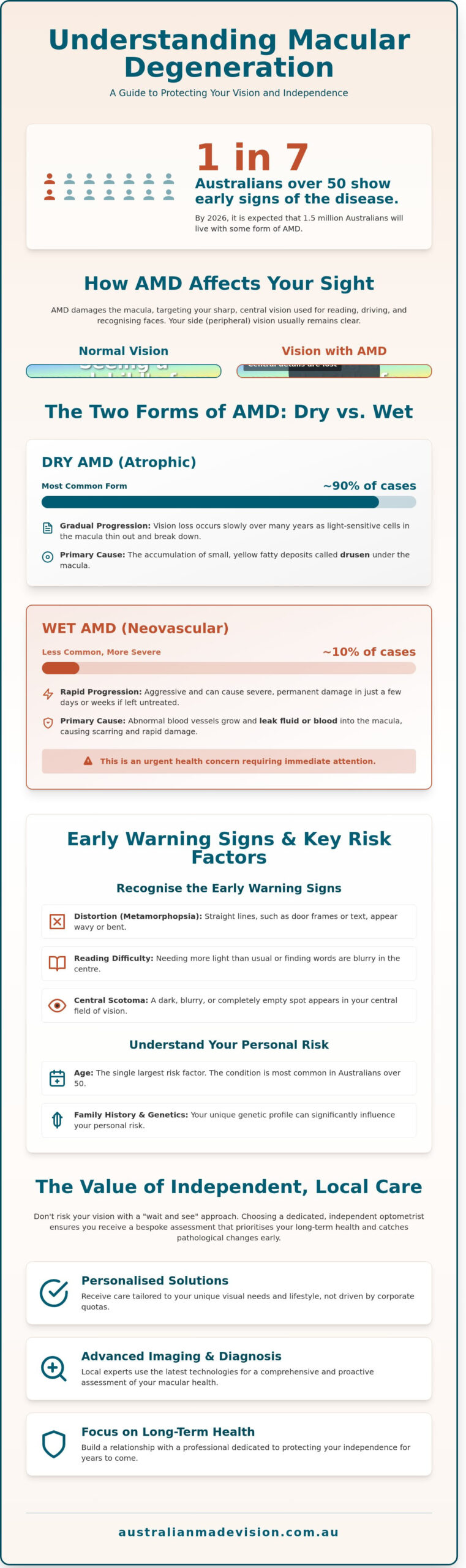
Did you know that 1 in 7 Australians over the age of 50 currently show early signs of macular degeneration? It’s a sobering figure that represents thousands of our neighbours and friends across the country. You might feel that slight blurriness while reading the morning paper is just a part of getting older, but the anxiety of potentially losing your driver’s licence or the ability to see your grandchildren’s faces is deeply personal. It’s a concern we hear often in our local communities, where vision is the thread that connects us to our heritage and our daily lives.
We believe that every Australian deserves access to high-quality, bespoke eye care that prioritises long-term health over corporate quotas. This guide will help you understand the specific causes and symptoms of the disease while introducing the most effective management strategies for 2026. You’ll learn how to distinguish between normal ageing and clinical concerns, ensuring you have the knowledge to protect your independence for years to come.
We’ll also show you how to find a dedicated, independent professional who understands the value of locally crafted solutions and personalised attention. From preventative steps to the latest treatments, we’re here to ensure your vision remains as clear and authentic as the Australian landscape itself.
Key Takeaways
- Gain a clear understanding of how macular degeneration impacts your central vision and why early intervention is the key to preserving your long-term independence.
- Discover the critical biological differences between Dry and Wet AMD to better identify when gradual changes become urgent health concerns.
- Learn to recognise early warning signs and understand how your unique family history and genetic profile influence your personal risk.
- Explore the advanced imaging technologies used by local experts to provide a comprehensive and proactive assessment of your macular health.
- Understand the value of seeking care from independent optometrists who offer bespoke, personalised solutions tailored to your specific visual needs.
What is Macular Degeneration and How Does it Affect Your Sight?
Macular degeneration is a chronic eye condition that specifically targets the macula, the small but essential part of the retina at the back of your eye. While many people assume that fading sight is just a natural part of getting older, this disease is actually a pathological change. It’s the leading cause of vision loss for Australians over the age of 50, with data indicating that one in seven people in this age group show signs of the condition. By 2026, experts expect that approximately 1.5 million Australians will live with some form of this disease.
The macula is responsible for your sharp, central vision. It’s what allows you to see the fine details needed for reading the newspaper, recognising the faces of your grandchildren, or safely driving to the shops. When this area becomes damaged, your ability to perform these high-detail tasks diminishes, even though your side vision often remains quite clear. Understanding the difference between normal ageing and this specific condition is the first step toward protecting your long-term eye health and independence.
The Anatomy of Central Vision
To understand how this condition works, it’s helpful to look at how light interacts with your eye. Light passes through the front of the eye and hits the retina, which functions like the film in a camera. You can find a more detailed breakdown of this process in our guide on The Human Eye. The macula sits right in the centre of this light-sensitive layer. It’s packed with millions of photoreceptor cells that provide the high-resolution images your brain needs to interpret the world.
- The macula provides the clarity needed for reading and writing.
- It enables colour perception and fine detail recognition.
- Peripheral vision, which is controlled by the outer retina, usually stays intact.
Because the outer parts of the retina aren’t usually affected, people with advanced macular degeneration don’t typically experience total darkness. Instead, they might see a dark or blurry patch right in the middle of their field of view. The edges of the room remain visible, but the ability to focus on a specific object is lost.
The Impact on Daily Australian Life
Vision loss isn’t just a clinical diagnosis; it’s a profound shift in how you experience your community and your home. Simple chores like reading the labels on a medicine bottle or checking the score on the cricket can become frustrating challenges. For many of our patients, the emotional weight of losing independence is the most difficult part of the journey. The thought of not being able to drive or see the expressions on a loved one’s face is understandably distressing.
We’ve found that a “wait and see” approach is the biggest risk to your vision. Many people ignore slight distortions, thinking they’ll go away, but early intervention is the only way to effectively manage the condition. Choosing a local, independent optometrist ensures you receive a bespoke assessment tailored to your specific needs. These masters of their craft take the time to conduct thorough screenings, ensuring that any pathological changes are caught well before they impact your daily freedom and quality of life.
Dry vs. Wet AMD: Understanding the Two Faces of the Condition
Macular degeneration isn’t a single experience. It presents in two distinct ways that require very different responses from both you and your local eye health team. In Australia, approximately 1.5 million people live with some form of this condition, making it a significant focus for our independent optometry community.
The primary difference lies in how the disease affects the macula. Dry AMD is the most common form, affecting about 90% of patients. It develops slowly as the eye ages. Wet AMD is less frequent but far more aggressive. It can cause permanent damage in just a few days if left untreated. According to MedlinePlus, these two forms represent different stages of cellular change within the retina.
Dry Macular Degeneration: The Gradual Change
This form begins with the accumulation of small, yellow fatty deposits called drusen. Think of these as tiny pieces of debris that the eye can’t clear away. Over time, these deposits cause the macular tissues to thin out and stop working correctly. It’s a slow process that often takes many years to impact your daily activities.
Managing this stage focuses on precision monitoring and lifestyle choices. We often recommend specific nutritional supplements and regular check-ups to track any changes. Since there’s currently no surgical cure for the dry form, maintaining a healthy diet and protecting your eyes from UV rays with high-quality, locally crafted lenses is vital for long-term health.
Wet Macular Degeneration: The Medical Emergency
Wet AMD occurs when abnormal blood vessels grow underneath the retina. These vessels are fragile and often leak blood or fluid, which lifts the macula from its normal position. This process causes sudden, severe blurring or a dark spot in your central vision. A hallmark sign is metamorphopsia, where straight lines, like door frames or floorboards, appear wavy or bent.
- Sudden onset: Vision changes can happen overnight.
- High risk: While it only accounts for 10% of cases, it causes the majority of legal blindness.
- Urgent action: You must see an optometrist within 24 hours of noticing distortion.
Every case of wet AMD starts as the dry form. There’s no way to predict exactly when or if this transition will occur, which is why we value the personal, consistent care provided by independent Australian optometrists who know your history. Early detection via advanced imaging is the best tool we have to save your sight.
Recognising the Signs and Assessing Your Risk
Early detection is the most powerful tool we have in the fight against vision loss. Because macular degeneration often develops slowly, the initial changes can be subtle. We recommend keeping a close watch on your central vision. If you notice any of the following, book a comprehensive eye test with an independent optometrist immediately.
Common Symptoms to Watch For
- Wavy lines: Straight edges, like door frames or bathroom tiles, appear distorted or “kinked.”
- Central blind spots: A dark, blurry, or “empty” patch develops in the middle of your visual field.
- Muted colours: Your favourite Australian landscapes look duller, and colours lose their vibrancy.
- Low light struggle: You find it increasingly difficult to read or recognise faces in dimly lit rooms.
These signs occur when the macula, the part of your eye responsible for sharp central detail, begins to break down. For a deeper look at how these symptoms progress, you can refer to this National Eye Institute guide on AMD which details the different stages of the condition. Recognising these changes early can be the difference between maintaining your independence and facing significant sight loss.
Who is Most at Risk?
Age remains the primary risk factor. Australians over the age of 60 face a significantly higher chance of developing the condition. Genetics also play a massive role; if a parent or sibling has the disease, your risk increases by 50 per cent. Your heritage isn’t your destiny, though. Lifestyle choices provide a genuine chance to protect your sight through proactive care.
Smoking is a major culprit, as it doubles the likelihood of vision loss. Systemic health issues like high blood pressure also impact the delicate blood vessels in your retina. In our harsh local climate, protecting your eyes from UV radiation is non-negotiable. Australian sunlight is intense. Cumulative damage from UV exposure can accelerate retinal aging and harm your long term health.
Nutrition is another area where you can take control. A diet high in saturated fats can harm the macula, while “eye-friendly” nutrients like lutein and zeaxanthin found in leafy greens offer a layer of protection. Choosing an independent practitioner ensures you receive a bespoke assessment tailored to your specific risk profile. These local experts take the time to understand your family history and lifestyle, providing the authentic care your vision deserves.
The Road to Diagnosis and Prevention
Early detection remains our most powerful tool against macular degeneration. A comprehensive eye exam at an independent practice involves much more than checking if you need new glasses; it’s a deep dive into your retinal health. Your optometrist will assess your central vision and use specialised drops to dilate your pupils, allowing a clear view of the macula at the back of the eye. This thoroughness ensures that even the smallest changes are caught before they impact your daily life.
Between these professional visits, you play a vital role in monitoring your own sight. The Amsler Grid is a simple yet effective tool for home testing. By looking at this grid daily, you can spot early signs of distortion or “wavy” lines that might indicate a progression from dry to wet AMD. If you notice any sudden changes, you should contact your local practitioner immediately. It’s this partnership between patient and clinician that preserves sight over the long term.
Advanced Diagnostic Tools
Modern independent clinics use Optical Coherence Tomography (OCT) to provide a 3D map of your retina. Think of it as a non-invasive ultrasound for the eye that uses light waves to see beneath the surface. This technology allows us to identify fluid or thinning layers that a standard physical exam might miss. Digital retinal photography complements this by capturing high-resolution images of drusen, which are small yellow deposits. By comparing these images over several years, your optometrist can track the rate of change with mathematical precision. Even if you feel your vision is perfect, these scans detect issues years before symptoms appear.
Proactive Prevention Strategies
You can take active steps to slow the progression of early-stage macular degeneration through specific lifestyle choices. The AREDS2 nutritional framework is a proven formula consisting of 500mg of Vitamin C, 400 IU of Vitamin E, 80mg of Zinc, 10mg of Lutein, and 2mg of Zeaxanthin. These antioxidants support macular pigment density and protect cells from oxidative stress. Beyond nutrition, quitting smoking is the single most impactful change you can make. Research shows that smokers are four times more likely to develop AMD than non-smokers. Protecting your eyes from the harsh Australian sun is also essential.
- Choose high-quality, polarised Australian-made lenses to filter 100% of harmful UV rays.
- Incorporate leafy greens like kale and spinach into your diet at least three times a week.
- Maintain a healthy blood pressure to ensure consistent blood flow to the retina.
- Wear wide-brimmed hats when outdoors to reduce peripheral light entry.
Our commitment to local craftsmanship means we value the health of our community. Supporting independent optometry ensures you receive bespoke care tailored to your specific genetic and environmental risk factors. You deserve a vision plan that is as unique as your heritage.
To ensure your eyes receive the highest standard of local care, find an independent optometrist in your area today.
Navigating Life with AMD: The Role of Independent Care
Managing a chronic condition like macular degeneration requires more than a standard prescription. It demands a dedicated partnership between you and your eye care professional. Independent optometrists are uniquely positioned to provide this level of longitudinal care. They often allocate 30 to 45 minutes for a consultation, which is significantly longer than the 15 minute slots typically found in high-volume corporate settings. This extra time allows for a thorough examination of the macula and a detailed discussion about your daily visual challenges.
Trust is the foundation of effective health management. By visiting a local independent practitioner, you ensure continuity of care. You see the same expert year after year. They understand your clinical history and your personal lifestyle needs. This relationship is vital for detecting the subtle, millimetre-level changes in retinal health that occur with macular degeneration. Your local optometrist acts as a guardian of your sight, offering stability in a healthcare journey that can often feel uncertain.
The Independent Optometry Advantage
Independent practices offer a broader spectrum of specialised lens technologies because they aren’t tied to a single corporate supply chain. They select products based on clinical merit and your specific visual requirements. This freedom allows them to source the latest innovations in retinal imaging and bespoke lens design. You can read our detailed guide on choosing the right optometrist to find a practitioner who prioritises your long-term wellbeing over retail targets.
Bespoke Visual Aids and Lenses
Standard lenses often lack the precision required to help a compromised macula. Australian-made high-index lenses, such as 1.67 or 1.74 resins, provide superior clarity while remaining lightweight and comfortable. Locally crafted occupational lenses can be customised to your exact workspace or hobby distances, maximising your remaining functional vision. Specific therapeutic tints, like amber or plum, can improve contrast sensitivity by up to 15 percent, making it easier to navigate stairs or read in low light. These bespoke solutions are designed with the care of a master artisan. We encourage you to find an independent optometrist today to explore how these precision tools can support your independence.
Your vision is a precious part of your identity and your connection to the Australian community. Don’t wait for symptoms to worsen before seeking expert advice. Early intervention and personalised lens solutions are your best defence against vision loss. Take the proactive step of booking a comprehensive eye exam with a local expert who values quality, precision, and the health of your eyes above all else.
Prioritising Your Vision Health Today
Managing your eye health is a lifelong commitment that requires both vigilance and expert support. Understanding the risks of macular degeneration and recognising early symptoms like distorted lines or blurred central vision can make all the difference. While the condition affects approximately 1.5 million Australians as of 2024, modern diagnostic tools and preventative strategies provide a clear path forward for maintaining your independence.
You deserve more than a one-size-fits-all approach to your sight. By visiting an independent practice, you’ll benefit from personalised clinical care and access to locally crafted, bespoke lens solutions designed for your specific needs. Supporting these practitioners means you’re also choosing to support local Australian manufacturing and high-quality craftsmanship. It’s a choice that strengthens our community while ensuring your eyes receive the meticulous attention they require.
Don’t wait for your vision to change before taking action. Your local expert is ready to help you navigate your eye health journey with precision and care. Find an Independent Australian Optometrist Near You to secure your vision for 2026 and beyond. Your future self will thank you for the clarity and peace of mind you’ve protected today.
Frequently Asked Questions
Is macular degeneration hereditary?
Yes, genetics play a significant role in your risk levels. Research from the Macular Disease Foundation Australia shows that if a first-degree relative has the condition, your personal risk increases by 50%. We recommend discussing your family history with an independent optometrist who can provide a bespoke screening plan tailored to your heritage.
Can I still drive if I have macular degeneration?
You can often continue driving in the early stages, provided you meet the specific vision standards set by your state’s transport authority. In most Australian states, you generally need a visual acuity of at least 6/12 in one or both eyes to hold a private licence. Our local independent practitioners perform precise assessments to ensure your vision remains safe for the road while prioritising your independence.
What is the difference between AMD and a cataract?
Macular degeneration affects the retina’s central part, while a cataract is a clouding of the eye’s natural lens. While cataracts can usually be corrected with a 20 minute surgical procedure, AMD requires ongoing management of the delicate retinal tissue. Both conditions impact clarity, but they require very different clinical approaches from your dedicated eye care team.
Does wearing sunglasses help prevent macular degeneration?
Yes, wearing high quality sunglasses with a lens category of 2, 3, or 4 helps protect your macula from cumulative UV damage. Australian standards require these lenses to block at least 95% of UV radiation to be effective. Investing in locally crafted, bespoke eyewear ensures your eyes are shielded from the harsh Australian sun while supporting our national manufacturing industry.
Is there a cure for the dry form of macular degeneration?
There’s currently no total cure for the dry form of macular degeneration, but new treatments are emerging in 2026 to slow its progression. Clinical trials have shown that specific antioxidant supplements can reduce the risk of advanced disease by 25% in certain patients. We focus on proactive monitoring and personalised care to help you maintain your quality of life for as long as possible.
How often should I have my eyes tested if I have a family history of AMD?
You should have a comprehensive eye exam every 12 to 24 months if you’re over the age of 50 and have a known family history. Early detection is vital, as 90% of vision loss from AMD can be prevented or slowed if caught early enough. An independent optometrist uses advanced imaging to track subtle changes in your retinal health with genuine care and precision. While macular degeneration affects central vision, other conditions like glaucoma can silently damage your peripheral vision, making comprehensive eye exams essential for protecting your complete field of sight.
Can macular degeneration lead to total blindness?
Macular degeneration rarely leads to total darkness because it primarily affects your central vision, leaving peripheral sight intact. While it makes tasks like reading or recognising faces difficult, you’ll typically retain enough side vision to navigate your environment safely. Our community focused clinics provide tailored strategies and low vision aids to help you make the most of your remaining sight.
What foods are best for supporting macular health?
Dark leafy greens like spinach and kale are the best choices because they’re rich in lutein and zeaxanthin. Eating oily fish like salmon at least twice a week provides essential omega 3 fatty acids that support retinal function. These dietary habits, combined with regular check ups at an Australian independent practice, form a strong foundation for protecting your vision for the long term. It’s also important to distinguish between serious conditions like macular degeneration and more common issues like conjunctivitis symptoms and causes, which can cause temporary discomfort but typically resolve with proper treatment.
Disclaimer
The information in this article is provided for general educational purposes only and should not be considered medical advice. For personalised advice regarding your vision or eye health, please consult a qualified optometrist.
Australian Made Vision is an independent directory that helps patients find optometrists across Australia who may offer Australian-made spectacle lenses. We do not provide clinical services and recommend contacting practices directly to confirm the products and services they offer.