
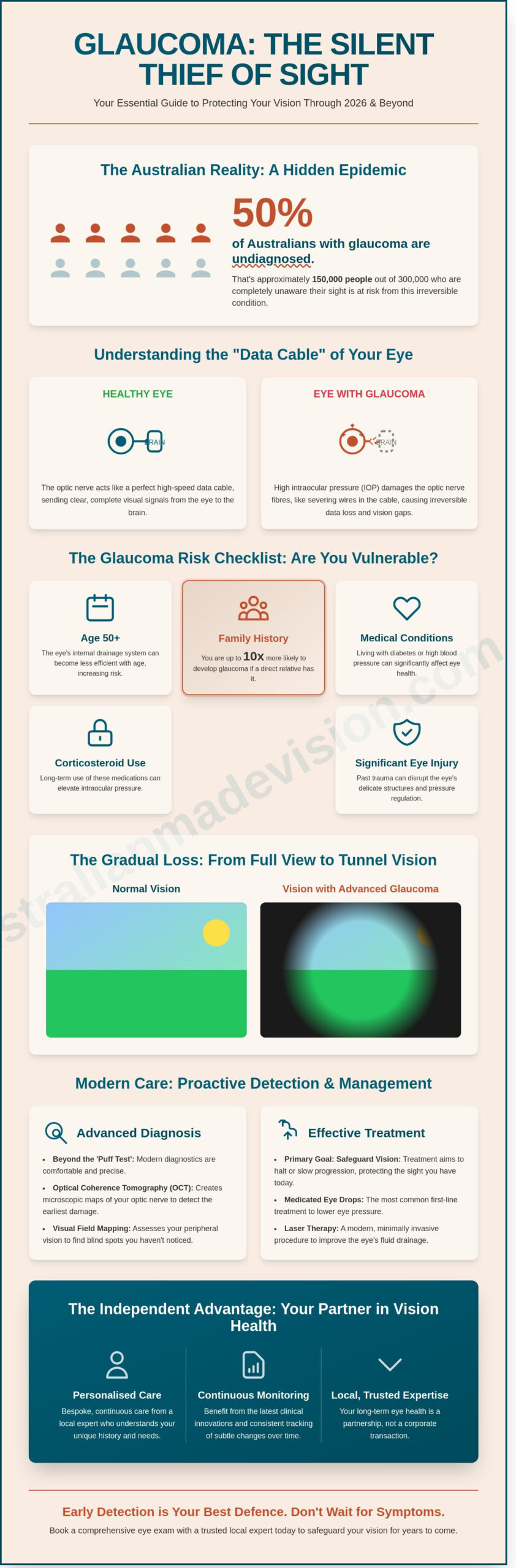
Did you know that 50% of the 300,000 Australians currently living with glaucoma are completely unaware their sight is at risk? It’s a startling figure that highlights why this condition is often called the silent thief of sight. You might feel that slight changes in your focus are just a part of getting older, but the line between natural ageing and a manageable disease isn’t always clear. It’s completely normal to feel anxious about invasive tests or the fear of losing your independence.
We believe that your eye health deserves the same level of craftsmanship and care as a locally made frame. You’ll learn the critical risk factors, subtle warning signs, and the essential management steps to safeguard your vision through 2026 and beyond. We’ve designed this checklist to replace confusion with clarity, giving you the confidence to partner with a trusted local expert who understands your unique needs. We’ll walk through how personalised care and modern diagnostic tools can help you maintain your quality of life with ease.
Key Takeaways
- Learn why glaucoma is known as the ‘silent thief of sight’ and how identifying optic nerve damage early is the most effective way to preserve your vision.
- Identify your personal risk profile using our 2026 checklist, specifically highlighting why Australians over the age of 50 require more frequent, proactive monitoring.
- Discover modern, comfortable alternatives to the traditional ‘puff of air’ test and understand how visual field mapping helps protect your peripheral sight.
- Gain clarity on current treatment pathways, from medicated drops to laser therapy, and why the primary goal is always to safeguard the vision you have today.
- Explore the benefits of the independent optometry model, where bespoke, continuous care from a local expert ensures your long-term eye health is never treated like a corporate transaction.
What is Glaucoma? Understanding the Silent Thief of Sight
Glaucoma is not a single disease. It is a group of complex eye conditions that cause irreversible damage to the optic nerve. This nerve acts as the vital link between your eyes and your brain. When it suffers damage, your ability to see clearly diminishes. This often occurs due to a buildup of intraocular pressure (IOP). You can think of IOP like the air pressure in a car tyre. Just as a tyre needs the right amount of air to function, your eye needs a stable internal pressure. However, when that pressure rises too high, it begins to compress and destroy the delicate nerve fibres responsible for your sight.
We frequently call this condition the “silent thief of sight.” It earns this title because the most common forms of the disease develop without pain or obvious warning signs. In Australia, approximately 300,000 people live with the condition, yet data suggests that 50% of them are entirely unaware they have it. By the time a person notices a change in their vision, significant damage has already occurred. While vision lost to glaucoma cannot be restored, early detection is a powerful tool. Catching the disease in its infancy allows your optometrist to implement treatments that stop or significantly slow its progression.
For a comprehensive overview of glaucoma, it’s helpful to understand that it is a chronic condition requiring lifelong management. Choosing a local, independent practitioner ensures you receive the consistent, personalised care needed to monitor these subtle changes over time. Their expertise and high-quality diagnostic equipment are your best defence against this quiet threat.
How Glaucoma Affects the Optic Nerve
To understand the damage, imagine your eye is a high-end digital camera and your brain is the display screen. The optic nerve is the high-speed data cable connecting the two. When glaucoma strikes, it is as if the individual copper wires inside that cable are being slowly severed. This destruction usually starts with the fibres responsible for your side vision. Consequently, people often lose their peripheral sight first, which creates a “tunnel vision” effect that many don’t notice until it’s quite advanced.
- Open-angle glaucoma: This is the most common form in Australia. It develops slowly as the eye’s drainage canals become clogged over time, much like a slow-draining sink.
- Angle-closure glaucoma: This type is less common but can occur suddenly. It’s a medical emergency where the pressure rises rapidly, often causing pain and blurred vision.
The Importance of Vision Health in 2026
Our lifestyles have changed rapidly. By 2026, the average Australian spends upwards of 10 hours a day engaged with digital screens. This constant near-task demand can lead to digital eye strain, which sometimes masks the more serious, underlying symptoms of eye disease. Prioritising your vision health in 2026 is no longer just about getting a prescription for glasses; it’s about comprehensive wellness checks.
Modern technology in 2026 has made detection more precise than ever. Independent optometrists now utilise advanced imaging like Optical Coherence Tomography (OCT) to map the optic nerve with microscopic detail. These high-quality, Australian-standard assessments allow for bespoke treatment plans tailored to your specific eye anatomy. Supporting local expertise means you benefit from the latest clinical innovations while receiving care that feels like it comes from a trusted neighbour.
The Glaucoma Risk Checklist: Are You at Risk?
Understanding your personal risk profile is the first step in proactive eye care. While anyone can develop glaucoma, certain factors significantly increase your vulnerability. We’ve compiled this 2026 checklist to help you identify where you stand. If you tick more than one of these boxes, booking a comprehensive exam with a local expert is your next logical step.
- Are you 50 years of age or older?
- Is there a history of the condition in your immediate family?
- Do you live with diabetes or high blood pressure?
- Have you ever sustained a significant eye injury?
- Have you used corticosteroid medications for an extended period?
Age remains one of the most consistent indicators. Once you pass 50, the internal drainage systems of the eye can become less efficient. Genetics play a massive role too. You’re up to 10 times more likely to develop the condition if a parent or sibling has it. This hereditary link makes sharing your family health history vital during your consultation. You can learn more about Glaucoma risk factors and diagnosis through clinical resources to understand these biological connections better.
Medical conditions like diabetes and hypertension also impact your ocular health. These issues can affect blood flow to the optic nerve, making it more susceptible to damage even at lower pressure levels. Managing these systemic health issues is a key part of protecting your sight for the long term.
Ethnicity and Eye Structure
Statistical data shows that individuals of African, Asian, or Hispanic descent face a higher risk, often developing the condition earlier in life. Your physical eye shape matters as well. People with high myopia, or severe short-sightedness, often have longer eye globes that can place extra stress on the optic nerve. If you’re managing this condition, our Myopia Guide offers deeper insights into how these risks overlap.
Previous Eye Injuries or Steroid Use
Physical trauma can cause secondary glaucoma years after the initial incident. A blunt blow to the eye might damage the drainage angle, leading to a slow pressure build-up. Similarly, long-term use of corticosteroids, whether in eye drops, inhalers, or tablets, is known to increase intraocular pressure in some patients. Always disclose your full medication list to your practitioner. For personalised care that prioritises your long-term health, consider finding an independent optometrist who can provide a bespoke monitoring plan.
Diagnosis and Monitoring: The Comprehensive Eye Exam
Many people dread the traditional “puff of air” test, known formally as non-contact tonometry. While it served its purpose for decades, modern Australian clinics now utilise more comfortable and precise alternatives. Devices like the iCare tonometer allow your optometrist to measure eye pressure without that startling burst of air. It’s a small but significant shift toward a more patient-focused experience that prioritises comfort alongside clinical accuracy.
A quick screening at a shopping centre kiosk is never a substitute for a professional evaluation. These screenings often miss subtle changes in the optic nerve that only a trained eye can detect. Understanding Glaucoma symptoms and causes is helpful for your own awareness, but clinical data is what truly saves sight. We rely on Optical Coherence Tomography (OCT) as the gold standard for imaging. This technology creates a high-definition, 3D map of your retina and optic nerve, allowing us to spot microscopic changes years before you notice a difference in your vision.
What Happens During Your Glaucoma Screening?
The process is thorough yet entirely painless. Your optometrist will guide you through several key stages to ensure a complete picture of your ocular health:
- Tonometry: This measures the internal pressure of your eye. High pressure is a major risk factor, though not the only one.
- Ophthalmoscopy: The practitioner uses a specialised light and lens to examine the shape and colour of your optic nerve.
- Perimetry: Also called a visual field test, this maps your peripheral vision to identify any emerging blind spots.
A comprehensive eye exam is the only definitive way to diagnose glaucoma before vision loss occurs. These tests are non-invasive and usually take less than 45 minutes to complete, providing you with peace of mind and a clear plan for your future eye health.
Medicare and Eye Test Accessibility in Australia
Accessing high-quality eye care is straightforward under our national healthcare system. Medicare typically covers the cost of a comprehensive eye test every two years for citizens and permanent residents under the age of 65. If you’re over 65, or if you’re identified as being at high risk for glaucoma, Medicare often subsidises these exams on an annual basis to ensure closer monitoring.
Many patients prefer the personalised touch and ethical commitment of a local independent optometrist. These practitioners often invest more time in your consultation and offer a bespoke approach to your care. You should always ask your local clinic about bulk billing options to ensure your eye health remains a priority. Choosing a local expert supports our Australian manufacturing landscape while ensuring you receive a standard of care that reflects the precision of a master artisan.
Living with Glaucoma: Treatment and Vision Support
Managing glaucoma isn’t about restoring your sight; it’s about guarding what you still have. The primary objective of any treatment plan is to halt further damage to the optic nerve by lowering intraocular pressure. Most Australians begin their journey with daily medicated eye drops. Clinical data indicates that 75% of patients successfully reach their target eye pressure through these drops when used correctly. Selective Laser Trabeculoplasty (SLT) is another common path; it’s a quick, 15-minute procedure that can often reduce the need for multiple medications. You must follow your prescribed schedule exactly. Missing even a single dose can lead to pressure spikes that cause permanent, irreversible damage to your field of view.
While medical treatments manage the internal pressure, high-quality spectacle lenses address the daily visual challenges that come with the condition. The goal is to maximize your remaining vision through precision optics. Choosing bespoke lenses ensures your eyewear is tailored to your specific lifestyle and the unique way your eyes process light. This personalized approach is a hallmark of independent optometry, where the focus remains on clinical outcomes rather than retail quotas.
Specialised Lenses for Enhanced Contrast
Glaucoma often erodes contrast sensitivity, making it harder to distinguish objects from their backgrounds in low light. We recommend bespoke, locally crafted lenses to address these specific visual hurdles. Choosing lenses manufactured in Australian labs ensures a level of precision that mass-produced imports can’t match. These high-quality lenses can be enhanced with premium anti-reflective coatings to minimise internal reflections. Photochromic options are also vital for many patients. They provide seamless transitions between indoor and outdoor light, protecting sensitive eyes from sudden brightness. By 2026, advancements in lens surfacing allow for customisations that significantly improve visual comfort for those with peripheral vision loss.
Protecting Remaining Vision
Protecting your remaining vision involves more than just medicine; it requires the right tools for your lifestyle. Polarised lenses are non-negotiable for many living with glaucoma because they eliminate 99% of debilitating horizontal glare. This is especially important for safety while driving on bright Australian roads or spending time near the coast. Our local artisans focus on creating occupational lenses that are tailored for your specific workplace tasks. Whether you’re at a desk or in a workshop, these specialised designs reduce eye strain and maintain clarity. Supporting local industry means you receive care from experts who understand our unique environmental light conditions and the importance of precision manufacturing.
To find a professional who offers these tailored solutions, you can find a local independent optometrist through our directory.
The Independent Advantage: Personalised Glaucoma Care
Managing a chronic condition like glaucoma is a marathon, not a sprint. It requires a steady hand and a familiar face. Independent optometrists offer a level of continuity that high-volume corporate chains often struggle to match. When you visit a local practitioner, you build a relationship with an expert who understands your clinical history and your lifestyle needs. This personal connection isn’t just a comfort; it’s a clinical advantage. Data from the Australian Institute of Health and Welfare suggests that patients who maintain consistent care with the same provider experience better management of chronic diseases because subtle changes are detected more reliably over time.
Corporate models often operate on strict 15 or 20-minute intervals to meet volume targets. In contrast, independent practices typically schedule 30 to 45-minute appointments. This extra time allows for thorough diagnostic testing and detailed discussions about your results. These practitioners invest in high-end technology, such as advanced OCT imaging, because they answer to their patients rather than shareholders. They also prioritise Australian-made lenses, ensuring your spectacles are crafted with precision by local technicians who understand our unique light conditions and environmental factors.
Why Choose an Independent Optometrist?
Independence means choice. Your optometrist isn’t restricted to a limited range of mass-produced frames and lenses. They provide bespoke recommendations tailored to your specific visual requirements. By selecting locally manufactured lenses, you support the A$1.2 billion Australian eyewear industry while receiving a product designed for durability and clarity. These lenses are often finished in local laboratories, reducing the carbon footprint and ensuring a faster turnaround for your vision needs. You receive a product that is authentic, high-quality, and ethically produced.
- Consistent Care: See the same practitioner at every visit to ensure your clinical baseline is accurately tracked.
- Bespoke Solutions: Access a wider variety of high-performance Australian-made lenses that corporate chains often bypass.
- Community Focus: Your investment stays within the local economy, supporting Australian manufacturing jobs and heritage.
Finding Your Local Eye Care Expert
Locating a trusted practitioner is the most important step in your eye health journey. You can use the Australian Made Vision directory to find a provider dedicated to high-quality care and local manufacturing. When you book your appointment, ask if they offer comprehensive glaucoma monitoring and what specific technology they use to track your eye pressure and optic nerve health. A master of their craft will always be happy to explain their process and the value of the local products they recommend.
Find an independent optometrist near you today to schedule your comprehensive eye exam.
Securing Your Vision for 2026 and Beyond
Protecting your sight starts with understanding that glaucoma currently affects over 300,000 Australians, yet roughly 150,000 of those individuals remain unaware they have the condition. Regular screenings are vital because early intervention can prevent up to 90% of permanent vision loss. By sticking to your 2026 checklist and booking a comprehensive exam every two years, you ensure that the silent thief of sight doesn’t compromise your clarity.
Independent optometrists offer a distinct advantage by providing bespoke clinical care that focuses on your unique eye health profile. These local practitioners are committed to clinical excellence and often choose to support 100% Australian-made lens manufacturing. This dedication to quality ensures you receive precision-crafted solutions while contributing to our local industry and national heritage. You aren’t just another patient in a corporate queue; you’re a valued member of a community that deserves the highest standard of authentic, locally-sourced care.
Take the first step toward lasting eye health today. Find an Independent Optometrist Near You through our trusted directory of local experts. Your future self will thank you for the clarity and confidence that comes with professional, personalised attention.
Frequently Asked Questions
Can glaucoma be cured or reversed?
No, glaucoma cannot be cured and any vision loss already sustained is permanent. Treatment focuses entirely on preventing further damage to the optic nerve by lowering eye pressure to a safe level. Since 1 in 8 Australians over the age of 80 will develop this condition, early detection through an independent optometrist is your best defence for maintaining your sight and your independence.
Is glaucoma hereditary and should my children be tested?
Glaucoma has a strong genetic link, and having a first degree relative with the condition increases your personal risk tenfold. We recommend that children of diagnosed patients begin regular screenings at least 10 years earlier than the age their parent was first diagnosed. Our local independent practices provide bespoke care plans that track these familial trends over decades to protect your family’s heritage of healthy vision.
Does a normal eye pressure reading mean I don’t have glaucoma?
A normal intraocular pressure reading doesn’t guarantee you’re free from the disease. Roughly 50% of patients diagnosed with glaucoma actually have normal-tension glaucoma, where damage occurs despite pressure falling within the standard range of 12 to 22 mmHg. This is why our community focused optometrists perform comprehensive scans of the optic nerve and visual field tests rather than relying on a single pressure “puff” test.
How often should I have an eye test if I am over 50?
You should book a comprehensive eye examination every 2 years once you reach age 50, or annually if you have existing risk factors like diabetes or high blood pressure. These regular checks allow your local practitioner to spot microscopic changes in your eye health before you notice any symptoms. By choosing an independent clinic, you ensure a consistent relationship with a professional who understands your specific clinical history. Additionally, as you age, it’s important to monitor for other conditions like macular degeneration symptoms and early warning signs that can affect central vision.
Can exercise or diet help lower eye pressure?
Regular aerobic exercise like brisk walking or cycling can lower intraocular pressure by approximately 3 mmHg, but it cannot replace your prescribed medical drops. While a diet rich in leafy greens provides antioxidants that support retinal health, these lifestyle choices work best as part of a holistic plan. Your optometrist will tailor these recommendations to suit your Australian lifestyle while ensuring your clinical treatments remain the primary focus.
What are the early warning signs of acute angle-closure glaucoma?
Acute angle-closure glaucoma presents with sudden symptoms like intense eye pain, nausea, and seeing rainbow coloured halos around lights. This condition is a medical emergency that requires immediate treatment to prevent total vision loss within 24 hours. If you experience a rapid “steaming up” of your vision accompanied by a severe headache, contact an emergency eye clinic or your local hospital immediately.
Will I still be able to drive if I have glaucoma?
Most people with glaucoma continue to drive safely if the condition is detected early and managed with precision. To meet Australian driving standards set by Austroads, you must maintain a horizontal visual field of at least 110 degrees. Regular testing at an independent clinic ensures your peripheral vision remains sharp enough to keep you and our community safe on the road.
Does Medicare cover the cost of glaucoma testing in Australia?
Medicare provides rebates for comprehensive eye examinations that include glaucoma screening for all eligible Australian residents. While a standard consultation is often covered, some advanced diagnostic imaging like OCT scans may involve an out of pocket cost of approximately A$50 to A$100 depending on the clinic. Supporting local independent optometrists ensures you receive high quality, authentic care while making the most of your Medicare benefits.
Disclaimer
The information in this article is provided for general educational purposes only and should not be considered medical advice. For personalised advice regarding your vision or eye health, please consult a qualified optometrist.
Australian Made Vision is an independent directory that helps patients find optometrists across Australia who may offer Australian-made spectacle lenses. We do not provide clinical services and recommend contacting practices directly to confirm the products and services they offer.