

What if the 20 minutes you spend with an optometrist dictates the next 730 days of your visual comfort? Many of the 13 million Australians who require vision correction have felt the rush of a high-volume clinic where the focus is on the transaction rather than the individual. It’s common to feel like a number in a waiting room or confused by “add-on” costs that don’t seem to offer real value.
You deserve a thorough eye examination and lenses that are built to withstand the unique Australian climate. This guide will show you how to choose a practitioner who prioritises your long-term health and the authentic quality of locally crafted craftsmanship. We’ll help you distinguish between high-volume retail models and the personalised care found in independent practices across the country.
We’ll explore the clinical markers of a superior consultation and how to use our directory to find experts who value your vision. By the end of this article, you’ll have the tools to secure high-quality spectacles that support our local community and provide lasting clarity.
Key Takeaways
- Learn to distinguish between primary eye care providers and surgical specialists to ensure your vision journey begins with the most appropriate expert guidance.
- Discover why partnering with an independent optometrist offers the clinical continuity and personalised care that corporate models often struggle to replicate.
- Understand the hidden impact of lens manufacturing on your visual comfort and the significant quality advantages of choosing locally crafted Australian lenses.
- Identify the essential diagnostic tools and comprehensive exam components that represent the gold standard in modern ocular health assessments.
- Master the art of researching local clinics to find a trusted, community-focused practitioner who invests in both advanced technology and ethical service.
Understanding the Role of an Optometrist in Your Eye Health Journey
An optometrist is a university-trained professional who detects, diagnoses, and manages eye conditions. They serve as the primary healthcare provider for your vision, acting much like a GP for your eyes. While many people associate a visit with simply getting a new prescription for glasses, the clinical reality is far more significant. For a comprehensive overview of optometry, it helps to understand that these professionals are trained to examine the internal and external structures of the eye to ensure everything is functioning correctly.
It’s important to distinguish between the three “O’s” in eyecare to ensure you’re seeing the right person. An optometrist provides clinical primary care, including eye exams and vision correction. An ophthalmologist is a medical doctor who performs surgery and treats complex eye diseases. An optician, often called a dispensing optician in Australia, focuses on the technical craft of fitting and dispensing the frames and lenses that your optometrist prescribes.
Prevention Over Prescription
Modern optometry has moved away from reactive “sight tests” toward proactive vision management. Your eyes are a unique window into your systemic health. During a thorough clinical screening, an optometrist can detect early markers of systemic issues such as diabetes and hypertension. They also look for signs of glaucoma and macular degeneration, conditions that often show no symptoms in their early stages. Research from Vision 2020 Australia indicates that up to 90% of vision loss is preventable or treatable if caught early, making these regular screenings a vital part of your healthcare routine.
Who Should See an Optometrist?
Everyone requires professional eye care, regardless of whether they currently wear glasses. The frequency of these check-ups changes as we move through different life stages:
- Children: Should have a comprehensive exam before starting school and then every two years to ensure vision issues don’t hinder learning. For detailed guidance on children’s eye tests and paediatric vision care, understanding the specific needs of young eyes is crucial for their academic success.
- Adults (18-64): A routine exam every two years is recommended to monitor changes and maintain eye health.
- Seniors (65+): Annual reviews are essential as the risk of age-related conditions increases.
You should book an immediate appointment if you experience warning signs like sudden flashes of light, a new shower of floaters, or abrupt blurring. By 2026, the rise of remote work and digital lifestyle means the average Australian will spend significant portions of their day looking at screens. Your optometrist is now a key partner in managing digital eye strain, providing bespoke lens solutions that protect your eyes from the fatigue of our modern, tech-heavy world.
Independent vs. Corporate Optometry: Which Model Suits Your Vision Needs?
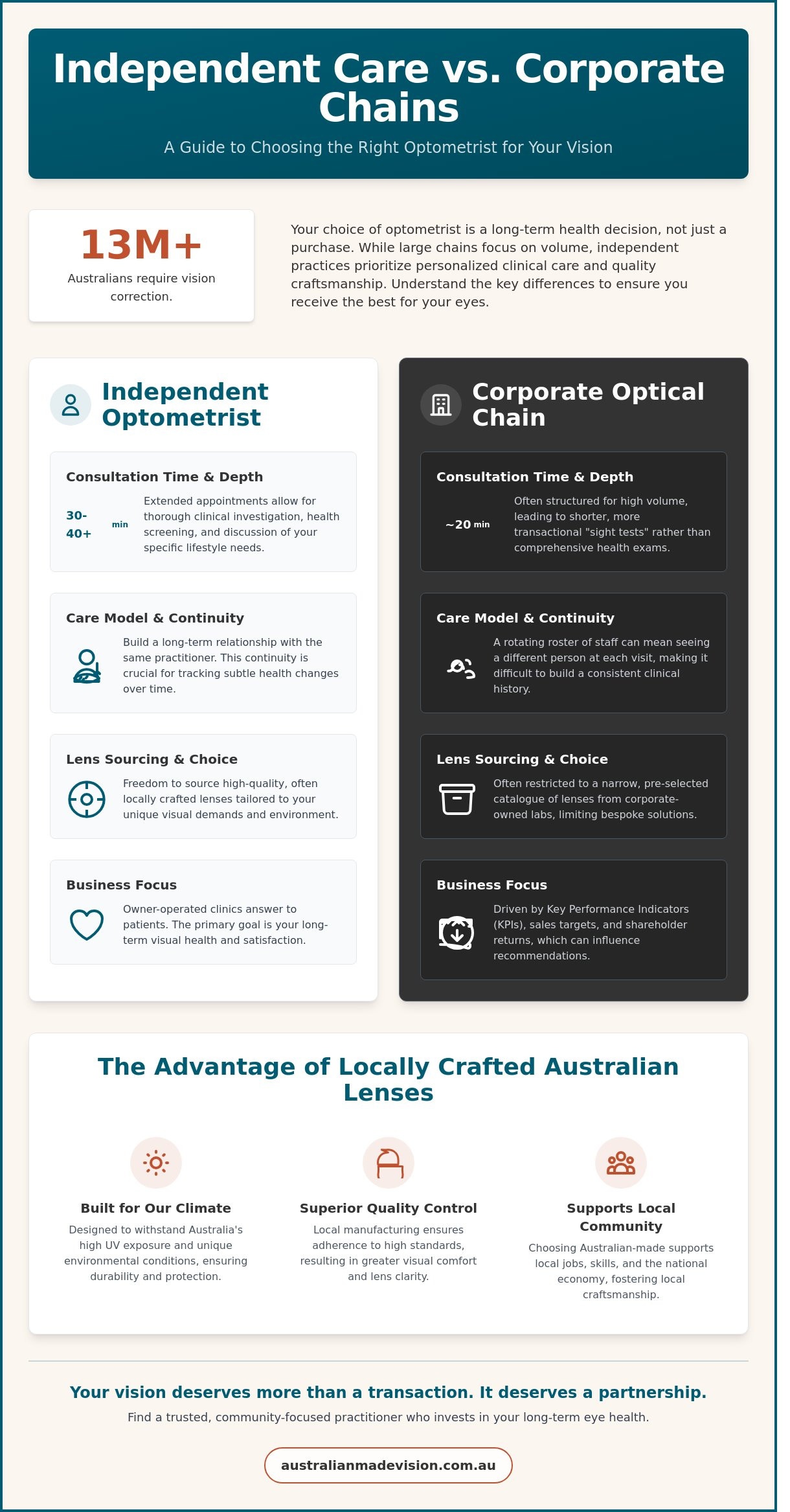
Choosing an optometrist is more than a retail transaction. It’s a choice between a volume-based business model and a long-term partnership focused on your clinical health. Independent practices are typically owner-operated. This means the person testing your eyes often has a personal stake in your visual comfort and the reputation of their local community. They don’t answer to offshore shareholders; they answer to the patient sitting in the chair.
The Personalised Care Advantage
Independent clinics generally schedule 30 to 40 minutes for a standard consultation. This extra time allows for a deeper clinical investigation into your eye health. You aren’t just a number in a high-speed queue. You’ll likely see the same practitioner every year, which builds a clinical history that a rotating roster of corporate staff simply can’t match. This continuity ensures that subtle changes in your macula or optic nerve are caught early by someone who knows your history.
Local practitioners offer tailored lens recommendations based on your specific lifestyle. If you spend 8 hours a day in a fabrication workshop or a design studio, your vision needs are unique. Independent practices have the freedom to source bespoke, locally crafted lenses rather than being restricted to a narrow corporate catalogue. This relationship-based approach ensures your spectacles are an authentic reflection of your daily requirements.
Corporate Efficiency vs. Clinical Depth
Large retail optical chains often focus on volume-based Key Performance Indicators (KPIs). These targets may track how many patients are seen per hour or the percentage of “add-ons” sold during the hand-over. While these models are efficient, their vertical integration often limits your choice of lens brands. You might be restricted to a specific range of house-brand lenses owned by the parent company. A “one size fits all” solution can lead to visual discomfort, especially for complex prescriptions.
Every practitioner must adhere to the Australian standards for optometrists, but the environment they work in dictates the level of care they can provide. In many corporate settings, the “Free Eye Test” is a marketing tool used to drive foot traffic. While bulk billing is a vital part of the Australian healthcare system, a zero-dollar fee often relies on high-volume frame sales to remain viable. You might find that a 15-minute window doesn’t allow for a thorough discussion about premium lens technologies or preventative care.
If you prefer a more thorough approach to your eye health, you can find a local optometrist who prioritises clinical depth and authentic, Australian-made quality over retail targets. Supporting these local experts keeps high-end skills within our community and ensures your vision receives the precision it deserves.
Why the Origin of Your Spectacle Lenses Matters for Visual Comfort
Many patients don’t realise that where their lenses are made directly affects how they see. While mass-produced stock lenses are often imported in bulk to reduce overheads, they lack the refinement of a bespoke product. A local optometrist who prioritises Australian-made lenses ensures your prescription isn’t just a generic approximation but a custom tool for your daily life.
Precision Surfacing and Technology
Digital surfacing technology has transformed lens manufacturing since its widespread adoption in the mid-2000s. Unlike traditional methods, digital surfacing uses computer-controlled lathes to cut the lens surface with an accuracy of 0.01 dioptres. This precision is vital for progressive lenses, where even a millimetre of misalignment causes peripheral distortion and “swim” effects. Locally crafted lenses offer several distinct advantages:
- Advanced Coatings: Superior anti-reflective properties designed to withstand the salt air and humidity common in coastal Australian cities.
- Bespoke Design: Lenses are surfaced to your specific frame measurements rather than being cut from a pre-made round disc.
- Sustainability: Choosing lenses manufactured within Australia reduces the carbon footprint by eliminating the 10,000-kilometre journey required for overseas shipping.
Supporting the Independent Ecosystem
Independent practices often form deep partnerships with local laboratories to achieve better patient outcomes. This collaboration relies on the clinical expertise gained through rigorous optometric education in Australia, allowing your provider to communicate directly with the technician making your glasses. You aren’t just a number in a global supply chain; you’re a patient receiving a product tailored to your specific visual environment.
Choosing local is an ethical decision that honours Australian craftsmanship and ensures fair labour standards for the domestic workforce. Australian-made lenses undergo rigorous quality testing to suit the harsh local UV conditions, which frequently reach a UV Index of 11 or higher during summer months. By supporting these labs, your optometrist helps keep technical skills onshore, ensuring the future of the domestic optical industry remains secure and vibrant for years to come.
Navigating Your Comprehensive Eye Exam: What to Look For
A truly thorough eye examination is far more than a simple vision check. While many corporate outlets focus on the speed of the “one or two” refraction, an independent optometrist prioritises a deep dive into your ocular health. This process often takes 30 to 45 minutes, allowing for a detailed assessment that looks beyond your prescription to the very fabric of your eye health.
Quality care involves a conversation about your lifestyle, family history, and specific visual demands. It’s about ensuring your eyes are healthy enough to support your vision for decades to come. When you visit a local practitioner, you’re often benefiting from a higher standard of clinical continuity, seeing the same professional year after year who understands your unique history.
Advanced Diagnostic Tools
Modern eye care relies on precision technology to catch silent conditions. Optical Coherence Tomography (OCT) is a non-invasive imaging test that uses light waves to take cross-section pictures of your retina. This allows your optometrist to see each of the retina’s distinctive layers, mapping them and measuring their thickness. These measurements help with the early detection of glaucoma and macular degeneration, often before you notice any change in sight.
- Visual Field Testing: This assesses your peripheral vision and can identify early signs of neurological issues or ocular diseases like glaucoma.
- Corneal Topography: Essential for mapping the surface curvature of the eye, this tool is vital for fitting bespoke contact lenses and managing complex astigmatism.
- Retinal Photography: High-resolution digital images provide a permanent record of your eye’s internal health, making it easier to track minute changes over time.
Specialty Optometry Services
Independent practices frequently offer niche clinics that larger chains might overlook. Myopia management is a critical field, especially as the World Health Organization predicts 50% of the global population will be myopic by 2050. By using specialised lenses or eye drops, practitioners can slow the progression of short-sightedness in Australian children, reducing the risk of retinal detachment in later life.
Dry eye syndrome affects approximately 20% of Australians, causing persistent irritation and blurred vision. Dedicated dry eye clinics identify the root cause, such as Meibomian Gland Dysfunction, rather than just suggesting over-the-counter drops. For those spending 8 or more hours a day on digital devices, occupational vision assessments provide tailored solutions for screen fatigue, ensuring your workspace is set up for long-term comfort and health.
Ready to experience the difference of personalised, local care? You can find a dedicated professional through our directory of independent Australian optometrists today.
How to Find a Trusted Independent Optometrist Near You
Choosing the right eye care professional is a decision that impacts your long-term health and daily comfort. You deserve a practitioner who prioritises clinical excellence over retail sales targets. Start by researching local practices through patient reviews. Look for feedback that mentions the thoroughness of the exam or the clarity of the explanations provided. High-quality care often leaves a trail of satisfied patients who feel their concerns were truly heard and respected.
Don’t hesitate to call a clinic before booking your visit. Ask about the diagnostic technology they use, such as digital retinal imaging or OCT scans. Inquire about their lens options too. Independent practices usually have the freedom to source high-performance lenses from various manufacturers, rather than being restricted to a single corporate supplier. This flexibility allows your optometrist to prescribe a bespoke solution that fits your exact lifestyle needs.
Your Local Vision Advocate
A local practitioner acts as a dedicated steward of your eye health. When you visit an independent clinic, look for the “Australian Made” logo in the optical lab they partner with. This mark represents a commitment to local craftsmanship and ethical production standards. You can easily locate these community-focused practitioners by using the Australian Made Vision directory. Supporting these businesses keeps clinical expertise and manufacturing jobs within our local communities.
Building a relationship with a local optometrist ensures continuity of care. They maintain your records over decades, tracking subtle changes in your vision that a rotating staff at a large chain might miss. This personal connection fosters trust and ensures your treatment plan is always authentic and tailored to your specific history. It’s about finding a master of their craft who lives and works in your neighbourhood.
Making Your Appointment Count
Arriving prepared helps you get the most out of your consultation. Bring your current spectacles, any previous prescriptions, and a list of your current medications. These details provide a vital baseline for your eye health assessment. Be ready to discuss your visual environment in detail. Whether you spend nine hours a day on digital screens or enjoy outdoor hobbies like fishing, your practitioner needs this context to recommend the right coatings and tints.
- List your primary work tasks and typical screen distances.
- Mention any history of eye strain or frequent headaches.
- Discuss your driving habits, especially if you struggle with night-time glare.
Independent clinics often schedule longer appointment times, typically 30 to 45 minutes, to ensure no detail is overlooked. This unhurried pace allows for a deeper conversation about your eye health and preventative care. Unlike high-volume environments, these practices value quality over quantity. Find your nearest independent optometrist today and experience the difference of personalised care.
Prioritising Your Vision for 2026 and Beyond
Your vision deserves more than a standard appointment. By choosing an independent optometrist, you gain access to clinical consultations that typically last 30 to 45 minutes, ensuring every aspect of your eye health is thoroughly assessed. This personalised approach extends to your eyewear, where you can select high-performance lenses crafted in local Australian laboratories. Supporting local craftsmanship means you aren’t just getting a pair of glasses; you’re investing in bespoke technology that supports our national industry.
Making an informed choice today protects your sight for years to come. You’ll enjoy a wider range of lens designs tailored to your specific lifestyle needs, from high-precision digital work to outdoor activities. It’s about finding a partner in your health journey who values quality and community as much as you do. We believe that every Australian deserves access to the precision of locally manufactured optics and dedicated clinical care.
Find an Independent Optometrist Near You
Take the first step toward clearer, more comfortable vision by connecting with a local expert who puts your needs first.
Frequently Asked Questions
Is an optometrist a doctor in Australia?
In Australia, an optometrist is a university-trained primary healthcare professional rather than a medical doctor. They complete a minimum of five years of tertiary education to earn a Master of Optometry or a Doctor of Optometry degree. This qualification allows them to diagnose eye diseases and prescribe therapeutic medications. While they don’t perform surgery like an ophthalmologist, they’re the first point of contact for most vision concerns.
How much does a comprehensive eye exam cost at an independent practice?
A comprehensive eye exam at an independent practice typically costs between A$70 and A$120 if the practice doesn’t bulk bill. Many independent providers charge a gap fee to cover the cost of advanced diagnostic technology like OCT scanning. Medicare provides a rebate of A$61.50 for a standard initial consultation once every three years for patients under 65. This investment ensures you receive a bespoke assessment tailored to your specific ocular health needs.
Can I take my prescription from a corporate chain to an independent optometrist?
You can absolutely take a prescription from a corporate chain to an independent optometrist to have your glasses made. Under Australian Consumer Law, any provider who performs an eye test must provide a copy of your prescription upon request. This allows you to support local craftsmanship and choose high-quality, Australian-made lenses. Independent practices often offer a more authentic range of frames that you won’t find in mass-market retail outlets.
What is the difference between an optometrist and an optician?
An optometrist is a clinical professional who examines your eyes to detect vision problems and health issues. In contrast, an optical dispenser, often called an optician in other countries, focuses on the technical fit and manufacture of your spectacles. They use their expertise to ensure your locally crafted lenses sit perfectly on your face. Both roles work together in an independent practice to provide a seamless, community-focused care experience.
How often should I have an eye test if I don’t wear glasses?
Most adults should schedule an eye test every two years even if they don’t currently wear glasses. This frequency changes to every 12 months for children or adults over the age of 65. Regular check-ups allow your optometrist to monitor for silent conditions like glaucoma, which affects 1 in 30 Australians over the age of 40. Prevention is a vital part of maintaining your long-term vision and overall well-being.
Do independent optometrists offer the same brands as corporate chains?
Independent optometrists often stock a curated selection of bespoke and international designer brands that aren’t available in corporate chains. While you might find some familiar names, the focus is usually on quality over quantity. They prefer frames that reflect authentic craftsmanship and offer a unique style for the local community. Choosing an independent practice means you’re more likely to find a pair of glasses that feels personal and exclusive.
What is myopia management and do all optometrists offer it?
Myopia management involves using specialised lenses or eye drops to slow the progression of short-sightedness in children. While most Australian optometrists are trained in these techniques, independent practices often invest more heavily in the specific equipment required for precision monitoring. Research shows that early intervention can reduce the risk of high myopia by up to 50 percent. It’s a proactive approach that safeguards a child’s vision for their entire life.
Are Australian-made lenses more expensive than imported ones?
Australian-made lenses are competitively priced and often offer better value than mass-produced imports due to their superior precision. By choosing locally crafted optics, you’re investing in a product that meets rigorous national quality standards. These lenses are often manufactured and delivered within 3 to 5 business days, which is much faster than waiting for overseas shipments. Supporting local industry ensures your vision is cared for by experts who understand the Australian lifestyle.
Disclaimer
The information in this article is provided for general educational purposes only and should not be considered medical advice. For personalised advice regarding your vision or eye health, please consult a qualified optometrist.
Australian Made Vision is an independent directory that helps patients find optometrists across Australia who may offer Australian-made spectacle lenses. We do not provide clinical services and recommend contacting practices directly to confirm the products and services they offer.