
What if that “free” service you’re booking is actually a shortcut that compromises your long-term vision health? Many Australians walk into a clinic expecting a standard bulk billed eye test, only to leave feeling like just another number in a rushed corporate assembly line. It’s a common frustration to discover that a brief, 15-minute appointment doesn’t provide the bespoke care or clinical precision your eyes truly deserve. Your vision is your heritage. It deserves better than a conveyor-belt approach.
You likely believe that quality healthcare should be accessible, and we agree that your Medicare entitlements should be transparent and easy to use. This guide promises to demystify the 1,095-day eligibility rule for those under 65 and show you how to avoid hidden gap fees at the checkout. We’ll walk through the essential steps to finding a reliable independent optometrist who values Australian-made quality over high-volume sales. You’ll learn how to secure thorough follow-up care and high-quality lenses that protect your sight for years to come.
Key Takeaways
- Understand the 2026 Medicare guidelines to ensure you never miss an essential check-up, whether you require a routine review every three years or annual care.
- Discover how a bulk billed eye test provides professional clinical care with no out-of-pocket costs, allowing you to prioritise your vision without financial strain.
- Learn why independent optometry practices often provide a more bespoke experience, dedicating the time needed to truly understand your unique visual health and lifestyle.
- See how local craftsmanship makes a difference by pairing your professional prescription with high-quality, Australian-made lenses for ultimate clarity and precision.
- Master the simple steps to prepare for your consultation, from documenting vision changes to locating a trusted independent expert in your local community.
What is a Bulk Billed Eye Test? The 2026 Australian Essentials
A bulk billed eye test is a healthcare arrangement where your optometrist bills Medicare directly for your consultation. In this scenario, the practitioner accepts the Medicare benefit as full payment for the clinical service provided. For you, the patient, this means there are no out-of-pocket expenses for the standard exam. It is a system built on the principle of universal access, ensuring that every Australian can monitor their vision health without financial barriers. Since the inception of the Health Insurance Act in 1973, this model has remained a cornerstone of our national identity, reflecting a commitment to community wellbeing and preventative care.
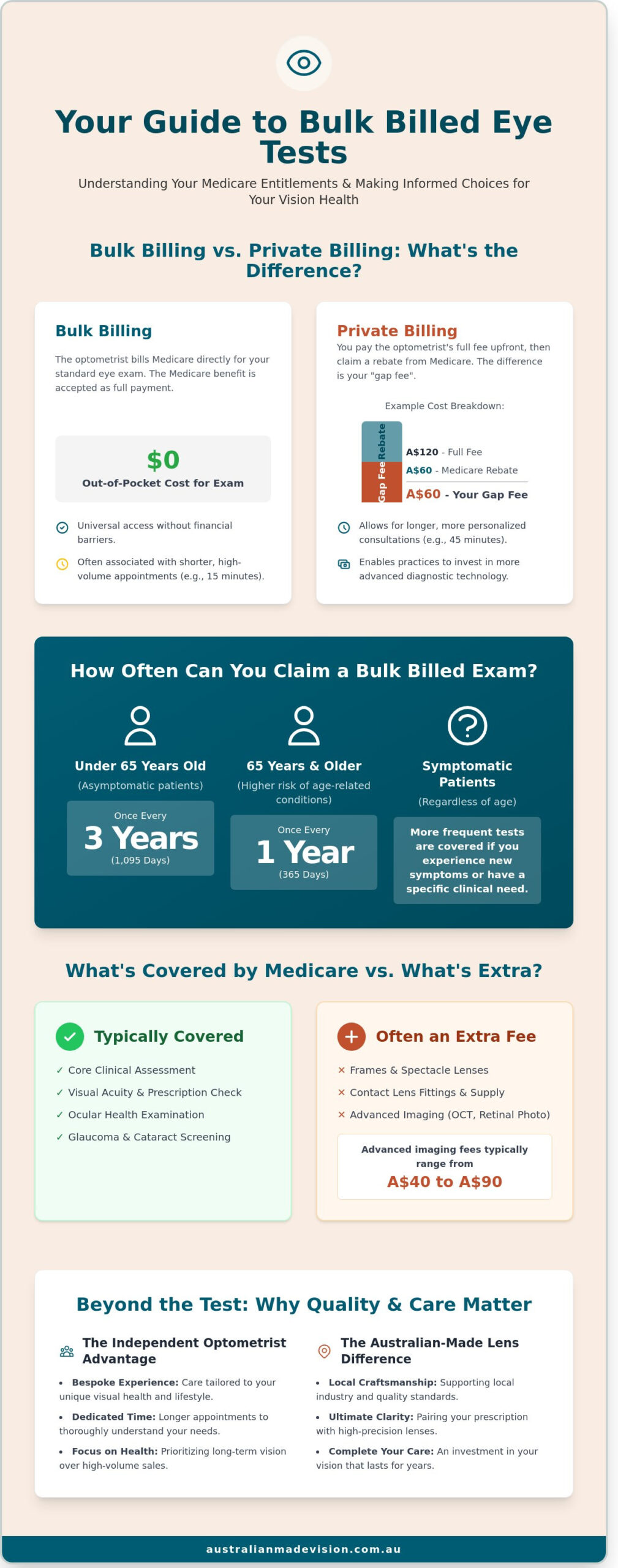
When you attend a bulk billed eye test, the clinic handles the paperwork behind the scenes. You simply provide your Medicare card, and the government rebate covers the cost of the optometrist’s time and expertise. This is particularly vital for the 13 million Australians who currently wear corrective lenses. However, it’s essential to understand that bulk billing typically covers the core clinical assessment. Modern clinics often invest in advanced diagnostic tools, such as digital retinal photography or Optical Coherence Tomography (OCT). These high-resolution imaging services often sit outside the standard rebate and may involve a separate professional fee, usually ranging from A$40 to A$90 depending on the technology used.
How Medicare Supports Your Vision
The Department of Health and Aged Care manages the Medicare Benefits Schedule (MBS), which dictates the rebate rates for optometry services. These rates are reviewed periodically; for instance, a 3.7% indexation increase was applied to most MBS items in mid-2024 to help clinics manage rising operational costs. Within Australia’s Medicare system, a standard comprehensive eye exam (often billed under MBS item 10910) is distinguished from brief or subsequent consultations. Medicare’s primary role is to fund the clinical assessment of your ocular health and visual acuity. It doesn’t extend to the physical purchase of frames or lenses. While the exam is subsidized, the craftsmanship of locally made, bespoke spectacles remains a private investment in your personal style and clarity.
The Difference Between Bulk and Private Billing
Not every independent clinic chooses to bulk bill every patient. Some practices utilize “private billing,” where you pay the full professional fee upfront and then claim a portion back from Medicare. The “gap fee” is the difference between what the optometrist charges and what the government pays. For example, if a clinic charges A$120 for a 45-minute extended consultation and the Medicare rebate is approximately A$60, your out-of-pocket cost is A$60. Many independent practitioners choose this path to allow for longer appointment times and more personalized care than a standard bulk billed eye test might permit.
Regardless of the billing method, the quality of clinical care is strictly regulated. Every practicing optometrist must meet the rigorous standards set by the Australian Health Practitioner Regulation Agency (AHPRA). This ensures that whether you are visiting a local artisan-expert or a larger clinic, the health check of your eyes meets national safety and quality benchmarks. Choosing a clinic that aligns with your values, whether they bulk bill or charge a gap fee, is a personal decision that supports the diversity of the Australian optometry landscape.
Medicare Eligibility and Frequency: How Often Can You Claim?
Medicare provides a safety net that ensures every Australian can access essential vision care. This system operates on specific cycles based on your age and eye health status. Understanding these timelines helps you plan your visits without facing unexpected out-of-pocket costs. It’s about ensuring your vision remains a priority while making the most of the public health benefits available to us all.
For most asymptomatic patients under the age of 65, Medicare covers a comprehensive examination once every three years. This 36-month window is defined by the Medicare Benefits Schedule (MBS), which outlines the clinical requirements for each claim. If you’re 65 or older, this frequency increases to once every year. This change acknowledges the higher risk of age-related conditions like glaucoma or cataracts that require closer, more consistent monitoring.
The Three-Year Rule Explained
The 36-month period begins exactly from the date of your last comprehensive initial consultation. If you can’t recall your last appointment, you can check your history through the Medicare section of your MyGov account or the Express Plus Medicare app. This digital record saves you the guesswork before booking your next bulk billed eye test. If a new symptomatic issue arises, such as sudden blurred vision or eye pain, Medicare often allows for an earlier claim under specific clinical exceptions.
Special Considerations for Children and Seniors
Children’s vision changes rapidly as they grow. While the standard rule might suggest longer gaps, many independent optometrists recommend annual checks for school-aged kids to ensure they’re meeting developmental milestones. Early detection of refractive errors is a vital part of developmental health, making children’s eye tests a priority for local families. For our seniors, Medicare supports consistent monitoring for age-related macular degeneration (AMD). These regular touchpoints ensure that your vision stays sharp while supporting the integrity of our local healthcare system.
Clinical exceptions allow for more frequent testing if you have a diagnosed condition. Patients with diabetes, progressive myopia, or those taking certain high-risk medications can often access a bulk billed eye test more than once every three years. Your optometrist will determine if your specific situation meets the MBS criteria for an earlier subsidised review. Our local independent practitioners take great pride in navigating these regulations to provide the best possible care for their patients.
To make your visit as smooth as possible, we’ve compiled a quick checklist of what you’ll need to bring to your appointment:
- A valid Medicare card, either the physical green card or the digital version.
- Any current spectacles or prescription sunglasses you currently use.
- A list of current medications, especially those for blood pressure or diabetes.
- Your previous optometrist’s details if you’re visiting a new practice for the first time.
Supporting local, independent practices ensures you receive bespoke care tailored to your unique lifestyle. When you’re ready to prioritise your health, you can find a local expert who understands the needs of our community and the value of Australian craftsmanship.
The Independent Advantage: Why Where You Test Matters
Choosing where you book your next bulk billed eye test changes more than just the name on the door. It defines the depth of clinical attention you receive. While large corporate chains often operate on a high-volume business model, independent Australian optometrists prioritise a tailored approach. These local practitioners typically dedicate 30 to 45 minutes to a standard consultation, whereas high-turnover environments may limit appointments to just 15 or 20 minutes to meet daily targets.
This extra time isn’t just for small talk. It allows for a meticulous examination of your ocular health, from tracking subtle changes in your macula to discussing how your screen time affects eye strain. Independent clinics don’t answer to distant shareholders or rigid corporate quotas. They have the clinical freedom to recommend the most precise lenses for your specific lifestyle, whether that’s a bespoke Australian-made progressive lens or a specialised coating for night driving. You’re treated as a patient with unique needs, not just a number in a queue.
Continuity of care is perhaps the greatest benefit of the independent model. In many local practices, the same optometrist has looked after the community for over 15 years. This long-term relationship means your practitioner remembers your clinical history and family health patterns without needing to scan a digital file for five minutes first. It’s a level of trust and heritage that’s difficult to replicate in a rotating clinical setting where you might see a different face every year.
Independent practitioners also have the autonomy to select the best equipment and products. They aren’t restricted to a specific house brand or a limited supply chain. This means they can source high-quality components that suit your vision needs perfectly, rather than what’s most profitable for a head office. It’s about professional integrity and the desire to provide the best possible outcome for every individual who walks through the door.
Personalised Care vs. Corporate Efficiency
A comprehensive eye exam in an independent setting focuses on total wellness rather than just a prescription update. These practitioners often invest in advanced diagnostic technology because they’re committed to the long-term health of their local neighbours. Their ethical billing practices ensure you receive the full benefit of Medicare coverage for eye tests without feeling rushed through the chair. If you value a thorough, unhurried experience, you should find an independent optometrist who can offer a truly bespoke service.
Supporting Local Australian Businesses
Selecting an independent clinic keeps your healthcare investment within the local economy. Australia’s optometry sector contributes significantly to the national GDP, and local practitioners often act as the backbone of regional health hubs. These artisan-experts take immense pride in their craft, frequently sourcing frames and lens components from Australian manufacturers. By choosing a local clinic, you’re supporting a system that values quality craftsmanship over mass-produced imports. It’s a choice that secures the future of domestic manufacturing while ensuring your bulk billed eye test leads to a superior clinical outcome and a stronger community.
Beyond the Prescription: Why Australian-Made Lenses Complete Your Care
Your prescription is a clinical blueprint. While a bulk billed eye test provides the necessary data to correct your vision, the physical lens is what performs the daily work. You wouldn’t commission a world-class architect to design a home and then build it with inferior materials; your eyes deserve the same logic. A prescription is only as effective as the lens it is written for, and choosing locally crafted optics ensures that the precision of your exam translates into crystal-clear sight.
Australian-made lenses offer a level of quality control that overseas mass-production facilities simply cannot match. When your lenses are surfaced in local labs like CR Surfacing, they undergo rigorous testing to meet strict national standards. This proximity allows for a faster turnaround, often delivering your finished spectacles in 3 to 5 business days, compared to the 14-day wait typical of international shipping routes. You aren’t just buying a product; you’re investing in a piece of high-tech manufacturing that supports local jobs and maintains high ethical standards.
The Quality Gap in Optical Lenses
Many budget-friendly imported lenses are “stock” products, meaning they are mass-produced to generic averages. This often results in peripheral distortion or “swim” effects, which lead to significant eye strain and headaches for the wearer. In contrast, Australian-crafted lenses utilise premium coatings that are designed for our harsh climate. These anti-reflective and scratch-resistant treatments are applied in controlled environments to ensure they don’t peel or degrade within six months of use. Bespoke surfacing is a sophisticated digital process that tailors the geometry of the lens to your specific frame dimensions and the unique way the glasses sit on your face.
Why Origin Matters for Your Vision
The “Australian Made” logo is a badge of integrity that signifies reliability and craftsmanship. Choosing local production reduces “lens miles,” which is a more sustainable choice for the environment. By cutting down on international air freight, we lower the carbon footprint of every pair of glasses sold. This local approach also allows for incredible technical precision. Labs like CR Surfacing use advanced software to calculate prescriptions to 0.01-dioptre increments, ensuring your visual comfort is absolute.
Modern life demands specialised solutions that generic lenses often ignore. With the average Australian now spending 5.5 hours a day looking at digital screens, blue light filters have become a functional necessity rather than an optional extra. Our local labs excel at creating high-definition progressive lenses that provide smooth transitions between distances, as well as photochromic options that react instantly to the intense Australian sun. Australian Made Vision serves as the vital link between your bulk billed eye test and a finished product that embodies manufacturing excellence.
Support local industry and experience superior visual clarity by choosing an independent optometrist through Australian Made Vision.
How to Prepare for Your Bulk Billed Eye Examination
Preparing for your appointment ensures you get the most out of Medicare’s contribution. Your vision is a vital asset, and taking ten minutes to prepare can significantly improve the clinical outcomes of your visit. Start by documenting any vision fluctuations, light sensitivity, or persistent headaches you’ve experienced over the last 30 days. These details provide your optometrist with a roadmap of your ocular health that a standard refraction test might miss.
Next, seek out an independent optometry practice that offers bulk billing. Unlike large corporate chains that often prioritise high patient turnover, independent clinics frequently dedicate more time to individual consultations. Before booking, call the clinic to confirm they utilize advanced diagnostic tools. While a standard bulk billed eye test covers the essential clinical assessment, asking for digital retinal imaging or Optical Coherence Tomography (OCT) provides a baseline of your eye health. This data allows your practitioner to track minute changes in your eye structure over the next 5 to 10 years.
Finally, inquire about the origin of their lens products. It’s a common misconception that all lenses are the same. Ask if they provide access to Australian-made quality. Choosing locally crafted lenses supports the domestic manufacturing sector and ensures your eyewear meets rigorous national standards. This step bridges the gap between a clinical necessity and a high-quality, bespoke product that serves you for years.
What to Ask Your Optometrist During the Test
Don’t leave the chair with just a set of numbers on a piece of paper. Ask specifically about the health of your retina and macula, as these areas are critical for long-term sight preservation. You should also ask: ‘Which lens technology will best suit my daily occupational needs?’ If you spend more than 6 hours a day on digital devices, your requirements differ from someone who works primarily outdoors.
For parents, it’s essential to discuss myopia management. With the Brien Holden Vision Institute estimating that 50% of the world’s population will be myopic by 2050, early intervention is a priority. Ask your optometrist if your child’s current vision profile requires specialised preventative care beyond a standard prescription.
Finding a Local Provider You Can Trust
Finding a reliable provider involves looking past the marketing of big-box retailers. Search for ‘independent’ branding in your local area. These practitioners often have deep roots in the community and rely on long-term relationships rather than aggressive sales targets. Check online reviews from the last 12 months to gauge the current level of patient care and clinical thoroughness.
Remember that you’re never obligated to buy frames at the same place you have your bulk billed eye test. You can take your prescription to any provider; however, staying with a local independent optometrist offers benefits like easier adjustments and consistent history tracking. Supporting local independent care is a commitment to your own health and the Australian economy. By choosing a provider who values craftsmanship and community, you’re ensuring that your vision care remains personal, authentic, and world-class.
Prioritising Your Vision and Supporting Local Craftsmanship
Maintaining your eye health shouldn’t be a luxury or a chore. Under 2026 Medicare guidelines, most Australians can access a bulk billed eye test once every three years, while those over 65 or with specific clinical needs can claim every 12 months. By choosing an independent optometrist, you’re opting for bespoke care that prioritises your long term health over corporate retail targets. These local experts provide the thorough diagnostic attention your eyes deserve.
Since 1976, we’ve remained dedicated to the Australian manufacturing landscape. Our premium lenses are precision-crafted in Dandenong South, ensuring that your clinical care is matched by world class local quality. Supporting 100% independent Australian optometry means you’re investing in your community and receiving a tailored experience that large chains simply can’t replicate. It’s about clear vision and a commitment to authentic, homegrown excellence.
Find an Independent Optometrist Near You
We’re proud to help you see the best of our country through lenses made with genuine passion and local expertise.
Frequently Asked Questions
Is an eye test always free with Medicare in Australia?
No, an eye test isn’t always free for every patient. While Medicare provides rebates for optometry, not all providers choose to bulk bill. Since 2015, the Medicare rebate has covered 85% of the scheduled fee for most consultations. If your optometrist charges more than this amount, you’ll pay an out-of-pocket gap fee. Choosing a bulk billed eye test means your practitioner accepts the Medicare benefit as full payment for the service.
Can I get a bulk billed eye test every year?
Medicare guidelines typically allow for one comprehensive eye examination every three years for patients under 65. Once you reach 65, you’re eligible for a rebated exam every 12 months. Exceptions apply if you have a chronic condition like diabetes or if your vision changes significantly. These specific health markers allow your optometrist to claim a rebate more frequently to ensure your eye health is properly managed.
What is the difference between an optometrist and an optician?
An optometrist is a university-trained clinician who performs eye exams, prescribes lenses, and diagnoses diseases. In Australia, the term “optician” is mostly replaced by “optical dispenser.” These are skilled technicians who specialise in fitting your frames and ensuring your lenses are manufactured correctly. While the optometrist focuses on your medical eye health, the dispenser helps you select bespoke, Australian made frames that suit your lifestyle and facial structure.
Does bulk billing cover the cost of my glasses frames?
No, bulk billing only covers the professional service fee for the clinical eye examination. It doesn’t include the costs of frames, lenses, or contact lens fittings. You’ll need to pay for these items separately, though many private health insurers provide rebates for prescription eyewear. Investing in high-quality, locally crafted frames ensures you’re supporting Australian industry while receiving a durable, authentic product that’s built to last for years.
What happens if my optometrist doesn’t bulk bill?
If your optometrist doesn’t bulk bill, you’ll pay the full consultation fee at the time of your appointment. You can then claim the rebate back from Medicare, which is approximately A$60.00 for a standard initial consultation in 2024. Many independent practices choose this model so they can invest more time in your care. They often use advanced diagnostic technology that provides a more thorough assessment than the basic Medicare schedule requires.
Can international visitors get a bulk billed eye test?
International visitors generally can’t access a bulk billed eye test unless they’re from a country with a Reciprocal Health Care Agreement. This agreement currently covers residents from 11 countries, including the United Kingdom, New Zealand, and Italy. Visitors from other nations must pay the full fee, which typically ranges from A$70 to A$150. Most travel insurance policies or Overseas Student Health Cover will reimburse a portion of these costs after the visit.
Are children’s eye tests always bulk billed?
Children’s eye tests aren’t automatically bulk billed by law, but many Australian independent practices offer this to support local families. Medicare provides the same rebate structure for children as it does for adults, covering a comprehensive exam once every three years. Early detection is vital, as 1 in 5 Australian children have an undiagnosed vision problem. Regular checks ensure that their sight doesn’t hinder their learning or development at school.
Do I need a referral from a GP for a bulk billed eye test?
You don’t need a referral from a GP to book a bulk billed eye test with an optometrist. Optometrists are primary healthcare providers, so you can contact a local clinic directly to schedule your appointment. If the optometrist identifies a complex condition, they’ll provide a referral to an ophthalmologist for specialist medical treatment. This direct access makes it simple for you to prioritise your vision and support independent Australian practitioners in your community.
Disclaimer
The information in this article is provided for general educational purposes only and should not be considered medical advice. For personalised advice regarding your vision or eye health, please consult a qualified optometrist.
Australian Made Vision is an independent directory that helps patients find optometrists across Australia who may offer Australian-made spectacle lenses. We do not provide clinical services and recommend contacting practices directly to confirm the products and services they offer.