

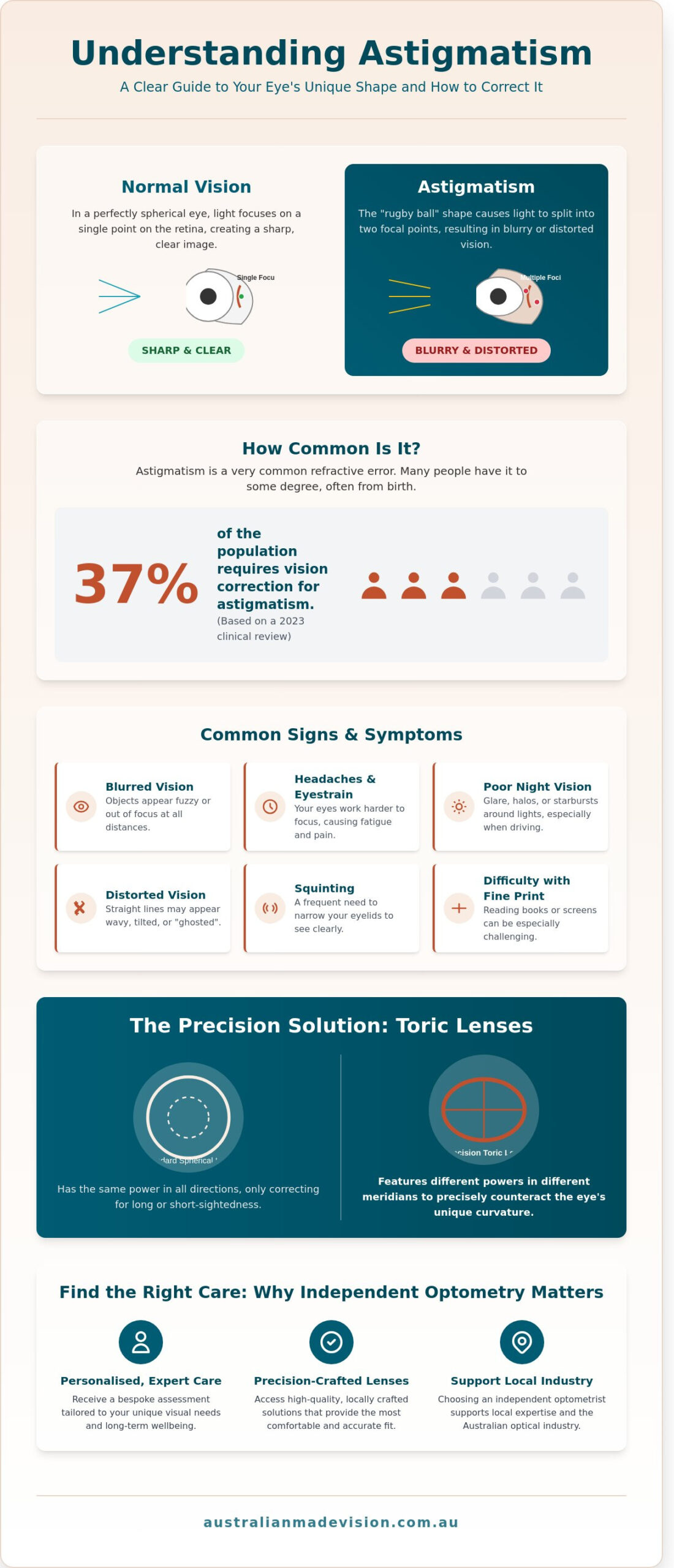
What if the persistent headaches you feel after a long day of screen work aren’t caused by stress, but by the subtle, football-like shape of your eye? A 2023 clinical review indicates that approximately 37 percent of the population requires correction for astigmatism, yet many Australians continue to struggle with distorted night vision or blurry fine print. It’s exhausting to constantly squint just to make sense of the world, especially when optical jargon feels like a different language.
We believe you deserve to understand your vision with absolute clarity. This guide will help you discover what this condition really is and how it impacts your daily focus. You’ll learn why precision-crafted Australian lenses offer the most comfortable path to sight and why a local independent optometrist is your best partner for bespoke care. We’ll explore the latest 2026 correction options so you can choose a solution that supports both your eyes and our local industry.
Key Takeaways
- Understand why your vision might be blurred by learning the simple difference between a “soccer ball” and “rugby ball” shaped eye.
- Discover how to identify common signs of astigmatism, including the frustrating “ghosting” effect that impacts your daily focus and comfort.
- Learn about the precision of Toric lenses and how these bespoke, locally crafted solutions provide a tailored fit for your unique eye curvature.
- Find out what to expect during a comprehensive eye exam and why regular testing is vital for tracking changes in your visual health.
- Explore the benefits of choosing an independent Australian optometrist to receive personalised, expert care that prioritises your long-term wellbeing.
What is Astigmatism? Understanding Your Eye’s Unique Shape
Many Australians feel a sense of worry when they first hear a professional mention this particular vision trait during an eye exam. It sounds clinical and perhaps a bit daunting. In reality, it isn’t an eye disease or a serious health crisis. It’s simply a common refractive error caused by the unique way your eye is shaped. Think of it as a natural variation in your anatomy; it’s much like being left-handed or having a specific height.
To understand What is Astigmatism?, imagine your eye is supposed to be shaped like a perfectly round soccer ball. In a standard eye, light enters and bends evenly to hit a single focus point on the retina. If you have this condition, your eye is shaped more like a rugby ball. This uneven curvature means light doesn’t focus on just one spot. Instead, it splits and lands on two different points, which creates a blurred or distorted image.
Don’t be alarmed if you’re told your vision isn’t “perfectly round.” This trait often occurs alongside myopia (short-sightedness) or hyperopia (long-sightedness). It’s a very common part of the human experience. Our focus is on the precision and care required to correct these minor anatomical quirks through high-quality, locally crafted solutions.
The Anatomy: Cornea vs. Lenticular Astigmatism
Most cases involve the cornea, which is the clear, protective front window of your eye. When the cornea has mismatched curves, we call it corneal astigmatism. Sometimes, the crystalline lens inside your eye is the actual culprit. This is known as the lenticular version of the condition. Both types interfere with the path of light, preventing it from reaching the back of the eye with absolute precision. Even a tiny fraction of a millimetre in these curves can change how you see the world.
Refractive Errors Explained
A refractive error is just a simple way of saying your eye doesn’t bend light correctly. Unlike short-sightedness, where things far away look fuzzy, astigmatism causes blur at all distances. You might notice that street signs look smeared or that light “streaks” during night driving. It’s common to have this alongside other vision issues. Many people manage a combination of these errors every day. If you’re noticing these symptoms, you can find a dedicated professional through our directory of independent optometrists to get a bespoke assessment for your unique eyes.
Common Symptoms and Causes of Astigmatism
Astigmatism doesn’t just make the world look fuzzy. It distorts the very geometry of what you see, often making objects appear stretched or tilted. Most Australians living with this condition describe a persistent blur that doesn’t discriminate between near and far distances. You might notice “ghosting,” which is a faint, secondary image that overlaps with the primary object. This visual interference makes reading street signs or fine print particularly draining for the brain to process.
Night driving presents a unique set of challenges. When the sun goes down, the lack of a single focal point causes light to scatter across the retina. This creates pronounced glare and starburst halos around oncoming headlights or traffic signals. According to the Common Symptoms and Causes of Astigmatism, these irregularities are often the first sign that the eye’s surface isn’t perfectly spherical.
- Squinting: A subconscious effort to flatten the eye and sharpen focus.
- Eye Fatigue: A heavy, tired sensation after prolonged visual tasks.
- Distorted Vision: Vertical, horizontal, or diagonal lines appearing slanted.
- Poor Night Vision: Difficulty navigating low-light environments due to light scattering.
Why Do People Develop Astigmatism?
Most people are born with an irregularly shaped cornea or lens. It’s largely down to genetics; your eye shape is as unique as your fingerprint. While it’s usually present from birth, it can shift as you age. Secondary causes include eye injuries or changes following specific ocular surgeries. A rarer condition called keratoconus, which affects approximately 1 in 2,000 Australians, causes the cornea to thin and bulge into a cone shape, requiring highly specialised clinical care from an expert who understands bespoke lens fitting.
Identifying the Signs in Daily Life
You might not realise your frequent headaches are actually coming from your eyes. When your visual system works overtime to piece together distorted images, it creates physical tension. If you find yourself tilting your head to see the television more clearly, your body is likely trying to find a better angle for light to enter the eye. This constant adjustment leads to significant eyestrain, especially during long shifts at a computer. Finding a trusted local optometrist through our directory is the first step toward reclaiming visual comfort with a personalised care plan.
How is Astigmatism Diagnosed during an Eye Test?
A professional eye examination is the primary way to identify the unique irregularities in your vision. It’s a precision-led process that goes far beyond simply reading letters from a distance. During a thorough assessment, your practitioner maps the specific contours of your eye to understand how light enters and focuses. Regular testing is vital because the physical shape of your eye can shift over time. By maintaining a consistent schedule of check-ups, you ensure that your prescription stays current and your visual comfort remains high. We believe the best way to receive this level of dedicated care is to find an independent optometrist who prioritises a bespoke approach to your eye health.
According to the National Eye Institute on Astigmatism, a comprehensive exam is necessary because this condition often presents alongside other issues like long-sightedness. Only a qualified professional can determine the exact “axis” of your astigmatism. This specific measurement identifies the precise angle where your eye requires corrective power. Without this expert calculation, even high-quality lenses won’t provide the clarity you deserve. Our local independent partners use their clinical expertise to ensure every measurement is captured with absolute accuracy.
The Tools of the Trade
The diagnostic journey usually begins with a visual acuity test. You’ll look at the familiar eye chart to determine how clearly you see at various distances. Following this, your optometrist uses a keratometer. This specialised instrument measures the curvature of your cornea by observing how light reflects off its surface. It’s a critical step in quantifying the degree of irregular shaping present. Finally, you’ll spend time with the phoropter. This is the large instrument containing many different lenses. By asking you to compare different options, your optometrist fine-tunes the exact lens power needed to correct your vision perfectly.
Understanding Your Prescription
When you receive your results, you’ll notice two specific values that differ from a standard myopia prescription. These are the “Cylinder” (CYL) and the “Axis.” The Cylinder value indicates the amount of lens power required to correct the astigmatism. A higher number suggests a more significant curve irregularity. The Axis value is a number between 0 and 180 degrees. It tells the lens maker exactly where that extra power needs to be positioned on the lens. This level of detail ensures that your locally crafted lenses are aligned perfectly with your eye’s unique geometry, providing a seamless and natural viewing experience.
Correcting Astigmatism: The Role of Precision Lenses
Correcting astigmatism requires a sophisticated approach that goes beyond standard vision correction. We rely on “Toric” lenses to bridge the gap between blurred perception and crisp reality. These aren’t your typical spherical lenses. They’re precision-engineered with different powers in different meridians, allowing them to compensate for the irregular curvature of your eye.
Precision is the cornerstone of this technology. Because the lens must address specific angles of distortion, stability is vital. If a toric lens rotates even slightly, the correction fails to align with your eye, resulting in smeared or doubled vision. Modern lens designs incorporate weighted zones or specialized geometry to keep the lens perfectly oriented throughout the day.
- Meridional Power: Different sections of the lens handle different refractive errors to balance the eye’s shape.
- Rotational Stability: Advanced design ensures the lens stays in the correct position despite head movement or blinking.
- Premium Coatings: Anti-reflective layers cut down the glare and “starburst” halos common with this condition.
We always advocate for high-quality coatings. These layers don’t just protect the lens; they significantly improve visual comfort. For someone with astigmatism, night driving is often a challenge due to light scattering. A premium coating reduces these reflections, making your evening commute safer and more comfortable. In fact, roughly 33% of the population has some degree of this condition, making these specialized coatings a standard necessity for modern life in 2026.
The Australian-Made Advantage
Choosing locally manufactured lenses offers a level of quality control that mass-produced imports can’t match. Bespoke surfacing techniques allow for a digital map of your prescription to be carved into the lens with incredible accuracy. This results in a wider field of clear vision and less peripheral distortion. There’s a deep sense of pride in wearing world-class optics that support our local industry and skilled Australian technicians. It’s about knowing exactly where your eyewear comes from and trusting the hands that crafted it.
Spectacles vs. Contact Lenses
Glasses remain the most consistent choice for many Australians. They provide a fixed, stable platform for the toric correction to sit. While toric contact lenses have improved immensely, they can sometimes shift during a blink or physical activity. Many patients find that high-quality spectacle lenses offer the sharpest clarity for detailed tasks like reading or office work. Your lifestyle and the specific shape of your eye will determine which option is best. An independent optometrist can provide a tailored recommendation that fits your unique daily routine.
Finding the Right Care: Why Independent Optometry Matters
Choosing how to manage your vision is a personal decision that impacts your daily life. Independent optometrists operate differently than large corporate chains. They aren’t restricted by head-office supply agreements or limited product ranges. Instead, these practitioners have the professional freedom to recommend the best lenses for your specific needs from a wide variety of global and local manufacturers. This independence ensures your prescription is based on what’s right for your eyes, not what’s on a corporate preferred-supplier list.
You’ll often see the same professional year after year. This continuity matters. An optometrist who knows your clinical history can track subtle changes in your vision more effectively than a rotating roster of staff. It’s a relationship built on trust and clinical excellence. They take the time to understand your lifestyle, whether you’re driving long distances on Australian highways or spending hours in front of a screen.
Tailored Solutions for Complex Eyes
Correcting astigmatism requires precision. Because the cornea is shaped more like a football than a basketball, “one-size-fits-all” solutions often lead to ghosting or discomfort. Independent clinics provide an artisan-like attention to detail. They take the time to measure the unique topography of your eye. These bespoke measurements are essential for crafting lenses that align perfectly with your visual axis. For a deeper look at how to select a provider, read our guide on choosing the right optometrist.
Supporting Your Local Community
Choosing an independent practice is an ethical investment in the Australian economy. Many of these clinics prioritise Australian-made products, supporting local jobs and high manufacturing standards. In 2024, the Australian eye care sector supported approximately 30,000 jobs across the country; supporting local businesses keeps that value within our suburbs. Your vision isn’t just a clinical necessity; it’s an investment in your quality of life.
When you choose a local expert to treat your astigmatism, you’re choosing a master of their craft who is deeply invested in your long-term health. They offer a calm, unhurried environment where your concerns are heard. Take the next step for your visual health today. Search our directory to find an independent optometrist near you today and experience the difference of personalised, locally-minded care.
Empowering Your Vision with Precision and Care
Correcting your vision starts with understanding that your eyes are as unique as your fingerprint. While astigmatism might sound complex, it’s simply a common variation in eye shape that requires the right expertise to manage effectively in 2026. You deserve more than a one-size-fits-all solution from a large corporate provider. Choosing an independent optometrist ensures you receive a thorough eye test and personalised recommendations tailored specifically to your lifestyle. These local experts provide access to high-precision bespoke lens technology that’s crafted with pride right here in Australia.
Supporting local Australian manufacturing means you’re investing in superior quality while helping our national industry thrive. When you choose bespoke eyecare, you’re opting for lenses designed with clinical accuracy and a human touch. Your sight is your most valuable sense, so it’s vital to trust it to those who value both craftsmanship and community connection. Take the first step toward sharper, more comfortable vision by booking a consultation with a professional who takes the time to get it right for you.
Find an independent Australian optometrist to check your vision today
We’re here to help you see the world with the clarity you deserve, backed by the best of Australian innovation and local care.
Frequently Asked Questions
Is astigmatism a serious eye condition?
Astigmatism isn’t a life-threatening disease or a serious medical emergency; it’s a common refractive error caused by an irregular curve in your eye. Statistics from the Australian Institute of Health and Welfare suggest that refractive errors affect approximately 37% of the population. While it isn’t “serious” in a clinical sense, untreated astigmatism causes persistent headaches and significant eye strain. Seeking care from an independent optometrist ensures you receive a precise diagnosis tailored to your specific ocular health.
Can astigmatism go away on its own?
No, astigmatism won’t disappear on its own because it’s a structural issue related to the physical shape of your cornea or lens. Most people are born with some degree of this condition, and it typically remains stable or changes slightly as you age. Since your eye is shaped more like a rugby ball than a soccer ball, it requires professional intervention to correct. You’ll need bespoke lenses or contact lenses to redirect light properly onto your retina.
Can you have astigmatism and myopia at the same time?
You can certainly have both astigmatism and myopia simultaneously. This combination is quite common, affecting roughly 25% of Australians who require vision correction. Myopia makes distant objects blurry, while astigmatism adds a layer of distortion or “ghosting” to images at all distances. Your local optometrist will prescribe specialised “toric” lenses that are crafted to correct both issues at once. This ensures your vision remains crisp whether you’re looking at the horizon or a book.
Do I need to wear glasses all the time if I have astigmatism?
Whether you need to wear glasses constantly depends on the severity of your prescription and your daily activities. If your astigmatism is mild, you might only feel the need for correction during high-concentration tasks like night driving or long hours at a computer. However, many people find that wearing their locally crafted glasses all day provides much better comfort. Constant wear prevents the subtle eye fatigue that builds up when your brain tries to compensate for blurred images.
Why does astigmatism make driving at night difficult?
Driving at night is difficult because astigmatism prevents light from focusing on a single point, causing it to scatter across your vision. This creates “halos” or “starburst” effects around streetlights and oncoming headlights, which become more pronounced when your pupils dilate in the dark. These visual distortions can be distracting and dangerous on Australian roads. High-quality lenses with anti-reflective coatings, designed specifically for your eyes, can significantly reduce this glare and restore your confidence behind the wheel.
Are Australian-made lenses better for astigmatism?
Australian-made lenses offer a level of precision and quality that mass-produced corporate alternatives often struggle to match. When you choose locally crafted lenses, you’re supporting a heritage of craftsmanship and ensuring your eyewear meets rigorous national standards. These bespoke products are tailored to your unique prescription by experts who take pride in their work. By visiting an independent optometrist who sources Australian-made vision solutions, you receive an authentic product that’s built to last and perfectly suited to our local environment.
Disclaimer
The information in this article is provided for general educational purposes only and should not be considered medical advice. For personalised advice regarding your vision or eye health, please consult a qualified optometrist.
Australian Made Vision is an independent directory that helps patients find optometrists across Australia who may offer Australian-made spectacle lenses. We do not provide clinical services and recommend contacting practices directly to confirm the products and services they offer.