

Imagine driving home at 6:30 pm on a rainy Tuesday, only to find yourself squinting against the blinding starbursts of modern LED headlights. It’s a common frustration that turns a routine commute into a high-stress ordeal. You’ve likely felt that nagging throb behind your eyes after eight hours under office fluorescents or noticed how distracting reflections on your lenses ruin your appearance in video calls. Modern anti-reflective coatings are designed to solve these exact pains, and we believe your vision should be effortless, not a source of daily fatigue.
This guide shows you how these advanced treatments eliminate glare, ensuring your vision remains sharp and your eyes feel rested. You’ll discover the latest 2026 lens technology and why choosing Australian-made quality makes such a difference to your visual comfort. We’ll also explain how our directory helps you find an independent optometrist who provides the bespoke, locally crafted care your eyes deserve, ensuring you receive a level of precision you won’t find in mass-produced alternatives.
Key Takeaways
- Understand how multi-layered mineral oxides increase light transmission to over 99%, providing the exceptional visual clarity required for modern Australian life.
- Discover why premium anti-reflective coatings are essential for managing harsh coastal glare and reducing the eye strain caused by our digital-heavy lifestyles.
- Learn to distinguish between mass-produced options and durable, Australian-made bespoke coatings that resist the common problem of lens crazing.
- Find out how independent optometrists provide a wider range of high-performance technologies to tailor your eyewear specifically to your unique occupational needs.
What Are Anti-Reflective Coatings and Why Are They Essential?
When you choose a new pair of glasses, you aren’t just selecting a frame that suits your face. You’re investing in a piece of precision engineering designed to sharpen how you see the world. An Anti-reflective coating is a series of microscopic, multi-layered mineral oxides applied to the lens surface. These layers work together to eliminate the distracting reflections that often plague untreated eyewear. By the time we reach 2026, these coatings have become a baseline requirement for anyone seeking true visual comfort.
The primary purpose of these coatings is to boost light transmission. A standard, uncoated plastic lens typically allows only about 92% of available light to reach your eyes. The remaining 8% is lost as it bounces off the lens surface. Modern anti-reflective coatings increase light transmission to over 99%. This extra light makes your vision feel brighter and sharper, especially in low-light environments. It also virtually eliminates “ghost images,” which are those faint, secondary reflections that can make night driving difficult for many Australians.
Modern technology has completely transformed the durability of these treatments. In the past, some coatings were known for being easily scratched or difficult to clean. The 2026 standard involves advanced vacuum-deposition processes that bond the coating to the lens at a molecular level. These lenses are now as tough as the material they cover. They often include oleophobic and hydrophobic properties to repel fingerprints and water, making them perfect for our active local lifestyle.
The Difference Between Glare and Reflection
It’s common to confuse glare with reflection, but they affect your vision in different ways. Glare is the harsh, external light from sources like the sun or car headlights. Reflection occurs when that light hits your lenses and bounces back. Back-surface reflections are particularly troublesome. This happens when light comes from behind you, hits the inside of your lens, and reflects directly into your eye. This “bounce-back” glare causes significant visual discomfort and eye strain. Clear vision depends entirely on light passing through the lens rather than reflecting off it.
Aesthetic Appeal: The ‘Invisible’ Lens
A high-quality coating makes your lenses look almost invisible to others. This allows people to see your eyes clearly without being distracted by a mirror-like sheen on your glasses. It’s a vital feature for the modern professional who spends hours on video calls or needs to look their best in photography. Without these coatings, your lenses can look thick and cloudy. High-index lenses, which are popular for their thin profile, actually reflect more light than standard plastic. For these specialised materials, an AR coating is essential to ensure the wearer doesn’t experience “veiling glare” that washes out contrast.
Supporting local industry ensures you get a product crafted with care. You can find a dedicated professional to help you choose the right options through our directory of independent optometrists. These local experts provide bespoke recommendations that corporate chains often overlook, ensuring your vision is tailored to your specific daily needs.
The Science of Clarity: How Modern Multi-Coat Technology Works
Precision is the hallmark of a great pair of spectacles. When you look through a lens, you shouldn’t see your own eye reflecting back at you. This clarity comes from the physics of destructive interference. By applying microscopic layers of metal oxides, engineers can force light waves to cancel each other out. To understand the specific physics of how these light waves interact, it’s helpful to explore How Anti-Reflective Coatings Work. While early versions used a single layer, modern Australian-made lenses employ a sophisticated multi-layer stack. These stacks target the entire visible spectrum; this ensures that glare is eliminated regardless of the light source.
Creating this bond requires vacuum deposition technology. Lenses are placed in a sealed chamber where minerals are vaporised and fused to the surface at a molecular level. This process creates a permanent finish that won’t peel or flake over time. However, the anti-reflective coatings are only as good as the substrate. If the lens material itself isn’t of a high optical grade, the coating can’t perform to its full potential. We believe in using high-quality local materials to ensure every layer works in harmony with the lens core.
Beyond Reflections: The Integrated Layers
Modern coatings do more than just manage light. They act as a protective shield for your vision. A high-quality hard-coat layer is applied first, providing the essential scratch resistance needed to protect the lens core. On top of the anti-reflective layers, we add hydrophobic and oleophobic treatments. These top-coats repel water and prevent fogging during humid mornings or temperature changes. They also resist skin oils and fingerprints. This means you spend less time cleaning and more time seeing the world clearly.
Antistatic and Dust-Repellent Features
Dust is a constant challenge in the Australian environment. Modern anti-reflective coatings now include antistatic properties to prevent the buildup of electricity that attracts fine particles. When a lens stays cleaner, you’re less likely to wipe it with a dusty cloth. This significantly reduces the risk of micro-scratches over the life of your spectacles. Australian-made lenses often lead the way in durability because they’re designed for our unique, harsh local conditions. If you’re looking for tailored advice on the best coatings for your lifestyle, you can find a local independent optometrist through our directory.
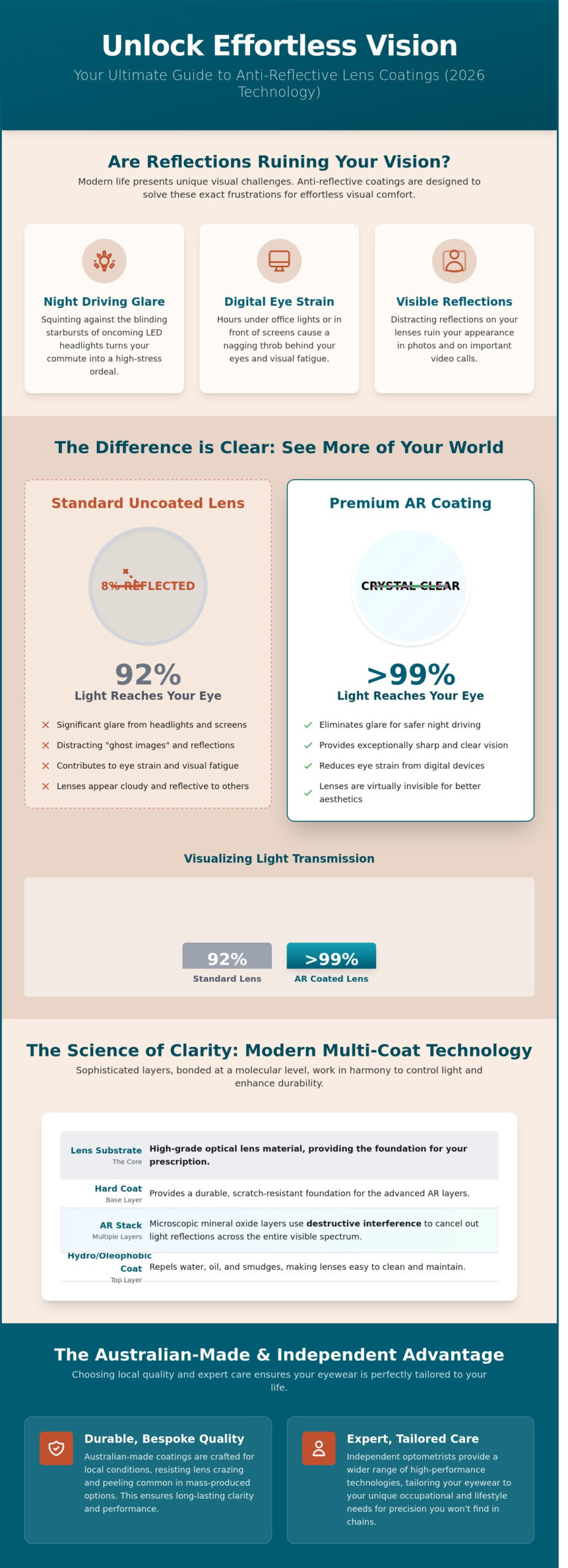
Comparing Options: Standard Lenses vs. Premium Anti-Reflective Coatings
Choosing the right lens finish is about more than just aesthetics. Standard plastic lenses without any treatment actually reflect about 8% to 10% of available light. This creates a persistent visual haze that reduces your ability to see fine details. Premium anti-reflective coatings eliminate this barrier by allowing up to 99.5% of light to pass through the lens. The result is vision that feels crisp, natural, and remarkably clear. We believe that every Australian deserves the precision that comes from locally crafted, high-quality optics.
Durability is where the gap between standard and premium options becomes most apparent. Cheap, mass-produced coatings are often applied using basic dipping methods. These layers are prone to “crazing,” a process where the coating develops a web of tiny cracks due to temperature changes or physical pressure. You’ve likely seen this on older glasses where the surface looks smudged or peeling. In contrast, bespoke premium coatings are applied in a vacuum chamber. This process bonds the layers to the lens material at a molecular level, ensuring they last for the full two or three years of your prescription life cycle.
The cost-to-value ratio for premium options is significant. While a top-tier coating might add A$80 to A$150 to your total, it protects your investment. Premium finishes include advanced oleophobic and hydrophobic layers. These repel fingerprints and water, meaning you clean your glasses less often. Because most scratches happen during cleaning, a lens that stays cleaner naturally lasts much longer. Investing in quality means you won’t be forced back into the clinic prematurely to replace damaged hardware.
- Enhanced UV Protection: Standard lenses often ignore “bounce-back” UV. Premium coatings include a back-surface UV absorber to stop rays from reflecting off the inside of the lens into your eyes.
- Surface Hardness: High-end coatings incorporate a “hard coat” layer that rivals the scratch resistance of glass.
- Visual Purity: Removing reflections means people see your eyes, not the glare on your lenses.
Night Driving and Safety
Navigating Australian roads at night presents unique challenges, especially with the rise of intense LED headlights. Standard lenses often cause “starbursting” and distracting halos around streetlights and oncoming traffic. These visual artifacts slow down your reaction times. Premium anti-reflective coatings improve contrast by 20% in low-light conditions. This is a critical safety consideration for older drivers or those experiencing the early stages of cataracts, as it helps define the edges of the road more clearly. Clearer vision leads to more confident, safer driving for everyone in our community.
Digital Strain and the Modern Workplace
Modern offices are filled with competing light sources, from overhead fluorescents to multiple digital monitors. This environment creates a constant “flicker” on the surface of standard lenses, forcing your eyes to work harder to focus. Premium coatings work in synergy with blue light filtering to reduce this environmental glare. When your eyes don’t have to fight through reflections, you stop the unconscious squinting that leads to end-of-day fatigue and tension headaches. You can find a local professional to help you select these tailored options by visiting our directory of independent optometrists.
Is an Anti-Reflective Coating Right for Your Lifestyle?
Choosing to add anti-reflective coatings to your eyewear depends largely on your daily routine and environment. Whether you’re a student in a brightly lit lecture hall or a hospitality professional working under harsh restaurant downlights, these coatings provide a clearer view. Australians living in high-glare coastal regions, such as the Sunshine Coast or Perth, find these coatings essential for managing the intense solar radiation that often exceeds 1,000 watts per square metre during summer months.
Lens compatibility is excellent across the board in 2026. You can apply these treatments to almost every lens design, including high-index materials, standard plastic, and complex multi-focal designs like progressives or bifocals. Independent Australian laboratories now use advanced vacuum deposition processes to bond these layers permanently to the lens surface, ensuring they don’t peel or flake over time.
Who Benefits the Most?
Night drivers see a 30% reduction in visual noise caused by oncoming LED headlights and street lamps. This helps reduce the “halo” effect that often leads to evening eye fatigue and headaches. For office professionals, anti-reflective coatings help manage the flicker from dual-monitor setups and overhead fluorescent tubes that can cause digital eye strain.
Public speakers and performers also find these coatings indispensable. By removing reflections from the front of the lens, the audience can see your eyes clearly, which helps build trust and connection during a presentation. This is particularly useful for those who participate in frequent video calls or media appearances where studio lighting is a factor.
Maintenance Tips for Longevity
Caring for your lenses is straightforward if you follow a few professional guidelines. The golden rule is simple: never wipe your lenses while they’re dry. Small dust particles act like tiny grains of sandpaper, so you should always rinse your glasses under lukewarm water before cleaning. This removes abrasive debris that could cause fine scratches over years of use.
You should avoid using household detergents, window cleaners, or tissues on premium coatings. These products often contain harsh chemicals or wood fibres that can strip the protective layers. Instead, use a dedicated pH-neutral lens spray and a clean microfibre cloth to maintain the surface. Storing your glasses in a hard case when you aren’t wearing them will also extend the life of the coating by preventing accidental contact with rough surfaces.
Why Choosing an Independent Optometrist for Your Lens Coatings Matters
Selecting where you purchase your eyewear is just as vital as the prescription itself. Independent optometrists operate with a level of clinical freedom that large corporate chains often lack. Because they aren’t tied to a single, restricted supply chain, these practitioners can source the world’s most advanced anti-reflective coatings from a variety of specialised manufacturers. This flexibility ensures you receive a lens solution based on performance rather than a corporate partnership.
Your daily life is unique. A landscape photographer requires a different coating stack than a software developer working under harsh office fluorescents. Independent practices excel at this level of personalisation. They take the time to understand your occupational hazards and visual habits, matching you with a specific combination of hydrophobic, oleophobic, and anti-static layers. This bespoke approach leads to better long-term visual comfort and fewer issues with lens maintenance.
- Unbiased Technology Access: Independents can select the highest-performing coatings from multiple global and local labs.
- Tailored Solutions: Your coating is chosen based on your specific environment, not a one-size-fits-all retail package.
- Ethical Transparency: You gain clear insight into where your lenses are surfaced and coated, ensuring the process meets high ethical standards.
- Technical Expertise: Independent staff often have deeper training in troubleshooting complex visual distortions.
The Value of Bespoke Eye Care
Independent optometrists focus on your long-term visual health rather than meeting high-volume sales targets. This commitment means they spend more time in the consulting room and the dispensing desk to get the details right. If you’ve struggled with “ghosting” or peripheral glare in the past, an independent practitioner has the tools to troubleshoot these specific issues through tailored treatments. You can find an independent optometrist near you to discuss which anti-reflective coatings will best suit your lifestyle.
The Australian-Made Quality Guarantee
Choosing locally manufactured lenses offers a distinct advantage in the Australian market. Our climate is uniquely demanding. With UV indices frequently reaching extreme levels of 11 or higher during summer, your lenses need to be exceptionally durable. Locally crafted lenses are designed specifically for these conditions, ensuring the coating doesn’t craze or peel under the intense Australian sun. Supporting local labs also means faster turnaround times, often reducing the wait for your new spectacles from weeks to just a few days.
There is a quiet pride in supporting local craftsmanship. When you choose Australian-made, you’re investing in the skills of local technicians who maintain world-class standards in precision optics. It’s a choice that combines ethical consumerism with superior quality control. Next time you’re in the chair, don’t hesitate to ask your practitioner: ‘Where were these lenses made?’ It’s a simple question that ensures your vision is supported by authentic, high-quality local industry.
Secure Your Vision for 2026 and Beyond
Choosing the right lens technology is about more than just seeing clearly; it’s about protecting your eyes in an increasingly digital world. High-quality anti-reflective coatings now eliminate up to 99% of distracting glare, which significantly reduces eye strain during night driving and long hours at a computer screen. By opting for premium multi-coat technology, you’re investing in a bespoke solution that’s built to last.
Independent optometrists provide access to a broader range of premium, locally crafted lenses tailored to your specific environment. Supporting Australian made products strengthens our local manufacturing heritage and ensures you receive expert advice from practitioners who prioritise your long-term health over corporate quotas.
When you visit an independent practitioner, you’re not just another appointment. These experts provide tailored advice based on your unique lifestyle, ensuring your eyewear reflects the highest standards of Australian craftsmanship. Choosing local means you’re supporting the thousands of workers in our domestic optical industry while receiving a product that’s truly world-class.
Discover the difference of personalised eye care and find your local independent optometrist today.
Your vision deserves the care of a master practitioner who understands the value of community and quality.
Frequently Asked Questions
Are anti-reflective coatings worth it for everyone?
Yes, anti-reflective coatings are worth the investment for almost everyone because they allow 99.5% of light to pass through the lens. This creates sharper vision and reduces the eye strain experienced by the 6.5 million Australians who spend their workdays in front of digital screens. Your independent optometrist can help you choose a bespoke coating that matches your specific lifestyle needs, ensuring you get the most value from your eyewear.
Do anti-reflective coatings scratch easily?
Modern lens treatments are engineered with integrated hard-coat layers that make them remarkably resilient against daily wear. While older versions were prone to peeling, 2026 technology ensures these layers are fused at a molecular level to resist scratches. Using a soft microfibre cloth and a pH-neutral lens cleaner will keep your bespoke lenses in pristine condition. It’s a simple way to protect your investment in high-quality vision.
Can I add an anti-reflective coating to my existing glasses?
No, you can’t add these coatings to lenses that have already been worn or cut into a frame. The application process requires a sterile laboratory environment where the coating is bonded to the lens surface in a vacuum chamber before the lenses are shaped. If you’re looking for better clarity, it’s a great time to visit an independent practice. They can guide you through locally crafted lens options that include these features from the start.
How do I know if my glasses have an anti-reflective coating?
You can identify the coating by tilting your glasses under a light source and looking for a subtle, coloured reflection. If the lenses have a coating, you’ll see a faint green, blue, or purple hue rather than a bright white reflection. Clear lenses without this treatment will reflect the light directly. This makes it harder for others to see your eyes clearly during face to face conversations or video calls.
Do anti-reflective coatings help with night driving?
Yes, anti-reflective coatings significantly improve safety during night driving by eliminating the halo effect around streetlights and oncoming headlights. By reducing internal reflections within the lens, they allow more light to enter the eye. This improves contrast sensitivity on dark Australian roads. It’s a vital feature for the 1 in 3 drivers who report discomfort or blurred vision when they are behind the wheel after sunset.
How long do anti-reflective coatings last on spectacles?
A high-quality coating typically lasts between 24 and 36 months, which matches the standard cycle for a new prescription. Its durability depends on your cleaning habits and avoiding high temperatures, like leaving your glasses on a car dashboard in the 40 degree Australian heat. When you choose locally crafted lenses from an independent provider, you often get a more robust bond that resists peeling better than generic, mass-produced products.
Why do some anti-reflective coatings have a green or purple tint?
The subtle green or purple tint is known as a residual reflex, which occurs because the coating is designed to cancel out specific wavelengths of light. While the coating makes the lens almost invisible, a tiny fraction of light reflects back at a specific colour. This depends on the specific formula used by the lens laboratory. Many Australians prefer the soft green hue because it’s often the most neutral and aesthetically pleasing option.
Are there different types of anti-reflective coatings available in Australia?
Australia has a diverse range of lens coatings, from blue-light filters for digital use to ultra-tough layers that repel dust and water. Independent practices often provide access to these specialised, high-performance options that corporate chains might not stock. These locally tailored solutions ensure your vision stays clear whether you’re navigating Melbourne’s rain or the bright sun of the Queensland coast. Supporting local industry ensures you receive the highest quality craftsmanship.
Disclaimer
The information in this article is provided for general educational purposes only and should not be considered medical advice. For personalised advice regarding your vision or eye health, please consult a qualified optometrist.
Australian Made Vision is an independent directory that helps patients find optometrists across Australia who may offer Australian-made spectacle lenses. We do not provide clinical services and recommend contacting practices directly to confirm the products and services they offer.