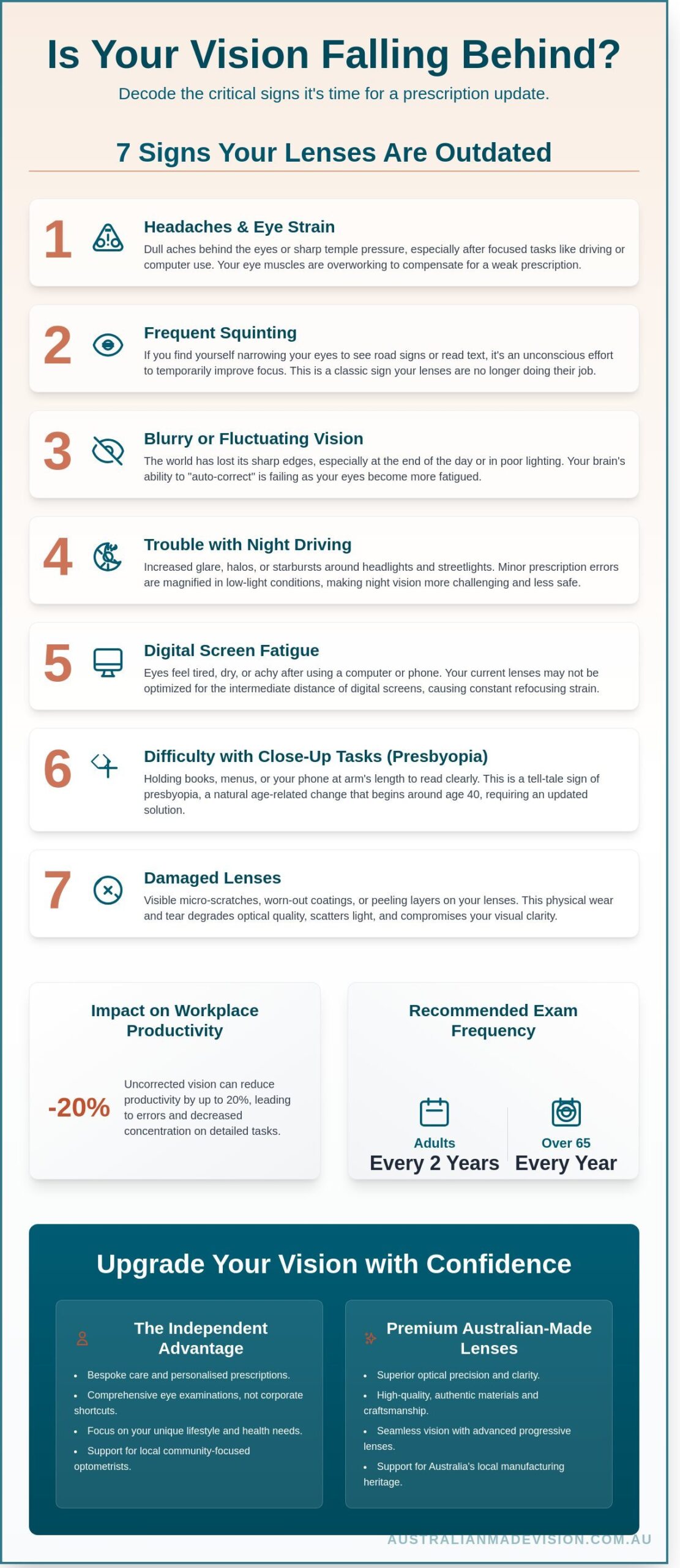

Has your world started to look a little less sharp? Are you finding yourself squinting at your screen or ending the day with a nagging headache? These are more than just minor annoyances; they are often the first subtle signs you need a new glasses prescription.
Vision changes happen so gradually that your brain often compensates, masking the problem until it affects your daily comfort. Recognising these cues early is the first step towards not just clearer sight, but a significant improvement in your quality of life. An updated prescription is an opportunity to upgrade to bespoke, Australian-made lens technology that is perfectly suited to your modern lifestyle.
Recognising the Subtle Signs You Need a New Glasses Prescription
An updated prescription becomes necessary when your current lenses no longer provide the correct refractive error correction for your eyes. While it can be tempting to “push through” the discomfort, doing so can lead to persistent eye strain and fatigue. For most adults, a comprehensive eye exam every two years is the best way to stay on top of your visual health.
The Gradual Shift: Why You Might Not Notice at First
Your brain is incredibly adept at adapting to minor shifts in your vision. It works overtime to fill in the gaps, meaning you might not consciously register a decline in clarity. This “habitual vision” can be misleading, as your perception of “normal” slowly changes. Your vision can also fluctuate depending on factors like tiredness or the lighting conditions, making it even harder to pinpoint a consistent problem.
The Role of Age and Presbyopia
For those over 40, a common reason for a prescription change is presbyopia. This is a natural, age-related condition where the eye’s lens becomes less flexible, making it difficult to focus on close-up objects. If you find yourself holding your phone at arm’s length or struggling to read a menu, your single-vision lenses may no longer be sufficient. Modern progressive lenses offer a seamless solution, providing clear vision at all distances without the tell-tale lines of traditional bifocals. For a deeper understanding of how your eyes change over time, you can explore our comprehensive guide to vision health.
7 Physical and Visual Indicators Your Lenses are Outdated
If you’re experiencing any of the following symptoms, it’s a clear signal that your prescription may be outdated.
- Frequent Headaches: Persistent, dull headaches, especially around your temples or behind your eyes, are a classic sign of eye strain.
- Constant Squinting: If you find yourself narrowing your eyes to see road signs or read text, your lenses are not doing enough of the focusing work.
- Noticeable Blurriness: Vision that was once sharp may now seem hazy or out of focus, either at a distance, up close, or both.
- Double Vision: Seeing a “ghost” image or a faint second outline around objects can indicate a change in your prescription, particularly with astigmatism.
- Eye Fatigue: Your eyes feel tired, heavy, or sore after short periods of reading, driving, or screen use.
- Difficulty with Night Vision: Seeing clearly in low light becomes more challenging, especially when driving at night.
- Increased Glare Sensitivity: You experience more “starbursts” or halos around lights, making night driving uncomfortable.
Headaches and Eye Strain: The Body’s Early Warning
When your glasses prescription is incorrect, the small muscles in your eyes must work much harder to focus. This constant effort creates tension, which often manifests as a headache. Eye strain is a direct symptom of uncorrected refractive error, where your eyes are overexerting themselves to compensate for what your lenses should be doing.
Night Vision and Glare Sensitivity
An old prescription can make night driving particularly hazardous. The inability to focus correctly is amplified in low-light conditions, and oncoming headlights can create overwhelming “starbursts” and halos. Modern anti-reflective coatings, applied to a correctly prescribed lens, are specifically designed to minimise this glare and dramatically improve visual comfort and safety after dark.
Beyond the Eyes: How Lifestyle and Lens Wear Affect Your Vision
Even a perfect prescription won’t perform well if the lenses themselves are compromised or unsuited to your daily tasks. Scratches, peeling coatings, and the demands of our digital lives all play a significant role in how well you see.
Digital Eye Strain and Blue Light
In 2026, our lives are more screen-based than ever, leading to a rise in Digital Eye Strain, also known as Computer Vision Syndrome. Prolonged exposure to high-energy visible (HEV) or “blue” light from screens can disrupt focus and even affect sleep patterns. Integrating a blue light filter into your new prescription can provide significant relief. For those who spend most of their day in an office, specialised occupational lenses offer a tailored solution for intermediate and near-vision tasks. You can learn more about how to reduce digital eye strain with our professional guide.
The Life Cycle of an Optical Lens
Over time, daily cleaning and environmental exposure can degrade your lenses. Micro-scratches, invisible to the naked eye, scatter light and create a hazy, unclear view. High-quality, durable coatings are essential for maintaining lens clarity and longevity. This is where the superior craftsmanship of Australian-made lenses provides a distinct advantage, ensuring your investment in clear vision lasts.
The Independent Advantage: Why Your Next Prescription Needs a Personalised Approach
When it’s time for a new prescription, the expert you choose matters. Independent optometrists offer a different level of care compared to larger corporate chains, focusing on a comprehensive, personalised approach to your long-term eye health. They often provide longer appointment times, ensure clinical continuity by allowing you to see the same practitioner, and offer access to a wider range of bespoke lens solutions.
Finding the Right Expert for Your Eyes
A personalised recommendation from a trusted expert will always serve you better than a generic retail promotion. An independent optometrist takes the time to understand your unique lifestyle, occupational demands, and visual challenges before recommending a solution.
- Take the next step: Find an independent optometrist near you to schedule a thorough assessment.
Bespoke Solutions for Complex Needs
Independent practitioners are uniquely equipped to manage complex conditions like astigmatism and provide advanced myopia management for children. They understand the critical link between precise measurements—taken with care and expertise—and your final visual comfort. Their commitment is to your health, not just a sale, reflecting the ethical standard of local, community-focused eyecare providers.
Upgrading Your Vision with Premium Australian-Made Lenses
Choosing your next pair of lenses is a chance to support local industry while receiving world-class technology. Australia has a proud heritage of optical innovation, with family-owned laboratories crafting precision lenses with exceptional skill for decades. Opting for locally manufactured lenses ensures higher precision, faster turnaround times, and the satisfaction of investing in the Australian economy.
Precision Surfacing: The Difference You Can See
Modern Australian-made lenses are crafted using state-of-the-art digital surfacing technology. This process allows for incredible customisation, shaping the lens to your exact prescription with unparalleled accuracy. Precision surfacing is a method of customising lenses to a 0.01 dioptre accuracy, resulting in sharper, clearer vision across the entire lens. This technology ensures your lenses are perfectly tailored not just to your eyes, but also to the specific frame you have chosen.
The Ethical Choice for Australian Eyewear
By choosing locally manufactured optical products, you are also making a sustainable choice. A local supply chain significantly reduces the carbon footprint associated with shipping products from overseas. It also comes with the transparency and high standards of Australian manufacturing. For your next prescription, visit your local independent optometrist and ask for Australian-made lenses—it’s a better choice for your eyes and for the community.
Frequently Asked Questions
How often should I get my glasses prescription checked?
For adults, it is recommended to have a comprehensive eye exam every one to two years, or more frequently if you have a known eye condition or notice any changes in your vision.
Can an old prescription cause permanent eye damage?
While wearing an old prescription won’t typically cause permanent damage to an adult’s eyes, it can lead to chronic eye strain, headaches, and fatigue. For children, an incorrect prescription can negatively impact visual development.
Why do I have headaches even though my vision seems clear?
Your eye muscles may be overworking to compensate for a subtle prescription change your brain has adapted to. This extra effort leads to tension headaches, even if you don’t perceive your vision as blurry.
What is the difference between an eye test at a corporate chain vs. an independent?
Independent optometrists often provide longer, more comprehensive exams focused on overall eye health. They offer greater continuity of care and access to a wider variety of specialised, bespoke lens options not tied to a single supplier.
Are Australian-made lenses better than imported ones?
Australian-made lenses are manufactured to some of the highest standards in the world, often using advanced digital surfacing for superior precision. Choosing local also means supporting the local economy and reducing your environmental impact.
How long does it take to adjust to a new prescription?
The adjustment period can range from a few hours to a few days. For more complex changes, such as moving to progressive lenses for the first time, it may take up to two weeks to feel completely comfortable.
Can I keep my old frames and just replace the lenses?
Yes, in most cases you can have new lenses fitted into your existing frames, provided the frames are in good condition. Your optometrist can assess their suitability.
What should I do if my new glasses feel “weird” or make me dizzy?
It’s normal to have a short adjustment period. However, if you experience persistent dizziness, headaches, or distortion after a few days, contact your optometrist. They can double-check the prescription and fitting to ensure everything is correct.
Disclaimer
The information in this article is provided for general educational purposes only and should not be considered medical advice. For personalised advice regarding your vision or eye health, please consult a qualified optometrist.
Australian Made Vision is an independent directory that helps patients find optometrists across Australia who may offer Australian-made spectacle lenses. We do not provide clinical services and recommend contacting practices directly to confirm the products and services they offer.