
What if the reason you’re struggling with blurry peripheral vision isn’t your prescription, but where your lenses were actually made? Since 2024, more Australians have begun to realise that high-volume retail chains often prioritise speed over the precision required for complex prescriptions. When you invest in the high-quality spectacle lenses australia provides through local, independent channels, you’re choosing a standard of craftsmanship that massive offshore factories simply can’t replicate.
It’s frustrating to pay for premium eyewear only to deal with lenses that scratch within months or feel like you’re looking through a fishbowl. You deserve a pair of glasses that feels as natural as your own sight while standing up to the rigours of daily life. This guide will show you how to identify genuine quality by looking at local manufacturing standards, advanced coating technologies, and the bespoke care provided by independent practices.
We’ll explore why supporting Australian made vision ensures better durability and how the right expert advice can finally give you the crystal clear clarity you’ve been searching for.
Key Takeaways
- Understand why modern lenses should be viewed as high-precision medical devices rather than simple plastic inserts, ensuring you prioritise quality for your eye health.
- Discover the tangible benefits of choosing spectacle lenses Australia-made, where local digital surfacing technology provides superior optical clarity and supports homegrown craftsmanship.
- Learn how to match specific lens technologies—such as progressive or occupational designs—to your unique lifestyle needs, from office work to long-distance driving.
- Identify the “independent advantage,” where bespoke care and access to a broader range of lens innovations offer a personalised alternative to corporate optical chains.
- Gain professional insights into how your frame selection influences lens thickness and performance, helping you achieve the perfect balance of aesthetics and vision.
Understanding the Spectacle Lenses Landscape in Australia
Choosing the right pair of glasses involves more than picking a stylish frame. Most people don’t realise that spectacle lenses australia are actually high-precision medical devices. They aren’t just simple plastic inserts; they’re engineered tools designed to interface directly with your neurological system. A quality lens ensures that light hits your retina at the exact point required for clarity, reducing the strain on your brain to interpret blurred images.
The current Australian market presents a clear divide between large corporate chains and independent boutique practices. While corporate providers often prioritise high-volume turnover, independent optometrists focus on tailored, clinical outcomes. By 2026, we’ve seen a decisive shift toward bespoke, locally manufactured optical solutions. Australians are increasingly rejecting generic products in favour of lenses crafted specifically for their unique visual needs. You can find a dedicated professional to help you achieve this through our directory of independent optometrists who value quality over quantity.
Visual comfort is the primary goal of any high-quality lens. This means your eyes and brain work together without effort, even after a long day of digital work. True comfort comes from the marriage of clinical expertise and manufacturing precision, ensuring your vision feels natural and effortless.
The Role of the Lens in Modern Eyecare
A Corrective lens does more than just clear up a blurry image. It precisely redirects light to compensate for refractive errors like astigmatism and myopia. We’ve moved far beyond heavy glass; modern high-index polymers allow for incredibly thin, lightweight profiles. These materials ensure that even high prescriptions don’t result in thick, uncomfortable glasses. Accurate pupillary distance (PD) measurements remain vital for lens alignment. If the optical centre is off by even a few millimetres, it can cause significant headaches and eye fatigue.
Why Australia Leads in Lens Innovation
Australia has a long, proud history of optical excellence and some of the world’s most rigorous quality standards. The “Australian Made” logo serves as a powerful mark of trust in our manufacturing sector. It represents a commitment to ethical production and superior craftsmanship that supports local jobs. Local precision offers a level of consistency that high-volume international imports often struggle to match. When you choose spectacle lenses australia made in local labs, you’re supporting a community of skilled artisans who understand the specific light conditions and lifestyle needs of our country.
A Comprehensive Guide to Modern Lens Technologies
Choosing the right spectacle lenses australia offers today involves more than just picking a frame. It’s about matching your lifestyle to the latest optical engineering. We’ve moved beyond basic glass or plastic; today’s lenses are sophisticated pieces of health technology. Most Australians fall into three main categories: single vision for a constant focal point, occupational lenses designed for office environments, and progressive lenses for seamless vision at all distances.
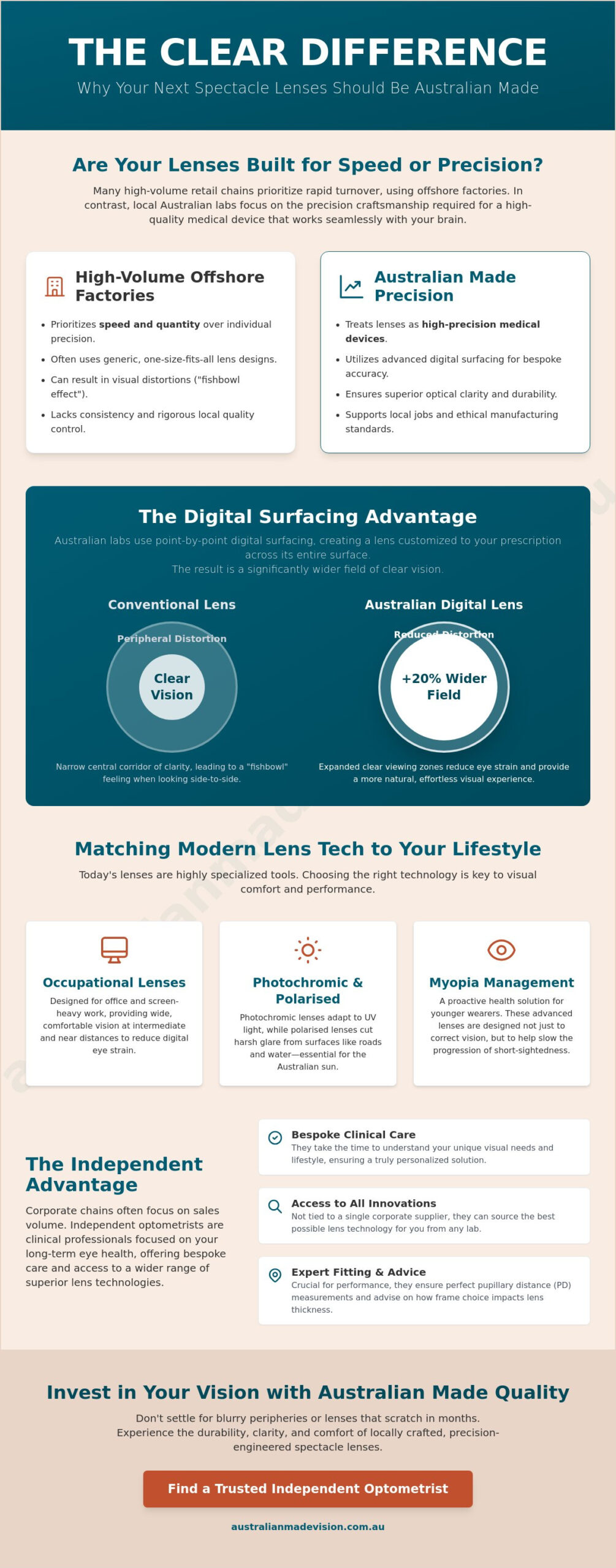
Digital surfacing technology has completely changed how we manufacture these lenses. By using computer-controlled precision, we can now map your prescription onto the back surface of the lens with point-by-point accuracy. This reduces peripheral distortion and provides a 20% wider field of clear vision compared to traditional methods. It’s the difference between a standard off-the-rack garment and a bespoke suit crafted in a local lab.
Living under the harsh Australian sun requires specific protection. Polarised lenses remain the gold standard for cutting glare from roads and water, while the latest photochromic technology adapts to UV levels in seconds. For our younger generation, myopia management lenses are now a proactive health solution. These lenses don’t just correct vision; they help slow the progression of short-sightedness. Supporting this innovation is vital, and the work done by the Centre for Eye Research Australia helps us understand how these treatments protect long-term ocular health.
Progressive and Multifocal Lenses
Modern progressives have eliminated the “image jump” that used to frustrate bifocal wearers. By using wide-corridor designs, these lenses provide a natural transition from your desk to the horizon. You’ll find that your head movements feel more fluid and less restricted. For a deep dive into how these work, check out our Progressive Lenses Pillar guide.
Specialised Coatings and Filters
The right coating is the final touch for any high-quality lens. Premium anti-reflective layers are essential for night driving, as they reduce the “halo” effect from modern LED headlights. In 2026, blue light filtration has become standard for anyone spending over four hours a day on digital devices. We also recommend hydrophobic and oleophobic layers. These coatings repel water and skin oils; this means you spend less time cleaning and more time seeing clearly. If you’re looking for a tailored recommendation, you can find an independent optometrist who prioritises your specific visual needs.
Australian Made vs. Imported Lenses: Why Local Manufacturing Matters
Choosing local spectacle lenses australia isn’t just a matter of national pride; it’s a commitment to superior optical performance. Many patients wonder if local lenses are worth the investment compared to cheaper imports. The difference is found in the precision surfacing process. Australian laboratories utilize advanced digital freeform technology to cut prescriptions with a tolerance of 0.01 dioptres. This level of accuracy is rarely matched by mass-produced alternatives that focus on volume over individual clarity.
Local production also offers practical advantages that impact your daily life. You’ll benefit from faster turnaround times, often receiving your bespoke prescription three to five days sooner than if the lenses were shipped from an overseas hub. Choosing local manufacturing reduces the environmental impact too. By eliminating the need for long-haul international shipping, your carbon footprint is lowered by approximately 60% per pair. You’re also supporting ethical labour practices that align with strict Australian workplace laws.
The Quality Gap in Mass-Produced Lenses
Many corporate chains use “stock” lenses to keep costs low. These lenses are pre-moulded in massive batches, which often results in compromised edge-to-edge clarity. You might notice “warping” or “waves” in the material, especially toward the periphery of the frame. These distortions can lead to eye strain and persistent headaches. High-quality Australian-made materials are built for longevity and stability. Every pair must adhere to the Australian Standard for Mounted Spectacle Lenses. This ensures your vision remains crisp and the material doesn’t degrade or yellow prematurely.
Supporting the Australian Economy
Your choice to buy local helps sustain over 2,000 skilled roles in the Australian optical manufacturing sector. It’s a community-focused decision that keeps specialized knowledge and technology on our shores. When you visit an independent optometrist, you’re participating in a circular local economy. This support allows labs to continue innovating and providing bespoke solutions for complex vision needs. Choosing Australian-made lenses is an investment in both your vision and our local industry. It ensures that high-quality eyecare remains accessible for all Australians.
How to Choose the Right Lenses for Your Lifestyle
Choosing the right spectacle lenses Australia offers means looking beyond just the numbers on your script. It’s about lifestyle dispensing. This is the process where a skilled independent optometrist evaluates your daily habits to tailor a bespoke solution. A person spending 10 hours a day in a Sydney CBD office has vastly different visual needs than a retiree living on the coast. Your lenses should be a tool that enhances your specific environment.
The frame you choose also dictates your lens performance. If you have a high prescription, selecting a large, oversized frame can result in thicker, heavier lenses that distort your peripheral vision. A smaller, well-centred frame allows for thinner edges and better optical clarity. Independent practitioners take the time to match your frame choice with the correct refractive index, ensuring your glasses look as good as they function.
Don’t be swayed by the “free” or “cheap” offers from large corporate chains. These deals often rely on mass-produced, older lens designs that lack the precision of modern surfacing. Locally crafted lenses are often ground to an accuracy of 0.01 dioptres. This precision provides a sharper visual experience that generic lenses simply can’t match. Supporting local manufacturing also ensures your lenses are made to withstand the unique Australian environment.
Lenses for the Digital Professional
Modern office work demands more than what standard progressives can provide. Occupational lenses are specifically designed for those who navigate multiple screens and physical documents. Unlike standard lenses, they offer an expanded intermediate zone. This prevents the “head-tilt” posture that causes neck strain. Pairing these with a premium anti-reflective coating helps manage the harsh glare from overhead LED lighting and digital devices.
Outdoor Performance and UV Protection
Australia’s UV levels are some of the highest globally, making 100% UV protection a health requirement rather than a luxury. While standard tints reduce brightness, they don’t eliminate the blinding glare from roads or water. Polarised lenses are the superior choice for driving and outdoor activities. They filter horizontal light waves, significantly improving reaction times and visual comfort during your morning commute or a weekend at the beach.
You can find a master of the craft who understands these nuances by visiting an independent practice. Use our directory to find a local independent optometrist who prioritises quality over volume.
The Independent Advantage: Finding Personalised Eye Care
Choosing the right provider is just as vital as selecting the frames themselves. Independent optometrists act as master artisans of vision; they provide a level of bespoke care that focuses on your specific lifestyle rather than high-volume turnover. These practitioners aren’t restricted to a limited corporate supply chain. This freedom allows them to source the most advanced spectacle lenses australia offers, ensuring you receive a product tailored to your unique visual requirements.
Clinical continuity plays a significant role in your long-term eye health. Seeing the same professional over five or ten years allows them to track subtle changes in your ocular health that a one-off appointment might miss. Industry reports indicate that patients who maintain a consistent relationship with their primary health provider experience better health outcomes. In an independent setting, you’re a person with a history, not just a number in a database; for instance, you can discover The Eye Centre to understand how comprehensive examinations support this patient-first philosophy.
- Access to global lens innovations and local boutique labs.
- Dedicated time to explain technical lens coatings and materials.
- Personalised fitments that account for facial anatomy and posture.
- Support for the local economy and Australian manufacturing.
Why Your Choice of Optometrist Matters
The difference often comes down to the clock. While corporate models often schedule appointments in 15 or 20-minute blocks to meet volume targets, independent practices frequently offer 30 to 45-minute consultations. This extra time isn’t just for chat; it allows for a deeper diagnostic process. Instead of a standardised sales target, you receive a tailored recommendation based on your hobbies, work environment, and digital habits. You can find an independent optometrist through our directory to experience this dedicated level of service.
Taking the Next Step for Your Vision
Your journey toward better sight begins with a comprehensive eye exam. This thorough assessment ensures your prescription is precise and your eyes are healthy. Australian Made Vision exists to bridge the gap between discerning patients and high-quality local providers. We believe in the power of local craftsmanship and the clinical expertise found in our suburbs. By choosing an independent provider, you’re opting for the highest standard of spectacle lenses australia can provide.
Visit the Australian Made Vision directory to support local businesses and see the difference that genuine care makes. We’re your sophisticated neighbour, here to help you see Australia clearly. By choosing an independent provider, you invest in your own vision and the future of our local manufacturing heritage. Our goal is to ensure every Australian has access to eyewear that’s as authentic and reliable as the people who make it.
Secure Your Vision With Local Excellence
Choosing the right eyewear involves more than a standard prescription. It’s about investing in local craftsmanship and precision technology that supports our national industry. By 2026, the benchmark for spectacle lenses australia has shifted toward bespoke solutions manufactured right here in our own backyard. You’ve seen how independent, family-owned practices provide a level of clinical care that corporate chains can’t replicate. These experts prioritise your long-term eye health by using advanced lens designs tailored to your specific lifestyle needs.
Find an Independent Australian Optometrist Near You
Your choice to support local optometry helps build a stronger, clearer future for all Australians.
Frequently Asked Questions
Are all spectacle lenses in Australia made locally?
No, many lenses sold in the Australian market are imported from large-scale manufacturing hubs in Asia and Europe. While these products meet basic standards, they often lack the precision of locally crafted optics. Choosing an independent optometrist increases your chance of receiving spectacle lenses Australia labs have surfaced and coated right here in our own communities. This local production supports our national economy and ensures a much faster turnaround for your new glasses.
What is the difference between multifocal and progressive lenses?
In the Australian optical industry, these two terms describe the same technology. Both designs allow you to see clearly at all distances without any visible lines on the lens surface. Progressive lenses are the modern evolution of the old bifocal, providing a smooth transition from distance vision at the top to reading vision at the bottom. We prefer the term progressive because it describes the seamless way the focal power changes to match your natural eye movements.
How much should I expect to pay for high-quality spectacle lenses in Australia?
Prices for premium lenses vary based on your unique prescription and the technical coatings required for your lifestyle. According to 2024 industry pricing guides, high-quality single vision lenses typically start around A$150, while advanced, bespoke progressive designs can range from A$500 to A$1,200. Investing in local craftsmanship means you’re paying for better visual clarity and more durable materials that often outlast cheaper, mass-produced alternatives.
Can I put new lenses into my old frames at an independent optometrist?
Yes, most independent practitioners are happy to fit new lenses into a frame you already own and love. This is a sustainable and cost-effective way to update your prescription with the latest spectacle lenses Australia has available. Your optometrist will first check your frame for signs of material fatigue or hidden cracks to ensure it’s strong enough to handle the heat and pressure of the fitting process. If the frame is in good condition, it’s a wonderful way to maintain your personal style.
Why are some lenses thinner than others even with the same prescription?
The thickness of your lenses is determined by the refractive index of the material used. A standard plastic lens has an index of 1.50, but high-index materials like 1.67 or 1.74 can make lenses up to 50 percent thinner and much lighter. Choosing a higher index is particularly beneficial for stronger prescriptions, as it prevents the “coke bottle” look and ensures your glasses sit comfortably on your face without sliding down. Your local expert can recommend the perfect index to balance aesthetics and comfort.
How do I know if my lenses are actually Australian made?
You can verify the origin of your eyewear by asking your optometrist for an authenticity certificate or a laboratory invoice. Many independent practices pride themselves on using local labs and will be happy to share details about where your lenses were surfaced and coated. Authentic Australian-made lenses are often delivered with branded packaging from the local lab, proving they weren’t shipped in from an overseas warehouse. Supporting these local businesses ensures that high-end manufacturing skills remain within our borders.
What are the best lenses for reducing night driving glare?
Lenses equipped with a premium anti-reflective coating are the gold standard for safer night driving. These coatings allow up to 99 percent of light to pass through the lens, which significantly reduces the “halo” effect and glare from modern LED headlights. By eliminating distracting reflections on the front and back of the lens, you’ll experience much sharper contrast when driving in low-light conditions. It’s a simple addition that makes a massive difference to your comfort and safety on the road.
Do blue light glasses actually help with sleep and eye strain?
Recent data from 2023 suggests that blue light filters are most effective at protecting your natural sleep cycle rather than just reducing eye strain. By filtering out the specific blue-violet light emitted by digital screens, these lenses help your body produce melatonin naturally in the evening. While they can help some users feel less fatigued after a long day at the computer, they’re most beneficial for people who use devices within two hours of bedtime. We recommend them as part of a holistic approach to eye health in our digital age.
Disclaimer
The information in this article is provided for general educational purposes only and should not be considered medical advice. For personalised advice regarding your vision or eye health, please consult a qualified optometrist.
Australian Made Vision is an independent directory that helps patients find optometrists across Australia who may offer Australian-made spectacle lenses. We do not provide clinical services and recommend contacting practices directly to confirm the products and services they offer.