

The disorienting “swim” effect and dizzying blur of cheap multi-focals aren’t a rite of passage; they’re a sign of a lens that wasn’t made for your eyes. You shouldn’t have to settle for a generic solution that forces your brain to work overtime just to see the world clearly. When searching for progressive lenses Australia offers, the difference between a mass-produced product and a locally crafted, bespoke lens is immediately apparent.
We know it’s frustrating when big-box retailers treat your vision like a transaction rather than a clinical necessity. You deserve a seamless transition from your phone screen to the distant horizon without the compromise of distorted peripheral vision. This 2026 guide shows you how independent optometric care and Australian made quality provide the ultimate solution for your sight. We’ll explore why personalised fitting matters and how supporting local industry ensures you receive the highest standard of craftsmanship available today.
Key Takeaways
- Understand how modern multifocal technology provides seamless vision across all distances without the distracting visible lines of traditional bifocals.
- Learn why choosing progressive lenses Australia-made ensures superior optical clarity and durability compared to mass-produced, imported alternatives.
- Discover the critical role of bespoke physical measurements and independent optometric care in achieving a perfect, comfortable fit for your unique lifestyle.
- Identify the specific lens designs—from office-specific to active wear—that best support your daily digital habits and physical activities.
- Master simple, practical techniques for a faster adaptation period, ensuring your transition to new lenses is smooth and effortless from day one.
What Are Progressive Lenses and Why Choose Them in 2026?
Progressive lenses represent the pinnacle of modern optical engineering, offering a sophisticated way to maintain your lifestyle without compromise. To understand the basics, What are progressive lenses? Essentially, they’re multifocal solutions providing a seamless transition between different focal points without outdated visible lines. For the modern Australian professional, these lenses offer a sleek, youthful appearance while addressing natural age-related changes in our sight. Choosing progressive lenses australia ensures you’re accessing world-class technology tailored for our local lifestyle, from navigating coastal highways to focused work in a home office.
By 2026, digital surfacing technology has completely transformed how we manufacture lenses. Unlike older “moulded” designs that often felt restrictive, modern digital processing allows for a bespoke prescription mapped across the entire lens surface. This precision eliminates the “image jump” that used to cause dizziness in traditional bifocals. Your human eye adapts much faster to these sophisticated zones because the transitions are fluid rather than abrupt. Local Australian labs now use software that accounts for your specific frame shape, ensuring the intermediate zone for computer work is wider and clearer than ever before.
The Evolution of Multifocal Technology
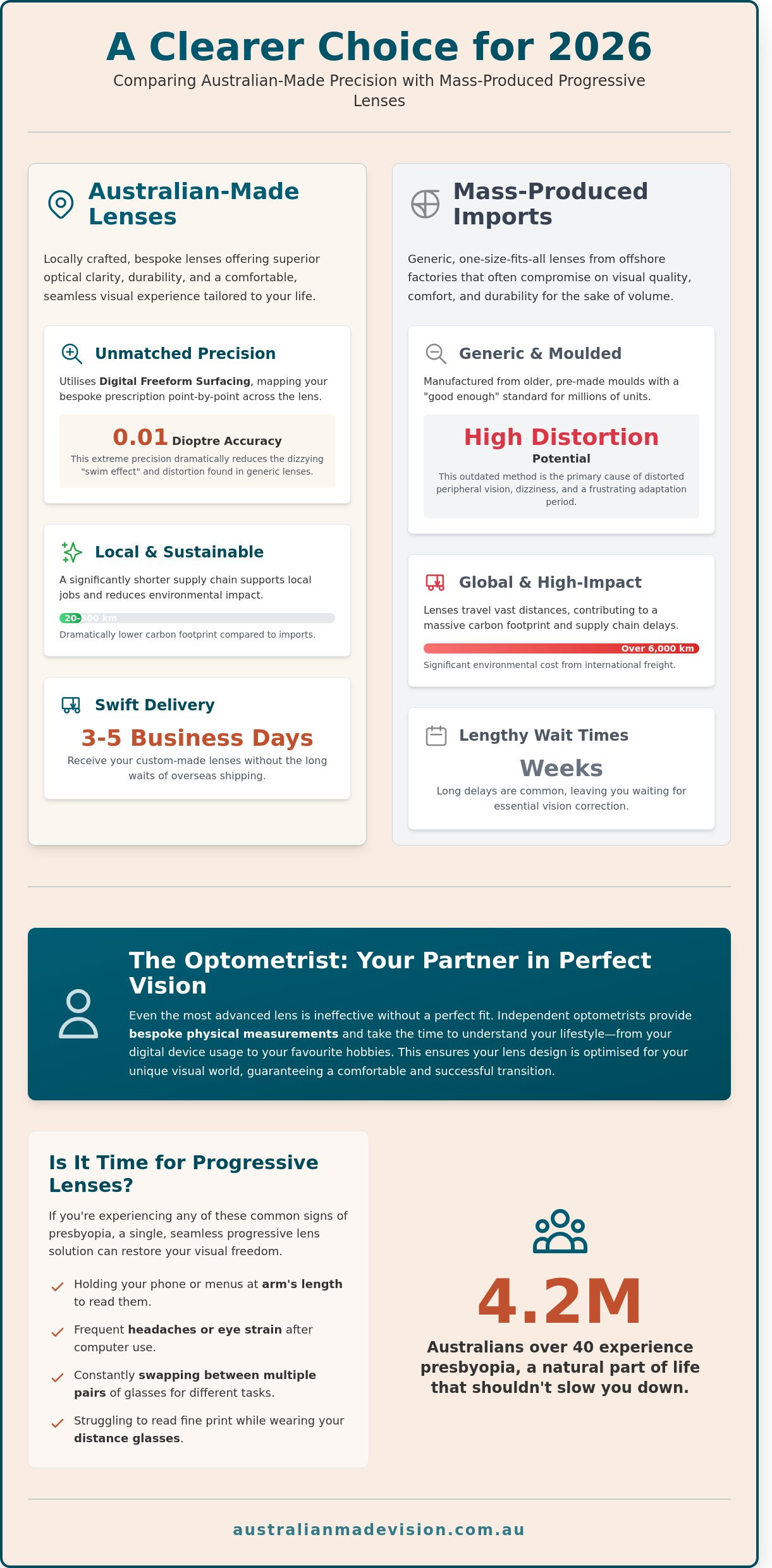
The transition from traditional bifocals to 2026-standard progressives is like moving from a standard television to a high-definition display. Modern lenses are crafted using point-by-point digital surfacing, which means the prescription is accurate to 0.01 dioptres. This level of precision was unavailable in the previous decade. It allows for a more natural visual experience, where the transition from looking at your dashboard to the road ahead feels effortless. By choosing locally crafted options, you’re supporting a heritage of precision that prioritises the unique visual needs of our community.
Signs You Might Need Progressive Lenses
Approximately 4.2 million Australians over the age of 40 experience presbyopia. This condition is a natural part of life, but it doesn’t have to slow you down. If you’re constantly swapping between different spectacles, it’s likely time to consider a single, elegant solution. Here are the common indicators:
- You find yourself holding your phone or the morning paper at arm’s length to see clearly.
- Struggling to read fine print while wearing your current distance glasses.
- Frequent headaches or eye strain during long hours of computer use.
- The daily inconvenience of carrying multiple pairs of spectacles for driving and reading.
Independent optometrists across the country report a 15 percent increase in patients opting for progressives to regain their visual freedom. This shift reflects a desire for convenience without compromising on the high-quality craftsmanship we value in our local communities. Finding the right fit starts with a visit to a trusted local expert. You can use our directory to find an independent optometrist who understands these advanced lens designs and provides the personalised care your vision deserves.
Why Australian-Made Progressive Lenses Outperform Mass-Produced Alternatives
Choosing locally made eyewear isn’t just about a label; it’s about the technical superiority of the final product. Generic lens blanks are often mass-produced in offshore factories where “good enough” is the standard for millions of units. In contrast, Australian optical laboratories utilise digital freeform surfacing to create lenses that match your specific prescription to within 0.01 dioptres. This level of precision reduces the “swim effect” often found in budget progressive lenses australia, providing a smoother transition between near and far vision.
Supporting local labs keeps skilled technicians employed within our borders while strengthening our national manufacturing capabilities. It also slashes the environmental cost of vision. A lens manufactured in a local lab typically travels between 20 and 500 kilometres to reach your optometrist, whereas imported lenses often travel over 6,000 kilometres from overseas hubs. This local supply chain allows for delivery times as short as three to five business days, ensuring you aren’t left waiting weeks for your bespoke prescription.
- Precision: Local labs use diamond-point cutting tools for extreme accuracy.
- Durability: Australian standards for hard coatings are designed for our grit and dust.
- Accountability: If a lens isn’t perfect, your local lab can rectify it immediately.
- Sustainability: Reduced air freight significantly lowers the carbon footprint of your spectacles.
Quality Control and Local Craftsmanship
Australian labs treat every pair of glasses as a unique piece of engineering. Our local technicians apply an artisan-expert approach to lens finishing, checking each surface under high-intensity lighting for microscopic imperfections that automated mass-production lines frequently miss. This meticulous oversight allows for tighter tolerances in complex prescriptions, especially for patients with high astigmatism or unique pupillary distances. Bespoke lens surfacing is the gold standard for Australian patients because it calculates the optical design point-by-point across the entire back surface of the lens.
Tailored for the Australian Lifestyle
Our climate demands more from our eyewear than the softer light of the Northern Hemisphere. Australian-made lenses are specifically engineered to handle some of the highest UV radiation levels in the world, which can be up to 15% higher than levels found in Europe at similar latitudes. Local manufacturers prioritise high-index materials and advanced coatings that manage intense glare and heat. Whether you need polarised filters for coastal driving or photochromic lenses that react quickly to our harsh sun, choosing locally crafted solutions ensures your vision is protected. You can find an independent optometrist who specialises in these bespoke local products to ensure your vision plan is as unique as your lifestyle.
When you choose progressive lenses australia that are surfaced locally, you’re investing in a product designed for the specific light conditions of our backyard. It’s a choice that supports our community while providing you with the clearest, most comfortable vision possible. This commitment to local quality ensures that your eyewear performs reliably, day after day, in the world’s most demanding environments.
The Role of Independent Optometry in Progressive Lens Success
Choosing progressive lenses australia involves more than just picking a stylish frame. It’s about the clinical precision behind the glass. Independent optometrists play a vital role here because they often prioritise quality of care over patient volume. While high-street chains might focus on a 15 minute “quick-check” to move through a queue, an independent practitioner typically invests 30 to 45 minutes in a comprehensive eye exam. This time allows them to detect subtle changes in your vision that a rushed assessment might overlook.
Precise physical measurements are the foundation of multifocal success. If your lenses aren’t aligned perfectly with your pupils, you’ll likely struggle with “swim” effects or a narrow field of vision. Even a 1 or 2 millimetre error in placement can lead to significant discomfort. Independent clinics use advanced diagnostic tools to ensure your prescription is tailored to your unique facial anatomy. You can use our directory to find an independent optometrist who specialises in these expert fittings.
The Personalised Care Advantage
Every person uses their eyes differently. A carpenter who looks up at high beams needs a different visual corridor than a librarian who spends hours reading fine print. Independent optometrists take the time to understand these specific hobbies and daily tasks. They don’t just measure your basic prescription; they calculate your pupillary distance, vertex distance, and pantoscopic tilt. These measurements ensure the lens sits at the perfect angle for your eyes. For more advice, see our guide on choosing the right optometrist for your long-term eye health.
Beyond the Big Chains
Corporate retail outlets often use “one-size-fits-all” lens designs to streamline their supply chains. This approach can limit your options, especially if you have a complex prescription. Independent practitioners operate differently. They have the freedom to access a wider range of lens technologies, including the latest Australian made innovations crafted in local laboratories. This access means you get a bespoke product rather than a mass-produced one.
- Long-term relationships: Seeing the same practitioner for years helps them track your visual history and anticipate changes accurately.
- Tailored solutions: Access to diverse lens designs means your eyewear is built for your life, not a corporate bottom line.
- Local expertise: Supporting independent clinics keeps highly skilled jobs and clinical excellence within our local communities.
When you choose an independent clinic, you’re investing in a master of their craft who views your vision as a lifelong commitment. This level of dedication is what makes the transition to progressive lenses australia smooth and successful.
Comparing Progressive Lens Designs for Your Lifestyle
Your daily habits determine which progressive lenses australia will serve you best. A retiree spending afternoons at a lawn bowls club in Perth needs different optics than a software developer in a Melbourne high-rise. Standard progressives provide a balanced view across all distances; however, they aren’t always the perfect tool for specific tasks. Choosing a bespoke design ensures your vision remains sharp without the physical strain often caused by generic alternatives.
The intermediate zone is the most critical area for modern life. It covers the distance of your computer screen or car dashboard. If this zone is too narrow, you’ll find yourself constantly tilting your head to find the “sweet spot.” High-quality Australian-made lenses often use digital surfacing technology to widen this corridor by up to 30 percent compared to older designs. Adding a premium anti-reflective coating or a blue light filter further reduces the digital eye strain that affects 65 percent of office workers according to recent industry surveys.
Occupational lenses are task-specific tools. While standard progressive lenses australia are great for driving to the shops and reading a menu, they can feel restrictive during an eight-hour shift at a desk. Occupational designs prioritise the near and intermediate zones, giving you a massive field of view for your workspace. Many Australians now choose these as a dedicated second pair to complement their primary eyewear.
The Digital Office Design
These lenses are engineered for the desk-bound professional. By expanding the middle section of the lens, they eliminate the need for “neck craning” while looking at monitors. You get a clear view of your screen and your keyboard simultaneously. This ergonomic advantage is a game-changer for anyone spending more than four hours a day on digital devices. It’s a localized solution for the modern Australian workplace.
Active and Outdoor Configurations
Active designs prioritise the distance zone and peripheral stability. They’re perfect for driving on the Pacific Highway or hiking through the bush. These configurations minimise the “swim” effect, which is the slight dizzy feeling some people get when moving their head quickly. Pairing these with polarised technology offers 100 percent UV protection. This is essential given Australia has some of the highest UV levels in the world, often reaching extreme levels on the index during summer months.
To find the right fit for your routine, you can find an independent optometrist who offers personalised lens consultations.
Tips for Adapting to Your New Progressive Lenses
Our local independent practices pride themselves on the precision of their measurements. However, even the most accurately dispensed progressive lenses australia has to offer require a learning curve. Your brain must learn to ignore the peripheral areas of the lens and focus through the central zones. Start wearing them the moment you wake up. This allows your neurological pathways to adapt while your eyes are rested and haven’t yet been strained by digital devices.
Movement is key to mastering multifocals. Instead of shifting your eyes to look at something, point your nose directly at the object. This ensures you are looking through the correct part of the corridor. You can practice this at home by moving your gaze between your phone, the television, and a distant object across the room. Repeating this cycle for five minutes a day helps your brain automate the focal shifts.
If you feel dizzy or experience persistent eye strain after 14 days, it’s time to consult your independent optometrist. Unlike high-volume corporate retailers, independent clinics offer the personalised care needed to troubleshoot specific visual issues. They can check the vertex distance and pantoscopic tilt of your frames to ensure the lens is sitting exactly where it was designed to be. This bespoke attention is what sets local practitioners apart from the assembly-line approach of big chains.
What to Expect During the First Week
Expect some mild depth perception changes or a “swimming” sensation when you move your head quickly. These feelings are normal and usually peak on day three. Avoid the temptation to switch back to your old glasses. This “back-and-forth” habit prevents your brain from forming the necessary neural connections for multifocal vision. Full adaptation typically occurs within 10 to 21 days for most Australian patients. Stay consistent, and the zones will soon feel completely natural.
Maintenance for Long-Term Clarity
Your premium progressive lenses australia manufactured deserve high-quality care. Use only approved sprays and microfibre cloths to protect the integrity of your coatings. Avoid using hot water or harsh household detergents, which can delaminate the bespoke treatments on your lenses. Schedule a frame adjustment every six months. A tiny 2-millimetre slip down your nose can move the reading zone out of reach, causing unnecessary strain. Keep your eye health a priority by booking a comprehensive exam every two years.
Empower Your Vision with Local Craftsmanship
Choosing the right pair of glasses is about more than just seeing clearly; it’s about supporting local industry and ensuring your eyes are protected by the best technology available. Opting for bespoke progressive lenses australia ensures you receive a product tailored to your unique lifestyle and our harsh local light conditions. By partnering with an independent practitioner, you’re choosing a professional who takes the time to get the fitting exactly right. These experts prioritize your long-term eye health over high-volume sales, ensuring your transition to multifocals is seamless and comfortable.
Premium lenses crafted for the Australian climate offer a level of durability and clarity that mass-produced alternatives often miss. Every pair represents a commitment to 100% Australian manufacturing and the 2026 standards of precision required for local optical labs. Your vision deserves the care of a master of their craft who understands the specific needs of the community. It’s time to see the world through lenses that are as authentic and reliable as the people who make them. Take the next step toward better vision by visiting a qualified independent practitioner who values quality as much as you do.
Find an Independent Optometrist for Your Bespoke Lenses
Frequently Asked Questions
Is it hard to get used to progressive lenses?
Most Australians adapt to new progressive lenses within 2 to 14 days. While your brain learns to blend the different focal points, you’ll likely feel a slight swimming sensation. This period is much shorter when you choose high-quality progressive lenses australia produced with precision digital surfacing. Consistent wear during the first week is the most effective way to train your eyes to find the clear zones naturally and it’s quite comfortable.
What is the difference between multifocal and progressive lenses?
In the Australian optical industry, the terms multifocal and progressive are often used interchangeably to describe lenses with multiple focal points. The key distinction is that progressive lenses provide a seamless transition from distance to near vision without any visible lines on the lens surface. Traditional bifocals have a distinct line, whereas modern progressives offer a more aesthetic look and a smoother visual experience for all your daily tasks.
Can I wear progressive lenses for driving?
You can absolutely wear progressive lenses for driving as they provide clear vision for the road ahead and your vehicle’s dashboard. The top portion of the lens is dedicated to distance, allowing you to see traffic signs clearly. Meanwhile, the middle zone helps you monitor your speedometer and GPS. Our local independent optometrists ensure the corridor of the lens is wide enough to maintain safety and comfort while you are behind the wheel.
Are progressive lenses more expensive than bifocals in Australia?
Progressive lenses generally carry a higher price point than traditional bifocals because of the complex digital manufacturing required to create a seamless gradient. According to 2023 industry data, the advanced software used to map these lenses accounts for the difference in cost. Investing in premium progressive lenses australia ensures you receive a bespoke product tailored to your specific eye movements, which offers better value over the long term than simpler, mass-produced lens designs.
Why should I choose an independent optometrist for progressives?
Choosing an independent optometrist gives you access to a broader range of lens designs and a more personalised fitting process. Unlike large corporate chains that may be limited to specific house brands, independent practices can source the best Australian-made technology for your unique needs. This artisan approach focuses on clinical precision and community care, ensuring your vision is managed by a master of their craft who is deeply invested in the local manufacturing landscape.
Do progressive lenses work for computer use?
Standard progressive lenses work well for general computer use, though many Australians benefit from a dedicated office or workplace lens if they spend over 5 hours a day at a desk. These specialised designs expand the intermediate zone, providing a wider field of view for monitors and keyboards. An independent optometrist can help you decide if a general-purpose lens or a task-specific bespoke design is the right choice for your professional work environment.
How do I know if my progressive lenses are fitted correctly?
You’ll know your lenses are fitted correctly when you can see clearly at a distance with your head in a neutral position. If you find yourself tilting your chin up or down excessively to find the sweet spot, the measurements likely need a slight adjustment. A precise fit involves measuring your pupillary distance to within 0.5 millimetres. This ensures the optical centre aligns perfectly with your pupils so you don’t experience any unnecessary eye strain.
Can I get Australian-made progressive lenses for any frame?
Most frames are compatible with Australian-made progressive lenses, provided the frame height is at least 28 to 30 millimetres. This depth is necessary to accommodate the full range of distance, intermediate, and near vision zones. When you support local manufacturing, your lenses are custom-crafted to fit your chosen frame perfectly. This bespoke service ensures that even high-fashion or wrap-around styles can be fitted with high-quality, locally produced optics that stand the test of time.
Disclaimer
The information in this article is provided for general educational purposes only and should not be considered medical advice. For personalised advice regarding your vision or eye health, please consult a qualified optometrist.
Australian Made Vision is an independent directory that helps patients find optometrists across Australia who may offer Australian-made spectacle lenses. We do not provide clinical services and recommend contacting practices directly to confirm the products and services they offer.