
How to Choose the Best Glasses for Your Vision and Lifestyle: A 2026 Guide

How to Choose the Best Glasses for Your Vision and Lifestyle: A 2026 Guide

Your choice of eyewear is the most important medical decision you’ll make this year that sits right in the middle of your face. You likely understand the frustration of being met with confusing technical terms or frames that cause nagging headaches by midday. According to 2024 industry reports, over 13 million Australians wear some form of corrective eyewear, yet many still settle for mass-produced glasses that don’t quite hit the mark.

We believe your vision deserves the same level of care as a bespoke piece of furniture. This 2026 guide helps you find glasses that offer both local style and clinical precision. You’ll learn to decode your prescription, select lenses manufactured to high Australian standards, and choose frames that actually fit your lifestyle.

By the end of this article, you’ll know exactly how to work with an independent optometrist to achieve clear, comfortable vision. We’ll cover everything from face shape matching to the ethical benefits of supporting local manufacturing and the precision of our community-focused approach.

Key Takeaways

  • Learn to decode your prescription values, turning complex medical numbers into a clear understanding of your bespoke vision requirements.
  • Discover why the technology inside your lenses matters more than the brand on the frame, and the precision benefits of supporting Australian-made quality.
  • Master the balance between style and clinical precision by learning how frame geometry affects both your look and your visual comfort.
  • Explore the benefits of choosing an independent optometrist to access a broader range of tailored glasses and personalised, clinical-first care.
  • Follow our essential checklist to ensure your new eyewear supports your lifestyle and meets strict Australian standards for safety and UV protection.

Understanding Your Prescription: The Foundation of New Glasses

Your prescription isn’t just a piece of paper. It’s a precise blueprint for a bespoke medical device. When we talk about glasses, we’re discussing a tool tailored to your specific refractive error, designed with the same care as any other health intervention. Understanding the history and types of glasses shows how far we’ve come from basic magnification to the high-precision, locally crafted lenses available today. We take pride in the fact that modern Australian optometry combines this heritage with clinical excellence.

A prescription older than 24 months is generally considered expired because your eyes change subtly as you age. If you find yourself squinting at the TV or experiencing late-afternoon headaches, it’s a clear sign your vision needs a fresh assessment. Maintaining a current prescription ensures your eye health is monitored for more than just clarity; it’s about early detection of conditions like glaucoma or macula degeneration.

How to Read Your Optometrist’s Prescription

Decoding the numbers on your script is simpler than it looks. SPH (Sphere) indicates the lens power required. A plus sign (+) means you’re long-sighted, while a minus sign (-) means you’re short-sighted. If you see numbers under CYL (Cylinder) and AXIS, your optometrist is correcting astigmatism, which is an irregular curvature of your eye. For those over the age of 45, the “Add” value specifies the extra magnifying power needed for reading or close work.

The most critical measurement for your lens alignment is the Pupillary Distance (PD). This is the distance between the centres of your pupils, measured in millimetres. It ensures the optical centre of the lens sits directly in front of your eye. Without an accurate PD, even the most expensive lenses can cause “pulling” sensations or nausea. It’s the difference between a mass-produced product and a truly bespoke fit.

When “Just Buying Readers” Isn’t Enough

Picking up a pair of magnifiers from a local chemist shop might seem like a quick fix. However, these “off-the-shelf” options assume both your eyes are identical and have no astigmatism. This is rarely the case. Using incorrect magnification for long periods forces your brain to work harder to fuse images. This often leads to eye twitching and significant digital eye strain during your work day.

A comprehensive eye exam is the only way to ensure your glasses are helping rather than hurting. We recommend visiting an independent optometrist to get a full picture of your ocular health. These local practitioners offer a level of personalised care and a broader range of frame choices that corporate chains often overlook. Supporting these experts means you’re investing in your vision and your local community simultaneously.

Selecting the Right Lenses: Why What Is Inside the Frame Matters

Most people spend hours picking a frame but only seconds thinking about the lenses. It’s easy to get distracted by a designer logo on the temple. However, the lenses in your glasses do the heavy lifting for your eye health and daily comfort. Choosing Australian-made lenses means you’re investing in precision surfacing and local quality control that meets our strict national standards. When lenses are crafted locally, they don’t sit in shipping containers for weeks; they’re produced with a level of care that mass-produced imports can’t match.

Material choice depends on your prescription and lifestyle. Lightweight polycarbonate is excellent for active Australians who need impact resistance. High-index options are essential for those with stronger prescriptions who want to avoid thick, heavy edges. Digital surfacing technology now allows for a precision of 0.01 dioptres, compared to the 0.12 dioptre increments found in traditional manufacturing. Unlike “stock” lenses that are pre-cast in bulk, bespoke surfacing creates a lens tailored to your specific frame shape. This process provides a 30% wider field of clear vision, which is a life-changer for multifocal wearers.

Advanced Lens Technologies for 2026

Photochromic lenses have evolved to transition faster than ever, moving from indoor clarity to category 3 sun protection in under 30 seconds. For those spending eight hours a day on digital devices, blue light filters help manage digital eye strain. In our harsh local climate, polarised lenses remain the gold standard. They eliminate 99.9% of horizontal glare, making them vital for safety during a bright afternoon drive or a day on the water. These technologies aren’t just luxury add-ons; they’re functional tools for modern Australian life.

Essential Lens Coatings for Longevity

  • Anti-reflective coatings: These are non-negotiable for night driving. They reduce the distracting starburst effect from modern LED headlights and overhead office lights.
  • Scratch-resistant layers: These protect your investment from the grit and dust of daily wear, ensuring your glasses last longer.
  • Oleophobic and hydrophobic treatments: These coatings repel fingerprints and water. They make cleaning effortless and ensure your vision stays clear even during a sudden coastal downpour.

Finding the right combination of technology and material is easier when you speak with a local expert who understands your environment. You can find a dedicated professional through this directory of independent optometrists to discuss which bespoke options suit your specific vision needs.

How to Choose the Best Glasses for Your Vision and Lifestyle: A 2026 Guide

Frame Selection and Fit: Balancing Style with Clinical Precision

Choosing the right pair of glasses isn’t just about the look in the mirror. It’s a delicate calibration between your unique facial geometry and the complex physics of light. We believe every frame should be a masterpiece of both form and function, crafted with the same precision we apply to our clinical assessments. High-quality materials like cellulose acetate provide a rich, hypoallergenic finish, while titanium frames are roughly 40% lighter than traditional metals, offering superior comfort for long Australian workdays.

Technical fit parameters like bridge width and temple length are non-negotiable for lasting comfort. We also focus on pantoscopic tilt, which is the slight vertical angle of the lens relative to your face. This tilt ensures that your eyes look through the optical centre of the lens at the correct angle, preventing visual distortion. When these elements align, your eyewear feels like a natural extension of your body rather than a cumbersome accessory.

Matching Frame Shape to Face Shape

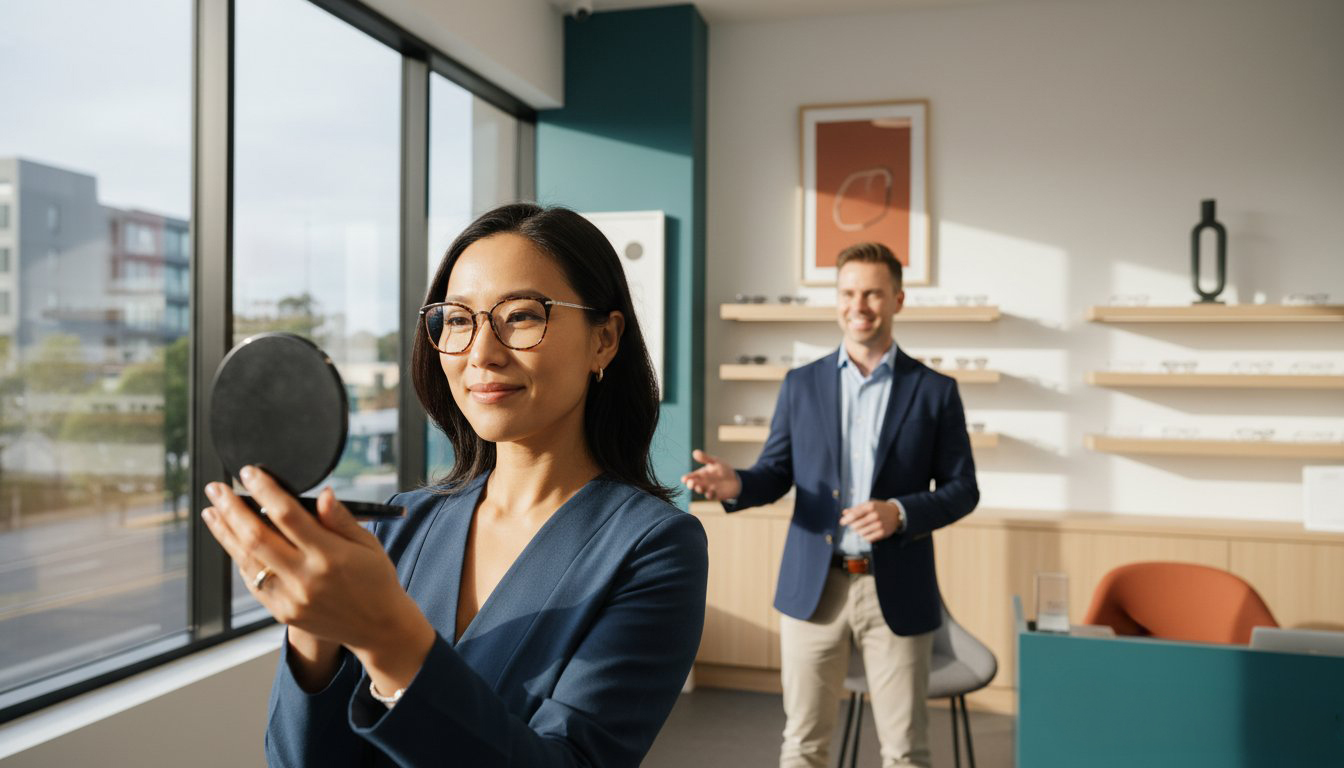
Balance is the goal of any bespoke fitting. We recommend angular, rectangular frames to add definition to rounder faces, while round or oval frames help soften the strong lines of square and heart-shaped faces. Scale is equally vital; a frame that’s too large for your proportions will feel heavy and look unbalanced. A professional fitting ensures the bridge rests securely on your nose, preventing the constant sliding that plagues off-the-shelf options.

The Fitting Gap: Why Online Ordering Often Fails

The rise of digital retail has introduced the “parallax error” to many unsuspecting buyers. This occurs when the distance between your eye and the lens isn’t measured in person, causing light to hit your retina at an unintended angle. A misalignment of just 2mm in the optical centre can cause significant headaches and blurred vision, particularly for those wearing multifocals or high-index lenses. Finding a skilled professional through our directory of independent optometrists ensures your lenses are adjusted to your specific posture and pupillary distance. Local experts take the time to refine the fit behind your ears and across your nose, a level of care that a computer screen simply can’t replicate.

Independent vs Corporate: Where Should You Buy Your Glasses?

Choosing where to purchase your glasses is a decision that impacts your daily comfort and long-term ocular health. Large corporate retailers often operate on a retail-first model, where success is measured by the number of frames moved through the door. This volume-based approach can sometimes lead to a “one-size-fits-most” mentality that overlooks the intricacies of your specific visual needs.

In contrast, independent optometrists typically lead with a clinical-first approach. They prioritise the precision of your prescription and the health of your eyes over meeting monthly sales quotas. This model allows for a deeper level of care, where the focus remains on finding the best optical solution for your lifestyle rather than pushing whatever stock is currently on promotion.

The Independent Optometry Advantage

Independent practices have the freedom to source from a diverse range of lens laboratories. They aren’t restricted to a single corporate supply chain, which means they can offer bespoke lens solutions tailored specifically to your unique hobby or occupation. Whether you spend ten hours a day behind a screen or require specialised optics for outdoor trade work, an independent expert has the flexibility to find the perfect match.

You’ll also find that independent experts spend significantly more time on the fitting and dispensing process. In many corporate settings, this crucial step is rushed, but a local professional takes the time to ensure your frames sit perfectly on your bridge and ears. Proper alignment prevents the headaches, dizziness, and slippage that often occur with poorly fitted eyewear. You can find an independent optometrist in your area who values your vision more than a quick transaction.

Redefining “Value” in Eyewear

It’s easy to be tempted by “2-for-1” deals, but these offers often involve lower-quality stock lenses with limited customisation. These budget options frequently lack advanced anti-reflective coatings or scratch resistance, leading to a shorter lifespan for your eyewear. High-quality, Australian-made lenses offer superior clarity and durability, often outlasting budget alternatives by several years. This makes them a more cost-effective choice in the long run.

Investing in quality means you won’t need frequent replacements due to lens degradation or frame failure. A local eye care expert focuses on health outcomes, ensuring your prescription is perfectly integrated into a frame that suits your face shape and skin tone. Choosing the right optometrist ensures you receive a product that supports your vision while contributing to the local Australian economy.

Supporting local industry ensures your glasses are crafted by skilled technicians who understand Australian standards. This commitment to local manufacturing results in faster turnaround times for repairs and a smaller environmental footprint. When you choose an independent practice, you’re building a relationship with a master of their craft who is deeply invested in your community’s well-being.

Experience the difference of personalised care by visiting an independent Australian optometrist today.

The Path to Perfect Vision: Your Glasses Checklist

Before you finalise your choice, take a moment to reflect on your typical 24-hour cycle. Your glasses should be a seamless extension of your identity and your daily tasks. If you spend four hours a day commuting on the Pacific Motorway, your needs differ significantly from a graphic designer working under intense LED office lights. A quick checklist helps ensure your selection is fit for purpose.

  • Review your primary focal distances: Are you mostly looking at a screen, a dashboard, or a workbench?
  • Check the safety ratings: Does the frame and lens combination meet Australian standards for impact resistance?
  • Confirm UV protection: Ensure your lenses provide 100% protection against UVA and UVB rays, which is vital for our local climate.
  • Verify the fit: The bridge should rest comfortably without pinching, and the temples should feel secure but not tight.

Lifestyle-Specific Eyewear Solutions

Occupational lenses are a game changer for Australian tradies and professionals. Unlike standard progressives, these are crafted to provide a wider field of view for specific tasks, such as overhead wiring or multi-screen data analysis. For those spending time outdoors, dedicated prescription sunglasses are essential. They offer superior glare reduction compared to “clip-on” alternatives. We also focus heavily on myopia management for younger wearers. Statistics show that nearly 36% of the population may be affected by myopia by 2050, so using specialised lenses early can help slow prescription changes significantly.

Caring for Your Investment

Quality eyewear is a precision tool that requires specific care to maintain its longevity. Always follow the “Microfibre and Spray” rule. Avoid using paper towels or old t-shirts, as these fibres can create microscopic scratches over time. You must also avoid household glass cleaners. Many contain ammonia or harsh chemicals that strip away bespoke anti-reflective coatings.

Never leave your glasses on a car dashboard. During an Australian summer, interior car temperatures can spike to over 70 degrees Celsius in less than 20 minutes. This extreme heat causes frames to warp and can lead to lens “crazing,” where the coatings expand and crack. Beyond maintenance, remember that vision is dynamic. It is vital to ensure your family has regular children’s eye tests as their eyes develop and change.

The journey to perfect vision starts with a conversation with a trusted professional. Choosing an independent practitioner ensures you receive personalised care and access to high-quality, locally-sourced products. You can find a skilled expert near you by using our directory of independent optometrists. Booking a comprehensive eye exam is the most important step in protecting your sight and supporting Australian craftsmanship.

Invest in Your Vision with Local Expertise

Choosing the right glasses shouldn’t feel like a compromise between clinical health and personal style. By prioritising high-precision bespoke lens technology and a frame that fits your unique facial structure, you’re investing in a piece of medical equipment you’ll wear every single day. It’s important to remember that your prescription is just the foundation. The expertise of your optometrist determines how well that prescription translates into real-world comfort and clarity for your specific lifestyle.

When you choose to support local Australian manufacturing, you’re not just getting a superior product; you’re strengthening our national community. These locally crafted lenses provide a level of precision that mass-produced alternatives often miss. It’s about finding a partner in your eye health who understands the value of heritage and quality craftsmanship. You’ll feel the difference that expert care from independent clinical professionals makes from the moment you put them on.

Ready to experience the difference of personalised care? Find an Independent Australian Optometrist Near You and discover the benefits of bespoke vision today.

Your eyes deserve the very best care our local artisan-experts can provide.

Frequently Asked Questions

How often should I update my glasses prescription?

You should generally update your glasses prescription every two years to ensure your vision remains sharp and your eyes stay healthy. Optometry Australia recommends this timeframe for most adults, though 35% of patients with existing conditions may require annual check-ups. Regular exams at an independent practice allow your optometrist to detect subtle changes in eye health early. This personalised care ensures your lenses always match your current lifestyle needs.

Can I put new lenses into my old frames?

You can certainly fit new lenses into your existing frames if they’re structurally sound and free from brittle plastic or deep corrosion. This sustainable choice allows you to keep a bespoke look you love while updating your vision. Our local technicians inspect every frame to ensure it can withstand the glazing process. Choosing this path supports a circular economy and celebrates the longevity of high-quality, locally crafted eyewear.

What is the difference between multifocal and bifocal glasses?

Multifocal lenses offer a smooth, gradual transition from distance to near vision without any visible lines on the lens surface. In contrast, bifocals feature a distinct line that separates two specific focal lengths. While 70% of modern wearers prefer the aesthetic and functional fluidity of multifocals, some people still value the wide, stable reading area found in traditional bifocals. Your independent optometrist will help you decide which style suits your daily routine.

Are expensive designer frames actually better quality?

Price doesn’t always dictate durability, as a 2023 industry report highlighted that many mass-produced designer frames use the same standard acetate as mid-range options. True quality often resides in bespoke, Australian-made frames that prioritise hand-finished details and robust components. Independent providers often source unique collections that offer superior longevity compared to corporate labels. Investing in local craftsmanship ensures your eyewear remains resilient through years of daily wear.

How long does it take for Australian-made lenses to be manufactured?

Australian-made lenses are usually manufactured and ready for collection within 3 to 10 business days. Because our laboratories are located right here in the community, we avoid the lengthy shipping delays often associated with international production. This local turnaround ensures you receive your precision-crafted eyewear quickly without sacrificing the meticulous care required for complex prescriptions. Supporting local industry means your vision is restored by experts who value both speed and accuracy.

Why do my new glasses make me feel slightly dizzy?

It’s common to feel a bit “off” or dizzy for the first 2 to 4 days while your brain adjusts to a new prescription. This adaptation period is normal, especially if you’ve switched to a different lens type or updated your frame shape. If the sensation persists beyond a week, return to your independent optometrist for a quick alignment check. They’ll ensure the fit is perfect and your eyes are transitioning smoothly to your new vision.

Is it safe to buy prescription glasses online without a fitting?

Buying online lacks the precise physical measurements that an in-person fitting provides, which can lead to optical errors in your glasses. A study found that roughly 40% of online spectacles failed at least one safety or optical power test. Independent optometrists provide essential face-to-face adjustments to ensure the focal point of the lens aligns perfectly with your pupils. This professional touch prevents eye strain and ensures your eyewear sits comfortably.

Does Medicare cover the cost of glasses in Australia?

Medicare provides rebates for comprehensive eye examinations, but it doesn’t typically cover the cost of frames or lenses for most Australians. However, some state-based schemes, like the Victorian Eyecare Service, offer subsidised eyewear to eligible concession card holders. Most people use their private health insurance extras cover to offset the price of their eyewear. Visiting an independent practice ensures you get the best value from your optical benefits through tailored, high-quality solutions.

Disclaimer

The information in this article is provided for general educational purposes only and should not be considered medical advice. For personalised advice regarding your vision or eye health, please consult a qualified optometrist.

Australian Made Vision is an independent directory that helps patients find optometrists across Australia who may offer Australian-made spectacle lenses. We do not provide clinical services and recommend contacting practices directly to confirm the products and services they offer.