

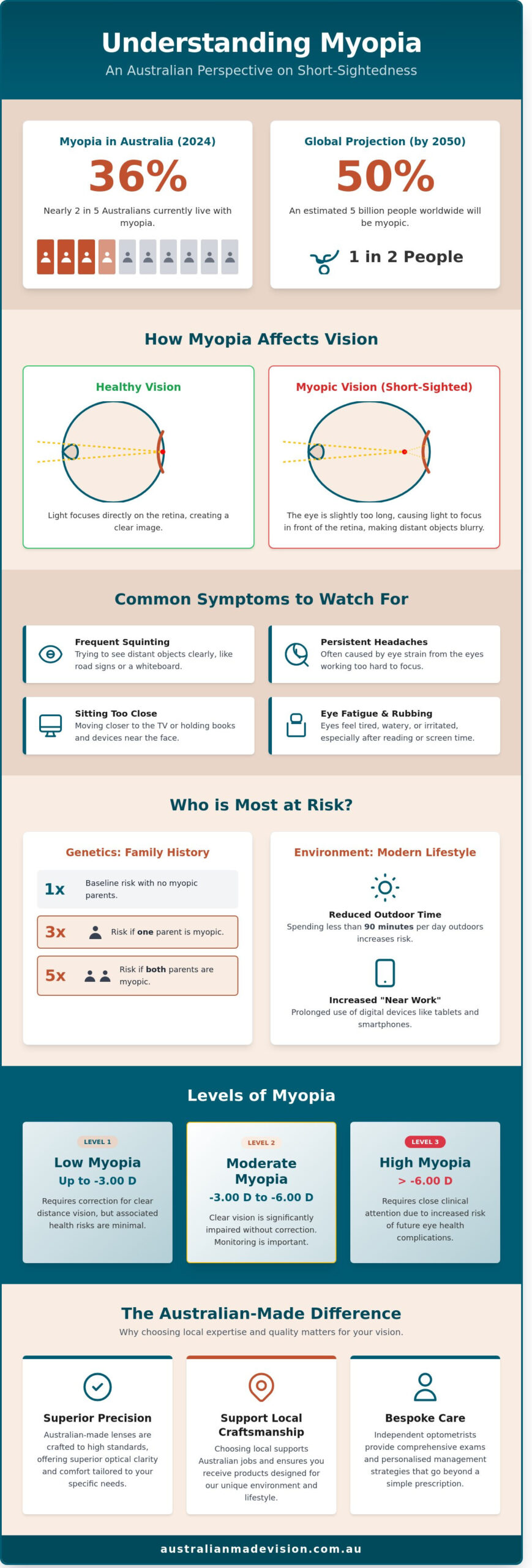
Did you know that by 2050, researchers at the Brien Holden Vision Institute predict that half of the world’s population will live with myopia? In Australia, 2024 data indicates that nearly 36% of our community already struggles with blurred distance vision. It’s natural to feel a sense of worry when you notice your child squinting at the classroom board or if you’re finding it harder to read street signs during your daily drive. You want the best for your family’s eye health, and the noise of conflicting advice can make choosing the right care feel like a challenge.
We understand that your vision is deeply personal. This guide explains the causes and symptoms of short-sightedness while introducing the latest Australian-made lens solutions designed specifically for our unique lifestyle. You’ll learn how bespoke management strategies can help stabilise your sight and provide lasting comfort. We also show you how to find a trusted independent optometrist who offers the personalised care and expert attention your eyes deserve. Your vision deserves precision, and we’re here to help you achieve it through local expertise.
Key Takeaways
- Understand the physical mechanics of short-sightedness and how the shape of the eye causes light to focus incorrectly.
- Discover how modern myopia management strategies focus on slowing down progression to protect your long-term ocular health.
- Learn why a comprehensive eye exam with an independent practitioner offers a level of bespoke care that goes beyond a standard sight test.
- Explore the advantages of choosing high-quality, Australian-made lenses that offer superior precision while supporting local craftsmanship.
- Gain insights into selecting the right clinical solutions tailored to your unique lifestyle and vision needs in 2026.
What is Myopia? Understanding the Basics of Short-Sightedness
Myopia happens when the eye grows slightly too long from front to back or the cornea becomes too steeply curved. This physical change means light focuses in front of the retina rather than directly on it, making distant objects appear blurry while close-up vision remains clear. It’s a common condition, yet we’re witnessing a global surge often described as a “myopia epidemic.” The Brien Holden Vision Institute predicts that 50% of the world’s population, roughly five billion people, will be myopic by 2050. This shift is particularly evident in Australia, where our digital lifestyles and reduced outdoor time impact how eyes develop during childhood.
Our modern environment plays a significant role in this trend. We spend more time on screens and less time in the natural Australian sunshine than previous generations did. Choosing locally crafted, high-quality lenses is a reliable way to manage this, but understanding the root cause is the first step toward better vision. Independent practitioners often provide the most thorough assessments, focusing on your specific lifestyle needs rather than just a quick prescription update.
Common Symptoms to Watch For
Recognising the signs of short-sightedness early can make a massive difference in long-term eye health. It’s not always about a total loss of vision; sometimes the signs are subtle. You should look out for:
- Squinting frequently to read road signs or see the television clearly.
- Persistent headaches caused by digital eye strain or muscle fatigue.
- Sitting unusually close to screens or holding books very near to the face.
- Rubbing eyes often or experiencing unexplained watery eyes after “near work.”
These symptoms suggest that the eye is working too hard to compensate for a refractive error. If you notice these signs in yourself or your children, seeking a professional consultation is the best course of action.
Who is Most at Risk?
Family history is a strong predictor of vision health. If one parent is myopic, a child’s risk triples. If both parents have the condition, that risk increases fivefold. Beyond genetics, our environment plays a massive role in how our sight evolves. Research indicates that children who spend less than 90 minutes outdoors each day are more likely to develop myopia. The rise in “near work,” like using tablets or smartphones for hours on end, also puts extra pressure on developing eyes.
Early intervention is essential for children. When we catch vision changes early, we can implement management strategies that protect eye health for decades to come. Connecting with an independent optometrist allows for a personalised approach. These local experts offer authentic care and bespoke solutions that corporate chains often overlook, ensuring your vision receives the precision and patience it deserves.
The Mechanics of Vision: Why Distant Objects Blur
To understand myopia, we need to look at how our eyes capture the world around us. In a perfectly balanced eye, light enters through the front and lands precisely on the retina. This light-sensitive layer at the back of the eye acts like a cinema screen, sending clear signals to the brain. When these elements align, you enjoy crisp, effortless vision at all distances.
Short-sightedness occurs when this delicate balance is disrupted. Instead of hitting the retina, light focuses at a point just in front of it. This usually happens because the eyeball has grown slightly too long from front to back. We call this measurement the axial length. Think of it like a camera lens that’s set for a specific distance; if the body of the camera is too long, the image on the film will always be out of focus.
Optometrists generally categorise the severity of the condition into three distinct levels:
- Low Myopia: A prescription up to -3.00 dioptres. While it requires correction, the health risks remain relatively low.
- Moderate Myopia: Prescriptions ranging from -3.00 to -6.00 dioptres.
- High Myopia: Anything beyond -6.00 dioptres or an axial length greater than 26 millimetres. This level requires much closer clinical attention.
The Role of the Cornea and Lens
The front of your eye consists of the cornea and the lens, which work together to bend incoming light. Refraction occurs when light bends as it passes through the cornea and lens to land on the retina. If your cornea is too steeply curved, it bends light too much, leading to refractive myopia. Most Australians, however, deal with axial myopia, where the eyeball’s length is the primary culprit. Our local independent practitioners take the time to measure these nuances, ensuring your lenses are tailored to your eye’s specific geometry.
Potential Complications of High Myopia
High myopia isn’t just about needing thicker lenses; it’s a structural health concern. As the eye grows longer, the internal tissues stretch and become thinner. This physical strain increases the risk of serious conditions like retinal detachment and glaucoma in later life. Studies show that people with high myopia are five to six times more likely to experience retinal issues compared to those with normal vision. Additionally, high myopia significantly increases the risk of developing macular degeneration, particularly in later years.
Simply getting stronger glasses won’t fix the underlying stretching of the eye tissue. It’s vital to move beyond basic retail prescriptions and seek comprehensive care. You can find a dedicated expert through our directory of independent optometrists who prioritise long-term eye health over quick sales. Regular monitoring allows these professionals to detect early warning signs of disease, protecting your sight for decades to come. Our community deserves the precision that only locally-focused, expert care can provide.
Modern Myopia Management: Beyond Basic Correction
In 2026, the focus has shifted from simply clearing a child’s vision to actively protecting their future eye health. Myopia management is no longer just about a pair of glasses; it’s a proactive clinical strategy. We aim to slow down the physical elongation of the eye, which reduces the lifetime risk of sight-threatening conditions like retinal detachment. Clinical interventions like low-dose atropine eye drops and Orthokeratology lenses have become standard practice in many Australian clinics. These tools allow us to manage how the eye develops during the critical growing years.
Choosing the right path requires a tailored approach. Independent optometrists often provide the most personalised care, taking the time to explain how different treatments suit your child’s lifestyle. You can connect with a trusted local expert through our directory of independent optometrists. They offer the bespoke attention and diverse product range that high-street corporate chains sometimes lack.
Specialised Spectacle Lenses
Modern lens technology has revolutionised how we treat myopia. Peripheral defocus lenses work by changing how light hits the outer edges of the retina. This sends a biological signal to the eye to stop growing longer. These aren’t off-the-shelf products. They require precision surfacing and bespoke designs tailored to an individual’s unique facial anatomy. Locally crafted lenses ensure that the optical centres align perfectly with the wearer’s pupils; this level of accuracy is vital for the treatment to be effective.
The “Outdoor Advantage”
Lifestyle remains a powerful tool in our management toolkit. Scientific data from the Brien Holden Vision Institute suggests that children should spend at least 120 minutes outdoors every day. Sunlight triggers the release of dopamine within the retina, a chemical that naturally inhibits excessive eye growth. It’s a simple, free, and effective way to support clinical treatments. We also recommend the 20-20-20 rule to manage digital strain. Every 20 minutes, children should look at an object 6 metres away for 20 seconds. This brief pause helps the eye muscles relax after intense close-up work. It’s also worth noting that prolonged screen use can contribute to dry eyes symptoms, which can compound visual discomfort alongside myopia.
Choosing the Right Care: The Independent Advantage
A standard vision screening often fails to capture the full picture of ocular health. Independent optometrists view a comprehensive eye exam as a vital clinical assessment rather than a simple retail transaction. They typically dedicate 30 to 45 minutes to each consultation, allowing for a thorough investigation of the eye’s internal structures. This unhurried approach ensures that subtle changes associated with myopia are identified early, providing a foundation for long-term vision preservation.
Personalised Care vs. Corporate Models
Independent practices thrive on continuity of care. You’ll likely see the same practitioner year after year, which allows them to build a detailed history of your vision. They don’t answer to head-office sales quotas, so their recommendations remain focused on your clinical needs. These master clinicians take the time to understand your lifestyle, whether you’re a student spending hours on a laptop or an outdoor enthusiast. This local expertise is why many families prefer the bespoke service of a community-based professional. You can find an independent optometrist who prioritises your long-term health through our dedicated directory.
What to Expect During a Myopia Consultation
Modern myopia management involves sophisticated diagnostic technology. During a consultation, an independent optometrist may use corneal topography to create a 3D map of the eye’s surface. They often measure axial length, the physical length of the eyeball, which research confirms is the most accurate way to track progression. Your practitioner will also discuss family history and visual habits to gauge environmental risks. This data informs a tailored treatment plan, which frequently includes high-quality Australian-made lenses. These locally crafted solutions offer a level of precision and customisation that mass-produced alternatives cannot match, ensuring the best possible outcome for your vision. Your practitioner may also assess whether you are experiencing dry eyes and associated discomfort, as this condition commonly co-exists with myopia and can affect the accuracy of your prescription measurement.
The Australian Made Difference: Quality Lenses for Clearer Vision
Choosing Australian-made lenses represents a commitment to precision that mass-produced imports struggle to match. When your lenses are crafted in a local laboratory, they undergo rigorous quality control checks by technicians who understand the specific needs of the Australian environment. This proximity ensures that your prescription is surfaced with exactness, providing the visual clarity required to manage myopia effectively.
The local optometry community thrives when we prioritise home-grown manufacturing. This relationship between your local practitioner and the lab creates a feedback loop of quality that benefits every patient. It’s a standard of care that views every lens as a bespoke piece of medical equipment rather than a generic commodity.
Why Local Manufacturing Matters
Local production significantly reduces “carbon miles” because your glasses don’t need to travel across continents before reaching your face. You’ll often receive your new prescription 40% faster than if the lenses were sourced from international mass-production facilities. This speed doesn’t come at the cost of quality; instead, it allows for a level of oversight that ensures every millimetre of the lens is perfect.
- Bespoke Surfacing: Local labs specialise in creating highly customised lenses for complex myopia prescriptions, ensuring thinner and lighter results for high-power corrections.
- Community Strength: Every pair of locally made lenses supports some of the 20,000+ jobs within the Australian optical and medical manufacturing sector.
- Ethical Standards: Australian facilities adhere to strict environmental and fair-work regulations, ensuring your eyewear is produced responsibly and sustainably.
Investing in Your Vision Heritage
It’s helpful to view your glasses as a precision medical device rather than just a fashion accessory. High-quality coatings, such as advanced anti-reflective layers and blue light filters, are essential for modern life and visual comfort. These treatments enhance the performance of your lenses, reducing the glare and digital strain that often accompany short-sightedness.
When you choose locally crafted products, you’re investing in optical excellence that prioritises your long-term health. Our local industry takes pride in the “gold standard” of lens surfacing, blending traditional craftsmanship with 2026 technology. To experience this level of care, visit an independent optometrist to request Australian-made lenses for your vision.
Securing Your Vision for the Decade Ahead
Managing myopia isn’t just about correcting blurry distance vision; it’s about protecting your long-term ocular health. Recent clinical data indicates that slowing progression by just 1 dioptre can reduce the lifetime risk of myopic maculopathy by 40%. This makes your choice of eye care provider more critical than ever in 2026. Independent optometrists offer the clinical expertise and dedicated time needed to develop these specialised management plans tailored specifically to your eyes.
When you choose a local independent professional, you gain access to precision-crafted bespoke lenses manufactured right here in Australia. Supporting Australian-made quality means you’re receiving world-class optics while contributing to our local industry. These practitioners focus on the human element of eye care, ensuring every pair of glasses meets the highest standards of accuracy. You don’t have to settle for mass-produced options when tailored, high-quality care is available in your community. Take the first step toward a clearer future by partnering with a professional who values your vision as much as you do.
Find an Independent Optometrist for Personalised Myopia Care
Frequently Asked Questions
Can myopia be cured or reversed?
No, myopia cannot be cured or reversed because it involves the physical elongation of the eyeball. Once the eye has grown too long, it cannot be shrunk back to its original shape. However, our independent optometrists focus on slowing its progression through advanced management strategies. Data from the Brien Holden Vision Institute suggests that early intervention with specialised lenses can reduce the rate of change by up to 60% in many children.
How often should someone with myopia have an eye test?
You should book a comprehensive eye test every 12 months if you are short-sighted, especially during childhood and adolescence. Adults with stable vision might only need a check every 2 years. Medicare typically provides rebates for these exams once every 3 years for those under 65, but more frequent visits are covered if your clinical needs change. Frequent monitoring allows your local practitioner to adjust your personalised treatment plan as soon as shifts occur.
At what age does myopia usually stop getting worse?
Vision typically stabilises between the ages of 18 and 21 for most individuals. Research indicates that 75% of young adults see their prescription level out by the time they reach age 18. However, a small percentage of people experience adult-onset changes where the eye continues to elongate into their mid-20s. Regular visits to an independent practice ensure these subtle shifts are managed with the care and precision your sight deserves.
Are Australian-made lenses better for myopia management?
Yes, choosing Australian-made lenses ensures you receive a product crafted with local precision and high-quality materials. These bespoke lenses are finished in local laboratories, allowing your optometrist to maintain direct oversight of the quality control process. Supporting local manufacturing also supports the 15,000 Australians employed in the medical technology sector. You’ll often receive your glasses within 5 business days, which is much faster than the 14-day wait typical for offshore production.
Can too much screen time cause myopia in children?
Excessive screen time is a significant risk factor for the development of myopia in Australian children. Research shows that children who spend more than 3 hours a day on near-work activities, like tablets or phones, face a higher risk of vision changes. To counter this, experts recommend at least 90 to 120 minutes of outdoor play daily. Natural sunlight triggers dopamine release in the retina, which helps regulate the eye’s growth and maintain its correct shape.
Is myopia the same thing as astigmatism?
No, these are two distinct refractive errors, although they often occur together in the same eye. Short-sightedness happens when the eye is too long, while astigmatism results from an irregular curvature of the cornea or lens. Roughly 47% of people requiring vision correction have a combination of both. Your local artisan-expert will craft a bespoke lens that addresses both the length of your eye and its unique surface shape for crystal clear results.
What is the difference between myopia and hyperopia?
The primary difference lies in which distances appear blurry; short-sighted people see close objects clearly while distant ones are fuzzy. In contrast, long-sighted individuals usually see distant objects better than close ones. This condition affects roughly 6.3 million Australians as of 2024. While one involves an eye that is too long, the other occurs when the eyeball is too short or the cornea is too flat to focus light correctly.
Does wearing glasses make your eyes weaker?
No, wearing glasses does not make your eyes weaker or cause your prescription to deteriorate faster. This is a common myth that has been debunked by decades of clinical evidence. A 2011 longitudinal study confirmed that wearing the correct prescription reduces eye strain and helps the brain process visual information more efficiently. Avoiding glasses when you need them often leads to chronic headaches and a lower quality of life rather than “strengthening” your sight.
Disclaimer
The information in this article is provided for general educational purposes only and should not be considered medical advice. For personalised advice regarding your vision or eye health, please consult a qualified optometrist.
Australian Made Vision is an independent directory that helps patients find optometrists across Australia who may offer Australian-made spectacle lenses. We do not provide clinical services and recommend contacting practices directly to confirm the products and services they offer.