
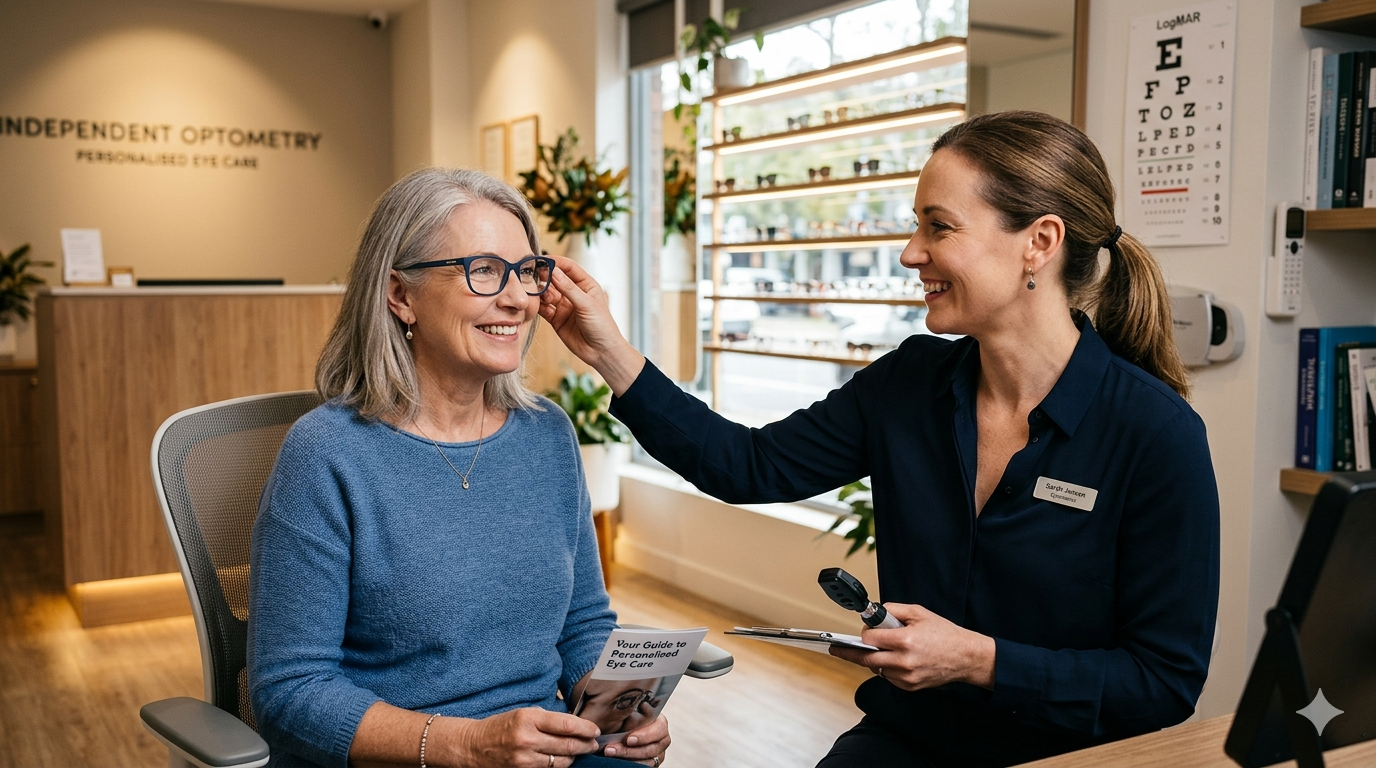
Independent optometry refers to locally owned eye care practices run by qualified optometrists who maintain full control over clinical decisions, product selection, and patient care. Unlike corporate optometry chains, these practices operate without external business targets or standardised protocols, allowing experienced optometrists to deliver genuinely personalised service tailored to each patient’s unique needs.
This guide covers everything you need to know about independent optometry practices in Australia—from the comprehensive services offered to the practical benefits of choosing local, patient-centred care. Whether you’re due for an eye test, concerned about your children’s vision, or seeking solutions for complex prescriptions, this information will help you make informed decisions about your eye health.
The key difference: Independent optometrists have the clinical freedom to recommend the best treatment options for your specific situation, rather than following corporate guidelines or being limited to particular product lines.
By reading this guide, you’ll understand:
- What distinguishes independent optometry from chain stores
- The comprehensive eye health services available to you
- How independent practices support children’s vision and development
- Advanced lens options for modern lifestyle needs
- How to find and choose a quality independent optometrist in your local community
Understanding Independent Optometry
An independent optometry practice is one where qualified optometrists own and operate the business directly, making all decisions about patient care, equipment, and products without corporate oversight. This structure exists specifically to prioritise clinical excellence and long-term patient relationships over sales targets or volume metrics.
What Makes a Practice Independent
Independent practices are locally owned by the optometrists who work there, creating strong ties to the local community they serve. This ownership structure means the practice can adapt to serve local needs—whether that’s offering flexible appointment times, stocking frames that suit diverse budgets and personalities, or investing in specialised equipment for particular eye conditions.
Clinical freedom stands at the heart of independent practice. Your optometrist can recommend the most appropriate treatment, lenses, or contact lenses based solely on what’s best for your eyes—not what a corporate office has dictated. This ability to operate without external constraints means independent optometrists can offer custom solutions, refer to specialists when needed, and spend adequate time understanding your specific visual requirements.
The business decisions remain with the optometrist, allowing the practice to build genuine expertise in areas that matter to local patients, whether that’s managing dry eye disease, fitting complex prescriptions, or supporting children’s vision development.
Core Philosophy of Independent Eye Care
The philosophy driving independent optometry centres on understanding each patient as an individual. Rather than a transactional approach where you’re processed through a standard system, independent practices emphasise continuity of care—you’ll often see the same optometrist at each visit, building a relationship where your complete eye health history informs every decision.
This tailored approach means treatment plans consider your lifestyle, work requirements, hobbies, and long-term goals. Whether you need prescription glasses for detailed computer work, lenses suited to outdoor activities, or support for a child struggling at school, independent optometrists have the time and flexibility to develop solutions that genuinely fit your life.
This patient-centred foundation enables independent practices to offer truly comprehensive services—something we’ll explore in detail next.
Comprehensive Services Offered by Independent Optometrists
The personalised philosophy of independent optometry translates directly into the breadth and depth of services available. Because independent practices aren’t constrained by standardised corporate protocols, they can offer thorough assessments and specialised care that goes well beyond a basic eye check.
Eye Examinations and Health Assessments
A comprehensive eye examination at an independent practice involves far more than reading letters on a chart. Your optometrist will assess your complete eye health, including:
- Glaucoma screening: Measuring intraocular pressure and examining the optic nerve to detect this sight-threatening condition early, often before you notice any symptoms
- Macular health assessment: Checking the retina for signs of age-related macular degeneration, which affects approximately 1 in 7 Australians over 50
- Diabetic eye screening: Using retinal imaging to detect diabetic retinopathy, essential for anyone managing diabetes
- Cataract evaluation: Monitoring lens clarity and advising on when treatment might be beneficial
Many serious eye conditions develop without obvious symptoms in their early stages. Regular comprehensive examinations give your optometrist the opportunity to monitor changes over time and intervene before vision loss occurs.
How often should you have an eye test?
- Children: First exam around age 3-4, then every 1-2 years during school ages
- Adults 18-39: Every 2 years, more frequently if you wear contact lenses or experience changes
- Ages 40-64: Every 1-2 years as risk factors increase
- Over 65: Annually, to monitor for age-related conditions
Your optometrist may recommend more frequent visits based on your individual risk factors, family history, or existing eye conditions.
Children’s Vision and Behavioural Optometry
Children’s vision requires specialised attention because vision problems can significantly impact learning and development. A child who struggles to see the board, experiences focusing difficulties, or has undiagnosed eye coordination problems may fall behind at school—often being labelled as inattentive or slow when the real issue is visual.
Independent optometrists with expertise in paediatric care can detect and manage conditions including:
- Amblyopia (lazy eye): Where one eye doesn’t develop normal vision, requiring early intervention for best outcomes
- Strabismus (eye turn): Misalignment of the eyes affecting both appearance and functional vision
- Focusing and convergence problems: Where eyes struggle to work together for near tasks like reading
- Myopia progression: Increasingly common in children, with options available to slow progression and protect long-term eyesight
Signs that a child may benefit from an eye examination include squinting, sitting too close to screens, frequent headaches, avoiding reading, or losing place while reading. However, many vision problems don’t produce obvious symptoms—making routine eye tests essential for all children.
Behavioural optometry takes a broader view, examining how vision, brain, and body work together. While some specific therapies remain debated in clinical literature, many children benefit from a thorough assessment of visual function beyond simple clarity, particularly when learning difficulties are present.
Modern Lifestyle Solutions
The way we use our eyes has changed dramatically. Australians now spend significant portions of each day looking at screens—computers, phones, tablets—creating new visual demands our eyes didn’t evolve to handle.
Digital eye strain affects approximately 40% of people who use screens extensively, causing symptoms like tired eyes, headaches, blurred vision, and difficulty focusing when looking up from a screen. Independent optometrists can assess your specific visual patterns and recommend solutions that address the root causes rather than just masking symptoms.
Regarding blue light protection: while heavily marketed, research from the University of Melbourne and systematic reviews found that standard blue-blocking lenses don’t significantly reduce digital eye strain symptoms. Independent optometrists can provide honest, evidence-based guidance about which lens options will actually benefit you, rather than simply upselling products.
Practical solutions for screen-related eye strain typically include optimised prescription for working distances, appropriate lens designs for your workflow, and guidance on healthy screen habits—a tailored approach based on how you actually use your eyes throughout the day.
Understanding these modern demands leads naturally to exploring the advanced lens technologies available through independent practices.
Advanced Lens Solutions and Technology
One of the key benefits of independent optometry is access to a wider range of lens options and the expertise to match you with the right solution. Without corporate restrictions on suppliers or product lines, independent practices can source the best available technology from across the industry.
Progressive and Multifocal Lens Options
Progressive lenses correct vision at all distances—near, intermediate, and far—in a single lens, eliminating the need to switch between reading glasses and distance glasses. However, not all progressive lenses are equal, and proper fitting is essential for comfort and function.
The fitting process at an independent practice typically involves:
- Initial consultation: Discussing your visual needs, work requirements, and lifestyle to determine the most appropriate lens design
- Measurement and fitting: Taking precise measurements including pupil distance, reading position, and frame fitting parameters
- Trial period: Allowing time to adapt while your optometrist monitors comfort and makes adjustments
- Final adjustments: Refining the fit based on your feedback to optimise the viewing zones
Premium progressive designs offer smoother transitions between zones and less peripheral distortion, though quality basic progressives remain a functional option for many patients. Your optometrist can recommend options that balance performance with budget, ensuring you receive genuine value rather than unnecessary upgrades.
Specialised Lens Comparisons
Choosing between lens options can be confusing. This comparison helps clarify when different technologies offer genuine benefits:
| Criterion | Photochromic Lenses | Anti-Reflective Coatings | Blue Light Filters |
| UV Protection | High – darkens in sunlight to block UV | Minimal direct UV protection | Minimal additional UV protection |
| Convenience | One pair handles indoor and outdoor; some delay in transitioning | Reduces glare and reflections for clearer vision | May slightly reduce screen glare |
| Cost | Mid to high depending on brand | Moderate; often included in packages | Usually small premium |
| Best For | People frequently moving between indoors and outdoors | Night driving, office work, reducing eye fatigue | Those who prefer warmer screen colours; limited proven benefit for eye strain |
The honest answer about blue light filters: current evidence doesn’t support significant benefit for reducing digital eye strain or protecting eye health from screen use. Independent optometrists can discuss whether there’s any reason for you personally to consider these coatings, rather than recommending them as standard.
For patients with more complex needs, independent practices often offer specialised contact lens options including Ortho-K (overnight corneal reshaping lenses for myopia control), scleral lenses for irregular corneas, and custom-designed lenses for unusual prescriptions. These solutions require expertise and equipment that not all practices stock, making independent practices with specialised focus valuable for patients whose needs extend beyond standard options.
Common Concerns and Solutions
Choosing where to receive eye care involves practical considerations beyond clinical quality. Here are straightforward answers to common questions about independent optometry.
Cost and Insurance Coverage
Independent practices may offer designer frames and premium lenses at various price points, and pricing structures vary. However, many patients find value in the personalised service and accurate prescriptions that prevent costly remakes or adjustments later.
Medicare covers the consultation component of comprehensive eye examinations for eligible patients—typically every three years for adults without risk factors, or annually for those over 65 or with specific conditions. Many independent practices bulk-bill the consultation portion.
To maximise your private health insurance benefits:
- Check your optical extras cover before your appointment
- Ask the practice about HICAPS for on-the-spot claiming
- Time major purchases to align with your benefit period reset
- Enquire about package pricing that may offer better value
Finding Quality Independent Practitioners
Look for optometrists who are registered with AHPRA and have experience relevant to your needs—whether that’s paediatric care, contact lens fitting, or managing specific eye conditions like dry eye disease.
Questions worth asking during your initial visit:
- What tests will be included in the examination?
- Do you have experience with [your specific concern]?
- What lens and frame options are available at different price points?
- What warranty or remake policy applies to new glasses?
- Will I see the same optometrist at future visits?
A quality independent practice will welcome these questions and provide clear, straightforward answers. The friendly team should make you feel comfortable asking about anything relevant to your care.
Appointment Availability and Convenience
Independent practices often offer more flexible scheduling than chain stores, with the ability to accommodate urgent concerns or adjust appointment lengths for complex needs. Many can assist with same day glasses for urgent requirements or simple prescription updates.
For emergency care—sudden vision changes, eye injuries, or acute symptoms—independent optometrists can often see you promptly and either manage the situation directly or facilitate urgent specialist referral. Building a relationship with a local practice means having someone who knows your history when problems arise.
Additional Benefits of Choosing Independent Optometry
Beyond clinical excellence and personalised care, independent optometry practices contribute positively to the local community and the broader world of eye health.
Supporting Your Local Community
When you choose a locally owned independent optometry practice, your spending stays within the community, supporting local jobs and businesses. This reinvestment helps maintain vibrant local economies and encourages practices to remain responsive and accountable to their patients.
Independent practices often participate in community health initiatives, school vision screenings, and educational programs focused on promoting eye health awareness. This engagement reflects their commitment not just to individual patients but to the wellbeing of the entire community.
Access to International Expertise and Products
Independent optometrists frequently have the flexibility to source products from international suppliers, ensuring access to the latest innovations in lenses, frames, and contact lenses. This global reach allows them to offer a broader selection of designer frames and cutting-edge lens technologies that may not be available through corporate chains limited to specific suppliers.
Moreover, independent practitioners often engage with international professional networks and continuing education, keeping them at the forefront of advances in eye care management and treatment options.
Long-Term Management and Continuity of Care
Independent optometrists provide ongoing management of chronic eye conditions, ensuring continuity of care that is essential for effective treatment. By seeing the same optometrist regularly, patients benefit from a deep understanding of their eye health history, which supports early detection of changes and timely adjustments to treatment plans.
This continuity is particularly important for managing complex prescriptions, progressive conditions like myopia, and eye diseases requiring careful monitoring and intervention.
Conclusion and Next Steps
Independent optometry offers Australians access to comprehensive eye care delivered by experienced optometrists who prioritise your individual needs. The combination of clinical freedom, personalised service, and community focus creates an environment where your eye health receives genuine attention rather than standardised processing.
The key benefits worth remembering: thorough examinations that detect eye conditions early, continuity of care with the same optometrist who understands your history, access to the full range of lens options suited to your prescription and lifestyle, and the expertise to manage complex needs from children’s vision to specialty contact lenses.
Your next steps:
- Find an independent optometrist in your local community—look for locally owned practices rather than chain store locations
- Book a comprehensive eye examination, especially if it’s been more than two years since your last thorough assessment
- Prepare a list of questions about your specific concerns—whether that’s digital eye strain, your child’s school performance, or finding glasses that truly suit your lifestyle
- Bring your current glasses and any relevant health information to your appointment
Whether you’re due for routine care, concerned about symptoms, or simply want to establish an ongoing relationship with an optometrist who’ll support your eye health for years to come, an independent practice offers the personalised attention your eyes deserve. Your vision matters too much for a rushed, one-size-fits-all approach. Visit a local independent optometrist and experience the difference that genuine, tailored eye care makes.