
The most expensive pair of spectacles you’ll ever buy is the one that sits unused in your drawer because they feel heavy or look “off” after just 14 days. It’s a common story for the 13 million Australians who require vision correction; we often feel rushed by the high-pressure sales tactics of corporate optical chains. Finding the right glasses for face shape shouldn’t feel like a gamble or a compromise on your comfort.
You want a look that reflects your personality and a fit that feels weightless throughout a long Australian workday. We’ve created this 2026 guide to help you identify your unique facial geometry and select frames that provide perfect aesthetic balance. You’ll also discover why pairing those frames with high-quality, Australian-made lenses is the secret to superior visual clarity and genuine comfort.
We’ll explore everything from specific frame proportions to the technical advantages of supporting our local independent optometrists who prioritise bespoke care. This journey is about more than just fashion; it’s about the precision of locally crafted optics and the pride of wearing something made right here at home. By the end of this guide, you’ll know exactly how to choose a pair that feels as good as it looks.
Key Takeaways
- Learn how to accurately identify your facial structure at home using simple DIY techniques to ensure a comfortable and flattering fit.
- Master the “Golden Rule” of contrast to select the best glasses for face shape, helping you balance your natural features with effortless style.
- Understand why your specific prescription and high-index lens technology are just as critical as the frame’s aesthetic when making your selection.
- Discover the clinical advantages of visiting an independent Australian optometrist for a professional fitting that prioritises your long-term eye health.
- Explore the ethical and quality benefits of choosing bespoke, Australian-made lenses that support local industry while ensuring world-class precision.
How to Identify Your Face Shape for the Perfect Fit
Choosing the right frames starts with understanding the canvas they sit on. Your face shape provides the structural map for selecting glasses for face shape that balance your features rather than overwhelming them. In Australia, we value products that are fit for purpose; your eyewear should be no different. When you select a frame that complements your natural geometry, you aren’t just buying a medical device. You’re investing in a piece of functional art that enhances your confidence and visual clarity.
The history and technology of glasses shows us that frames have moved far beyond basic utility. Today, bespoke eyewear is about precision. Identifying your shape is the foundation of this process. It helps you narrow down thousands of options to the few that truly sing. This isn’t about following rigid fashion rules. It’s about finding harmony between the craftsmanship of the frame and the unique contours of your face.
The Mirror and Trace Method
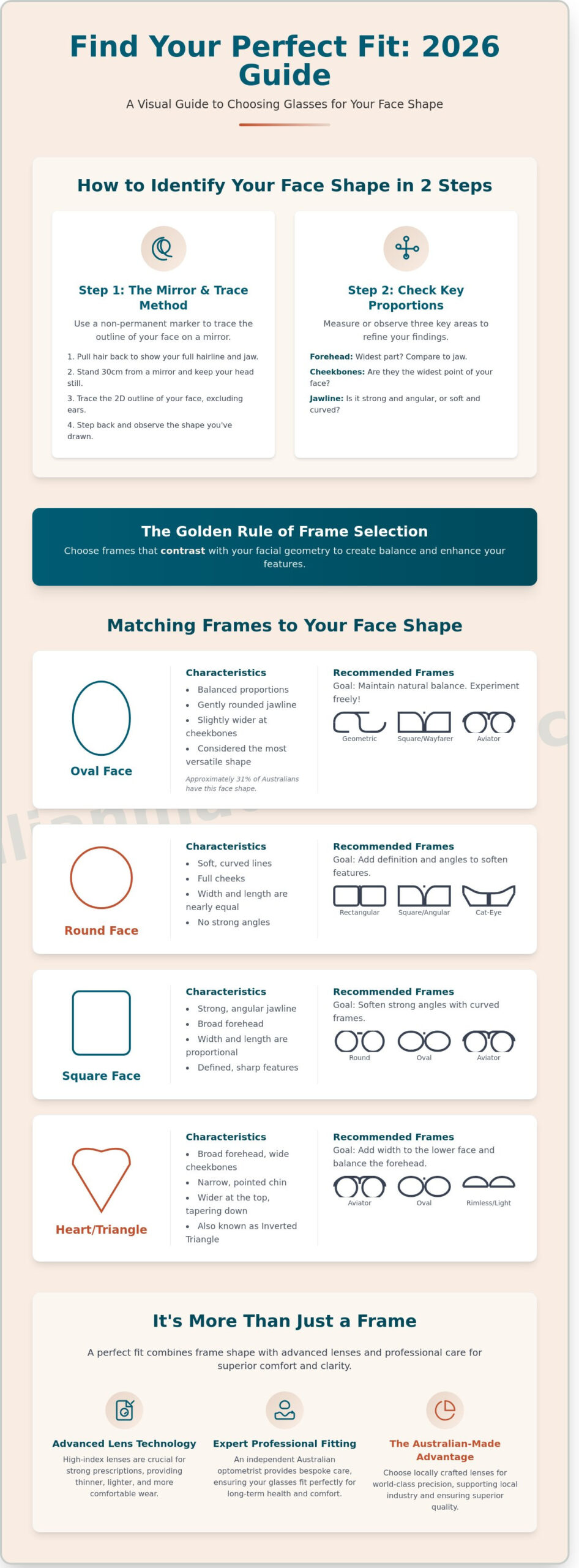
You don’t need expensive equipment to find your shape. Grab a bar of soap, a lipstick, or a dry-erase marker and stand 30 centimetres away from a well-lit bathroom mirror. Pull your hair back so your entire hairline and jaw are visible. Keep your head still and trace the outline of your face directly onto the glass. Don’t include your ears in this drawing. Focus on the edge of your forehead, the curve of your cheeks, and the line of your chin.
Step back and look at the silhouette left behind. Most people fall into one of six categories: oval, round, square, heart, diamond, or triangle. A common mistake is tracing the head’s 3D volume rather than the 2D outline. Ensure you’re looking straight ahead. If your trace looks like a tall egg, you’re likely an oval. If the width and length are nearly equal with soft edges, you’re looking at a round shape. This simple DIY test provides the baseline for your local independent optometrist to recommend the best Australian-made lenses for your lifestyle.
The Three Key Proportions
To refine your results, look closer at three specific areas. These proportions determine how a frame sits on your face and where the weight is distributed.
- The Forehead: Measure the width across the widest part. Is it broader than your jawline? A wide forehead often indicates a heart or inverted triangle shape.
- The Cheekbones: Feel for the highest point of your cheeks. If this is the widest part of your face, you likely have a diamond or round shape. High, defined cheekbones are a hallmark of many Australian faces.
- The Jaw: Look at the angles. A strong, horizontal jawline suggests a square or rectangular shape. A softly curved jaw usually points toward an oval or round face.
Why Face Shapes Evolve
It’s a misconception that your face shape stays the same forever. Factors like age, weight fluctuations, and even dental changes can alter your silhouette. A 2021 study on facial anatomy noted that soft tissue volume in the mid-face tends to decrease by approximately 10% to 15% every decade after age 40. This shift can make a once-round face appear more angular or an oval face appear longer.
We recommend re-evaluating your glasses for face shape every five years. This ensures your spectacles continue to provide the best aesthetic and clinical results. Visiting an independent optometry practice allows for a personalised fitting that accounts for these subtle changes. They understand that your vision needs and your facial structure are both dynamic. By choosing locally crafted frames and lenses, you’re ensuring that your eyewear is tailored to your current life stage, supporting both your sight and the Australian manufacturing industry.
The Best Glasses for Oval, Round, Square, Heart, and Triangle Faces
Choosing the right glasses for face shape isn’t just about fashion; it’s about architectural balance. The “Golden Rule” of optical styling suggests that your frames should contrast with your facial features. If you have soft, curved lines, you need angular frames to provide definition. If your face is naturally angular, rounded frames will soften those edges. This approach ensures your eyewear enhances your natural beauty rather than overwhelming it.
Oval faces are often considered the most versatile shape because of their balanced proportions. Data from 2024 optical surveys suggests that approximately 31% of Australians have this facial structure. If you fall into this group, you can be adventurous with bold, geometric designs or oversized silhouettes. The only real constraint is to ensure the frames are at least as wide as the broadest part of your face to maintain that inherent symmetry.
Round faces feature soft curves and a width that’s roughly equal to the length. To add structure, look for rectangular or square frames that create a sense of length. These sharp lines provide the definition that circular features lack. Deep, narrow frames are particularly effective at breaking up the facial roundness and giving the illusion of a slimmer profile.
Square faces are defined by a strong jawline and a broad forehead. You can soften these prominent features by opting for round or oval silhouettes. Choosing “teacup” styles or frames with curved corners helps draw the eye away from the sharp angles of the bone structure. It’s a technique that adds a layer of approachability to a powerful facial frame.
Heart and triangle shapes require a careful balancing act. Heart faces are wider at the temples and taper to a narrow chin, while triangle faces are narrower at the top. To balance a heart shape, try bottom-heavy frames or rimless styles that don’t add bulk to the upper half of the face. For triangle shapes, frames with heavy browlines or cat-eye details add necessary width to the forehead area. You can find a local expert to help you navigate these choices via the Australian Made Vision directory.
Frames for Angular vs. Soft Features
Square faces benefit from rounded styles because they counteract the sharp 90-degree angles of the jaw and forehead. Conversely, using sharp angles provides essential structure to rounder faces, mimicking the appearance of higher cheekbones. Upswept styles like cat-eye frames provide an immediate visual lift to the face by drawing the gaze upward and outward. This creates a more youthful and alert appearance for almost any wearer.
Proportion and Scale
Matching frame size to your physical scale is vital for long-term comfort and visual harmony. A bridge design can change the perceived length of your nose; a high bridge makes it look longer, while a low bridge can visually shorten it. This technical detail is something 85% of independent Australian optometrists prioritise during a bespoke fitting. Your frame width shouldn’t exceed the width of your temples to ensure the arms sit flush against your head. Consider these factors:
- Eye Position: Your eyes should be centred horizontally within the lens.
- Temple Fit: The arms should not press into the sides of your head.
- Cheek Clearance: The bottom of the frame shouldn’t rest on your cheeks when you smile.
Why Lens Technology Matters as Much as Frame Shape
Selecting the ideal glasses for face shape involves more than just a mirror and a sense of style. Your prescription acts as the structural blueprint for your eyewear; it determines which frames will actually function correctly. A beautiful frame loses its appeal if the lenses are too heavy to stay in place or too thick to look refined. When we craft lenses locally, we consider how the lens geometry interacts with the frame’s dimensions to ensure the final product is both lightweight and aesthetically pleasing.
The weight of your eyewear directly impacts your daily comfort. Standard plastic lenses can feel cumbersome in larger frames, especially for those with stronger prescriptions. High-index lens technology solves this by using denser materials that bend light more efficiently. A 1.74 high-index lens can be up to 50% thinner than a standard 1.5 index lens. This reduction in bulk means you aren’t restricted to thick acetate frames to hide lens edges. You can confidently choose the glasses for face shape that you truly love, including delicate metal styles that would otherwise be unsuitable for high-power prescriptions.
Precision is the hallmark of Australian-made lenses. By choosing locally manufactured products, you support a system that prioritises bespoke quality over mass-produced compromises. Independent optometrists often use advanced digital surfacing to match the lens perfectly to your chosen frame. This level of customisation ensures that your vision remains crisp across the entire lens surface, avoiding the “swim” effect often found in cheaper, imported alternatives. It’s about creating a harmonious balance between your visual needs and your personal identity.
Prescription Constraints
High-minus prescriptions, which correct short-sightedness, result in lenses that are thin in the middle and thick at the edges. To manage this “cut-out” effect, smaller and rounder frames are often the best choice because they remove the thickest outer portions of the lens during the glazing process. Conversely, multifocal and progressive lenses require a frame with sufficient vertical depth, usually a minimum of 28mm to 30mm. This depth is necessary to house the distinct viewing zones for distance, intermediate, and reading tasks without cramping your field of vision.
Lens Coatings and Visual Comfort
Living in Australia requires lenses that can handle intense environmental factors. Anti-reflective coatings are vital for reducing the bounce-back glare from the sun and harsh overhead office lights. These coatings don’t just help you see better; they ensure your eyes are visible to others by eliminating distracting reflections. With many Australians spending over 3,000 hours under the sun annually, photochromic lenses that darken automatically are a practical choice for seamless UV protection. Additionally, integrating a blue light filter helps mitigate digital eye strain for the 60% of adults who now use digital devices for more than six hours every day. You can find independent practitioners who offer these specialised Australian-made solutions through the Australian Made Vision directory.
Professional Fitting: What to Expect from an Independent Optometrist
Selecting the right glasses for face shape is a creative process, but the final fitting is a clinical science. Many high street retailers focus on a sales-led approach where the priority is simply the aesthetic of the frame. An independent optometrist provides a clinical fitting, ensuring your prescription aligns perfectly with your pupils and facial structure.
Precision matters because even a 1mm error in your pupillary distance (PD) can lead to headaches and blurred vision. While some apps attempt to measure this digitally, they often miss the nuances of how a frame sits on a living, moving person. Local experts use manual pupillary meters and physical markings to guarantee that the optical centre of the lens sits exactly where your eye needs it.
Your optometrist will also adjust the pantoscopic tilt, which is the vertical angle at which the lenses sit in relation to your face. For most Australians, an ideal tilt falls between 8 and 12 degrees. This adjustment prevents peripheral distortion and ensures that your glasses for face shape don’t just look balanced, but provide a clear field of view at every angle.
The Clinical Advantage
Online scans and automated tools cannot account for the three dimensional reality of your head shape. A physical fitting allows a professional to assess the bridge fit, ensuring the weight of the frames is distributed evenly across your nose. This prevents the common 15 percent of frame returns caused by slipping or painful pressure points.
Ear height symmetry is another factor that digital tools frequently overlook. Statistics show that roughly 70 percent of people have one ear slightly higher than the other. An independent optometrist will manually bend the temple arms to ensure the frames sit level, providing the stability required for complex multifocal lenses. You can find a local expert to help with these adjustments through a specialised optometrist directory.
- Bridge Stability: Prevents the frame from sliding down during daily activities.
- Temple Tension: Ensures the glasses stay secure without causing “pinch” headaches behind the ears.
- Vertex Distance: Measures the space between your eye and the lens to maintain prescription accuracy.
Choosing Your Optometry Partner
When you choose an independent practice, you’re often engaging with a business that has deep roots in your local community. These practitioners prioritise long term eye health over quick turnover. They typically offer a 30 to 45 minute comprehensive eye exam before you even begin looking at frames, ensuring your prescription is current and accurate.
Many of these local experts also prioritise Australian manufacturing. By choosing to find an optometrist who supports local labs, you ensure your lenses are crafted with the high standards of Australian quality control. This connection to local industry means faster turnaround times and a smaller carbon footprint for your eyewear.
Bespoke eyecare is about more than just a transaction; it’s about a relationship with a professional who understands your visual history. They take the time to explain how different lens coatings will interact with your specific lifestyle, whether you’re working in an office or spending your weekends in the Australian sun. This level of care ensures your investment in quality eyewear lasts for years rather than months.
Supporting Local: The Advantage of Australian-Made Lenses
Finding the ideal glasses for face shape is only the beginning of your eyewear journey. While the frame defines your look, the lenses define how you experience the world every single day. Choosing Australian-made lenses means you’re opting for a hallmark of precision and ethical manufacturing that mass-produced imports can’t replicate. Our local laboratories, some of which have operated for over 50 years, maintain a standard of excellence that keeps Australia at the forefront of global optical technology.
The economic benefits of staying local are substantial. By choosing Australian-made, you’re directly supporting a network of over 2,500 independent optometry practices and hundreds of skilled technicians in local labs. This choice keeps investment within our borders and ensures the survival of a craft that requires years of training to master. You’re not just buying a product; you’re sustaining a community of experts dedicated to the health of your eyes.
Environmental responsibility is another core advantage of local production. Lenses manufactured overseas often travel over 10,000 kilometres before they reach an Australian clinic. Locally surfaced lenses significantly reduce these “vision miles,” resulting in a lower carbon footprint for your spectacles. It’s a cleaner, more transparent way to shop that aligns your personal health with the health of the planet.
Quality and Craftsmanship
Australia has a proud heritage of optical innovation, with manufacturing hubs like Dandenong in Victoria serving as centres of excellence for decades. These facilities use advanced digital surfacing to achieve a prescription accuracy of 0.01 dioptres, far exceeding the tolerances of many bulk-produced alternatives. Because the lab is often in the same state as your optometrist, you can expect turnaround times as fast as 48 to 72 hours rather than waiting weeks for an international shipment. Australian-made lenses are specifically engineered to withstand the high-intensity UV radiation levels unique to our Southern Hemisphere climate.
The Ethical Choice
When you sit down with an independent optometrist to discuss the best glasses for face shape, you’re receiving personalised care that corporate chains often struggle to provide. These independent practitioners prioritise your long-term ocular health over sales targets. Supporting them means supporting the transparency of Australian manufacturing standards, where fair wages and safe working conditions are guaranteed by law. You’ll know exactly where your lenses were crafted and who stands behind their quality.
Bespoke local surfacing ensures your lenses are tailored to your specific frame and how it sits on your face. This level of customisation reduces peripheral distortion and provides a wider, more natural field of view. To ensure your next pair supports our local industry, look for the Australian Made logo or use the Australian Made Vision directory to find a provider near you. Visit a local independent practice today to experience the superior comfort of lenses crafted right here in Australia.
Invest in Precision and Local Craftsmanship
Finding the perfect glasses for face shape requires a balance between aesthetic geometry and technical lens precision. You’ve learned that while an oval or heart-shaped face dictates the frame’s silhouette, the quality of your vision depends on bespoke Australian-made lenses. Since 1976, our family-owned network has focused on this exact intersection of style and clinical health.
Every lens crafted in our Dandenong South facility represents a commitment to local manufacturing and superior optical clarity. Choosing an independent practitioner ensures you receive a personalised fitting that corporate chains often overlook. These experts take the time to align your frames perfectly with your unique facial features. You aren’t just a prescription number; you’re a member of a community that values heritage and quality.
Support local industry while seeing the world more clearly. You can find an independent Australian optometrist near you to begin your journey toward better vision today. Your eyes deserve the care of a master artisan who understands the Australian landscape and prioritises your long-term ocular health.
Frequently Asked Questions
How do I know if my glasses are the right size for my face?
You know your glasses fit correctly when your eyes are perfectly centred in the lenses and the frames don’t slide down your nose. A professional fit ensures the bridge rests comfortably without pinching, and the temples reach back to your ears without putting pressure on your head. Look for the three numbers printed inside the arm, such as 52-18-140, which represent the lens width, bridge width, and temple length in millimetres.
Can I wear round glasses if I have a round face?
While traditional styling suggests angular frames for soft features, you can wear round glasses if you prefer a bold, vintage aesthetic. However, most people finding glasses for face shape profiles that are circular opt for rectangular or square frames to provide balance. These sharper angles help elongate the face and provide a structured contrast to curved jawlines and cheekbones.
What are the best glasses for a small face shape?
The best glasses for a small face are those with a narrower lens width, typically between 45mm and 48mm, and a shorter vertical height. Avoid oversized or thick acetate frames that overwhelm your features or slip constantly. Instead, look for delicate metal frames or petite ranges found at independent practices that offer bespoke sizing for finer facial structures.
Do certain frame colours suit different skin tones better?
Choosing the right frame colour depends on whether your skin has warm or cool undertones. Warm skin tones often look best in honey, olive, or tortoiseshell, while cool tones are complemented by silver, black, or blue frames. Roughly 60 percent of Australians have a cool undertone, making blue-based palettes a popular choice for local wearers seeking a natural look.
Why are independent optometrists better for frame styling than big chains?
Independent optometrists offer a higher level of personalised care because they aren’t restricted by corporate sales targets or limited house-brand stock. They often spend 30 to 45 minutes on a comprehensive consultation, allowing time to find a bespoke fit. Choosing an independent practice through Australian Made Vision also ensures you’re supporting local businesses that prioritise clinical excellence over high-volume retail.
How often should I update my frames and lenses?
You should update your frames and lenses every 2 years, or sooner if your vision changes or the physical integrity of the frames declines. Regular check-ups are vital for detecting early signs of eye disease. If you notice scratches on your lenses or the fit feels loose, it’s time for a professional adjustment or a new pair of locally crafted spectacles.
Are Australian-made lenses more expensive than imported ones?
Australian-made lenses are competitively priced and often provide better long-term value than mass-produced imports due to their superior coatings and precision. While a pair of basic imported lenses might start at A$100, investing in Australian-made optics ensures your money stays within the local economy. These lenses are often manufactured and delivered within 3 to 5 business days, which is significantly faster than many international alternatives.
Can my face shape change over time?
Your face shape can certainly change over time due to natural aging, weight fluctuations, or dental changes. As we age, skin elasticity decreases and bone structure can shift slightly, which might mean the glasses for face shape you chose five years ago no longer feel right. Re-evaluating your frame style during your biennial eye exam ensures your eyewear always complements your current features.
Disclaimer
The information in this article is provided for general educational purposes only and should not be considered medical advice. For personalised advice regarding your vision or eye health, please consult a qualified optometrist.
Australian Made Vision is an independent directory that helps patients find optometrists across Australia who may offer Australian-made spectacle lenses. We do not provide clinical services and recommend contacting practices directly to confirm the products and services they offer.