
Myopia management for children goes beyond making distance vision clear. It may combine appropriate vision correction with optical, pharmacological or behavioural approaches intended to slow myopia progression, together with ongoing monitoring. The plan is individual: an optometrist or ophthalmologist considers the child’s prescription history, examination findings, eye health, daily routine and the practical requirements of each option. No approach should be presented as guaranteed to stop progression or reverse myopia that is already present.
For a broader explanation of myopia (short-sightedness), including symptoms and causes, see AMV’s main myopia guide.
What is myopia management for children?
Myopia, or short-sightedness, is commonly managed first by correcting blurry distance vision. Myopia management has an additional goal: to reduce the rate at which myopia progresses in a child when active management is considered appropriate.
Australian specialist and optometry sources describe a range of optical, pharmacological and behavioural approaches that may form part of a management plan.
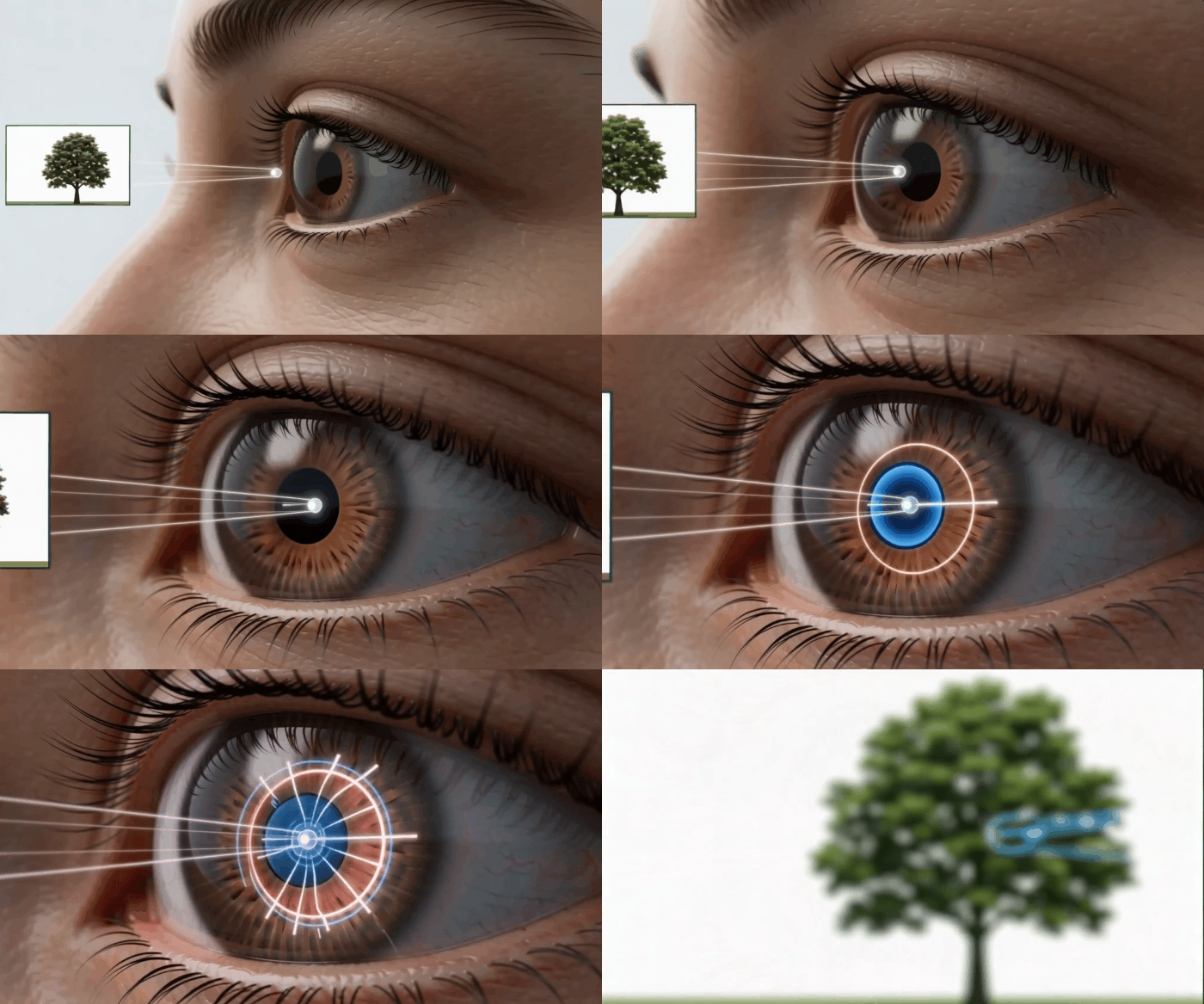
A paediatric patient’s parent or guardian does not select a management option from a list. Suitability depends on clinical assessment and on practical factors such as whether the child can safely handle contact lenses, whether prescription medicine is appropriate, and what follow-up the chosen approach requires. Different practices may also provide different products, equipment, and management pathways.
AUSTRALIAN MADE VISION CHILD MYOPIA
Have questions about your child’s myopia?
Get eye health updates on childhood myopia, management options and ongoing monitoring to help you prepare questions for your child’s optometrist.
Correction versus slowing progression
Standard prescription glasses or contact lenses can correct the blur caused by myopia. Myopia-management strategies are chosen with the additional aim of slowing progression. These goals are related, but not the same. A child seeing clearly in their current prescription does not by itself show that the myopia has stopped changing.
How is childhood myopia assessed and monitored?
An eye-care professional may assess vision, refraction and general eye health, and review how the child’s prescription has changed over time. Previous prescriptions can be useful because progression is judged across time rather than from a single visit.
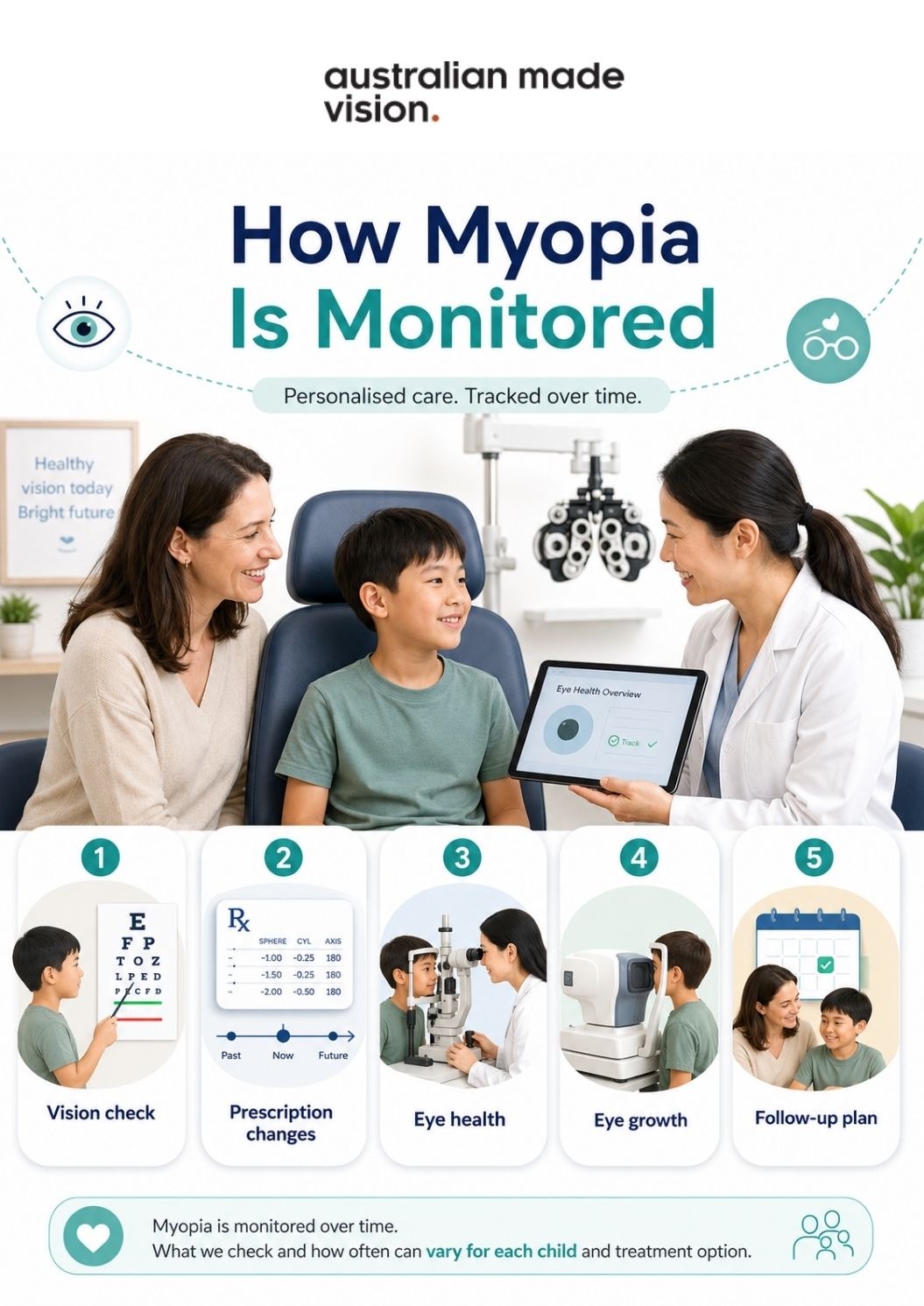
For progressive childhood myopia, some clinicians may also use ocular biometry, including axial-length measurement, where it is clinically appropriate and the equipment is available. These measurements can add information about eye growth, but no single measurement should be treated as proof that a treatment is succeeding or failing. Monitoring methods depend on the child and the management option.
There is no one review timetable that should be copied from a general website for every child. Follow-up needs can vary with the child’s age, prescription, rate of change, treatment type, tolerance and examination findings. The treating clinician should explain what will be monitored and when.
What may influence the management discussion?
- the child’s age and age when myopia began
- current prescription and previous prescription changes
- eye-health findings and, where used, ocular measurements
- daily routine and the practical demands of the proposed option
- ability to manage contact-lens handling and hygiene safely
- possible side effects or tolerance issues
- family preferences, follow-up requirements and costs.
Is Your Eye
Health on Track?
Complete our free 18-point checklist to check your eye health, spot any gaps, and take charge of your vision.
Start Free Checklist Test →What myopia management options may be discussed?
Several categories may be discussed for childhood myopia management. They should not be ranked as a universal “best” option because products, evidence, suitability, safety requirements, and day-to-day demands differ. The aim is to match the approach to the child and review it over time.
Specialised Spectacle Lenses
Some spectacle lens designs are intended to correct myopia while also being used as part of a myopia-management plan. They may be considered for children who are suited to spectacle-based management. The exact design, prescription range, fitting requirements, and availability depend on the product and the individual practice.
Parents can ask how the lenses are expected to be worn, what follow-up is needed, and how vision changes or progression will be assessed. Product-specific performance claims should be discussed in the context of the evidence for that exact lens design rather than assumed to apply to every specialised spectacle lens.
Specialised Soft Contact Lenses
Some soft contact lens designs may be used to correct vision and manage myopia progression in suitable children. Contact lens options require professional fitting, ongoing eye-health review, and a child and family who can follow the handling, cleaning and replacement instructions for the prescribed lens.
Contact lens hygiene matters because eye infections can be serious. A child who wears contact lenses and develops a painful or red eye should be assessed promptly. Contact lenses should not simply be continued through new pain, marked redness, or other concerning symptoms without professional advice.
Orthokeratology (Ortho-k) Ortho-k Short for orthokeratology, a contact-lens-based approach using specially fitted rigid lenses according to a clinician-directed wearing schedule.
Orthokeratology uses specially fitted rigid contact lenses according to a clinician-directed wearing schedule, commonly overnight. It is one of the contact-lens-based approaches included in evidence-based myopia-management education for suitable patients.
Because the lenses sit on the eye, fitting, cleaning, lens care, and eye-health monitoring are important. Ortho-k Ortho-k Short for orthokeratology. should not be described as permanently correcting or reversing myopia. Parents should ask the individual practice about suitability, fitting, ongoing care, and what symptoms should trigger an earlier review.
Prescription Atropine
Atropine eye drops are a pharmacological option that may be discussed for some children with progressive myopia. In Australia, atropine for this purpose is prescription medicine, and current TGA TGA Therapeutic Goods Administration — Australia’s regulator for therapeutic goods, including medicines and medical devices. indications are product-specific. A prescribing clinician should determine whether it is appropriate, including the formulation, dose, and monitoring plan.
The medicine should not be presented with a universal starting age, dose or treatment schedule in a general guide. Parents should receive a clear explanation of the intended benefit, possible side effects, how the child will be monitored, and what alternatives are available.
How do myopia management options differ?
The practical differences between options can matter as much as the category name. Some approaches are worn as spectacles, some involve contact-lens handling, and atropine involves prescription medicine. Monitoring also differs according to the option and the child. Effectiveness should not be reduced to one universal percentage because results depend on the product, study population, duration, and how the outcome is measured.
| Option | How it is used | Key practical factors | Safety / monitoring | Verify with practice |
|---|---|---|---|---|
| Specialised spectacle lenses | Daytime spectacle wear | Fit, prescription, and wear pattern | Review vision and progression | Available designs and costs |
| Specialised soft contact lenses | Contact-lens wear | Handling, hygiene, and replacement | Eye health, tolerance, and progression | Products, fitting, and follow-up |
| Orthokeratology | Clinician-fitted rigid lenses, commonly worn overnight | Handling, cleaning, and routine | Corneal/eye-health review and progression | Service, fitting, and ongoing care |
| Prescription atropine | Prescription eye drops | Medicine use and possible side effects | Prescriber review and progression | Current prescribing pathway and costs |
| Outdoor / near-work advice | Behavioural support | Daily routine | Supportive, not a guaranteed standalone treatment | Individual advice |
What Role Do Outdoor Time and Near-Work Habits Play?
Outdoor time is part of Australian parent guidance on childhood myopia. Healthdirect links myopia with spending less time outdoors, while RANZCO RANZCO Royal Australian and New Zealand College of Ophthalmologists. also discusses outdoor exposure and near-work behaviour as modifiable environmental factors. These are population-level associations and practical discussion points; they do not prove why one individual child developed myopia.
For a child who already has myopia, lifestyle measures should be viewed as supportive rather than as a guaranteed way to stop progression. A clinician may discuss regular outdoor activity and ways to reduce long, uninterrupted periods of recreational near work alongside appropriate vision correction and any active myopia-management plan. There is no need to blame a child or parent, and a general article should not impose one screen-time rule for every family.
Is Your Eye
Health on Track?
Complete our free 18-point checklist to check your eye health, spot any gaps, and take charge of your vision.
Start Free Checklist Test →What are the limitations and safety considerations?
No myopia-management option is suitable for every child, and response can vary. A useful discussion therefore includes what the approach is intended to do, what is known about its benefits, what its limitations are, and what day-to-day responsibilities come with it.
Contact-lens-based approaches require careful hygiene, appropriate fitting and professional follow-up. Prescription medicines can have side effects and require appropriate prescribing and monitoring. Spectacle-based options still need correct fitting, prescription review and consistent use according to professional advice.
Availability is another practical limitation. Products, prescribing pathways, equipment, fees and follow-up arrangements vary between practices. Parents should confirm these details directly rather than assume that every AMV-listed practice provides the same myopia-management services. A management plan may also need to be adjusted over time if the child’s prescription, eye health, tolerance or circumstances change.
How do you know whether myopia management is working?
Myopia management is assessed over time. Reviews may consider changes in refraction or prescription, visual performance, eye-health findings and, where used, ocular biometry such as axial length. The clinician may also ask about how consistently the management option is being used, whether the child is tolerating it, and whether there have been side effects or difficulties.
Clear vision on an ordinary day does not necessarily mean that myopia progression has stopped. The useful question is whether the child’s overall pattern of change is acceptable in the context of the chosen plan. Because children and management methods differ, there should not be one internet-defined threshold for ‘success’. Parents can ask the treating clinician which measurements are being followed and what would lead to continuing, changing or stopping an approach.
Questions to ask an optometrist or practice
Before choosing a management pathway, parents and carers may find it useful to ask:
- What is this recommendation intended to do for my child?
- What other options could reasonably be considered?
- What benefits, limitations and possible side effects should I know about?
- How will you monitor my child’s myopia and response to management?
- Does this option require contact-lens handling or prescription medicine?
- Which symptoms should prompt an earlier review?
- Which products, services, equipment and follow-up arrangements are available at this location?
- What fees may apply now and during follow-up?
- When might referral or co-management with an ophthalmologist, GP or another clinician be appropriate?
Services, products, equipment, fees and follow-up arrangements vary between practices, so confirm these details directly with the individual practice.
When should a child be reviewed sooner?
Parents should follow the treating clinician’s review plan, but some symptoms need earlier attention. If a child wears contact lenses and develops a painful or red eye, Healthdirect advises prompt assessment.
Seek urgent medical care for sudden vision loss or a sudden major change in vision, severe eye pain, or marked sensitivity to light. If an optometrist or doctor is not available and the symptoms are severe, Australian guidance includes attending an emergency department; call triple zero (000) for serious symptoms such as loss of vision.
Choosing the next step
The next step is not to choose a treatment from a table. It is to discuss the child’s prescription history, eye health, practical needs, safety and monitoring with an appropriately qualified clinician. AMV provides information and a directory of participating independent practices; the individual practice provides the examination, treatment discussion, prescribing and follow-up. Confirm myopia-management services directly with the practice before booking.
Directory pathway: find an independent optometrist
YOUR CHILD’S NEXT STEP
Discuss Your Child’s Myopia Care
Find an independent optometrist to discuss your child’s myopia management options and follow-up needs. Confirm the practice’s services and monitoring arrangements before booking.
Find an Optometrist →Frequently asked questions
Can myopia management stop or reverse my child’s myopia?
Myopia management is intended to slow progression; it should not be described as guaranteed to stop myopia or reverse myopia that is already present. How a child responds varies, so progress needs to be monitored, and the plan may change over time.
Does every child with myopia need active myopia management?
No single treatment rule applies to every child. Whether active management is discussed depends on factors such as the child’s age, prescription history, progression pattern, eye health and suitability for the available options. An eye care professional should assess these factors with the family.
Are myopia management glasses better than contact lenses or atropine?
There is no universal ‘best’ option for every child. Spectacle lenses, contact-lens approaches and prescription atropine differ in practical use, safety, monitoring and suitability, and evidence is product- and context-specific. The comparison should be made for the individual child rather than from a general ranking.
How often will my child need to be reviewed?
Review timing depends on the child and the management option. A general article should not set one interval for everyone. The treating clinician should explain what will be monitored, how often review is needed and what changes should bring the appointment forward.
Can more outdoor time replace myopia management treatment?
Outdoor time is relevant to childhood myopia guidance, but it should not be presented as a guaranteed substitute for clinically recommended management once a child has myopia. It can form part of broader behavioural advice alongside appropriate correction and, when indicated, active management.
What eye symptoms need prompt or urgent care during contact lens-based treatment?
A painful or red eye in a contact lens wearer needs prompt assessment. Sudden vision loss, severe eye pain, or marked light sensitivity can require urgent or emergency care. If symptoms are severe or vision is suddenly lost, follow Australian emergency guidance.
Australian Made Vision is an independent directory that helps patients find optometrists across Australia who may offer Australian-made spectacle lenses. We do not provide clinical services and recommend contacting practices directly to confirm the products and services they offer.
Sources
- Healthdirect Australia — Short-sightedness (myopia) — last reviewed September 2024; accessed 13 August 2026. Open source
- Royal Australian and New Zealand College of Ophthalmologists (RANZCO) — Position Statement: Progressive Myopia in Childhood — published 4 June 2025; accessed 13 August 2026. Open source
- RANZCO — What parents need to know about myopia (near-sightedness) — last updated 21 August 2024; accessed 13 August 2026. Open source
- Optometry Australia / UNSW School of Optometry and Vision Science — Evidence-Based Myopia Management — dated 15 June 2026; accessed 13 August 2026. Open source
- Therapeutic Goods Administration — EIKANCE (Aspen Pharmacare Australia Pty Ltd) — registered 17 February 2026; accessed 13 August 2026. Open source
- Healthdirect Australia — Eye care — accessed 13 August 2026. Open source
- Healthdirect Australia — Eye infections — accessed 13 August 2026. Open source